
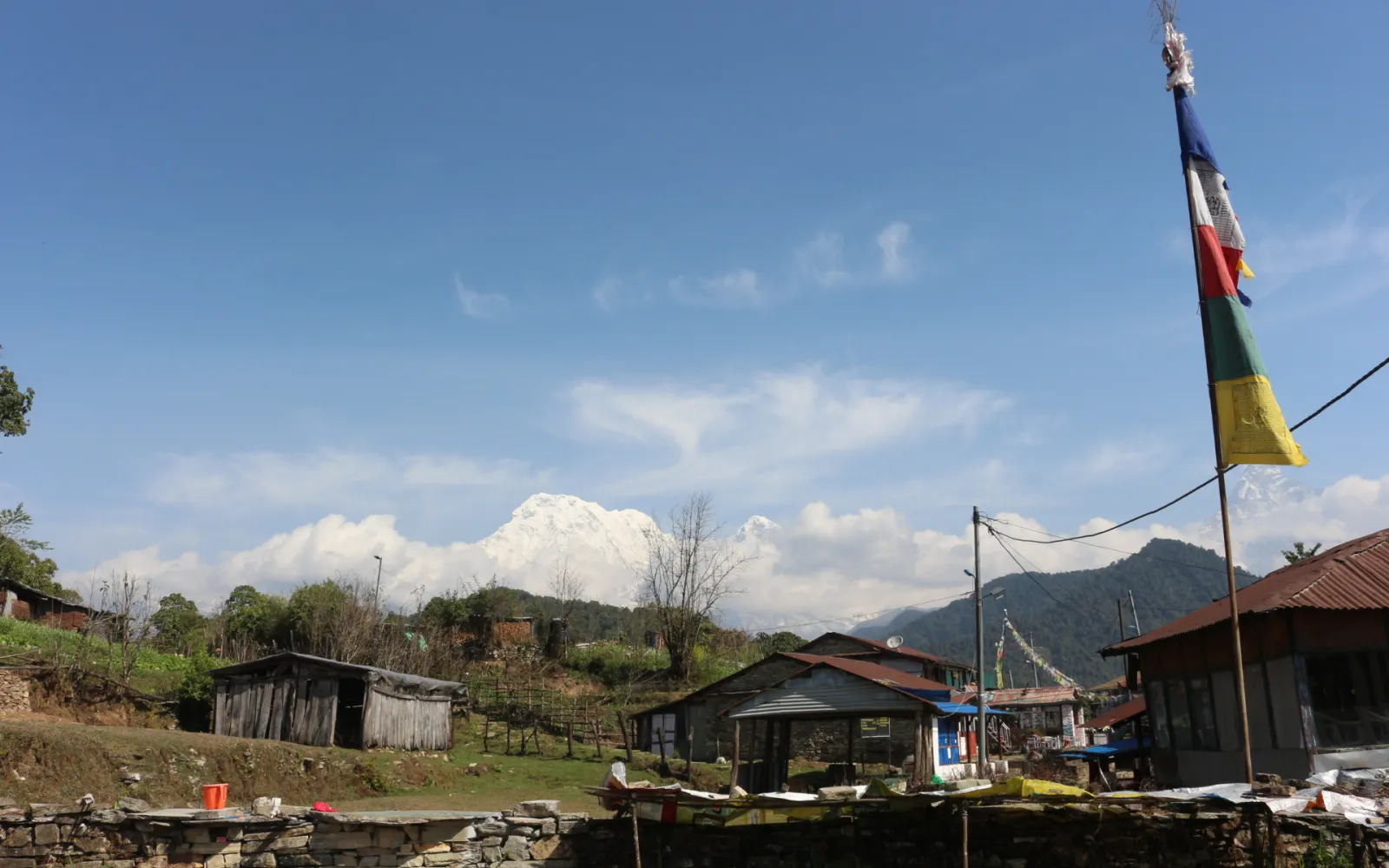
4-day Mardi Himal trek from Pokhara is a shorter Himalayan trail exploring the shadow of Machhapuchhre and the views of the Annapurna range. In addition to, the 4-day route offers forest paths, rhododendron woods and stays in traditional lodges as well as exposed ridges.
While the Annapurna Base Camp trail is more crowded, the trek to Mardi Himal is quieter and closer to Machhapuchhre. Nevertheless, the latter route becomes steep, narrow and exposed after High Camp.
Here, the Mardi Himal trek from Pokhara usually begins with a drive to Kande (1,770 m) and then follows the trail to Mardi Himal Base Camp (4,500 m).
In addition, the Mardi Himal trek cost from Pokhara ranges between USD 195 and USD 360 per person, depending on the group size and services.
Meanwhile, Spring and Autumn are generally good trekking seasons, although the weather can be unpredictable. You can book a local trekking company to get permits, organize transport and accommodation as well as a guide.
The Mardi Himal trek route from Pokhara begins with a drive to Kande, which is about 1,770 metres above sea level. Following the path, you will pass the Australian Camp, Pothana and Forest Camp before entering higher forested areas and exposed ridges.
In addition, the Mardi Himal trail goes through Low Camp, Badal Danda and High Camp en route to the Upper Viewpoint (4,200–4,250 m).
Here, those who want to extend their route beyond High Camp will reach Mardi Himal Base Camp (4,500 m). Nevertheless, the Mardi Himal trek rarely goes above 4,200 metres because of the snow cover and weather.
Mardi Himal trekking route and elevation Profile
Trail stop| Approximate elevation
Pokhara | 822 m
Kande |1,770 m
Australian Camp | 2,060 m |
Pothana | 1,950 m
Forest Camp | 2,520–2,600 m
Low Camp | 2,970 m
Badal Danda | 3,210 m
High Camp | 3,580 m
Upper Viewpoint| 4,200–4,250 m
Mardi Himal Base Camp| 4,500 m
Siding Village| 1,750–1,900 m
However, the information about the Mardi Himal trek route elevation may vary on different sources including maps, teahouses and itineraries.
Mardi Himal trek route facts
Starting point: drive roughly between 1 and 1.5 hours from Pokhara to Kande, depending on the traffic
Distance: 40–45 km for a classic out-and-back-to-descent route, depending on the variation and the end points
Duration: 4 days is a fast hiking schedule; a 5–7-day itinerary gives more flexibility to the daily stages
Surface: stone steps, paths in the woods, steep slopes and exposed ridges
Lodges: offer accommodation, food, but sometimes the heating, hot water and electricity are not available
Hence. It is advisable to engage a licensed guide who knows the trail, the variations and can safeguard you during the trip.
Although the Mardi Himal trek is less busy than the Annapurna Base Camp route, the Upper Viewpoint and High Camp can get crowded in the peak season.
The 4-day Mardi Himal Trek itinerary from Pokhara will satisfy most fit trekkers with its combination of Himalayan views and a short holiday, but getting to 3,580 metres at High Camp and 4,200 to 4,250 metres at the upper viewpoint can be quite a climb.
Mardi Himal Trek Itinerary
Distance and walking times are approximate and depend on the route, overnight stops and weather conditions.
Day 1: Pokhara to Forest Camp (via Kande)
Pokhara 822 m → Kande 1,770 m → Forest Camp 2,520-2,600 m
Drive from Pokhara to Kande in about 1 to 1.5 hours and walk through Australian Camp and Pothana to Forest Camp, about 10-12 km and taking 5-7 hours walking, with a big climb.
Elevation gain: around 750-830 metres from Kande.
Overnight: Forest Camp (basic teahouse).
Day 2: Forest Camp to High Camp
2,520-2,600 m → Low Camp 2,970 m → Badal Danda 3,210 m → High Camp 3,580 m
Walk up the valley through rhododendron forest to Low Camp and Badal Danda, then along the ridge to High Camp, about 7-9 km further and another 5-7 hours walking, depending on the trail and your pace.
Elevation gain: around 980-1,060 metres.
Overnight: High Camp (basic mountain teahouse).
Day 3: High Camp to Mardi Himal Viewpoint and Siding
3,580 m → Upper Viewpoint 4,200-4,250 m → Siding around 1,750-1,900 m
Climb to the viewpoint at dawn for close views of Machhapuchhre and the Annapurna massif. The round-trip from High Camp to the viewpoint is about 4-6 km and takes 3-5 hours, with a long walk back down to Siding.
Elevation gain: around 620-670 metres to the upper viewpoint.
Overnight: Siding (teahouse or lodge).
Note: The walk to Mardi Himal Base Camp at around 4,500 m is extra distance and time.
Day 4: Siding to Pokhara
Siding around 1,750-1,900 m → Pokhara 822 m
Either walk or get some local transport to the road, depending on which route you have taken and what vehicles are available. Allow 1-3 hours walking time and 2-3 hours driving, although the road journey can take longer in changing conditions.
Walking distance: around 2-5 km, if you have walked to the road.
Overnight: Pokhara hotel, excluded unless confirmed in your package.
Four-Day Itinerary Summary
Day | Main destination | Approximate walking time
1 | Kande-Forest Camp | 5-7 hours
2 | Forest Camp-High Camp | 5-7 hours
3 | High Camp-Viewpoint-Low Camp | 6-7 hours
4 | Low Camp - Siding-road access | 1-3 hours (if walking)
Planning tip: You should note that this fast itinerary focuses on the upper viewpoint, rather than Mardi Himal Base Camp. Also, the 5-day itinerary allows for more leeway for acclimatization and bad weather.
The Mardi Himal Trek cost from Pokhara will depend on the group size, as well as transport, accommodation, food and guide services. To plan the cost of a trek in 2027, budget around USD 165-320 per person for four days and USD 195-360 for five days, depending on the confirmed package.
Mardi Himal Trek Price for 2027
Trekking package | Estimated cost per person
Budget 4-day trek | USD 165-200
Standard 4-day trek |USD 200-320
Standard 5-day trek | USD 195-360
Private or upgraded services | Quote Required ( USD 400-555)
Here, the above is a rough guide for planning purposes and is not a confirmed quotation.
What Should Your Mardi Himal Trek Package Include?
You should ensure that your Mardi Himal trekking package specifies the services that are included, such as:
Transport: Pokhara-Kande and return from Siding or whichever endpoint is agreed.
Permits: Relevant Annapurna Conservation Area entry permit.
Accommodation and meals: Teahouse stays as specified in the itinerary.
Guide and porter: Certified guide, with porter services noted separately.
Staff costs: Guide and porter's wages, meals, accommodation and insurance, as appropriate.
Taxes: Applicable company taxes and service charges.
What Should Your Mardi Himal Trek Package Not Include?
Unless stated otherwise, international airfare, Nepal visa, travel insurance, drinks, snacks, hot showers, Wi-Fi and other personal expenses are likely to be excluded.
Importantly, ask Haven Holidays Pvt. Ltd. for a quotation specific to your preferred 2027 trek, including a detailed breakdown of what is covered and what is not, any discounts for groups, and cancellation terms. In this way, you will know whether the advertised price reflects what the package includes or not.
The journey from Pokhara to Kande is usually the first leg of the Mardi Himal Trek, a short transfer by road that takes around 45 to 90 minutes. Kande village is located approximately 1,770 metres above sea level.
Furthermore, trekkers have the choice of shared local village transport, private car and private 4WD, depending on the availability and convenience. For example, those with private transport have more flexibility, while shared local transport may require additional waiting time.
Pokhara to Kande Transport Options and Costs
Transport option | Approximate journey time | Estimated cost
Shared local vehicle (when available | 45 – 90 Mi | NPR 300 – 700 per person
Private ca | 45 – 90 Mi | NPR 3,000 – 5,000 per vehicle
Private 4W | 45 – 90 Mi | NPR 4,000 – 7,000 per vehicle
Note: Fares are approximate and subject to change, so it is best to confirm the final cost for 2026 – 2027 before departure.
Practical Tips for Travel from Pokhara to Kande
Pickup location: Hotels in Lakeside and central Pokhara are popular places for private car pickups.
Luggage: Trekkers should carry daypacks with them and double-check that the transport can accommodate both luggage and passengers.
Weather conditions: Heavy rainfall, traffic jams and roadworks can cause serious delays, so it is best to leave plenty of time for the transfer, especially at the beginning and end of the trekking season.
Shared transport: Arrangements and departure times for shared local transport can be irregular, so it is wise to plan ahead and research the luggage and passenger restrictions.
Guided Package: A trekking agency can organise the transport to Kande and the guide meeting point, as well as making any necessary arrangements.
So, the best option for trekkers staying in a four-day itinerary is usually a pre-booked private vehicle. Those who opt for shared local transport should allow greater flexibility, as these transfers can be unpredictable.
The distances, walking hours and elevation of the Mardi Himal Trek depend on a range of different factors, including the specific trail, overnight stays and the chosen destination.
For example, a four-day walking itinerary can involve walking between 35 and 45 km, starting at Kande (1,770 m) and finishing at the upper viewpoint (approximately 4,200 – 4,250 m).
In addition, trekkers climb gradually from Forest Camp to Low Camp, Badal Danda and High Camp (approx. 3,580 m) and then to the exposed upper ridge. The Mardi Himal Base Camp reaches approximately 4,500 m, so it is important to remember that early starts and extra time for steep climbs, unpredictable weather and descending slopes are all essential considerations.
Mardi Himal Trek Itinerary
Day | Route | Approximate distance | Walking time
1 | Kande (1,770 m) to Forest Camp (2,520 – 2,600 m | 10 – 12 K | 5 – 7 Hours
2 | Forest Camp to High Camp (3,580 m | 7 – 9 K | 5 – 7 Hours
3 |High Camp – Upper Viewpoint (4,200 – 4,250 m)- Low Camp (2970m) –| 10 – 11 Km | 7 – 8 Hours
4 | Low Camp to Siding (1,750 – 1,900 m) – then drive to Pokhara (822 m) | 3 – 5 Km| walking (if applicable | 1 – 3 Hours walking ( 2-3 hrs drive)
Note: Distances and times should only be used as rough guidance as all itineraries and weather conditions are different. It is recommended to factor in extra time as day three is a long day on the mountains and the four-day walking itinerary is not always feasible.
Mardi Himal Trek Key Elevations
Places | Approximate elevation
Pokhara | 822 m
Kand | 1,770 m
Australian Cam | 2,060 m
Pothan | 1,950 m
Forest Cam | 2,520 – 2,600 m
Low Cam | 2,970 m
Badal Dand | 3,210 m
High Cam | 3,580 m
Upper Viewpoint | 4,200 – 4,250 m
Mardi Himal Base Camp | 4,500 m
Mardi Himal Trek Elevation, Distance and Time Tips
Distance and Time: Plan on walking at least 35 – 45 km over the course of the trek, depending on the specific route and destination.
Viewpoint vs Base Camp: The elevation of the upper viewpoint is approximately 4,200 – 4,250 m, while the Mardi Himal Base Camp is approximately 4,500 m.
Walking speed: Walking speeds can vary due to a number of conditions, including steep slopes, slippery stones, snow and lack of oxygen at higher altitudes.
Altitude illness: Those with a history or risk of altitude illness should climb slowly and drink plenty of fluids. Dizziness, nausea, headaches and extreme tiredness should be reported to the guide immediately.
Route options: Tracks can vary depending on the season, the location of the lodges and the accuracy of the GPS recording.
So, it is generally better to leave extra time on multi-day treks to allow for altitude changes and the speed of the trekking group. A 5-day walking itinerary is actually recommended as it allows more time to enjoy the upper ridge views and make a safe descent to Siding village.
The Mardi Himal Trek is between moderate and challenging – depending on which route you take, your fitness, the weather, and the altitude. While the lower slopes are relatively easy to navigate, the climb involves steep climbs, rocky scree, and uneven cobbles.
Additionally, the 4-day itinerary also includes a long walk on the first day and a rapid altitude increase from Kande at 1,770 metres to High Camp at 3,580 metres.
Here, hiking to Mardi Himal Base Camp at around 4,500 metres requires extra caution and preparation for colder temperatures and thinner air.
Mardi Himal Trek Difficulty: A Route by Route Breakdown
In short, here’s how the Mardi Himal trail difficulty breaks down by section:
Trail section | Difficulty Notes
Kande–Forest Camp | Moderate Uneven paths and stone steps
Forest Camp–Low Camp | Moderate Long climbs through the forest
Low Camp–High Camp | Moderate to challenging Steep ridges and uneven ground
High Camp–Upper Viewpoint | Challenging High altitude and rockier paths
Viewpoint–Siding | Challenging Long downhill trek
Preparing for the Mardi Himal Trek: Fitness and Other Essentials
In general, here are some of the most important things to consider when preparing for the Mardi Himal Trek:
Walking fitness – Build your fitness by going for regular walks (around 60-90 minutes long), and try to increase the distance with time
Cardiovascular fitness – Getting a regular workout (running, cycling, swimming, or any other form of cardio is good)
Strength training – Focus on strengthening your lower body (lunges, stairs, squats, and step aerobics)
Itinerary – If you are relatively new to trekking, consider going for a five-day itinerary instead of a four-day one
Altitude – Building stamina will help, but it will not protect you from the effects of altitude
In addition, most beginner trekkers can complete the Mardi Himal Trek with adequate preparation. However, it is advisable to hire a guide if you are inexperienced with hiking or backpacking and purchase travel insurance.
Additionally, leave enough time in your schedule in case of weather delays or personal emergencies.
In short, the best season for the Mardi Himal Trek is spring (March to May) and autumn (September to November). The weather is generally pleasant, the paths are clear, and the mountain views are spectacular.
Moreover, you can expect to see blooming rhododendrons in the lower and mid-level forests during spring.
However, keep in mind that the mountain weather can change rapidly, so you might miss the spectacle due to low visibility. Winters can be cold and harsh, with snow showers on the upper trails, but the lower valley remains quite temperate for most of the season.
On the other hand, monsoon season sees heavy rainfall that makes the trails slippery and increases the likelihood of landslides.
The Mardi Himal Trek Weather Forecast by Season
Below is a short summary of what to expect when hiking the Mardi Himal Trek during different seasons:
Season | Months | Conditions | Notes
Spring | March–May | Warm weather and blooming rhododendrons | Generally excellent conditions for trekking
Monsoon | June–August | High humidity, leeches, and challenging mountain weather | Not recommended for most trekkers
Autumn | September–November | Generally clear skies and comfortable temperatures | Great season for mountain views
Winter | December–February | Cool temperatures and snow on the mountain trails | Not recommended for most trekkers
Best Months for Mardi Himal Trekking According to Season
Here’s a closer look at the best and least-best months for the Mardi Himal Trek:
March and April are generally excellent months for trekking, as the spring season has started. The rhododendron trees are blossoming, and the weather is warm enough to keep you comfortable during the day
May is also a great month for the Mardi Himal Trek, as the temperature is high, and there are fewer crowds of people. However, be prepared for more cloud cover and rain as the monsoon season approaches
October and November are generally great months for trekking with spectacular mountain views. That said, you might find the teahouses and other accommodations booked out well in advance
December and February are relatively quiet months with comfortable temperatures in the valley. The higher altitude areas might have snow and ice, making the trail more challenging. This is not a recommended time for first-time trekkers
June to September is not a great season for the Mardi Himal Trek due to high humidity, leeches, landslides, and generally poor visibility due to rain
In conclusion, October, November, March, and April are the best months for the Mardi Himal Trek. Having said that, always research the exact weather forecast and conditions for your preferred route and time and double-check the availability of local guesthouses.
Mardi Himal Trek accommodation and food are provided by mountain lodges and teahouses along the way. Compared to the busy Annapurna Base Camp trail, some Mardi Himal tea houses offer improved lodging conditions, but quality and facilities vary by location and time of year.
Meanwhile, accommodation simplifies at higher altitudes like High Camp, with lower temperatures and reduced provisions. Most Mountain lodges provide twin-sharing rooms with simple bedding, shared bathrooms, and additional fees for hot water, electricity, and internet connection in specific camps.
Accommodation Facilities Along the Mardi Himal Trek
Location | Typical accommodation | Facilities to expect
Australian Camp and Pothana | Teahouses and small lodges | Basic private or twin rooms, meals, and some attached bathrooms
Forest Camp | Basic Forest lodges | Simple rooms, shared facilities, limited connectivity
Low Camp and Badal Danda | Mountain teahouses |Basic rooms, dining areas, and variable hot-water access
High Camp | Basic mountain lodges | Simple rooms, cold conditions, and limited facilities
Siding | Village lodges and teahouses | Basic rooms and access to local road tran
Furthermore, Mardi Himal Trek food available at mountain teahouses and lodges provide typical Nepali dishes that support trekkers with energy for the long walks.
Dal bhat – rice, lentils, vegetables, and additional dishes
Noodles and soups – convenient and filling meals for lunch and dinner, especially in cold weather
Rice, potatoes, and eggs – staple dish and options
Breakfast – porridge, toast, eggs, pancakes, and other local specialties
Drinks – tea, coffee, and hot water available at most tea houses with higher prices at higher altitudes
Practical Tips for Meals and Lodges
Confirm availability – book rooms in advance, particularly for October-November and March-April, and ensure options at the High Camp.
Special dietary needs – inform your Mardi Himal Trek company about vegetarian, vegan, gluten-free, or other food restrictions in advance.
Additional costs – budget for extra expenses like hot water, charging, or internet at mountain tea houses.
Bring a sleeping bag – warm sleeping bags are recommended as teahouse blankets are usually thin in higher altitudes.
In summary, the Mardi Himal Trek provides budget-friendly teahouse accommodations without comforts and facilities at various points along the way. It is critical to confirm food options, lodging standards, and additional costs in advance for a more comfortable and enjoyable trek.
On the Mardi Himal Trek, permits are required for entering the protected area, including the Annapurna Conservation Area Permit (ACAP). The national trust for nature conservation online portal states that the permit fee is NPR 3,000 for foreign nationals and NPR 1,000 for SAARC nationals.
Furthermore. trekkers need to carry their permits with them in case of inspection at checkpoints by the authorities. Permits for the Mardi Himal Trek and other climbing and trekking activities are subject to change, and travelers must confirm current permit rules and trekking regulation before departure in 2027.
Mardi Himal Trek Permit Fees
Permit or requirement |Foreign Nationals |SAARC Nationals
ACAP entry permit |NPR 3,000 | NPR 1,000
TIMS card, if applicable |Current rules Rs.2000 |Current rules (Rs.1000)
Actually, ACAP fees are based on ntnc permit information reviewed in October 2026. Always confirm the most recent permit requirements for Nepali citizens and children with the issuing authority.
Where to Obtain Mardi Himal Trek Permits
Pokhara | Kathmandu |Through a trekking company| Documents
Annapurna Conservation Area Project permit office or online system | Local permit office, Central Permit Office, Online system |A trekking company can provide required permits |Passport or valid identification, photographs, and personal details may be required
Actually, the NTNC online permit system provides the most updated permit information available. Travellers must also confirm the most recent permit rules and payment procedure in 2027.
Important Permit Advice for 2027
Furthermore, do not assume that TIMS rules and requirements apply the same to all trekkers or booking arrangements, because official guidelines and operating procedures are subject to change. For example, ask Haven Holidays Pvt. Ltd. to confirm the required permits, fees, and regulations in writing and ensure that these expenses are included in your Mardi Himal Trek package.
A Mardi Himal Trek guide and porter can carry out essential duties like navigating the trail, giving advice, recommending accommodations, and informing about the weather. Moreover, a trekking porter will assist by carrying one’s personal equipment. Furthermore, hiring an experienced guide is mandatory on the Mardi Himal Ridge Walk, as trekkers are likely to encounter unpredictable weather conditions and challenging terrain.
In addition, trekking guides are not responsible for ensuring that no one will suffer from altitude sickness. Additionally, it is advisable for a trekker to keep pace and inform their guide about their condition if they feel ill.
The table below shows the estimated expenses:
Mardi Himal Guide and Porter Costs
Guide/Porter Service | Estimated Daily Cost | Guide/Porter Responsibilities
Licensed trekking guide | USD 35-40 per day | Assisting in navigating the trail, giving advice, recommending accommodations, and informing about the weather.
Trekking porter | Around USD 25 per day | Carrying one’s personal equipment
Hiring a guide and porter together| USD 60-65 per day| Two separate guide and porter services
Note that the rates may vary depending on the staff’s expertise, season, group size, and employment terms.
Things to Note Regarding a Guide and Porter
Clarify the guide’s level of expertise and ensure that they are familiar with the area under exploration.
Discuss the luggage weight and its distribution among porters. Usually, a porter can carry around 20 kg or 55 lbs on their back. This luggage weight is enough for two trekkers.
Ask the company whether the guide and porter’s wages, food and accommodation, insurance, and transport are included in the price.
Inquire about the company’s emergency procedures, including rerouting, illness, and rescue operations.
Ensure that the business has the necessary accreditation and provide contact information in case of emergency.
In addition, a guide and porter service can help arrange permits, accommodation, transport, and staff. Beforehand, receive a detailed description of the services offered by Haven Holidays Pvt. Ltd. and clarify if there are any additional costs.
Since the Mardi Himal Trek passes through diverse climatic ranges and elevations, one has to pack accordingly.
Here, a trekker is likely to encounter a wide range of temperatures, from warm weather during the day to freezing nights at the campsites. Moreover, the forest trail can be slippery and rugged, and mornings can be chilly at the upper ridges of the trekking route.
Although spring and autumn seasons have almost constant pleasant weather, trekkers must prepare for unpredictable climate changes.
Despite that, the most suitable time for Mardi Himal Trek is in spring and autumn when the temperatures are relatively stable.
Nevertheless, rain, snowfall, high winds, and sudden cold snaps are still possible during these seasons.
Hence, it is essential to pack light clothing and check with the trekking company about the gear they might provide or rent.
Clothing and Footwear
Base Layers: Shirts made of sweat-wicking fabrics and thermal tops to keep the body warm
Insulating Layers: A fleece jacket, a cosy down jacket, and thermal bottoms
Weather Protection: Waterproof jacket and trousers to stay dry and warm
Trekking Pants: Two pairs of lightweight trekking pants or leggings that are quick-drying and durable
Footwear: Comfortable, sturdy, and broken-in trekking boots and a few pairs of thick wool socks
Accessories: Warm gloves, a sun visor, a woollen beanie, and a neck warmer
Trekking Equipment and Personal Gear
Daypack: A 20-30 litre backpack with a rain cover
Sleeping Bag: A good-quality sleeping bag depending on the season and the tent’s sleeping bag insulation
Lights: A reliable headlamp with extra batteries
Hydration Pack: A water bottle or hydration bladder
Sun Protection: Sunscreen, lip balm, and UV-protective sunglasses
Maps & Navigation: Physical maps and a fully charged smartphone
Toiletries and Other Personal Items: Toothbrush, towel, and cash.
Health and Safety Equipment
First Aid Kit: Bandages, antiseptic wipes, blister plasters, and personal medications
Water Purification Tablets: Bottled water, portable water filter, or another water purification method
Altitude Sickness: Inform the trek leader if one has a medical condition or is taking any medication. Moreover, it is advisable to discuss altitude sickness symptoms with the guide.
Insurance: A travel insurance policy that covers hiking and emergency medical costs at high altitude.
Snacks and Nourishment: Energy bars, trail mix, and other easily digestible and storable foods.
Hiring or Renting Trekking Equipment
Importantly, one should also contact Haven Holidays Pvt. Ltd. and ask if the company provides sleeping bags, duffel bags, trekking poles, or any other gear. Trekking shops in Kathmandu and Pokhara provide a wide range of equipment for rent or sale.
However, the availability and prices vary. If possible, it is better to bring some of the required gear from home.
In addition, it is advisable to keep the daypack minimal and only include a few warm clothes, water, snacks, and personal medications.
Moreover, a hiker should also carry a small bag for storing dirty clothes and used towels. A well-packed luggage can greatly contribute to a trekker’s comfort and well-being during the Mardi Himal Trek.
Follow these Mardi Himal Trek safety tips to prepare for high altitude, steep paths and wild weather on the mountain.
Here, most Mardi Himal treks take place between 1 770 metres in Kande valley up to around 4 200 – 4 250 metres at the viewpoint on the upper ridge. The base camp is at roughly 4 500 metres elevation as an average.
Additionally, high altitude combined with rapid ascents, cold temperatures and exposed ridges present more risks of altitude sickness and poor weather conditions. So, plan a realistic itinerary by checking forecasts and be ready to alter your plans.
Essential Safety Tips for Mardi Himal Trek
Ascend gradually – Don’t rush from Kande village (1 770m) to higher camps and consider extra time if necessary.
Recognise altitude sickness – A headache, nausea, dizziness, and feelings of weakness or tiredness can be symptoms.
Respond to altitude sickness – Descend the mountain if you feel unwell or stop if your altitude sickness becomes severe to seek medical attention.
Be aware of weather conditions – Ask your guide about rain, snow, high winds, limited visibility and trail conditions ahead of departure.
Leave early enough – You’ll need sufficient daylight at the upper viewpoint and for the return journey down to Siding.
Stay hydrated – Drink water throughout the trek and eat regularly rather than relying just on fluids to avoid altitude sickness.
Dress appropriately – Pack warm clothes, a waterproof jacket, gloves and warm, grippy shoes for trekking.
Stick to the trail – Always use the marked path and carry offline maps and do not wander off trail, especially in restricted areas, high altitude or adverse weather conditions.
Insurance and Emergencies
Also make sure your insurance covers activities as hiking at the highest altitude and helicopter rescue if necessary. Save emergency numbers, carry any personal medication and a few basic first aid items and agree communication plans with a guide.
In addition, a licensed guide and a registered trekking company can help with accommodation, route selection and emergency management. But these services don’t reduce all risks on a mountain. Always follow safety advice and consider health before aiming for summit or viewpoint.
The Mardi Himal Trek vs Annapurna Base Camp comparison helps you decide which mountain trail suits your time, money and fitness.
Here, Mardi Himal has a shorter route crossing a dramatic Machhapuchhre ridge with close views while the ABC trek enters the vast Annapurna Sanctuary valley beneath huge Himalayan peaks.
Actually, a 4-day Mardi Himal itinerary works for those with limited holidays while Annapurna Base Camp treks generally take longer.
Both paths have significant ascents but the ABC trek may require greater endurance and Mardi Himal has steeper, narrower ridges. Accommodation varies on both trails but some Mardi Himal lodges offer more modern comforts than basic teahouses on specific ABC sections.
More importantly, see the table below comparing Mardi Himal and ABC treks for more information:
Mardi Himal Trek vs Annapurna Base Camp: Comparison
Feature | Mardi Himal Trek | Annapurna Base Camp Trek
Typical duration | 4-5 days| 5-8 days
Approximate package cost | USD 195-360 | for 5 days USD 375- for 8 days 625
Highest destination | Mardi Himal Base Camp approximately 4 500m| ABC approximately 4 130m
Main scenery| Machhapuchhre and Annapurna ridgelines| Annapurna Sanctuary and surrounding peaks
Trail character | Forests, narrows ridges and exposed sections | Forests, long ascents and descents, villages, valleys and mountain sanctuary
Difficulty |Moderate to challenging | Moderate to challenging
Crowds | Generally quieter | Generally busier during peak seasons
Accommodation | Basic lodges, with some newer facilities | Established and better teahouses, with variable room standards
Starting access | Drive from Pokhara to Kande | Usually drive to a chosen trailhead ( Ghandruk/Ulleri or Jhino)
Best suited for | Short holidays trek to view Machhapuchhre ridge | Longer journeys to visit Annapurna Sanctuary
Importantly, prices, durations and elevations are approximate with costs depending on the route, season and group size.
Final Decisions on Mardi Himal vs ABC Treks
Thus, select the Mardi Himal trek if you prefer a ridge line with limited time.
The Mardi Himal Trek from Pokhara with Haven Holidays provides an opportunity to speak with a local contact about transport, permits, accommodation, or guided trekking services.
Here, Haven Holidays Pvt Ltd arranges a Mardi Himal trekking package from Pokhara with guaranteed services and costs before the start of the trip.
In addition, a prepared trekking package can give an idea of the average distance walked per day, standards of accommodation, luggage rules, or estimated extra costs.
However, it is important to clarify exactly what services are included in the selected Mardi Himal trek package.
What to Look for in the Haven Holidays Mardi Himal Package
Guide: Ask to see the licence of the English-speaking trekking guide and confirm the route details for Mardi Himal.
Transport: Book the driver’s services for the transport from Pokhara to Kande and back from the end of the trekking route.
Permits: Make sure that the cost of the Annapurna Conservation Area permit is included in the Mardi Himal trek package.
Accommodation: Confirm the number of nights at the lodge and the meals provided and clarify if there are any extra charges.
Porter: Agree on luggage allowances, porter wages, and staff insurance, and make sure that their expenses are not added to your costs.
Costs: Obtain a detailed breakdown of the inclusions and exclusions in your Mardi Himal trek package and ask for cancellation rules, deposits, and advances.
Weather: Prepare questions about the impact of weather conditions on the trek, and discuss emergency plans, evacuations, and altitude sickness.
Book Your Mardi Himal Trek from Pokhara
At the same time, customer reviews, samples of photographs from real treks, official registration, and contract rules can help evaluate the services of a travel agency.
Before paying a deposit, it is recommended to research online and obtain copies of the signed document about the Mardi Himal trek.
When planning your Himalayan holiday, consider the Mardi Himal Trek from Pokhara with Haven Holidays, and contact us to request a quotation for your trip.
Here, you can also ask for the most up-to-date itinerary for a 4-day Mardi Himal trek or a 5-day programme with a professional English-speaking guide and porter.
The Mardi Himal Trek from Pokhara is an excellent opportunity to enjoy views of the rhododendron forest, mountain peaks, and Machhapuchhre ridge.
In addition, a 4-day Mardi Himal trek itinerary is ideal for experienced trekkers with little free time, while a 5-day trek provides more flexibility for walks and rest days.
Meanwhile, the Mardi Himal Trek from Pokhara usually costs between USD 165 and USD 320 for a 4-day trip and between USD 195 and USD 360 for 5 days, depending on the selected services and the group size.
Here, the best seasons for a Mardi Himal trek are spring and autumn, as snow or rain can occur in both summer and winter months, temporarily closing the trail to the viewpoint at 4,200-4,250 m and Base Camp at 4,500 m.
Final Checklist Before Booking Your Mardi Himal Trek
Itinerary: Select a preferred trekking package and compare the daily distances and elevations according to your skills and interests.
Budget: Clarify all the expenses for a Mardi Himal trek and make sure that the chosen travel agency includes the maximum number of services.
Weather: Pack warm clothes for a Mardi Himal trek in spring, autumn, and winter and arrange travel insurance with altitude sickness coverage.
Terms and Conditions: Discuss the terms of the Mardi Himal trek with your local guide and bring any questions or concerns to their attention.
Contingency Planning: Leave enough time for unforeseen circumstances on the trail and prepare for sudden changes in the weather.
Finally, a local travel agency can provide you with all the necessary documents and a professional guide for your Mardi Himal trek. Arrange your holiday with Haven Holidays Pvt Ltd and ask for an updated 2027 Mardi Himal trek itinerary and a quotation for your trek.
1. What Is the Cost of 4 Day Mardi Himal Trek from Pokhara
The 4 day Mardi Himal trek cost from Pokhara is approximately USD 195-360 per person at Haven Holidays depending on the size of your group and what extras are included in your Mardi Himal trip. This usually covers a guide, permit, teahouse accommodation, food and transport
2. What Is the Itinerary of 4 Day Mardi Himal Trek from Pokhara
The first day of your Mardi Himal trek from Pokhara involves a drive to Kande and a trek to Forest Camp. On the second day you will walk to High Camp passing Low Camp and Badal Danda. On the third day you will have an early morning hike to the upper viewpoint before heading back down again. The final day involves walking to Siding and then back to Pokhara
3. What Is the Distance of 4 Day Mardi Himal Trek from Pokhara
The distance of the 4 day Mardi Himal trek from Pokhara is approximately 40-45 km and it depends on how far you go on the last day and where you decide to stay. The most common route involves a trek from Kande to Forest Camp to High Camp and then to the Mardi Himal viewpoint before descending again to Low Camp and Siding
4. What Is the Difficulty Level of 4 Day Mardi Himal Trek from Pokhara
The 4 day Mardi Himal trek from Pokhara is moderately difficult due to a long uphill walk on the final day. A good level of fitness and some trekking experience is recommended although beginners can still manage it if they take things slowly. Due to the early morning start on the last day it is a good idea to come prepared so that you can keep warm while you wait for sunrise
5. What Is the Elevation of 4 Day Mardi Himal Trek from Pokhara?
How high you can climb on the Mardi Himal trek depends on how far you go beyond High Camp. The viewpoint is usually between 4200-4500 meters while High Camp is at around 3580 meters above sea level
6. What Permits Are Required for 4 Day Mardi Himal Trek from Pokhara
You will normally require an Annapurna conservation area permit for the Mardi Himal trek depending on the route you take. You should also confirm with Haven Holidays what other permits you may need and what the current regulations are in Nepal regarding trekking guides
7. Does the Cost of 4 Day Mardi Himal Trek From Pokhara Includes a Guide & Porter
Depending on the package you choose with Haven Holidays, you will be provided with a local certified English speaking guide as well as a porter to carry your bags. It is important to ask them what porter services are included, the maximum weight allowed and whether any extra charges apply
8. What are Accommodation & Food Facilities During the 4 Day Mardi Himal Trek from Pokhara?
During the 4-day Mardi Himal trek from Pokhara you will be staying in mountain teahouses and lodges. As you get higher up the mountain the facilities become more basic and you may find that there are fewer options for food. You can normally expect to be provided with dal bhat, noodles, soups, rice and eggs. Hot showers and charging facilities may be available at an extra cost
9. What Are the Included and Excluded services in a 4 Day Mardi Himal Trek from Pokhara?
The activities included in a 4 day Mardi Himal trek from Pokhara will vary depending on the package you choose. Normally, a guide, permit and teahouse accommodation will be included. Food and transport from Pokhara to the trailhead are also usually included. Drinks, snacks and personal items are normally not included so make sure you double-check with Haven Holidays before departing
10. What Is the Best Season for 4 Day Mardi Himal Trek from Pokhara?
The best season for a 4-day Mardi Himal trek from Pokhara is in the spring and autumn when temperatures are at their mildest. During the spring months of March to May the flowers are also in bloom so many people prefer this time of year.
As the 4-day Mardi Himal trek itinerary is quite tight it is important that you keep an eye on the weather forecast and road conditions especially if you are planning to trek during the winter or monsoon seasons.
Our travel experts are ready to assist you with any questions.
Send us a message.Have a question before you book? Send your enquiry below and our travel experts will get back with the required information.