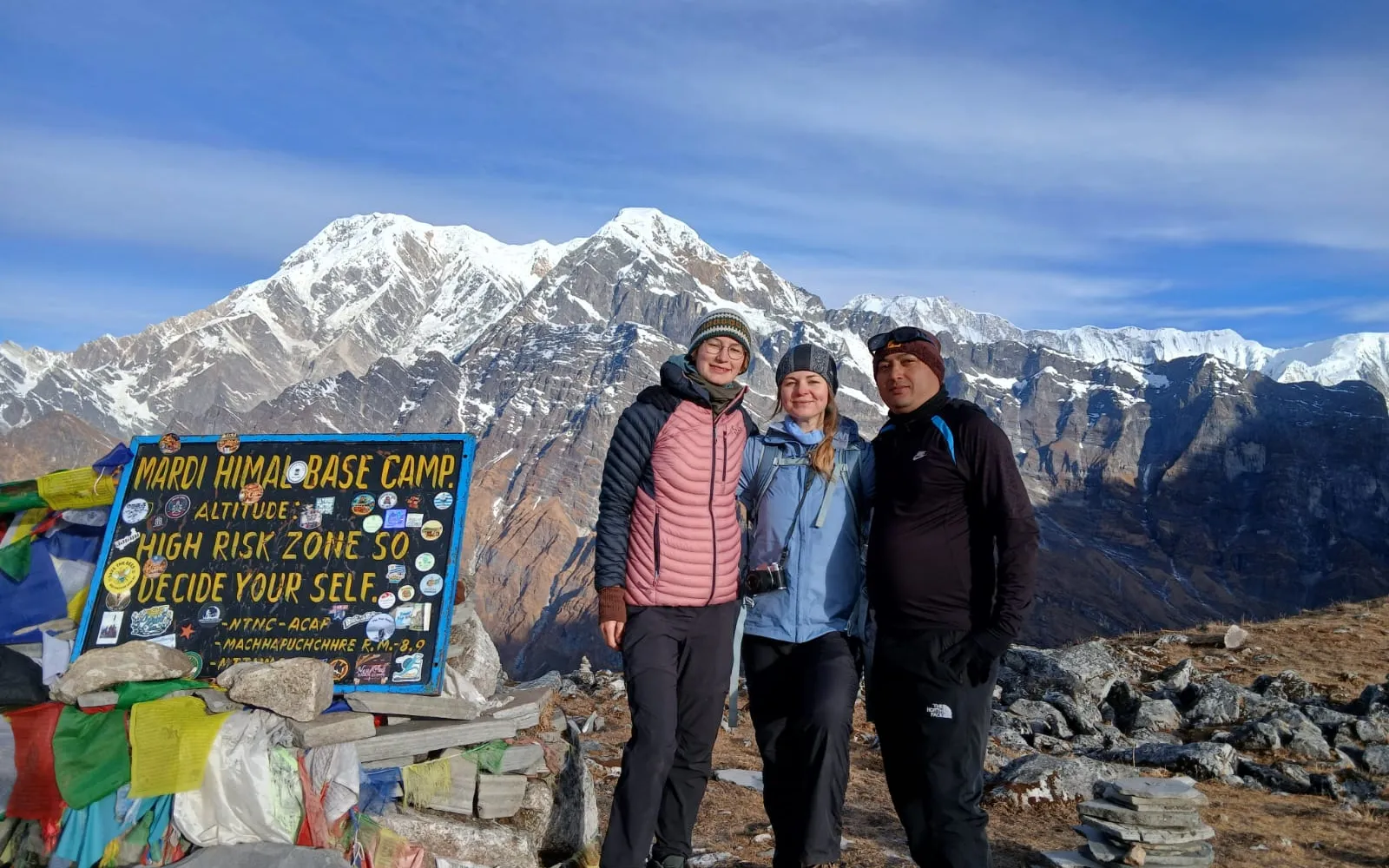
Yes, you can do the Mardi Himal Trek in February – as long as you are well prepared, have the right winter clothing and an experienced local guide. However, it will still be winter in Nepal, so temperatures will be cold, there may be snowfall and icy paths, especially above High Camp.
Actually, February can be a great time to trek the Mardi Himal Trek. The trails are usually quiet, the forest is peaceful and you may get some great views of the Annapurna range depending on the weather.
Importantly, the first half of February can be quite challenging due to the winter conditions, but temperatures will start to rise towards the end of the month.
Summary of Mardi Himal Trekking Conditions in February
Factor| Conditions in February
Season | Late Winter
Trekking | Possible with preparation
Lower Trail | Generally good, depends on the weather
Upper Trail | May be snowy and icy
Crowds | Generally less people
Views | It is possible
Challenges | Cold, snow, wind and icy paths
Viewpoints | Depends on conditions
Why Mardi Trek in February?
Fewer people on the trails
Can get better accommodation because of few people on the trail
Less Costly Packages
Snowy conditions on the upper ridge
Clear mornings can give great views of Machhapuchhre, Annapurna South and Hiunchuli.
Peaceful places to stay – some lodges are less busy. This depends on the location.
Generally, temperatures will start to get more pleasant towards the end of February.
Can you get to the Mardi viewpoint in February?
The Mardi Himal Trek usually goes from Kande (1770m) up to Forest Camp (2520m approx), Low Camp (2985m), and High Camp (3580m). From here you will continue up the upper ridge to Upper Viewpoint (4200m approx) and Mardi Himal Base Camp (4500m approx).
However, if there has been fresh snowfall, the ice will be harder and the wind will be strong so it can be challenging or impossible to go up the upper ridge. It is best to listen to your guide.
Important Trekking Tips
Check the snowfall, forecast and lodges are open.
Above High Camp check the depth of snow, ice and wind.
If you are a beginner it may be best to turn back.
Check the lodges are open.
Check if you can accompany with local guide for safety
To have a safer trek in February, book with a registered local operator such as Haven Holidays Pvt. Ltd. and check the latest conditions.
Overall temperatures will still be cold in February but generally get better towards the end of the month. Villages and forest areas will be a bit more pleasant but High Camp and upper ridge will be freezing.
As you ascend in height, the temperatures will drop. Open areas will also have more wind chill. You will find that the days will be pleasant when it is sunny but will drop quickly once the sun sets, especially around High Camp.
Temperatures in February by Height
These are just guides to give you an idea of what to expect. Temperatures will vary depending on how much snow falls, how cloudy it is, wind and local conditions.
Location | Height | Day | Night
Kande | 1770m | 8-16°C | 0-6°C
Forest Camp | 2520m | 5-12°C | -1 to 3°C
Low Camp | 2985m | 2-10°C | -3 to 2°C
Badal Danda | 3210m | 0-8°C |-5 to 0°C
High Camp | 3580m | -4 to 6°C | -10 to -5°C
Upper Viewpoint | 4200m | -6 to 2°C | Freezing
How will the temperatures vary?
Villages – will be relatively pleasant to walk through during the day if the sun is out. However, it will be chilly in the mornings.
Forest Camp – There will be lots of trees so it won’t be too windy. However, it can be very cold at night.
Low Camp – It will be colder in the evenings and you may start to notice some frost.
High Camp – The ridge is open so it will be very cold at night and windy. You will need the right winter clothing.
Upper Ridge – It can be quite challenging due to the snow, ice and wind chill.
Why is it colder at High Camp?
High Camp is around 3580m so temperatures can drop below -10°C. The ridge is open so there will be strong winds. This will make it feel much colder than the actual temperature.
Importantly, you will want to wear a jacket with insulation, thermals, warm gloves and a sleeping bag. A sleeping bag rated to around -10°C would be a good minimum to plan for. However, it can get colder.
Important – Temperatures will start to improve throughout February but it doesn’t mean the upper trail will be easier. Always check the latest forecast and snowfall.
[Note: These temperatures are just guides for your Mardi Himal Trek in February which was experienced by our guides in the field. We recommend adding photos with dates and real observations from our guides on February departures.]
Yes, it is possible to have snow on the Mardi Himal Trek in February. Although it will depend on the weather, it is likely to snow around the High Camp (3580m) and upper area.
As you get higher up the trek there will be more snow and snowfall. You will likely get snow around the High Camp. However, the forest areas of the trek will be less likely to have snow.
Where Will You Get Snow on the Mardi Himal Trek in February?
Location | Elevation | Snowfall in February
Kande | 1770m | Unlikely to snow
Forest Camp | 2520m | Occasionally there may be frost or snowfall
Low Camp | 2985m | Possibly some snowfall
Badal Danda | 3210m | Possible snowfall and icy patches
High Camp | 3580m | More likely to have snowfall
Upper Viewpoint | 4200m | Possible snowy and icy areas
Mardi Himal Base Camp | 4500m | Possibly deep snowfall
What Effect Does the Snowfall Have?
New snowfall - Can cause confusion with the trek markers.
Snowfall in higher areas - Can cause snow to stay for a few days.
Icy - Can cause snow to become icy and slippery.
Lower areas - The trek will be less likely to have snowfall in the forest areas.
Snowfall can melt - If there are sunny days the snow can melt. However, if it is very cold at night the snow can become icy.
How Long Will the Snow Stay?
The higher areas can have snowfall for a few days. However, if there is snowfall in the open areas it may not last so long as the snow will melt.
Meanwhile, the forested areas and narrow areas of the ridge can be icy even if there is no snowfall. So, do not assume if the weather is clear the upper areas will be clear.
What Safety Tips Should You Take?
Wear waterproof boots with good grip and ankle support.
If there is icy areas, bring microspikes or appropriate traction devices.
Start early, but do not attempt any open icy areas until you know.
Bring trekking poles, warm gloves, sunglasses and waterproof clothing.
Avoid any steep areas with snowfall if visibility is poor.
Importantly, heavy snowfall can cause you to not be able to go to the Mardi Himal Viewpoint (approx 4200m) and Base Camp (approx 4500m). Always listen to your local guide and if there is snow or ice on the trail turn back.
The Mardi Himal Trek will follow the same route as in spring and autumn. However, there may be some issues with the snowfall, frozen ground and lack of daylight. This can cause the trek to be slower.
Meanwhile, the popular route will start from Kande (1770m) or Phedi. You will walk through Australian Camp, Deurali, Forest Camp, Low Camp and High Camp. The lower forested areas will be easier to walk. However, you will need to be careful on the open ridge.
Mardi Himal Trek Route in February
Location | Approximate Elevation | Approximate Walking Time
Kande | 1770m | Start Point
Australian Camp | 2060m | 1-1.5 hrs from Kande
Deurali | 2100m | 2-3 hrs from Australian Camp
Forest Camp | 2520m | 3-4 hrs from Deurali
Low Camp | 2985m | 2.5-3.5 hrs from Forest Camp
Badal Danda | 3210m | 1-1.5 hrs from Low Camp
High Camp | 3580m | 1-1.5 hrs from Badal Danda
Upper Viewpoint | 4200m | 2-3 hrs from High Camp
Mardi Himal Base Camp | 4500m | Further 2-3 hrs from Upper Viewpoint (weather permitting)
Note: These times are approximate, which are experienced by Haven Holidays Team in the field and will vary depending on your fitness, route taken, snow, ice and weather. These times do not include long breaks.
Approximate Distance of Trek
The total distance of Mardi Himal Trek will depend on where you start, where you stay and where you go to in the higher areas. If you start from Kande the popular route will be approximately 35-45km.
Section | Approximate Distance
Kande to Australian Camp | 2-3km
Australian Camp to Deurali | 3-4km
Deurali to Forest Camp | 5-6km
Forest Camp to Low Camp | 4-5km
Low Camp to High Camp | 3-4km
High Camp to Upper Viewpoint | 3-4km (one way)
Upper Viewpoint to Base Camp | 2-3km (one way)
Note: These distances are approximate and are for planning. They are not accurately measured by any reliable tools. Depending on the route you take the total distance can vary.
What is the Mardi Himal Trek Like in the Higher Areas in February?
Generally, the trek from High Camp (3580m) to Upper Viewpoint (approx 4200m) will be more open. There can be difficult areas due to the steepness, narrow ridge, loose stones and snow.
High Camp to Viewpoint - There may be snow and ice on the steep ridge.
Viewpoint to Base Camp - You will need good weather to continue to approx 4500m as the snow needs to be safe.
Downhill - The frozen slopes can be difficult to walk down.
Poor visibility - There can be poor visibility due to clouds, snow and strong winds.
What to Do If the Upper Area is Not Safe
Option A - Continue to Upper Viewpoint if your guide says it is safe.
Option B - Enjoy the view from the lower ridge around Badal Danda (3210m).
Option C - Go back to Low Camp or Forest Camp if there is more snowfall, ice or poor visibility.
Do not attempt to go up the ridge just because others are.
Always ask your local guide if it is safe to go higher due to the snowfall, ice, wind and visibility.
Overall, the Mardi Himal Trek is a moderate trek, however in February the cold weather, snow and icy trails will make it a more challenging trek. It will require extra preparation, the right gear and some careful route decisions.
However, Mardi Himal Trek in Winter will take longer and you will use more energy, especially above Low Camp (2985m). Try and keep a comfortable pace.
Main Challenges of Mardi Himal Trek in February
Winter Challenge | Possible Conditions | Recommended Preparation
Cold Weather |Freezing temperatures at High Camp | Thermal clothing and insulated jacket
Snow |Snow above 3000m | Waterproof clothing and gaiters
Icy Trails | Slippy shaded areas | Microspikes if needed
Strong Winds | Wind chill on upper ridge | Windproof outer layers
Shorter Days | Less hours walking in winter | Start early and don’t rush
Difficult to descend | Frozen or slippy slopes | Trekking poles and good boots
Altitude | Less oxygen available above 3000m | Ascend slowly and acclimatise
How Difficult is it to Walk on Snow & Ice?
Walking on snow and ice will make the trek more challenging. Especially on the ridge between High Camp (3580m) and Upper Viewpoint (approx 4200m). The frozen ground can make your feet slip and become tiring.
Snowy Trails – Deep snow can slow you down
Icy Areas – Careful foot placement on frozen trails
Steep Descents – Trekking poles help keep you balanced
Wind – Strong winds can cause you to lose body heat
Longer Walk – Extra time may be required
Recommended Gear for Mardi Himal Trek in Winter
Footwear – Waterproof ankle boots with good grip
Grip – Microspikes for icy trails (if advised by your guide)
Trekking Poles – Adjustable poles to help with balance on uneven ground
Clothing – Thermal base layers, fleece, insulated jacket and waterproof shell
Sleeping: Sleeping bag resisting -25 Degree Celsius
Accessories – Warm gloves, woolly hat, sunglasses & sunscreen.
Altitude Sickness & Safety in Winter
You will still need to be aware of altitude as you will be trekking up to 3580m at High Camp and 4200m at Upper Viewpoint. As it is a short trek you may be at risk of acute mountain sickness (AMS) if you ascend too quickly.
Here, common symptoms include headache, nausea, dizziness, unusual tiredness and loss of appetite. Ascend slowly, stay hydrated and inform your guide immediately.
Important Altitude Safety Tips:
Don’t ignore any persistent headaches or nausea
Don’t ascend any further if you start to get altitude sickness
Descend if symptoms get worse
Seek urgent medical attention if you get confused, trouble walking or short of breath.
Never attempt to go to the viewpoint if it is dangerous due to snow, strong winds or poor visibility.
A 5-day Mardi Himal Trek from Pokhara is a great option for those of a reasonable fitness and who have some hiking experience. However, in February you may want to be more flexible as snow and icy trails can impact how much you can walk each day.
Importantly, we, Haven Holidays Pvt. Ltd. Team recommend trekking through Kande, Australian Camp, Deurali, Forest Camp, Low Camp, Badal Danda and High Camp. Spending the night at High Camp will help you get an idea of how the upper trail is.
5 Day Mardi Himal Trek in February
Day /Trek Route | Approximate Walking Time | Overnight
1 Pokhara – Kande – Australian Camp – Deurali – Forest Camp | 5-7 hours | Forest Camp
2 Forest Camp – Low Camp | 4-5 hours |Low Camp
3 Low Camp – Badal Danda – High Camp | 5-6 hours | High Camp
4 High Camp – Upper Viewpoint (if safe) – Descend to Low Camp| 6-8 hours | Low Camp
5 Low Camp – Siding – Drive to Pokhara 4-5 hours (Walking) Pokhara
Note: These are approximate walking times experienced by Our team in the field. Snow, ice, fitness, rest breaks and trail can impact how long your trek takes.
Daily Breakdown of Mardi Himal Trek in Winter
Day 1 – Pokhara – Kande, Australian Camp, Deurali & Forest Camp
Your trek will start with a drive to Kande (1770m) from Pokhara then ascend to Australian Camp (2060m). After Deurali (approx 2100m) you will head through some lovely forest trails to Forest Camp (2520m) where you will stay.
Day 2 – Forest Camp – Low Camp
On day two you will slowly ascend through some lovely forest trails from Forest Camp (2520m) to Low Camp (2985m). The trail is very pretty with Rhododendron trees and mountain views but there could be frost and slippy trails in the morning of February.
Day 3 – Low Camp – Badal Danda & High Camp
You will slowly ascend above the forest to Badal Danda (3210m) then onto High Camp (3580m). This section gets more exposed so make sure you dress warmly and walk carefully if there are strong winds or icy patches.
Day 4 – High Camp – Mardi Himal Viewpoint & Low Camp
Start early to go to Upper Viewpoint (approx 4200m) if your guide has confirmed it is safe. This can take approx 4-6 hours return from High Camp depending on the snow, ice and how quickly you walk. Carefully descend to Low Camp (2985m) if conditions and daylight allow.
Day 5 – Low Camp – Siding & Pokhara
On your final day of trekking you will descend through some forest trails to Siding village (approx 1700m). You will then take a local jeep or organised vehicle back to Pokhara. How long this takes will depend on road conditions.
Important Tips for Mardi Himal Trek in February
New Snow – If conditions are not safe to move you can add an extra night at a suitable lower lodge.
Upper Trail – If it is unsafe due to snow, ice or strong winds don’t go to the viewpoint.
Accommodation – Double check accommodation before you leave especially at High Camp.
Long Walk – Allow extra time for difficult snowy sections.
Descend Lower – Descend through the lower forest trail to Siding.
Therefore, we would recommend having an extra flexible day if possible. Especially if it is important to reach the Upper Viewpoint. Mardi Himal Base Camp (approx 4500m) should be optional as you may not be able to get there safely due to the snow in February.
As temperatures can drop below freezing at the High Camp (3,580m) and snow and ice may occur on the upper ridge (4,200m), it is best to pack warm clothing, waterproof clothing and winter trekking equipment.
Overall, you will need to pack for fluctuating temperatures, cold nights and potentially snow. What you pack will also depend on the weather forecast, how long you will be trekking for and if you plan on going to the upper viewpoint.
1. Clothing
It is important to layer up as temperatures will vary greatly between the lower villages and higher altitude. Ensure you have warm clothing that will allow you to sweat.
Thermal base layers – 2 sets of top and bottom
Fleece Jacket – A fleece or light insulated jacket
Down Jacket – A warm insulated jacket for freezing mornings and evenings.
Waterproof Jacket – A waterproof and windproof jacket.
Trekking trousers – Comfortable quick drying trousers and thermal trousers.
Gloves – Warm insulated gloves and light gloves.
Headwear – Warm woolly hat, neck warmer and sun hat.
Socks – 3-4 pairs of warm trekking socks.
2. Footwear & Traction
It is important to have good footwear for the February trek as paths can be slippery due to snow and freezing conditions. As there will be some steep sections around the High Camp you will need good ankle support and traction.
Trekking Boots – Waterproof well broken in boots with solid soles.
Microspikes – Good traction if there is likely to be ice.
Gaiters – To stop snow getting into your boots.
Trekking Poles – Adjustable poles to help with balance.
Extra laces – Extra laces.
3. Sleeping & Personal Items
As you may be staying in winter accommodation there may not always be enough blankets. It is a good idea to take a sleeping bag which will keep you warm. Especially at the High Camp.
Sleeping Bag – A sleeping bag with a comfort rating around -10 degrees or lower.
Backpack – A comfortable 35-45 litre backpack.
Headtorch – With extra batteries.
Toiletries – Toothbrush, toothpaste, quick drying towel and toiletries.
Medicine – Your personal medication.
Power Bank – Charged power bank for your essential electronics.
4. Sun Protection & Hydration
Sun protection is still important as you will be at a higher altitude so will be exposed to more UV. As it can be cold you may not feel as thirsty so it is important to stay hydrated.
Sunglasses – UV protection sunglasses for the snow.
Sun Cream – SPF 30-50 and lip balm.
Water Bottles – 2 reusable water bottles or hydration.
Water Purification – Water purification tablets or suitable filter.
Snacks – Energy bars, nuts, chocolate and dried fruits.
5. Safety & First Aid
As it can be a winter trek it is advised to have some basic safety items. As the weather can change you may be delayed so it is a good idea to have a small personal first aid kit.
First Aid – Blister plasters, bandages, antiseptic and personal medication.
Navigation – Have your route and emergency contacts to hand.
Identification – ID, insurance details and any necessary permits.
Mobile Phone – Keep your phone charged and have your guide number saved.
Emergency Blanket – An emergency thermal blanket.
Trekking Checklist for Mardi Himal Trek in February
Packing Category | Essential Items
Clothing | Thermal, Fleece, Down Jacket, Waterproof
Footwear | Trekking Boots, Warm Socks, Gaiters
Traction | Microspikes if required, Trekking Poles
Sleeping | Sleeping Bag with suitable comfort rating
Personal | Backpack, Headtorch, Toiletries
Sun Protection | Sunglasses, Sun Cream & Lip Balm
Hydration | Water Bottles, Water Purification Tablets
Safety | First Aid Kit, Personal Medication, Emergency Blanket
Importantly, do not over pack as this will make trekking up the hill harder. Check what the latest forecast is for February and ask your local guide about the snow.
The Mardi Himal Trek will mostly consist of simple teahouses and mountain lodges. However, as it is a quieter month in February some lodges may not have much service or will be closed.
As you get closer to the High Camp (3,580m) the accommodation will be simpler. It is a good idea to check what accommodation you will be staying in.
1. Accommodation on the Mardi Himal Trek in February
Most of the accommodation will be simple mountain lodges with basic rooms, bathrooms and eating areas. However, this can vary between villages and there may not be many hot showers or charging facilities in the winter.
Forest Camp (2,520m) – Basic teahouses offering rooms, food and shared facilities.
Low Camp (2,985m) – There are several simple lodges.
Badal Danda (3,210m) – Less accommodation options.
High Camp (3,580m) – Simple mountain lodges.
2. Food & Drinking
The teahouses will offer traditional Nepalese food and simple international foods. As you get higher there may be less choice of food as it will depend on the transport and carrying.
Common Foods:
Dal Bhat – Rice, Lentil soup, Vegetables and sometimes extra sides.
Noodles – Vegetable Noodles & Noodle Soup.
Soups – Garlic soup, Vegetable soup etc.
Potatoes – Boiled, Fried or with local vegetables.
Breakfast – Eggs, Porridge, Pancakes, Bread & Tibetan Bread.
Drinks – Tea, Ginger Tea, Lemon & Hot Chocolate.
Thus,iIt is best to drink treated or properly boiled water. You may want to carry plenty of water as it can be freezing.
3. Why hire a Licensed Local Guide for Mardi Trek in February?
A Licensed Local Guide will be very useful in February as the weather can change quickly. An experienced guide will be able to assess the amount of snowfall and difficult parts of the trail. They will be able to suggest safer routes.
More importantly, they will help with navigating in the winter as they will know where the established route is. They will be able to assess the local weather.
In addition to, they will be able to recognise potential altitude sickness and other issues. Likewise, they will help with confirming available accommodation. Similarly, they will know the changes in the trail during certain seasons and what alternative routes are suitable.
4. Porters for Mardi Himal Trek in February
Hiring a porter will make trekking in the winter easier. As you will be carrying extra warm clothing and sleeping gear. They will carry your main luggage whilst you will have a smaller day pack with your water, snacks and essentials.
However, make sure to keep your essentials, medication, valuables and emergency clothing in your own backpack. Make sure to check what weight limit the porter can carry and have the correct insurance.
5. Cost of Mardi Himal Trek in February
The cost of the Mardi Himal Trek in February will depend on how many people are in your group, what route you are taking, what accommodation you are staying in, how many guides and porters you are hiring, transport and what is included in your package. The accommodation and food may vary depending on what is available.
However, Mardi Himal Trek in February cost ranges between USD 345-555 for 4-5 day Itinerary from Pokhara with full board meals package.
Main Influences:
Cost Influenced by:
Guide – Wages of licensed guide.
Porter – How many days you are trekking and weight of luggage.
Accommodation – Availability of lodge.
Food – Meals, Drinks & Altitude.
Transport – Pokhara to Kande & Siding to Pokhara.
Permits – Any entry requirements to conservation areas.
Equipment – Sleeping Bag & Winter Gear Hire.
6. What is included in a Haven Holidays Pvt. Ltd. Mardi Himal Package?
Haven Holidays can organise all the essential trekking services for you with their local team. However, this will depend on what package you choose.
Licensed English speaking trekking guide.
Porter – If included in your package.
Transport – Transport for trek from Pokhara to Kande and back to Pokhara from Sidding village
All Necessary trekking permits (ACAP and TIMS)
Mountain lodge accommodation.
Meals – Depending on your package ( normally full board meals( BLD)
Staff wages, Meals & Insurance
Basic first aid for sudden risks in the mountain
Please note – Make sure to check with Haven Holidays what the latest price is for your February package. Make sure to clearly separate what is included in your package (meals, accommodation, transport & permits) from your personal costs (drinks, tips & optional equipment hire).
Thus, we would recommend choosing reliable accommodation, an experienced guide and suitable winter equipment rather than choosing the cheapest package.
9. Is it possible to reach Mardi Himal Viewpoint in February?
Yes, it is possible to reach Mardi Himal Viewpoint in February as long as the weather and trail conditions are favourable. However, snow can build up causing the upper ridge to be difficult to walk. Icy slopes and strong winds can also cause issues.
Actually, Mardi Himal Viewpoint and Base Camp are separate locations so it is important to know the differences between them, distances and height before attempting to reach the top.
1. Differences Between Mardi Himal Viewpoint & Base Camp
Actually, the Upper Viewpoint offers some stunning views of the Machhapuchhre, Annapurna South and surrounding Himalayan peaks. The Mardi Himal Base Camp is higher up and provides a closer view of the southern side of the mountain. This means that there will be extra walking required to reach the Mardi Himal Base Camp.
Destination | Approximate Height | Distance From High Camp
High Camp | 3580m | Starting point (night)
Upper Viewpoint | 4200m | 2-3 Hours (uphill)
Mardi Himal Base Camp| 4500m | Extra 2-3 Hours (from viewpoint)
Here, the heights and times are approximate. Depending on which viewpoint you choose and conditions of the trail, the times can vary.
2. What makes the Upper Trail Difficult in February?
As you climb above High Camp (3580m), the upper ridge gets more exposed. Winter snowfall can cause narrow trails to become covered in snow. Overnight freezing can also cause slipperiness on the steep parts.
Snowfall – New snow can make it difficult to find trail markers.
Icy slopes – Frozen trails can cause slipperiness.
Strong winds – The open ridges can be quite windy causing a wind chill.
Poor visibility – Snow and clouds can make it difficult to see your route.
Height – Upper Viewpoint is approx 4200m and Base Camp is approx 4500m.
3. Will an early start help?
An early start can help you get to the top and back quicker. However, the snow can be frozen making it very slippery to walk on in the early morning. This depends on what your guide thinks.
Likewise, clear skies in the morning don’t mean the trail will be safe. Check how much snow has fallen recently, how fast the wind is, how visible the trail is.
4. When should you turn back?
It isn’t essential to reach the Base Camp. It will never be worth it to push through in unsafe winter conditions. Listen to what your guide says and if there is extra risk from snow, ice or visibility.
Continue – If you can see the trail, there is good visibility and the snow conditions aren’t too bad.
Wait – If the weather may improve in a short amount of time and there is somewhere safe to wait.
Turn back – If there is heavy snowfall, strong winds or dangerous ice.
Choose a lower viewpoint – Enjoy the mountain views around Badal Danda (3210m) or another safe part of the ridge.
5. Can you still enjoy the Mardi Himal Trek Without Reaching Base Camp?
Yes! The Mardi Himal Trek can still be an enjoyable experience even if you can’t reach the highest parts due to the winter conditions. The Lower Camp, Badal Danda and High Camp route offers some amazing views of the Machhapuchhre and Annapurna range if the conditions are favourable.
Actually, the winter conditions can offer a different experience with snowy forests, quieter lodges and sometimes snowy landscapes. Overall, it is best to think about the whole experience.
Most crucially, never pressure your guide to continue towards the viewpoint/Base Camp if it becomes unsafe. Always put your safety first and return to High Camp or a lower lodge.
10. Should I go in the first half or second half of February?
Both halves of February are suitable for the Mardi Himal Trek. However, the first half will tend to have more winter conditions. The second half of February may have slightly warmer days.
However, there is no guarantee that the trails will be snow free in late February. Recent snowfall, overnight freezing and wind can still be an issue throughout the month especially above 3000m.
1. First Half vs Second Half of February
Trekking Factor | First Half of February | Second Half of February
General Conditions | Colder (winter) | May get slightly warmer
Day Temperatures | Generally colder | May get slightly warmer
Night Temperatures | Freezing (higher altitudes) | Freezing (higher altitudes)
Snowfall | Possible |Still possible
Icy Trails | Commonly possible | Still possible
High Camp Conditions | Cold & possibly snowy | Cold & variable snow
Mountain Views | Possible (clear days) | Possible (clear days)
Number of People |Generally fewer people | Generally fewer people
Rhododendron Flowers | Generally not in bloom | Early signs (lower altitudes)
2. First Half of February (1st-15th February)
Generally, you will have a colder trek in the first half of February. The Low Camp (2985m) and High Camp (3580m) will be quite cold. Recent snowfall can also cause some parts to be snowy and frozen.
Cold mornings, freezing nights and occasional snowfall.
Snow and ice can cause issues at higher altitudes.
Some of the upper lodges may be open but with limited services.
Snowy landscapes.
Make sure you have the correct winter clothing, traction aids and sleeping bag.
3. Second Half of February (16th-28/29th February)
You may have slightly warmer days. The lower parts of the trail will be through the forest. However, the High Camp and upper ridges can be very cold. There may also be fresh snowfall and icy parts.
Slightly warmer days. Freezing nights.
You may encounter the previously built up snow may melt in the sunny areas. However, it will be frozen in the shaded areas.
Lodges may be more open. Some may be closed.
Clear mornings can offer some amazing mountain views.
Here, some lower areas may show some early signs of the season changing. However, generally the Rhododendron flowers won’t be in bloom until later.
4. Which half should I go?
Preference | Suggested Time
Colder winter atmosphere | First Half
Potentially warmer days | Second Half
Quieter trek | Both
Snowy upper landscapes | Depends on recent snowfall
Easier to walk on upper trails | Depends on current conditions
If you are looking for slightly warmer days then the second half of February may be preferable. However, there is no guarantee that you will have easier access to the Mardi Himal Viewpoint (4200m) or Base Camp (4500m).
Most importantly, check the recent snowfall, local weather, lodge availability and upper trail conditions. Decide on a final date to leave that allows some flexibility with the changing winter conditions.
11. Conclusion: Is February a good month to do the Mardi Himal Trek?
Yes, the Mardi Himal Trek can be a great option for those that are well prepared and love to trek on quiet trails. Although February can be very cold, with potential snowfall and ice in the higher regions of the trek, it can offer a peaceful trek. You can also expect clear views of the Annapurna range.
Actually, the second half of February can be a bit warmer during the day, especially in the lower regions of the trek. However, the nights will still be very cold with strong winds and snow build up in High Camp (3580m), Mardi Himal Viewpoint (4200m) and Base Camp (4500m).
Why doing the Mardi Himal Trek in February?
Quiet trails – You will enjoy a more peaceful trek.
Snowy landscape – You will get to see snowy landscapes if there has been recent snowfall.
Mountain views – You can expect clear weather to see Machhapuchhre, Annapurna South and Hiunchuli.
Warmer weather – The temperatures may start to get a bit warmer during the day in Late February.
Solitary Lovers: Best Time for solitary lovers with few crowds
Flexible – You can choose to go to different viewpoints if the higher regions of the trek are difficult.
Things to remember:
Thermal clothing – Make sure to take thermal layers, a warm down jacket and waterproof clothing.
Appropriate footwear – Make sure to wear waterproof trekking boots and microspikes.
Experienced guide – Trek with an experienced licensed local guide who knows the conditions during winter.
Check weather conditions – Check if there has been recent snowfall, strong winds and if the higher regions of the trek are accessible.
Be flexible – Allow extra time for any delays due to the weather and potential changes in route.
Plan Your Mardi Himal Trek in February with Haven Holidays.
February can be a great month to do the Mardi Himal Trek during winter, as long as you are well prepared and make sensible choices. However, you should always consider the actual weather and trail conditions when deciding whether to go to the highest viewpoint or Base Camp.
If you are looking to book the Mardi Himal Trek, contact Haven Holidays Pvt. Ltd. We can help you with up-to-date trail information, licensed guides, accommodation and a suitable itinerary for trekking in February. Our local team can help you organise your trek from Pokhara with safety, realistic planning and comfortable mountain trekking.
Frequently Asked Questions ( FAQs)
1. Can you go on a Mardi Himal Trek in February?
Yes you can! If you are an amateur but have good fitness levels then you can go on this trek. Be prepared for the cold temperatures, which can include snowfall. The steep ascents can be challenging, especially those near High Camp. If you’re going on a first trek in winter, ensure you have a flexible itinerary and trek with a licensed guide.
2. How cold is Mardi Himal Trek in February?
The temperatures can vary depending on where you are and the weather. The lower villages will be more pleasant. The High Camp in Mardi Himal can be very cold with temperatures reaching freezing during the day and -5 or -10 degrees at night (or lower if it is cold). These are approximated temperatures so ensure you pack appropriate winter clothing.
3. Does it snow on the Mardi Himal Trek in February?
Yes it can. There can be snowfall during February, especially around High Camp and on the upper part of the trail. During early February there can still be winter conditions but usually the temperatures start to improve. It can vary from year to year so check local reports to see what the conditions have been like recently.
4. Is Mardi Himal Viewpoint open in February?
There is no guarantee that Mardi Himal Viewpoint will be accessible during February. You may be able to get to the viewpoint if the trail is clear and the conditions are favourable. However, snow, ice, wind and poor visibility can make the ascent unsafe. Listen to your guide.
5. Can I go to Mardi Himal Base Camp in February?
You may be able to get to Mardi Himal Base Camp (approx 4500m) in February. However, the higher part of the trail can be challenging due to ice, snowfall and high winds. Check local accessibility and don’t attempt the ascent if the conditions aren’t favourable.
6. Is February a good time to go on a Mardi Himal Trek?
Yes! February can be a great time to go on a Mardi Himal Trek. Especially during the second half of the month as winter starts to give way to spring. The trails will usually be less busy and you may have clear mornings. However, the nights can still be cold and there can be some snowfall.
7. Do I need a guide for the Mardi Himal Trek in February?
Yes. Foreign trekkers will need to have a licensed guide for the Mardi Himal Trek. This can be organised through a registered trekking agency. Having a guide in February can help with checking the snowfall, ice and planning daily walks.
8. Are teahouses open on the Mardi Himal Trek in February?
There are many teahouses along the Mardi Himal Trek. Forest Camp, Low Camp and High Camp are all well known stops. However, some lodges may not be open during the quieter winter months. Confirm your accommodation before you start your trek, especially if you want to stay overnight at higher altitudes.
9. What should I carry for the Mardi Himal Trek in February?
Thermal base layers, trekking pants, fleece and insulated down jacket. Waterproof clothing, warm gloves, winter hat, thick socks and sturdy waterproof trekking boots. Trekking poles and microspikes can also be useful if there has been recent snowfall.
10. Is the Mardi Himal Trek busy in February?
Usually, the trek isn’t too busy in February as it is off season trekking in Nepal. You may not see as many trekkers on the trail and can enjoy a more peaceful teahouse experience. However, more people may be visiting towards the end of February as spring is approaching.
Note: Conditions can change quickly at higher altitudes in February. Check for recent snowfall, availability of High Camp lodge and conditions on the upper part of the trek. You may have more comfortable conditions during the second half of the month but there is no guarantee that you’ll have clear mountain views. Mardi Himal Viewpoint and Base Camp may not be accessible.
Our travel experts are ready to assist you with any questions.
Send us a message.Have a question before you book? Send your enquiry below and our travel experts will get back with the required information.