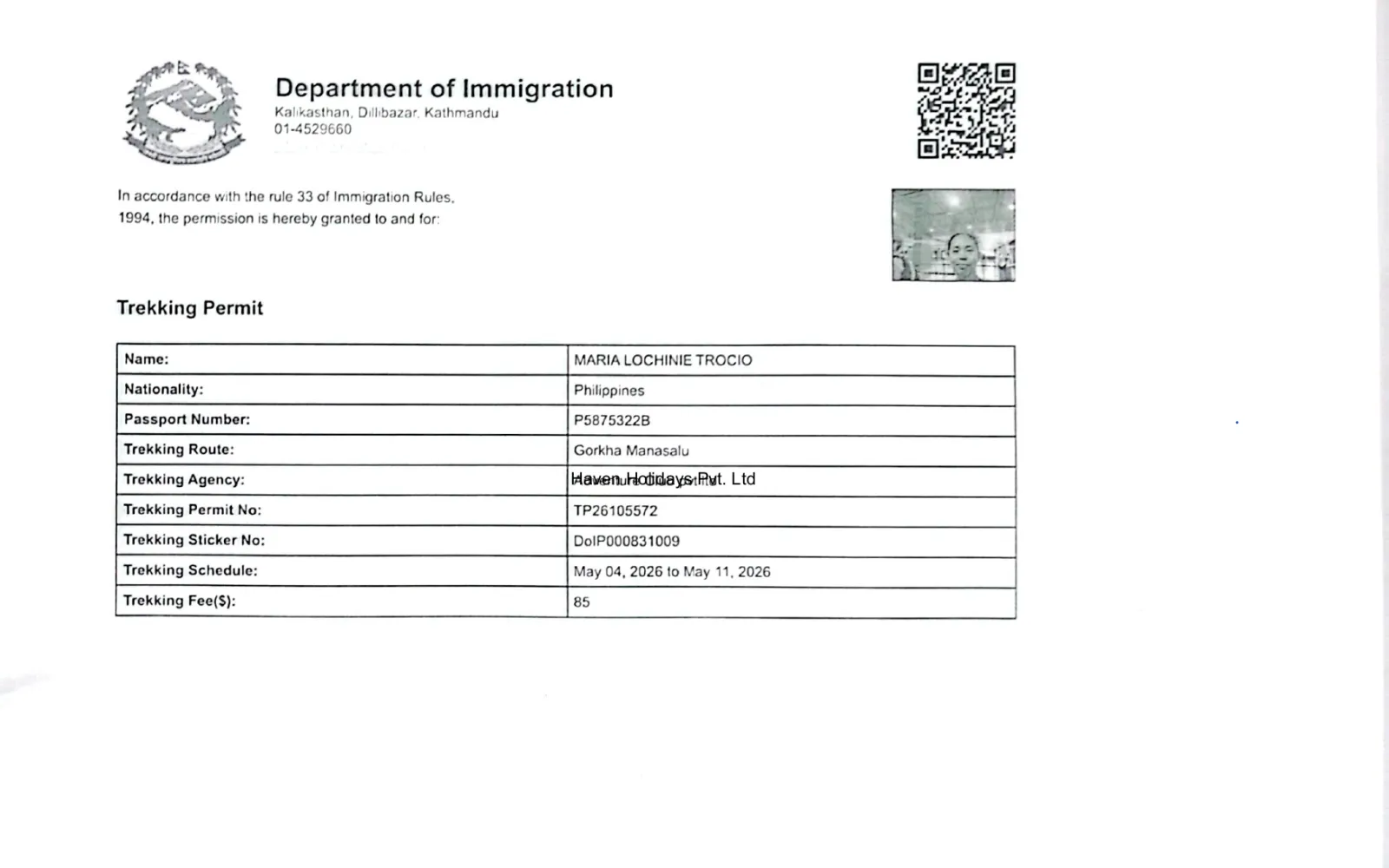
A Restricted Area Permit in Nepal is a permit required for foreign trekkers wishing to visit a restricted area of Nepal. These areas are important due to geographical, cultural, environmental and security reasons. They commonly occur near the north international border.
Meanwhile, these permits allow control of access to specific villages, rural municipal wards and routes. These popular restricted areas include Upper Mustang, Upper Dolpo, Manaslu, Tsum Valley, Nar Phu Valley and Kanchenjunga.
In addition to, trekkers must be accompanied by an authorised tour operator. A licensed trekking guide must accompany trekkers. The permit will state the destination and the duration of trekking. You must therefore follow the approved route.
Why are there Restricted Area Permits in Nepal?
Security – some areas are located close to international borders.
Cultural Protection – Communities are influenced by Tibetan culture. It is important to protect the languages, monasteries and traditions.
Environmental Protection – Remote mountain areas require responsible management of tourism.
Tourism Management – Permits allow authorities to manage and monitor tourists.
Types of trekking permits compared to Restricted Area Permits
Permit Type | Purpose
Restricted Area Permit (RAP) | Access to restricted area
Annapurna Conservation Area Permit (ACAP)| Access to Annapurna Conservation Area
Manaslu Conservation Area Permit (MCAP)| Access to Manaslu Conservation Area
Trekker Information Management System (TIMS)| Trekkers’ information and monitoring (if applicable)
National Park Permit | Access to specific national parks.
Note: A Restricted Area Permit does not mean that you do not need any conservation or national park permits. If you are visiting any of these areas, you must have all applicable permits.
Most importantly, this article includes information on where these areas are, how much they cost in 2027, what documents are required and how to apply. We also include useful information for international trekkers.
There are 15 Restricted Area Permits in Nepal within 13 districts. However, only certain areas within each district are restricted. It is important to check which rural municipal wards and villages are restricted within your intended trek.
Here, the popular restricted areas include Upper Mustang, Manaslu, Tsum Valley, Upper Dolpo and Nar Phu. However, there are also less well known restricted areas within Humla, Dolakha, Solukhumbu, Rasuwa, Mugu, Bajhang and Darchula.
List of Restricted Area Permits in Nepal (2027)
No.| Restricted Area| Specific area
1 | Upper Mustang | Lomanthang (Wards 1-5), Lo-Ghekar Damodarkunda (Wards 1-5), Baragung Muktichetra (Ward 3), Satang Village (Ward 5)
2| Upper Dolpo | Dolpo Buddha (Wards 4-6), Shey Phoksundo (Wards 1-7), Chharka Tangsong (Wards 1-6)
3 | Gorkha Manaslu | Chumnubri (Wards 1-4)
4 | Humla | Simikot (Wards 1, 6, 7), Namkha (Wards 1-6), Changkheli (Wards 3-5)
5 | Taplejung | Phaktanglung (Wards 6-7), Mikwakhola (Ward 5), Sirijunga (Ward 8)
6 | Lower Dolpa | Thulibheri, Tripurasundari, Jagdulla, Mudkechula, Kaike, specific wards in Dolpo Buddha and Shey Phoksundo.
7 | Dolakha |Gaurishankar (Ward 9), Bigu (Ward 1)
8 | Gorkha | Tsum Valley Chumnubri (Wards 3, 6, 7)
9 | Sankhuwasabha | Bhotkhola (Wards 1-5), Makalu (Ward 4)
10 | Solukhumbu |Khumbu Pasang Lhamu (Ward 5)
11 | Rasuwa | Gosaikunda (Ward 1) and specific areas in Ward 2.
12 | Manang | Nar Phu Narpa (Wards 1-5), Nasho (Wards 6-7)
13 | Bajhang | Saipal (Wards 1-5)
14 | Mugu | Mugumakarmarong (Wards 1-9)
15 | Darchula | Vyas (Ward 1)
Key Restricted Trekking Areas in Nepal
Upper Mustang – Lo Manthang and traditional villages at approx 3800m.
Manaslu Circuit – Pass over Larkya La Pass (approx 5106m).
Tsum Valley – Traditional Himalayan villages, including Chumling and Nile.
Nar Phu Valley – Remote villages of Nar and Phu. Pass over Kang La (approx 5320m).
Upper Dolpo – Shey Gompa and remote Phoksundo area.
Kanchenjunga – Trek towards North and South Base Camp. Highest Pass: Pangpema (5143m).
Note: While Mustang, Gorkha, Manang, Dolpa and Taplejung are all restricted areas, it is not the entire district. Only specific areas will require a Restricted Area Permit. Neighbouring areas may require different permits.
For example, Manaslu Circuit and Tsum Valley are both restricted areas in Chumnubri Rural Municipality. Lower and Upper Dolpo have different boundaries and permit types.
Key considerations
Before booking a restricted area trek, you should consider the following:
Check if your route is in a restricted area – Check if the villages and walking routes you will be in are in restricted areas.
Hire Licensed Guide: You are not permitted to enter into restricted area in Nepal without licensed guide from an authorized trekking company
Allow enough time to get permits – You should allow enough time to obtain your permit(s) before entering restricted areas.
Check for extra permits – Some routes require conservation area and/or national park permits.
Check heights of routes – Routes with high passes (Larkya La, Kang La) will require proper acclimatisation.
Check current regulations – Fees and processes for permits may change between now and 2027.
Practical Tip: It is best to check your full route before applying for your permit. If you wish to change restricted area destinations, you may need additional permits and authorization.
Note: The information about permit boundaries and costs in this article is based on the current information from the Nepal Tourism Board. Please double check with the Department of Immigration to make sure that permit fees have not changed before publishing or taking bookings for 2027.
Depending on the route and time of year, the price of restricted area permits will vary. Foreign trekkers must pay the appropriate government fee to enter restricted areas.
Meanwhile, the most accurate source of information on restricted area permit pricing in 2027 can be found on the Department of Immigration website. The prices below were confirmed on 21 st November 2026.
However, these prices should not be guaranteed for 2027 until any changes are confirmed by the government.
Complete List of Restricted Area Permit Prices in Nepal
Below are the full costs of restricted area permits for all 15 restricted areas in Nepal. The price of permits depends on the route taken, and can be charged weekly, daily or for an initial period of time.
| Restricted Area | Price (Sep-Nov) | Price (Dec-Aug) |
| Upper Mustang | $50 per person per day | $50 per person per day |
| Upper Dolpo | $500 (10 days) + $50 (per day) | Same |
| Manaslu | $100 (1 week) + $15 (per day) | $75 (1 week) + $10 (per day) |
| Humla | $50 (1 week) + $10 (per day) | Same |
| Taplejung | $20 (per week for 4 weeks) + $25 (per week) | Same |
| Lower Dolpo | $20 (per week for 1 week) + $5 (per day) | Same |
| Dolakha | $20 (per week) | Same |
| Tsum Valley | $40 (per week for 1 week) + $7 (per day) | $30 (per week for 1 week) + $7 (per day) |
| Sankhuwasabha | $20 (per week for 4 weeks) + $25 (per week) | Same |
| Solukhumbu | $20 (per week for 4 weeks) + $25 (per week) | Same |
| Rasuwa | $20 (per week) | Same |
| Nar Phu Valley | $100 (per week for 1 week) + $15 (per day) | $75 (per week for 1 week) + $15 (per day) |
| Bajhang | $90 (per week for 1 week) + $15 (per day) | Same |
| Mugu | $100 (per week for 1 week) + $15 (per day) | Same |
| Darchula | $90 (per week for 1 week) + $15 (per day) | Same |
Important: Upper Mustang and Upper Dolpo have different pricing. Upper Mustang is charged per day, whereas Upper Dolpo is charged $500 for the first 10 days.
Upper Mustang Permit Cost
The cost of a restricted area permit to Upper Mustang is $50 per person per day. Therefore, for a 10 day trek, the cost will be $500 per person (excluding any other permits/fees).
Meanwhile, the restricted area includes Lo Manthang, Lo-Ghekar Damodarkunda and specific areas of Baragung Muktichhetra. Lo Manthang is around 3,840m in elevation. The overall area for this trek contains high mountain passes and villages.
Upper Mustang Permit Cost
| Trek Duration | Permit Cost (per person) |
| 7 Days | $350 |
| 10 Days | $500 |
| 12 Days | $600 |
| 14 Days | $700 |
Additional fees should also be considered, as the restricted area permit does not include additional costs such as ACAP, transport, accommodation, food and guides.
Manaslu Circuit Permit Cost
The restricted area permit to Manaslu costs $100 per person for the first 7 days (Sep-Nov), and $75 per person for the first 7 days (Dec-Aug).
Additional days cost $15 (Sep-Nov) and $10 (Dec-Aug). This permit applies to specific areas within Chumnubri Rural Municipality. This includes the main Manaslu trek route.
Manaslu Permit Cost
| Duration | Sep-Nov | Dec-Aug |
| 7 Days | $100 | $75 |
| 10 Days | $145 | $105 |
| 14 Days | $205 | $145 |
Typically, the Manaslu Circuit takes 12-16 days to complete depending on route and acclimation. Larkya La Pass is around 5,106m so it is important to be well prepared.
In addition to the restricted area permit, trekkers will require a Manaslu Conservation Area Permit (MCAP) and Annapurna Conservation Area Permit (ACAP) if applicable to your route.
Tsum Valley Permit Cost
Tsum Valley permits change depending on the time of year. During Sep-Nov the cost is $40 per person, and during Dec-Aug the cost is $30 per person.
Any additional days after 7 days cost $7 per person in any season. This permit applies to specific areas in Tsum Valley on the traditional route of Sirdibas, Lokpa, Chumling, Chhekampar, Nile and Chule.
Tsum Valley Permit Cost
| Duration | Sep-Nov | Dec-Aug |
| 7 Days | $40 | $30 |
| 10 Days | $61 | $51 |
| 14 Days | $89 | $79 |
Actually, Tsum Valley villages typically range in elevation from 2,000m to 3,700m. The highest point in Mu Gompa village is around 3,700m. Tsum Valley contains many important Buddhist monasteries and traditional villages.
If you are combining the Tsum Valley with the Manaslu Circuit, trekkers must pay both appropriate restricted area permits. In addition, MCAP permits are required.
Nar Phu Valley Permit Cost
There are different prices for restricted area permits in Nar Phu Valley depending on whether it is peak season or off-peak season. During Sep-Nov, the permit costs $100 per person for 7 days. During Dec-Aug, it costs $75 per person for 7 days.
After 7 days, the permit costs $15 per person per day in both seasons. This permit applies to specific areas in Narpa and Nasho Rural Municipalities in Manang District.
Nar Phu Permit Costs
| Duration | Sep-Nov | Dec-Aug |
| 7 Days | $100 | $75 |
| 10 Days | $145 | $120 |
| 14 Days | $205 | $180 |
Phu Village is around 4,080m in elevation. Nar Village is around 4,110m. However, trekkers should be prepared for high altitudes of around 5,320m if crossing Kang La Pass.
As a general rule, trekkers will need an ACAP permit to enter the Nar Phu Valley. The restricted area fee and conservation area permit must be paid separately.
Upper Dolpo & Lower Dolpo Permit Costs
Upper Dolpo and Lower Dolpo have different restricted area permits. The permit to Upper Dolpo costs $500 for the first 10 days, with additional days costing $50. The permit to Lower Dolpo costs $20 for the first 7 days, with additional days costing $5. As such, the permit is much cheaper in Lower Dolpo.
Comparison of permit costs in Dolpo
| Duration | Upper Dolpo | Lower Dolpo |
| 7 Days | $500 | $20 |
| 10 Days | $500 | $35 |
| 14 Days | $700 | $55 |
Actually, the restricted area in Upper Dolpo includes specific areas around Shey Phoksundo, Dolpo Buddha and Chharka Tangsong. The restricted area in Lower Dolpo includes further municipalities and wards such as Thulibheri, Tripurasundari and Kaike.
In addition to, Shey Phoksundo Lake is around 3,611m. Shey Gompa is around 4,320m. Overall, Dolpo contains challenging high altitude treks, with remote villages.
Depending on the route taken, trekkers may be required to pay permits to enter national parks or other conservation areas. Please check the exact route in order to calculate total permit costs.
Kanchenjunga Permit Cost
Kanchenjunga falls under the Taplejung restricted area in the list of restricted area permits. The cost is $20 per person per week for 4 weeks, and $25 per person per week thereafter.
Actually, the restricted area refers to specific wards in Phaktanglung, Mikwakhola and Sirijunga Rural Municipalities. Not all routes and villages in Taplejung will require this restricted area permit.
Kanchenjunga Permit Costs
| Duration | Permit Cost (per person) |
| 7 Days | $20 |
| 14 Days | $40 |
| 21 Days | $60 |
| 28 Days | $80 |
| 35 Days | $105 |
Actually, Kanchenjunga North Base Camp (Pangpema) is around 5,143m in elevation. Kanchenjunga South Base Camp is around 4,730m. The entire circuit typically takes 18-24 days to complete.
In addition to, trekkers will need to pay a Kanchenjunga Conservation Area Permit (KCAP). The restricted area permit and conservation area permits serve different purposes.
Other Permit Costs in Restricted Areas in Nepal
Many less popular restricted area treks in Nepal also have permit costs. These include Humla, Dolakha, Sankhuwasabha, Solukhumbu, Rasuwa, Bajhang, Mugu and Darchula. The cost depends on weekly or daily basis.
Restricted Area Permit Costs
| Destination | Initial Cost | Additional Cost |
| Humla | $50 (per week) | $10 (per day) |
| Dolakha | $20 (per week) | N/A |
| Sankhuwasabha | $20 (per week for 4 weeks) | $25 (per week) |
| Solukhumbu | $20 (per week for 4 weeks) | $25 (per week) |
| Rasuwa | $20 (per week) | N/A |
| Bajhang | $90 (per week) | $15 (per day) |
| Mugu | $100 (per week) | $15 (per day) |
| Darchula | $90 (per week) | $15 (per day) |
Important: These permit costs only apply to specific restricted geographical areas. Not all treks in that district can be restricted.
3. What other costs are not included in restricted area permits?
While restricted area permits allow trekkers to legally enter specific areas, trekkers should be aware of additional costs.
Other costs to consider:
- Conservation permits – ACAP, MCAP & KCAP (if applicable).
- National Park Permits – Sagarmatha or Shey Phoksundo (depending on route).
- Guide – professional guides cost money per day.
- Transport – domestic flights, private vehicles and local vehicles.
- Accommodation – Teahouses, lodges, camping.
- Food – Breakfast, Lunch, Dinner and Drinking Water.
- Insurance – Evacuation and high altitude insurance.
Here, it is important to note that permit costs do not include the full cost of restricted area treks. Trekkers should ask for a detailed breakdown of costs.
To trek in restricted areas in Nepal, trekkers must have a permit, be part of a registered trekking company and be accompanied by a licensed guide. This applies to all foreign trekkers wishing to enter restricted areas, including Upper Mustang, Manaslu, Tsum Valley and Nar Phu.
Actually, the restricted area permits are managed by the Department of Immigration. Since 22 nd March 2026, individual foreign trekkers can apply for restricted area permits. However, individual trekkers must still be part of an approved trekking company and be accompanied by a licensed guide.
Must trekkers be accompanied by a licensed guide?
Yes, foreign trekkers must be accompanied by a licensed guide in restricted areas of Nepal.
The Department of Immigration have set a maximum number of 7 trekkers per licensed guide. If there are 8 trekkers or more in a group, additional guides must be arranged.
Important requirements for guides:
- Must have a valid guide licence.
- Must be arranged by a registered trekking company.
- Must be with the group in restricted area.
- The Trekking Company must have emergency and rescue support in place.
- The Trekking Company must ensure the approved route is followed.
The guide requirement is in place as part of the government restrictions and safety measures.
Can individual trekkers get restricted area permits?
Yes, individual foreign trekkers can get restricted area permits since a new decision was made by the Department of Immigration on 22 nd March 2026. Previously, most restricted area permits required at least 2 foreign trekkers.
However, individual trekkers must still be organised by an approved trekking company and must be accompanied by a licensed guide.
Guidelines for solo trekkers in restricted areas (March 2026 onwards):
| Requirement | Solo Trekker |
| 1 foreign visitor | Permitted |
| Registered Trekking Company | Compulsory |
| Licensed Guide | Compulsory |
| Trek independently | Not permitted |
| Follow approved route | Compulsory |
| Emergency support from Company | Required |
Although this change benefits trekkers who cannot find a partner, they should be aware that they will still have to pay the appropriate permit fee, and organise a guide and company.
Here, the change in policy means it is easier for trekkers to complete restricted area treks, however the government has still ensured safety measures are in place.
Must trekkers be part of an approved trekking company?
Yes, to get restricted area permits in Nepal as a foreign visitor, trekkers must be part of an approved trekking company. This applies to individual trekkers and larger groups.
Importantly, the company will organize the permits, guide, route and documents. They also take responsibility for emergency support in line with the new government guidelines.
Responsibilities of Trekking Companies:
1. Confirm the restricted area route & category of permit.
2. Collect necessary information from trekkers and passports.
3. Create a trekking schedule and permit application.
4. Arrange licensed guides and staff.
5. Coordinate payment of applicable permits and documents.
6. Provide support for emergency communication and support.
As such, trekkers should confirm that their operator is approved, and ask for confirmation of what is included and what is not in the permit. They should not pay deposits until they have received written confirmation.
Can trekkers change their route?
Once trekkers have started their trek in a restricted area, they must follow the approved route. The Nepal Tourism Board have stated that if trekkers go outside of the approved route, or enter an unapproved area, they may be breaking the law.
Therefore, trekkers should not change their route independently. If changes need to be made due to weather, landslides, illness or other emergency issues, the Trekking Company must contact relevant authorities.
Important considerations when changing route:
- Inform your guide of any changes to the route.
- Contact your Trekking Company before changing restricted area destinations.
- Get official approval where necessary.
- Confirm if any additional permits/fees are required.
- Follow instructions from local authorities in an emergency.
For example, if you are trekking Manaslu, you cannot extend your trek to Tsum Valley simply by having a Manaslu restricted area permit. As it is a different restricted area, you must have appropriate authorization.
Consequences of not having a Valid Permit
It is illegal to enter restricted trekking areas without a permit. In Nepal, trekkers must have appropriate permits to enter restricted areas.
In addition, trekkers must have a valid copy of their permit at all times. They must show this to immigration officers/police if asked.
Important rules for permit compliance:
- Obtain appropriate permit for restricted area.
- Have a valid copy of permit at all times.
- Show permit to officials when required.
- Follow the approved route and time period.
- Do not enter restricted villages without appropriate permission.
Actually, trekking in restricted areas is monitored by the Department of Immigration and appropriate security personnel. Therefore, trekkers should never assume that a conservation area permit gives unrestricted access to restricted areas.
If trekkers do not have the correct documentation, it may cause complications at checkpoints and in emergency situations. To ensure trekkers’ safety and to follow Nepal’s trekking guidelines, it is important to have appropriate permits.
International trekkers must provide valid identification, visa information and trekking information. Supporting documentation must also be provided from a registered trekking agency, including insurance information, approved itinerary and company information.
As digital applications are now available in Nepal, required information can be submitted online. Depending on the type of application and current procedures, different documentation may be required.
Valid Passport
A valid passport is required. A clear copy should be provided with the following information included: name, nationality, passport number and expiry date.
Ensure that the information in the passport matches the information provided in the application to avoid any delays. If there are any typos or incorrect passport numbers, delays may occur.
Checklist
- Original passport for personal identification
- Clear copy of passport information
- Correct name and passport number
- Valid for the duration of the trek
- All documents include consistent personal information.
Nepal Tourist Visa
A valid tourist visa must be provided for the Restricted Area Permit to be applied for. The department will use valid visa information to confirm that applicants are foreigners.
Visa information must be provided. The visa must be valid for the duration of the trek.
Information to Include
| Information | Details |
| Visa Number | Number shown on visa |
| Visa Type | Appropriate tourist visa |
| Valid Dates | Must be valid for the duration of the trek |
| Entry Date | Date entered into the country |
| Digital proof | Clear copy of visa |
Note: If trekkers are applying from outside of Nepal, they can enter the application process using the Application Submission ID in the new digital system. However, please ensure that you are aware of the requirements in the system.
Passport Size Photos
A recent passport sized photo may be required. Within the application checklist a personal application form must be completed with a passport photograph.
Please ensure that the photo is clear. If a printed version is requested by your trekking agency or relevant office, ensure you have one ready.
Checklist
- 1 recent passport sized photo per trekker.
- Clear face with minimal edits.
- Simple background, and adequate lighting.
- Digital photo in the format requested by the agency.
- Matches personal information on the passport.
Trekking Itinerary
A detailed trekking itinerary is required for a Restricted Area Permit. An official trekking plan must be completed including the route, locations and duration of the trek.
Here, this must be completed on letter headed paper from the trekking agency with an authorized signature and company stamp. The route must also fit within the geographic restrictions, and the correct permit category.
Information to Include
| Information | Details |
| Trek Location | Manaslu, Upper Mustang or other restricted area |
| Start and End Locations | Start and End Points |
| Day by Day Route | Villages and places to stay |
| Duration of Trek | Total number of approved days |
| Trek Dates | Expected Start and End Date |
| High Passes | Relevant passes and elevation to stay |
| Trekking Agency Information | Letter head, signed and stamped. |
For example, if you are undertaking the Manaslu Circuit trek, the itinerary should include the locations Machha Khola, Jagat, Namrung, Samagaun, Samdo and Dharmashala and crossing of the Larkya La pass. This helps confirm the correct route, and length of permit required.
Trekking Guide and Agency Information
To apply for a Restricted Area Permit, appropriate business and operation documents must be provided from the registered trekking agency. This confirms that they are authorised to provide restricted area treks.
Importantly, the agency must also provide information on the trekkers insurance, and insurance for Nepalese staff. A list of trekkers and supporting documents from the agency must also be provided.
Information generally provided by Trekking Agencies
- Valid business and operation licence.
- PAN card certificate for the agency.
- Current tax clearance certificate.
- Foreign currency exchange licence from the Nepal Rastra Bank (if applicable).
- Guarantee letter, and agreement.
- Details of licensed guides, and insurance for staff.
- List of trekkers, and insurance for foreign visitors.
- Official trekking itinerary and application forms.
- Appropriate permit fee payment voucher, and bank receipt.
As the trekking agency manages the permit application and emergency arrangements, it is not generally required for individuals to obtain internal documents from the agency. However, it is very important that these documents are provided.
Application and Payment
Correct personal information must be provided, and the correct government fee confirmed. Required application forms will be completed by the trekking agency. Supporting documents will be submitted through the correct digital system.
In addition to, payment evidence must be provided in line with current procedures with the Department of Immigration. Confirm with your agency to ensure correct payment method and total amount is paid.
Checklist
1. Confirm Restricted Area Permit category.
2. Confirm number of days for trek, and season.
3. Confirm government fee from current schedule.
4. Complete digital application.
5. Provide correct payment evidence.
6. Save permit and payment confirmation.
Checklist for Complete Documentation
The following checklist can help international trekkers prepare the correct information to give to a trekking agency.
| Document/Information | Responsibility |
| Valid copy of passport | Trekker |
| Nepal tourist visa information | Trekker (if applicable) |
| Recent passport photo | Trekker |
| Trek Dates & Itinerary | Agency & Trekker |
| Personal Information & List of Names | Agency & Trekker |
| Trekker Insurance | Trekker & Agency |
| Guide & Porter Insurance | Agency |
| Guide & Agency Information | Agency |
| Company Registration & Tax Documents | Agency |
| Application & Payment Evidence | Agency |
Tip: Provide clear copies of passport and visa information to your agency in advance. This will allow them to check your personal information and resolve any issues with documentation before submitting for permits.
To apply for a Restricted Area Permit in Nepal, select a permitted destination, contact a registered trekking agency, and provide the required documentation. Permits are issued by the Department of Immigration in Kalikasthan, Kathmandu.
In an effort to streamline the application process, digital permits are available. As a result, applications can be submitted by registered agencies online. Under revised procedures, individual foreign trekkers can submit individual applications.
Step 1: Select a Restricted Trekking Destination
Select the location of your restricted area trek. In Nepal, different permits are required for Upper Mustang, Manaslu, Tsum Valley, Nar Phu, Dolpo and other areas.
Select a route based on the amount of time you have, your fitness and experience. You must also consider the permit fee, and any additional costs for conservation areas or national parks.
Popular Restricted Treks
| Destination | Duration | Maximum Elevation |
| Upper Mustang | 10-14 Days | Lo Manthang 3840m |
| Manaslu Circuit | 12-16 Days | Larkya La 5106m |
| Tsum Valley | 10-14 Days | Mu Gompa 3700m |
| Nar Phu Valley | 9-12 Days | Kang La 5320m |
| Upper Dolpo | 18-25+ Days | Shey Gompa 4320m |
| Kanchenjunga Circuit | 18-24 Days | Pangpema 5143m |
Notes: The duration of these treks are approximate durations. The time taken to process permits from the government is not related to these durations. The duration of actual itineraries will depend on the route taken, acclimatisation and transport.
Step 2: Contact a Registered Trekking Agency
Once a destination has been chosen, contact a registered trekking agency in Nepal to arrange a Restricted Area Permit. They will confirm the route, regulations and documentation.
Here, they will arrange a licensed guide, and emergency support. As professional guidance is required for restricted area treks, ensure these arrangements have been made before paying a deposit.
Confirm the following with your trekking agency:
- That the company is registered and authorized.
- That a licensed guide can be provided.
- Cost of Restricted Area Permit and any additional costs.
- Itinerary and accommodation.
- Insurance and emergency rescue.
- What is included/excluded from the quote.
Step 3: Provide Passport and Visa Information
Provide correct identification and immigration information. This will allow the agency to create an individual permit application, and confirm your identity.
If you are in Nepal already, provide valid visa information. If applying from outside of Nepal, you can use the Application Submission ID in the new digital application process.
Information to provide
- Passport with personal information.
- Valid Nepalese visa number (if applicable).
- Recent passport sized photo.
- Full name and nationality.
- Dates of trek.
- Travel insurance information.
Ensure all information in your passport is correct to avoid any delays.
Step 4: Confirm Trek Itinerary and Permit Duration
An official trek itinerary will be created by the trekking agency. This must include: starting location, destination of each day, overnight stop and total duration of the trek.
Here, this must be completed on official letter headed paper from the agency, with an authorized signature and company stamp. The duration of the permit must allow for the planned duration of the restricted area trek.
Example: Manaslu Circuit Trek
| Day | Location | Approximate Elevation |
| 1 | Machha Khola | 900m |
| 2 | Jagat | 1340m |
| 3 | Deng | 1860m |
| 4 | Namrung | 2630m |
| 5 | Samagaun | 3530m |
| 6 | Acclimatisation Samagaun | 3530m |
| 7 | Samdo | 3860m |
| 8 | Dharmashala | 4460m |
| 9 | Pass over Larkya La to Bimthang | 5106m |
| 10 | Tilije | 2300m |
Note: This is a shortened example of the route. Full itineraries must be included in permit applications.
Step 5: Submit Application and Payment
Once all documents have been completed, the application can be submitted by the registered trekking agency in the digital permit system. The agency will also make payment of the correct government fee, and relevant financial documents.
Importantly, the permit fee will depend on the location, season and duration of the trek. Be sure to confirm the total cost before making payment.
Application and Payment Process
- Complete online application.
- Enter passport, visa and trekker information.
- Upload official itinerary and insurance.
- Include supporting documents from the agency.
- Make payment of government fee.
- Submit payment voucher/receipt.
If you are applying from outside of Nepal, you can also use the Application Submission ID in the digital system. In addition, you can make payments in advance. However, a registered agency and licensed guide is still required.
Step 6: Collect and Check Permit
Once the application and payment has been reviewed, the permit will be processed. From the service information provided by the Department of Immigration, if applications with payment are submitted 1 hour before closing, permits will be processed the same day.
However, if applications are submitted later in the day, they will be processed the next working day. Delays may occur due to incomplete documents, payment issues or technical issues.
Check the following information
- All trekkers names are spelled correctly.
- Passport number and nationality matches.
- Correct restricted area destination.
- Correct start and finish dates.
- Correct duration of permit and payment.
- Approved route of trek matches.
Importantly, ensure you have a copy of your permit during the trek. It is best to have a physical and digital copy. If requested at checkpoints by immigration officers or police, show the permit.
Summary of Applying for a Restricted Area Permit
1. Select Destination
Confirm location, route and correct permit category.
2. Contact Registered Trekking Agency
Arrange licensed guide, itinerary and required documentation.
3. Provide Personal Information
Provide passport, visa, photo and insurance information.
4. Create Official Itinerary
Confirm dates of trek, place to stay and duration of permit.
5. Submit Application, and Make Payment
Submit application through correct system. Make payment of correct fee.
6. Collect Permit
Ensure all information is correct.
Tip: To avoid unnecessary delays, it is advised to arrange permits in advance to remote treks. Having correct documentation, an approved itinerary and a licensed guide will help provide a safer trek.
There are many different Permits Required for trekking in Nepal to ensure sustainable and controlled tourism in these mountainous regions. Depending on the trek, multiple permits may be required.
Meanwhile, Restricted Area Permits allow access to certain restricted areas. Conservation and National Park permit allow access to certain protected areas. Additionally, a TIMS card may be required to register and monitor trekkers in certain areas.
In addition to, international trekkers should ensure they know what permits are required for their whole route. Even if you have one permit, it may not allow you in to all protected/restricted areas within your trip.
Difference between RAP and Conservation Area permits in Nepal
Type of Permit | Purpose | Management |Popular Regions
Restricted Area Permit (RAP) | Access to certain restricted areas | Department of Immigration | Upper Mustang, Manaslu, Nar Phu
ACAP | Entry to Annapurna Conservation Area | National Trust for Nature Conservation |Annapurna, Nar Phu
MCAP | Entry to Manaslu Conservation Area | National Trust for Nature Conservation | Manaslu Circuit
Sagarmatha National Park Permit | Entry to Sagarmatha National Park | Department of National Parks and Wildlife Conservation | Everest Base Camp, Gokyo
Shey Phoksundo National Park Permit | Entry to Shey Phoksundo National Park | Department of National Parks and Wildlife Conservation | Upper Dolpo and Lower Dolpo
TIMS Card | Register and monitor trekkers | Nepal Tourism Board and appropriate agencies | Appropriate Trek routes
Depending on the permit, the way in which they are issued and collected can vary. Ensure you know how to apply for the correct permits before you go.
Difference between restricted area permits and TIMS
Restricted Area Permits allow entry to specific restricted trekking regions. A TIMS card is used for the registration & monitoring of trekkers.
Therefore, a TIMS card cannot be used in place of Restricted Area Permits. Likewise, just because you have been issued with a Restricted Area Permit, it does not mean that you will also be required a TIMS card, or vice versa.
When to get ACAP, MCAP or National Park Permits
Conservation and National Park permits are separate to restricted area permits. They allow regulation of people in protected areas and help support conservation in these areas.
Actually, some restricted area treks may cross multiple protected areas. As such, trekkers must ensure they have the correct combination of permits to enter these areas.
Which permits do I need?
Depending on where you are trekking, you will need to get multiple permits. Some treks in restricted areas may require restricted area permits, conservation area permits and a TIMS card.
Permits Required in popular Restricted Trekking Areas
Trek Location | Restricted Permit | Additional Protected Area Permit | TIMS
Manaslu Circuit | Manaslu RAP | MCAP & ACAP (Depends on route) | Required
Tsum Valley | Tsum Valley RAP | MCAP | Required
Manaslu-Tsum Combined | Both relevant RAPs | MCAP & ACAP (Depends on route) | Required
Upper Mustang | Upper Mustang RAP | ACAP | Required
Nar Phu Valley | Nar Phu RAP | ACAP | Required
Kanchenjunga | Appropriate Taplejung RAP | KCAP
| Required
Upper Dolpo | Upper Dolpo RAP | Shey Phoksundo National Park (If applicable) | Required
What is ACAP in Nepal?
The Annapurna Conservation Area Permit allows you to enter the Annapurna Conservation Area, supporting conservation efforts, protecting the environment, and sustainable tourist practices in the region.
Currently, international trekkers are charged 3,000 NPR to enter Annapurna Conservation Area (on top of the Restricted Area Permit if trekking Upper Mustang/Nar Phu). This fee is set by the Nepal Tourism Board.
Trek routes requiring ACAP
Upper Mustang Trek
Nar Phu Valley Trek
Annapurna Circuit Trek
Annapurna Base Camp Trek
Ghorepani and Poon Hill Trek
Annapurna Conservation Area Permit and other conservation area permits can be applied for via the online portal. As these permits cannot be transferred and are non-refundable, please ensure you have filled in the details correctly.
What are MCAP and KCAP?
The Manaslu Conservation Area Permit (MCAP) and Kanchenjunga Conservation Area Permit (KCAP) allow entry to their respective conservation areas.
Currently, international visitors must pay 3,000 NPR to enter Manaslu Conservation Area and Kanchenjunga Conservation Area. Neither of these permits can be used instead of restricted area permits.
Where these permits apply
Permit | Primary Trek Location | International Visitor Fee
MCAP | Manaslu and Tsum Valley | 3,000 NPR
KCAP | Kanchenjunga | 2,000 NPR
Here, kindly note that the KCAP cost is different to the MCAP cost. Therefore, it is best not to assume all conservation area permits are the same price. Both permits can be organized through the NTNC online portal.
When are national park Permits Required?
If you are trekking through National Parks, you will be required to purchase a permit. For example, in the Dolpo region there are treks that take place in Shey Phoksundo National Park.
Here, international visitors are currently charged 3,000 NPR to enter Shey Phoksundo National Park and Sagarmatha National Park. These fees are separate to restricted area permits and TIMS.
National Park Permit Requirements
Upper and Lower Dolpo – Shey Phoksundo National Park Permit (if entering park)
Everest Region – Sagarmatha National Park Permit.
Makalu Region – Makalu Barun National Park Permit (if applicable)
Depending on the Approved Trekking Route, the combination of Permits Required will change. Please ensure you know what permits are required for your trek before departure.
Do I require a TIMS card for These Restricted Trekking Routes?
According to the updated TIMS requirements provided by the Nepal Tourism Board, trekkers in the Upper Mustang, Manaslu, Tsum Valley, Nar Phu, Kanchenjunga, Upper Dolpo and Lower Dolpo areas require a TIMS card issued by a trekking agency. A licensed guide is also required.
TIMS Fees
International Visitors: 2,000 NPR
SAARC visitors: 1,000 NPR
An electronic card is issued through registered trekking agencies, containing a QR code to verify.
Permits for restricted area treks in Nepal are checked at specific check points along Popular Trekking Routes. Immigration officers, police and conservation area staff can check your permit, passport and details of your trek.
Importantly, this ensures tourists are being appropriately monitored and are adhering to the right Approved Trekking Route. Trekkers should carry physical copies or official digital versions of their permits, as instructed by your trekking agencies.
Where are restricted area Permits Checked?
Restricted area permits can be checked at various checkpoints along the trek. Depending on the trek location, the checkpoints in place can vary.
In Manaslu the Jagat tourist checkpoint opened in April 2025 to check permits and conservation areas. In Upper Mustang, Kagbeni is the primary entrance for international visitors.
Check points for permits on popular routes
Route | Common Check Point / Check | Type of Permit Checked
Manaslu Circuit | Jagat | Manaslu RAP and MCAP
Tsum Valley | Jagat and checkpoints along route | Tsum RAP and appropriate conservation permits
Upper Mustang | Kagbeni | Upper Mustang RAP and ACAP
Nar Phu Valley | Koto | Nar Phu RAP and ACAP
Upper Dolpo | Along route checkpoints | Upper Dolpo RAP and National Park Documentation
Kanchenjunga | Security and conservation checkpoints (depends on route) | Appropriate RAP and KCAP
Notes:
Manaslu – Jagat is an important check point for tourists and conservation.
Upper Mustang – Kagbeni is the primary entry point for international visitors.
Nar Phu – Koto is normally the entry point to reach the restricted area.
Tsum Valley – This route branches off from the Manaslu trek.
Kanchenjunga – You must follow the approved route. If asked to show permits, you must do so.
Here, your licensed guide will organize any checkpoints and permit checking during the trek. You do not need to stress on this.
Why must I follow the Approved Trekking Route?
Restricted area permits only allow you to enter defined areas for a defined time. This does not mean you can freely enter other areas in the district, or other restricted areas.
For example, if you have the permit to trek the Manaslu Circuit, you may not necessarily be allowed to enter the Tsum Valley. If you have a permit for Upper Mustang, not all restricted treks in the Mustang District may be permitted.
Important Notes
Follow the approved route of your trek.
Stay in the defined area(s) stated on your permits.
Trek within the given time frame defined on your permits.
If you have deviated from your route, make sure to inform your guide.
If entering a new restricted area, make sure you have extra authorization.
Follow instructions at checkpoints and with local authorities.
In extreme conditions such as weather issues, landslides and medical issues, you may need to change your trekking plan. In this case, your guide and agency will work with the relevant authorities to adjust your route.
If I lose my Permit?
Losing your Restricted Area Permit may cause issues when checking in at checkpoints and for immigration. Please ensure you take care of the permit documentation. If you lose it, make sure to let your guide and trekking agency know immediately.
In addition to, they can get in contact with the appropriate issuing body to confirm the permit is recorded. Further verification may be required to receive a replacement permit, therefore do not assume that a photo can be used in place of official permission.
What to do if permit is lost
Inform your guide.
Contact the registered trekking agency.
If instructed, report the loss to the appropriate local authority.
Provide a copy of your passport, and any copies of permit.
Request verification / replacement from issuing body.
Follow instructions before proceeding through restricted check points.
Therefore, it is advised to print off copies of permits separately from your original passport, and store digital copies on your phone. This means that even if your documents become damaged or lost, you still have valuable information.
Can I extend/change my Restricted Area Permit?
Restricted area permits are issued for specific destinations and within a defined time frame. If you need more time, or have changed your itinerary, please speak to your trekking agency before your original permit has expired.
Here, they can work with the Department of Immigration to extend/amend your permit. Depending on the destination, and new time frame, extra government costs may be incurred.
When to check permits / amend permits
Reason | Action
Extra days in trek | Apply for an official extension of permit
Different restricted area | Check if extra Permits Required
Different date of entry | Contact issuing body through agency
Altered route | Get instructions and approvals if required
Medical issue | Inform guide and agency immediately
Damaged / lost permit | Request verification / replacement
Example: Extending the Manaslu Circuit trek beyond 7 days in restricted area will incur extra daily permit costs. The agency should organise payment of the correct amount, and relevant documentation.
However, if your permit has expired, do not assume that you can continue in the restricted area. Please confirm with relevant bodies first.
How can I prepare for permit checks?
To make permit checking at checkpoints easier, trekkers should ensure they have all their identification and permit information to hand.
Documents to have before trek
Passport.
Valid Visa for Nepal.
Restricted Area Permit.
ACAP / MCAP / KCAP (where applicable).
National Park Entry Permit (where applicable).
TIMS card (where applicable).
Trekking Agency / Guide contact information.
Travel Insurance and Emergency Contacts.
Importantly, guides should ensure that you have made the correct registration at conservation area checkpoints. Visitors should register at specific check posts in conservation area treks as instructed by NTNC.
Tip from Haven Holidays: Ensure all permits checks are completed before departing Kathmandu/Pokhara to remote trekking locations. Have copies of permits to hand, and allow your licensed guide to manage official permit checks.
Best times to trek in the restricted areas of Nepal depend on the location and altitude. However, in general, spring (March-May) and autumn (September-November) are best.
Actually, Upper Mustang and Upper Dolpo fall into a rain shadow meaning that they experience different conditions to other areas. You can trek in these areas during certain months of the monsoon season, but you should consider rainfall, wind and trail conditions.
Spring (March-May)
Spring is a very popular time to trek in restricted mountainous locations in Nepal. Temperatures begin to rise, snow conditions can be improved, and villages in the mountains are more accessible.
Generally speaking, Manaslu, Tsum Valley, Nar Phu and Kanchenjunga are a good choice to trek in spring. However, snow can still be present in the higher passes, including Larkya La (5106m) and Kang La (~5320m).
Highlights
Manaslu – Generally good conditions from March to May.
Tsum Valley – Warmer temperatures mean exploring villages and monasteries is easier.
Nar Phu – April and May are generally the best months to cross high passes.
Kanchenjunga – Rhododendrons are in bloom and better access to mountains.
Upper Mustang – Comfortable conditions for exploring Lo Manthang.
Autumn (September-November)
Autumn is generally a very good time to trek in restricted areas in Nepal. After the monsoon season, clearer views of the mountain can be seen, the trails are drier, and comfortable daytime temperatures can be reached.
Likewise, Manaslu, Tsum Valley, Nar Phu and Kanchenjunga are very popular during October and November. However, temperatures get colder in November and early snowfall can occur in high mountain passes.
Highlights
Destination | Best months to visit | Key considerations
Manaslu | September-November | Snowfall at Larkya La
Tsum Valley | September-November | Colder overnight temperatures in high villages.
Nar Phu |September-November | Snow and ice at Kang La.
Upper Mustang | April-November | Windy in afternoon.
Upper Dolpo| June-September and in certain months of spring and autumn| Conditions on high passes.
Kanchenjunga| March-May and September-November |Snow and difficulty in remote trails.
Note: These are general recommendations from Haven Holidays Nepal Team. Conditions will vary depending on levels of snow, rainfall and local forecasts.
Monsoon (June-August)
As Upper Mustang and Upper Dolpo fall in the rain shadow of the Himalayas, much less rainfall will be received in these areas in comparison to the mountain slopes in southern Nepal.
Actually, Upper Mustang is a very good place to trek in summer, as dry conditions mean reasonable accessibility.
Upper Dolpo can also be trekked in summer, however, due to the remoteness of the area, and therefore, domestic flights, unpredictable weather can occur.
Key considerations
Upper Mustang – Relatively dry conditions in Lo Manthang and surrounding villages in June to August.
Upper Dolpo – Can be suitable for experienced trekkers in June to August, especially on high plateau routes.
Lower Dolpo – Heavier rainfall may occur on approach routes.
Transport – Delays and cancellations may occur on flights to Juphal.
Trail conditions – Check river crossings, landslides and conditions on high passes.
Despite falling in a rain shadow, it is still very important to allow extra days in your itinerary, and to check local weather conditions before embarking on a trek in remote areas.
Winter (December-February)
In general, trekking in restricted high altitude areas of Nepal in winter can be very challenging. Temperatures drop significantly, snowfall can increase, and many high passes may be difficult or impossible to cross.
Importantly, great care should be taken in Manaslu, Nar Phu, Upper Dolpo and Kanchenjunga. In remote villages there may be limited accommodation, food and transport services available.
Common issues during winter
Snowfall in high passes (Larkya La and Kang La).
Very cold temperatures above 3500m.
Icy trails and less daylight.
Closed accommodation and Limited food.
Disruption to flights in remote mountain areas.
Difficulties in accessing medical or rescue services.
Challenges of trekking in Nepal in Winter
Destination | Suitability | Key considerations
Upper Mustang| Limited- Depends on itinerary| Very cold and Closed accommodation.
Manaslu | Generally not recommended for full circuit| Snowfall at Larkya La.
Tsum Valley | Possible (low routes) |Cold and Limited services.
Nar Phu | Generally not recommended| Snowfall at Kang La and isolation.
Upper Dolpo | Generally not suitable| Passes may be snowed in and Very cold.
Kanchenjunga | Generally not recommended|
Snow, cold and remote access.
Note: Even if you have a permit for the restricted area, you cannot be guaranteed that the route will be accessible or safe. Guides and agencies should check forecasts, snow levels, trail conditions and accommodation availability to ensure safe travel.
Summary of restricted area trekking in Winter
Season | Destination (best for trekking)
Spring (March-May) | Manaslu, Tsum, Nar Phu, Kanchenjunga, Mustang.
Monsoon (June-August) | Upper Mustang, Certain routes in Upper Dolpo.
Autumn (September-November) | Most restricted trekking areas.
Winter (December-February) |Certain low altitude areas, depending on conditions.
Expert tip: Manaslu and other high altitude restricted areas are generally very good in October and April. Upper Mustang and Upper Dolpo have greater flexibility in terms of seasons due to being in the rain shadow.
Trekking in restricted areas of Nepal requires more preparation than in many other teahouse treks in Nepal. Due to the remote nature of these areas, high altitudes and lack of infrastructure, it is very important to plan well.
Depending on the location, accommodation and food may only be available in very basic lodges or trekkers may need to bring camping equipment and organized food supplies.
Here, it is important to ensure you are physically prepared for the trek, have the correct travel insurance, clothing, transport and emergency plans in place.
Physical Fitness and Altitude
Good physical fitness and acclimatization is required for trekking to high altitudes. Treks to Manaslu, Nar Phu and Upper Dolpo require long walks and high altitudes (over 5000m).
Additionally, allow gradual ascents, including acclimatisation days. Be aware of the symptoms of altitude sickness, and descend immediately if serious symptoms occur.
Key considerations
Regular walking and hill walking to build fitness.
Wearing a comfortable rucksack.
Include acclimatisation days at higher settlements.
Avoid very quick ascents and over-exertion.
Know symptoms of acute mountain sickness.
Speak to a qualified doctor about preventative medicine.
Accommodation and Food
Accommodation and food availability can vary greatly between restricted areas. In Manaslu and Upper Mustang, there are good teahouse accomodations. However, in Upper Dolpo, camping is often required.
In remote villages, food choice may be limited. It is important to check what accommodation, food and essential supplies you can expect before you start.
Destination | Accommodation | Food
Manaslu | Teahouses and basic accommodation | Generally available
Tsum Valley | Local teahouses | Basic
Upper Mustang | Teahouses and accommodation | Generally available
Nar Phu | Basic accommodation in villages | Limited food options
Upper Dolpo | Mainly camping in remote areas | Organized food supply
Kanchenjunga | Basic teahouses| Camping in some areas and Limited in remote areas.
Travel Insurance
It is very important to have travel insurance whilst trekking in remote areas of the Himalayas. Ensure that your insurance covers the highest altitude you will be trekking to, and emergency helicopter transfers.
Standard travel insurance may not cover high altitude trekking or helicopter rescues. Ensure to carefully check the wording of your policy.
Ensure that your insurance covers:
High altitude trekking to maximum altitude.
Emergency helicopter rescue.
Medical treatment and hospital costs.
Emergency transport from remote locations.
Repatriation (if applicable).
Entire duration of the trip.
For example, trekkers visiting Manaslu (Larkya La, 5106m) will need insurance to cover this altitude. Upper Dolpo and Nar Phu will also require appropriate insurance for remote high altitude treks.
Transport and Communications
Transport and communications can be limited in some restricted trekking areas. For some areas, domestic flights, long jeep journeys and walking will be required to reach main trekking areas.
Importnatly, mobile phone and internet connectivity may be very limited in remote valleys. It is very important to arrange emergency communication and transport support with your trekking agency.
Transport and Communication
Destination | Transport | Communication
Manaslu | Road from Kathmandu to Machha Khola| Limited.
Upper Mustang | Flight or road to Jomsom| Better in larger villages.
Tsum Valley | Road towards Machha Khola| Limited in high villages.
Nar Phu | Road towards Koto| Limited in remote villages.
Upper Dolpo | Flight towards Juphal then trek| Very limited.
Kanchenjunga | Flight or road to Taplejung| Limited in remote areas.
Here, it is advisable to carry plenty of cash as banking facilities and card payments may be unreliable in remote villages. Allow extra days in your itinerary in case of delays on roads, cancelled flights or unexpected weather.
Cultural Sensitivity
Restricted trekking areas include culturally significant Himalayan villages and communities practicing traditional Buddhism. Be respectful of local culture, places of worship, monasteries and traditions.
In addition to, Upper Mustang, Tsum Valley and Upper Dolpo have strong Tibetan cultural influences. To help preserve cultural heritage in these areas, and to support local people, responsible trekking is very important.
Responsible trekking tips
Dress appropriately when in monasteries.
Ask permission to take photos of local people.
Remove footwear in areas where it is required by religious traditions.
Do not disrupt prayer rituals or items of religious importance.
Bring refillable water bottles to reduce plastic waste.
Buy local products and support local services.
Be respectful of local wildlife, grazing and traditions.
Weather & Preparing the Route
Weather conditions in mountainous areas can be unpredictable. In the main trekking seasons, snow, strong winds, heavy rainfall and landslides can cause transport issues and difficulties on high altitude trails.
Before beginning your trek, check the forecast for the area, and what conditions the trail may be in. Allow extra days in your itinerary in case of unexpected transport issues and route changes.
Checklist
Clothing Layered clothing, warm jacket and waterproofs.
Footwear Comfortable waterproof boots.
Sleeping bag Appropriate for expected temperatures.
Medicines Personal medicines and basic first aid.
Documents Passport, visa, permits and insurance.
Money Sufficient cash in Nepalese Rupees.
Equipment Head torch, power bank, trekking poles.
Communication Emergency contact details. Backup in place.
Timing Extra days in case of weather or transport issues.
Expert Tip from Haven Holidays: Check for up-to-date information on permits, guides and route conditions before leaving Kathmandu. As accommodation, transport and emergency services may be limited in remote areas, it is very important to be well prepared.
Note: 2027: The best times to trek in these areas are based on typical conditions. To ensure that the route is accessible, check actual snow levels, local forecasts, transport, accommodation and trail conditions in advance of your trip.
It is necessary to obtain a restricted area permit to trek in restricted areas of Nepal. The costs of restricted area permits and the documentation required can vary depending on which restricted area you wish to trek in.
Therefore, make sure you are aware of the most up-to-date trekking permit regulations in Nepal.
Meanwhile, it is best if you work with a registered trekking company in Nepal and a licensed guide. Although solo trekkers can apply for restricted area permits individually (in accordance with 2026 updates), they must still comply with the requirements set for working with an agency and licensed guide.
Additionally, trekkers must follow the approved routes, time frames and checkpoints within their restricted area permit.
By carefully Planning Your Restricted Area trek in Nepal, you can have a well organized trip.
Before departing, ensure that you are aware of the costs of the restricted area permit, conservation/national park fees, accommodation, transport, insurance and trail conditions during that season.
Restricted Area Trek in Nepal with Haven Holidays
Haven Holidays Pvt. Ltd can help international trekkers obtain restricted area permits and plan their treks in restricted areas of Nepal.
Here, we can assist you in applying for your trekking permit in Nepal, working with licensed guides, creating an appropriate itinerary and making necessary arrangements.
If you are looking to trek in Upper Mustang, Manaslu, Tsum Valley, Nar Phu or another restricted area of Nepal, we can help you plan your trip. Get in touch with Haven Holidays to discuss which route you would be interested in taking, and book a restricted area trek in Nepal.
What is a restricted area permit in Nepal?
Restricted Area Permits (RAPs) allow foreign visitors to trek in restricted areas of Nepal. They are issued by the Department of Immigration to control access to sensitive border areas, and remote areas. Trekkers must adhere to the conditions, date and route stated on their permit.
Which areas require Restricted Area Permits in Nepal?
Restricted areas in Nepal include: Upper Mustang, Upper and Lower Dolpo, Manaslu, Tsum Valley, Nar and Phu, as well as certain areas in Humla, Kanchenjunga, Makalu and other bordering districts. Permits may be required in certain wards, not necessarily whole districts. Please check the accurate restricted area boundaries.
How much is a restricted area permit in Nepal in 2027?
Prices vary depending on location, season and duration of trek. In Upper Mustang, permits are $50 per person per day. In Manaslu, permits are $100 per week between September to November, and $75 per week between December to August. Please check the most up to date prices.
Can I trek alone in restricted areas in Nepal?
Yes, individual foreign trekkers can obtain Restricted Area Permits. However, you cannot trek alone in restricted areas. You must have a licensed guide, and must trek with a registered trekking agency.
Do I need a licensed guide in restricted areas?
Yes. Foreign trekkers must be accompanied by a licensed guide in restricted areas of Nepal. This guide must be provided by a registered trekking agency. The agency must make all the necessary arrangements for trekkers, and provide support in case of emergencies. Although trekkers can now apply individually, they must still have a licensed guide.
Do I need a trekking agency to obtain a restricted area permit?
Yes, you cannot apply for a restricted area permit by yourself. Applications must be made by a registered trekking agency. They submit the application online, and provide the necessary documentation. This applies to individual trekkers in 2027.
What documents do I need to get a restricted area permit?
You will generally need a valid passport, and a visa for Nepal for the dates of your trek. You will also need information about yourself as a trekker, travel insurance, and a detailed itinerary. You will also need information on travel insurance for guides and porters you are travelling with. Applications will be prepared by your registered trekking agency, and submitted through the online system.
Where can I get a restricted area permit in Nepal?
Applications can be made through online systems provided by the Department of Immigration. Applications can be made at offices in Kathmandu and Pokhara. Usually you will give your documents to the registered trekking agency, who will apply and pay for you.
How long does it take to get a restricted area permit?
If all documents are submitted and paid for before the deadline in the same day, applications can be processed in the same day. If documents are incomplete, payments have issues, or it is a public holiday, applications may take longer. You should apply for your permit in advance of travelling to restricted areas.
Is a restricted area permit different to a TIMS card?
Yes. A restricted area permit is a separate permit to a TIMS card. The restricted area permit will allow you to enter a specific restricted area. A TIMS card is a system to manage trekker information. A TIMS card is not a replacement for a restricted area permit.
Do I need an ACAP/MCAP in addition to a restricted area permit?
Yes. If you are trekking in protected areas, you may need additional permits. In the Manaslu Circuit trek, you will require a Manaslu Conservation Area Permit (MCAP) and Annapurna Conservation Area Permit (ACAP) in addition to a restricted area permit. Please check what permits you will require based on your specific route.
Can I change my restricted trekking route?
Once you have received your restricted area permit, you should not make changes to your route, dates or entry points. If you need to make changes due to weather, ill-health or trail conditions, please contact your trekking agency. They can check with immigration authorities to see if the changes can be approved.
Our travel experts are ready to assist you with any questions.
Send us a message.Have a question before you book? Send your enquiry below and our travel experts will get back with the required information.