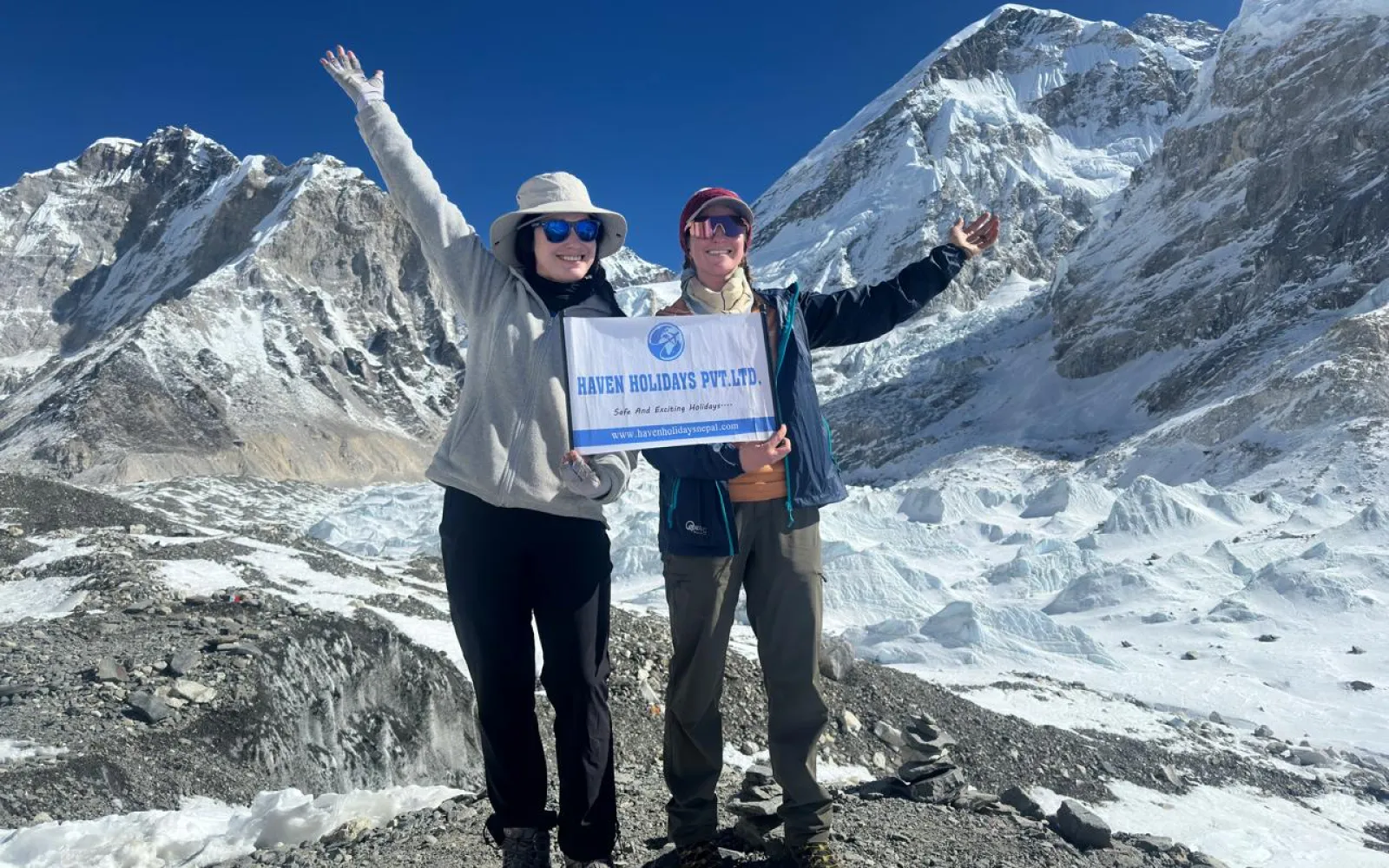
Along with being one of Nepal's most popular treks, the Everest Base Camp Trek is also a high altitude adventure which immerses visitors in the stunning Khumbu area. People must, therefore, prepare for this trek as altitude, weather, temperature and terrain can all affect trekkers' safety.
Typically, the Everest Base Camp Trek includes walks through various well-known Sherpa villages. These include Lukla (2,860m), Phakding (approx. 2,610m), Namche Bazaar (3,440m), Tengboche (3,860m), Dingboche (4,410m) and Lobuche (4,910m).
Trekkers, then, head on to Gorakshep (5,164m) and finally Everest Base Camp (approx. 5,364m). The viewpoint of Kala Patthar (5,545m) is also frequently visited.
Whilst the EBC trek does not involve specialist mountaineering skills, it still has long walking periods, and includes steep climbs, rocky ground and even hanging bridges.
Moreover, medical services are less available at high altitude. Helicopter rescue can also be impacted by weather, visibility and helicopter factors.
More specifically, only physical fitness is insufficient to avoid altitude illness. Indeed, even highly fit and experienced people can suffer from acute mountain sickness as the body must adapt to lower levels of oxygen at higher altitudes.
Hence, in addition to good physical health and motivation, there are further key areas to consider in order to ensure a safe Everest Base Camp Trek.
Below are 20 top tips to assist trekkers with their preparations, acclimatization and decision making.
Above all, whilst getting to Everest Base Camp is extremely exciting, safely returning is of the utmost importance. An appropriate trek plan, alongside the guidance of a knowledgeable local guide, can all help to minimize avoidable dangers and ensure a more responsible Himalayan trek.
Physically prepare and create an appropriate trek plan
People should prepare for the trek several weeks in advance. Physical health, together with an appropriate trek plan, and adequate acclimatization are all key to successfully completing the Everest Base Camp Trek.
Whilst it is important to be physically fit, the trek must also be managed in a way which takes high altitude into account.
Even if you are physically active, you should not attempt to complete your trek too quickly as your body will need to adapt as you walk at higher altitudes (above Namche Bazaar and Dingboche).
Tip 1. Physically prepare
Physically preparing yourself is key to successfully completing the Everest Base Camp Trek. Ideally, people should start to do this 8-12 weeks prior to their trek. Again, the level of preparation will differ depending on both your existing fitness and hiking experience.
As well as including both gentle and more strenuous ascents, the trek also has lengthy descents and stoney steps. People typically walk for between 5-7 hours (or more) each day.
For instance, there is a notably challenging ascent from Phakding (approx. 2,610m) to Namche Bazaar (3,440m), especially following crossing of the Hillary Suspension Bridge close to Monjo.
Physical preparation ideas:
Walk – Walk for 60-90 minutes, several times per week. Then, progressively extend both the distance and time of your walks.
Climb stairs or hills – This will effectively target leg muscles and so enable you to better handle climbs.
Carry out cardio exercises – For example, cycle, swim, jog or fast walk to boost overall fitness.
Undertake strength training – This can target legs, hips, and upper and lower back in order to aid balance and steadiness on uneven ground.
Trek – Test yourself by trekking, and carry a day pack. Also, ensure that you are using the correct trekking footwear.
As previously mentioned, it is also important to simulate multi-day trekking experiences. In addition to progressively building up your physical preparation, ensure that you allow time for recovery.
Likewise, do not suddenly embark upon highly intensive treks at short notice prior to your trip.
Although good fitness is advantageous, it will not guarantee that altitude illness does not occur. Indeed, even highly fit people can suffer from AMS at, for example, Namche Bazaar, Dingboche and/or higher altitudes.
Thus, again, a steady rate of ascent and effective acclimatization are vital.
Tip 2. Ensure that you have a suitable number of trek days
Providing yourself with an appropriate number of trek days is another key element of safely trekking to Everest Base Camp. People can become more tired if they try to complete their trek too quickly and also may not have sufficient opportunity to acclimatize.
Generally, it takes about 12-14 days to complete a typical Lukla-based trek (there and back). Some people however, find that they require more days for their trip.
Ideally, a trek plan should contain days for acclimatization at both Namche Bazaar (3,440m) and also around Dingboche (4,410m). People can then undertake mild acclimatizing treks and return to their 'sleeping altitude’ to enable their bodies to adapt before continuing their trek upwards.
Typically, after arriving at Namche Bazaar, trekkers will often add an extra night there and then walk to either the Everest View Hotel or Khumjung.
They will, subsequently, return to Namche Bazaar. Likewise, an acclimatization day at Dingboche can involve a mild trek to Nagarjun Hill, followed by a return to Dingboche for the night.
Key points to note when devising your trek plan:
Provide yourself with days for acclimatization.
Do not ascend to higher sleeping altitudes too rapidly, especially above 3,000m.
If you feel unusually tired or display any signs of altitude illness, then allow yourself extra rest days.
Also, provide yourself with contingency days in case of adverse weather conditions, or flight delays from Lukla, for example.
Do not assume that because you are fit, an intensely strenuous trek is automatically safe.
Finally, if you have an international flight to catch then you may also wish to add on days in Kathmandu after your trek.
As Lukla flights can be delayed or cancelled due to factors such as poor visibility, wind and weather, it can be stressful to have little time between landing in Lukla and catching your next flight.
Therefore, allowing extra days in Kathmandu can help to alleviate such stress.
Although a more extended trek will incur further expenses for both accommodation and food, it will also offer more room for acclimatization and contingency.
Therefore, ensure that your trek plan enables your body to adequately acclimatize, rather than solely endeavoring to swiftly reach Everest Base Camp.
Tip 3 – Use a recognized trekking company and qualified guide
Selecting a recognized company and qualified guide is key to ensuring a safe Everest Base Camp Trek. Local knowledge is particularly useful in this far-flung region, for dealing with varying trail conditions and altitude and other unforeseen issues.
Meanwhile, a recognized trekking company will ensure that for the trek you book, the correct permissions, guide and transport and accommodation are arranged in accordance with current guidelines.
Furthermore, a licensed trekking guide and company-produced TIMS card are required for the Everest Base Camp Trek according to the Nepal Tourism Board’s updated guidelines. Always verify the most recent information and requirements prior to travel as out-of-date information can be misleading.
In addition to, a qualified guide can offer valuable support throughout a trek. They are able to regulate a group’s pace, observe and respond to people’s symptoms and liaise with lodges to adapt a trek in the face of weather or health related issues.
What should you assess about a trekking company?
Recognition – Ensure that the company is recognised and that it regularly undertakes treks in the Everest area.
Guide – Confirm that your guide is qualified and has experience of leading treks at high altitude.
First aid – Establish that your guide has undertaken first aid training and can identify typical high altitude symptoms.
Illness and injury – Investigate how the trekking company manages health issues and co-ordinates evacuations. Also, ascertain how it communicates with emergency services.
Communication tools – Determine whether or not the trekking team has a functioning mobile phone and/or local SIM and/or other communication tools.
Porters – Evaluate the number of porters, their maximum carrying capacity and the type of clothing they wear. Additionally, check that they are insured.
More importantly, a trekking guide must never insist that a trekker continues to Lobuche, Gorakshep and/or Everest Base Camp despite them feeling unwell.
Rather, the guide should place great importance on health concerns and assist in ensuring suitable evaluation takes place. The guide can then facilitate a safe decision to halt or change a group’s ascent.
Here, Haven Holidays Pvt. Ltd. provides trekkers with a qualified English-speaking guide and suitable porter support. Typically, each porter supports two trekkers with a maximum total carrying capacity of 20kg.
Above all, select a trekking company which values safety and ethical trekking, rather than one which is solely concerned with ensuring that trekkers complete their treks.
As the Everest Base Camp Trek involves slow ascents to altitudes in excess of 5,000 meters, altitude illness can also be a key health concern. As altitude increases, air pressure falls and so each breath contains a smaller amount of oxygen.
Typically, on an EBC Trek, trekkers sleep in Namche Bazaar (3,440m), Dingboche (4,410m), Lobuche (4,910m) and Gorakshep (5,164m). Gradual ascent, together with good acclimatization and early identification of symptoms, are therefore key to promoting a safe trek.
Whilst recognizing that individuals differ in their response to altitude, the CDC stresses that although good planning can be undertaken, no trek plan can fully prevent altitude illness. It does, however, highlight that slow elevation gains are an important element of acclimatization.
Tip 4 – Ascend slowly and acclimatize effectively
Slow elevation gains are highly effective at reducing the likelihood of altitude illness. As a trekker ascends, their body must adapt to the reduced oxygen availability, particularly if sleeping above 3,000 meters.
Above this altitude, the CDC advocates that no more than roughly 500 metres should be added to a trekkers’ sleeping elevation per day.
Here, it also advises that for every extra 1,000 metres gained in sleeping elevation, an extra acclimatization day should be incorporated in a trek. Nevertheless, some people require slower elevation gains.
Typically, an EBC Trek includes the following key acclimatization points:
Namche Bazaar (3,440m)
Add an extra night and slowly trek to either the Everest View Hotel (approx. 3,880m) or Khumjung (approx. 3,790m). Then return to Namche Bazaar to sleep at the original elevation.
Dingboche (4,410m)
Add an extra acclimatization day. Optionally, slowly trek to Nagarjun Hill which lies above the village. Again, return to Dingboche and do not sleep at a greater elevation.
Here, these points enable a trekker’s body to acclimatize. However, both the trekking path and the pattern of elevation gains should be personalized to a trekker’s health and past altitude experience.
Key acclimatization advice for an EBC Trek:
Ascend at a steady pace and avoid over-exertion when acclimatizing.
Ensure good hydration, but do not over-hydrate.
Avoid consuming alcohol during early altitude exposure.
Notify your guide or trekking buddy of headaches, sickness, light-headedness and/or atypical fatigue.
Although it is good practice to trek to a higher vantage point in the day time, you should never sleep at this higher elevation.
Indeed, the principle of daytime ascents followed by returns to a lower elevation can be beneficial to acclimatisation, provided that this is suitable for an individual’s health.
Despite best efforts, no acclimatization program is foolproof. If altitude illness occurs, do not persist with an ascent merely because an extra acclimatization day has been built into your trek.
Tip 5 – Never disregard initial altitude illness symptoms
It is vital to recognize initial indications of acute mountain sickness (AMS) on an Everest Base Camp Trek. Often, this type of altitude illness occurs following elevation gain and can manifest itself within a few hours or on the first night at a new altitude.
AMS can cause a variety of symptoms, such as:
Headache
Sickness
Light-headedness
Loss of appetite
Atypical fatigue and/or weakness
Insomnia
For instance, a trekker could suffer from both a headache and sickness having ascended to Dingboche (4,410m). Despite having felt well at Namche Bazaar, these symptoms should not automatically be attributed to simple tiredness, dehydration and/or the exertion of trekking.
How should you respond if you think that you are suffering from AMS?
Stop your ascent and promptly advise your guide or trekking buddy.
Rest at your present elevation and obtain suitable medical and/or first aid evaluation.
Do not sleep at a higher elevation.
If symptoms intensify or fail to abate, organize your descent as directed by a suitably qualified medical practitioner.
Never hide your symptoms to conform with the rest of your trekking group.
Generally, AMS will improve if a person ceases to ascend and allows themselves to acclimatize at the same elevation. However, if symptoms become worse, then, descent is necessary. Never use medication as a reason for continuing an ascent.
Even if you are disappointed that your plans have to change, it is crucial to candidly convey your concerns to your guide. Never prioritize reaching Lobuche, Gorakshep and/or Everest Base Camp over your health.
Tip 6 – Recognize the severe symptoms of HAPE and HACE
Both high altitude pulmonary oedema (HAPE) and high altitude cerebral oedema (HACE) are severe and can even be life threatening. They can occur on high altitude treks and necessitate immediate medical intervention, rather than simple rest.
HAPE symptoms:
This form of altitude illness influences the lungs and can cause breathing difficulties as fluid builds up in this area. Initial HAPE symptoms may involve:
Breathlessness, which is disproportionate to an individual’s level of exertion.
A worsening cough and/or chest tightness.
Reduced capability to walk at a normal pace.
Unusual fatigue and/or weakness.
Breathlessness at rest.
In severe instances, extreme breathing difficulty can occur. Sometimes, people also produce frothy and/or blood-stained phlegm.
Actually, a trekker will begin to experience disproportionate breathlessness whilst strolling around Lobuche (4,910m), this should not be automatically considered to be a typical response to altitude.
Indeed, rest-breathlessness, an aggravating cough and/or a rapidly deteriorating ability to walk all require immediate evaluation.
HACE symptoms:
This type of altitude illness affects the brain and can result in severe neurological related issues. Typical indicators include:
Disorientation and/or atypical behavior.
Poor coordination and/or an inability to walk in a straight line.
Extreme sleepiness and/or changes in a person’s level of consciousness.
Progressively more intense headaches alongside neurological related issues.
Difficulties with balance and/or adhering to instructions.
For example, if a trekker becomes disoriented and/or has trouble walking in a straight line close to Gorakshep (5,164m), the trekking group must regard this as a medical emergency.
Importantly, such symptoms should not be disregarded as mere tiredness and the affected person must not be encouraged to continue towards Everest Base Camp.
How should you deal with suspected HAPE or HACE?
Immediately stop your ascent and organize prompt medical help.
Commence your descent to a lower elevation as soon as it can safely be done.
If required and available, arrange for an emergency evacuation.
Only use supplementary oxygen and/or prescribed emergency medication under correct medical and/or emergency personnel advice.
Ensure constant supervision of, and evaluation of, the affected person.
According to the CDC, descent is urgently and fundamentally important for both suspected HACE and, in most situations, HAPE. Supplementary oxygen and suitable medical intervention may also be needed. However, medication should never be allowed to postpone a descent.
Never defer action until the next day if you suspect that you or another trekker has suffered from severe altitude illness. As treks in areas above Lobuche are often in far-flung locations, weather conditions, darkness and challenging landscape can all add complexity to evacuation.
Consequently, early identification of, and rapid reaction to, severe altitude illness is especially important.
Tip 7 – Consult a doctor regarding altitude medication
Consulting a medical professional about medication for altitude is a key area of medical preparation for an Everest Base Camp Trek. Some trekkers may be advised to take acetazolamide (brand name Diamox) to help to avoid AMS.
Whilst this drug can facilitate quicker body acclimatisation, it does not replace slow elevation gains, good acclimatisation practice and suitable management of altitude related health issues.
Before using Diamox on an EBC Trek, you should:
Discuss medication – Consult a medical professional to assess whether or not medication should be taken for your particular trek and health background.
Allergies – Advise your doctor of any past allergic reactions to acetazolamide and/or other medication.
Current medication – Inform your doctor of any regular medication, supplements and/or over the counter drugs that you take.
Side effects – Ask about typical side effects including numbness, frequent urination and altered taste.
Emergency medication – Find out what, if any, emergency medication your doctor recommends and how it should be used.
In addition, never commence taking prescribed medication just because another trekker suggests that you should or because it is listed in somebody else’s pack. The correct medication for you will depend on your medical background, the altitude at which you will be trekking and your particular risk profile.
Furthermore, certain drugs for severe altitude illness, such as dexamethasone, need to be administered under medical supervision. They should never be seen as an alternative to good acclimatization practice or descent.
Whilst medication can be a useful element of altitude preparation for some people, safe elevation gains are fundamental to avoiding altitude illness.
Medical note: This information is general in nature and is not intended as a personal diagnosis or treatment method. Prior to travel, trekkers should consult medical professionals.
Also, they should seek urgent medical help if they or others in their trekking group suffer from severe altitude illness.
Good health is fundamental to trekking to Everest Base Camp. Appropriate walking speed, good hydration and clothing, as well as sufficient rest, are all key to effectively managing the challenges of high altitude trekking.
Tip 8. Walk at a suitable pace
Walking at a steady and slow speed is one of the key tips for trekking to Everest Base Camp. People tend to tire quicker and find it harder to manage the challenges of trekking at high altitude if they walk too fast.
Therefore, walk at a speed that enables you to breathe easily and to talk without over exertion. Walk at a slower rate when ascending, especially on parts of the trail beyond Namche Bazaar to Tengboche and Dingboche.
Key tips for a suitable walking speed:
Warm-up gradually each morning.
Pause for short periods to enable yourself to re-breathe.
Ensure that you continue to drink water during your walking breaks.
Avoid sitting for long periods where it is cold and/or windy.
Allow extra time when walking uphill and on uneven terrain.
Adhere to your guide’s suggested walking speed – do not try to match the speed of other trekkers.
When trekking in a group your guide should tailor your group’s walking speed to that of the slowest and/or most vulnerable member. Do not attempt to walk faster than others or try to match their speed.
Generally, walking steadily and slowly is a more comfortable and effective way of trekking at high altitude than walking at a faster pace and tiring quickly.
Tip 9. Hydrate and eat enough
Good hydration and good nutrition are fundamental to sustaining your energy for trekking. Despite not feeling particularly thirsty, people often become dehydrated in the cold, dry mountain air and through exertion.
Consequently, drink clean water throughout the day. However, do not over-hydrate as your hydration requirements will vary according to your level of activity, together with your and prevailing environmental factors.
Key tips for good hydration and nutrition:
Drink clean water.
Use a re-usable flask or hydration system.
Ensure that water is correctly treated (by boiling, filtering or purifying) for drinking.
Never assume that water from a stream is safe to drink.
Eat meals to sustain your energy levels.
Carry nutritious and easily accessible food items (such as nuts, biscuits and energy bars) for days when you are walking for long periods.
Do not over-consume alcohol and avoid using energy drinks as substitutes for good quality food and water.
Many teahouses on the Everest Base Camp Trek provide typical food which can be used to support energy levels. Below is a table highlighting typical food and drink items.
Typical Food and Drink Items
Food and/or drink | Benefit
Dal bhat | Supplies carbohydrates, protein and energy
Vegetable and/or noodle soup | Provides heat and fluids
Rice and potatoes | Supply carbohydrates to support activity
Porridge | A heating breakfast item
Eggs | Supply protein
Nuts and energy bars | Easily available mid-meal food items
Boiled and/or treated water | Supports good hydration
In conclusion, select food and drink that is enjoyable and easy for you to digest. If you suffer from continual sickness, lack of appetite and/or headaches, tell your guide. These can also all be symptoms of altitude sickness.
Tip 10. Prevent colds, wind and sun effects
Whilst trekking to Everest Base Camp, the weather can vary greatly between villages at lower and higher altitudes. Although daytime temperatures may be pleasant, mornings and evenings can often become very cold, particularly in areas such as Lobuche and Gorakshep.
Therefore, suitable clothing should therefore be worn and layered so that it can be adapted to different temperatures and levels of activity.
Essential clothing and sun protection:
Thermal top and bottom clothing – to assist in keeping the body warm and dry.
Insulated jacket – to provide extra warmth in the morning, evening and during rest periods. Down and/or synthetic insulation is good to use.
Waterproof and windproof outer jacket – to defend against rain, snow and wind.
Insulated gloves, a warm head covering and neck warmer together with appropriate trekking socks.
Lip balm and covering for skin in cold and/or windy weather.
Appropriate sunglasses to prevent eyes from being damaged by bright sunlight and reflections.
High SPF sunscreen to apply to skin (including on the face, neck and ears).
As altitude rises, so does exposure to UV radiation. In addition, the snow can cause light to be reflected onto the face and eyes. Thus, it is still important to use sun protection even in cold and/or overcast weather.
Tip 11. Wear suitable footwear and use trekking poles
Good quality footwear is key to trekking at Everest Base Camp. As well as uneven and stoney ground, there are also steps and loose ground to negotiate. In addition, some higher parts of the trail can be impacted by snow and/or ice depending on the season and recent weather conditions.
Importantly, wear good fitting and comfortable trekking boots or hiking shoes. Good grip and ankle support are also important.
Most importantly, ensure that your footwear is broken in prior to travelling to Nepal so that you can recognize and avoid pressure points and so as to prevent blisters forming.
Footwear and equipment guidance:
Wear well-fitting trekking boots.
Break in your footwear prior to travelling to Nepal.
Wear suitable trekking socks to minimize rubbing.
Carry plaster for blisters and basic foot care items.
Use trekking poles for added stability when walking on uneven ground and descending.
Only use microspikes and/or crampons where extra grip is required due to snow and/or ice conditions.
Actually, trekking poles are especially helpful for descending from one village to another. They can provide extra stability and also help to lessen knee strain when descending on uneven ground.
Nevertheless, microspikes and/or crampons are not always necessary. Only use them where extra grip is required and adhere to your guide’s advice concerning suitable and safe usage.
Tip 12. Value and manage rest days effectively
Alongside being a key aspect of your trekking experience, rest days are integral to your acclimatization to high altitude. They allow your body to adapt and also to recuperate from successive days of walking.
Typically, Namche Bazaar (around 3,440m) is used as an acclimatization point on the Everest Base Camp Trek. Many trekkers will walk to Everest View Hotel and/or Khumjung in the day and then return to Namche for the night.
Furthermore, Dingboche (around 4,410m) is also commonly used for acclimatization. Often trekkers will lightly walk to Nagarjun Hill and then return to Dingboche to sleep at a lower altitude.
Common Namche and Dingboche Acclimatisation Activities
Acclimatization point | Daytime activity | Sleeping altitude
Namche Bazaar | Walk to Everest View Hotel and/or Khumjung and return | Approx. 3,440m
Dingboche | Lightly walk to Nagarjun Hill and return | Approx. 4,410m
As with many situations, it is typical to ascend during the day and then sleep at a lower altitude. Nevertheless, the daytime activity should not be overly strenuous.
Key considerations for acclimatization days:
Obey your trekking itinerary for rest days.
Undertake light exercise.
Return to your designated sleeping altitude.
Continue to eat regular meals and drink clean water.
Notify your guide of any headaches, untypical fatigue, sickness or sleeping issues.
Avoid undertaking challenging side excursions as your body recovers.
Although rest days are an important element of your trek, they do not always fully protect you from altitude sickness. In such cases, do not proceed further uphill until you have received suitable evaluation and advice.
5. Plan for and manage weather, trail and Lukla flight issues
Weather and transport factors can impact upon your trek to Everest Base Camp throughout the year. It is thus important to frequently review local weather and trail information, and to adhere to your guide’s advice. Flexibility in your travel plans is also advisable.
Tip 13. Review weather and trail information daily
Weather conditions can alter rapidly within the Everest area, and this can be especially true at higher altitudes. Adverse weather such as high winds, snow, rain and fog, together with low temperatures can all influence both visibility and trekking conditions.
Prior to beginning your daily trek therefore, seek advice from your guide regarding up-to-date weather information.
Although mornings may be sunny, this does not always mean that good conditions will be maintained throughout the day.
Weather and its potential impact on trekking:
Weather type | Potential effect
High winds | Can create unpleasant conditions and encourage heat loss
Snow | Can limit visibility. Rocky and/or uneven ground can also be covered in snow
Rain | Can cause trails to become slippery and so increase fall risks
Fog and poor visibility | Can hinder navigation and recognition of trail indicators
Low temperatures | Can heighten susceptibility to cold related injuries
Changing cloud cover | Can obstruct views of the local area and points of interest
Whilst trekking, also be aware of evolving weather conditions. Poor visibility, high winds and new snowfall can all contribute to making it more challenging to navigate exposed and/or upper section trails.
Before setting off on a daily trek:
Enquire from your guide for current weather information.
Ascertain whether and to what extent the intended trail is open and safe.
Have information regarding how long your trek is likely to last and where challenging areas may lie.
Ensure that you are equipped with suitable rain/waterproof and warm clothing.
Obey local advisories and guidance.
Be ready to modify your travel plans and/or timing.
More importantly, your guide will decide whether or not to proceed with, postpone or alter your travel plans, having analyzed the trail and local conditions.
Although an Everest Base Camp weather forecast can be helpful in planning, it cannot guarantee the weather conditions for the whole trekking route.
Tip 14. Prepare for travel delays
Weather, visibility, wind and other factors can affect flights to and from Lukla. As a result, flight delays and cancellations can occur, particularly when adverse weather is experienced.
Wherever possible, add one or more spare days to your travel plans. Furthermore, avoid arranging an international flight directly after your intended date of returning from the mountainous region as a Lukla flight delay might then affect your international travel plans.
Common Travel Problems and Recommendations for Dealing with Them
Travel issue | Recommended measures
Lukla flight cancellation | Add additional days to your travel plans
Poor visibility and/or high winds | Refer to airline and local aviation advisories
Flight from Ramechhap | Verify details of the airport for and ground transport to Ramechhap
Extra overnight stay | Allow expenditure for extra accommodation and food
Further flight delays | Consult your trekking agency to explore alternative options
Road and/or transport problems | Establish information about current road conditions prior to departure
Depending on availability and prevailing conditions, alternative travel methods can include helicopter and/or road travel. However, these are not always available and can be costly.
Factors to consider in relation to these options include weather, safety, road conditions and availability. Each situation will also differ.
Prior to departing from Kathmandu, ensure that you:
Know which airport your Lukla flight will depart from.
Ascertain ground transport details to Ramechhap if needed.
Have access to your travel and trekking documentation.
Stay in communication with your trekking agency during travel delays.
Allow for extra expenditure on additional accommodation, food and transport.
Avoid arranging an international flight too soon after your intended return date.
Above all, do not compromise on safety in order to regain lost time. Lukla flight safety should always be prioritized over your intended international travel schedule.
Tip 15. Stick to organized routes and listen to your guide
It is important to follow recognized trekking routes. Local guides and porters are highly knowledgeable about the mountain pathways that link villages, teahouses and points of interest.
Do not cut across hillsides, stray from your trekking party or independently investigate unrecognized routes. Loose stones, ice, tight spaces and exposed areas can all raise fall and/or slide risks.
Guidance for safe trekking:
Follow recognized routes and hearken to your guide’s advice.
Do not cut across steep and/or unstable hillsides.
Inform your trekking party if you need to halt and/or diverge from the recognized route.
Allow sufficient room for yaks, dzopkyos and porters to pass.
When pack animals are nearby, walk towards the upward slope.
Never stand on the downward slope side of a tight pathway when pack animals are passing.
Obey local information regarding closed trails and safety guidance.
Exercise particular care when crossing bridges and walking on stoney steps which are wet.
Also ensure that there is sufficient room for yaks, dzopkyos and porters to pass each other, especially on narrow mountain pathways. Do not attempt to overtake pack animals in restricted areas and avoid standing in a position where they may propel you onto an exposed downward slope.
In addition to, always adhere to your guide’s advice when crossing bridges, navigating tight pathways and approaching areas of loose stones. Respect local and park authority and village representative closure and safety information.
Following your guide and travelling along recognized routes is a key means of minimizing avoidable risks on your trek to Everest Base Camp.
6. Insurance, Provision and Emergency Management
Good insurance provision, together with suitable equipment and emergency procedures are key considerations for an Everest Base Camp Trek.
As much of this trek is in isolated mountain locations, trekkers must consider how they will manage in locations where medical, transport and communication resources may be restricted.
Tip 16 – Obtain insurance which Covers High altitude trekking and helicopter rescue
Obtaining good quality insurance is one of the key Everest Base Camp Trek safety considerations. Standard travel insurance often does not cover high altitude trekking and mountain rescue.
Therefore, ensure that your insurance policy does cover both the highest point you plan to trek to and the activities which you intend to undertake.
Whilst the typical Everest Base Camp location is around 5,364m, the popular Kala Patthar viewpoint is situated at around 5,545m.
Thus, if Kala Patthar is part of your trek, your insurance must cover you for trekking at this altitude and not only up to that of Everest Base Camp.
Key insurance provision for the Everest Base Camp Trek
Insurance provision | Required verification
High altitude trekking | Insurance covers trekking to at least the highest point on your itinerary.
Emergency medical cover | Insurance covers medical attention for accidents and/or sudden illness.
Altitude illness | Insurance covers the treatment of both AMS and severe altitude related illness.
Helicopter rescue | Insurance covers helicopter rescue in isolated mountainous areas, where medically necessary.
Search and rescue | Verify whether or not your policy covers search and rescue.
Medical repatriation | Insurance covers medical repatriation.
Trip cancellation | Costs incurred from cancellation are covered in line with the policy.
Trip disruption | Costs incurred from an unforeseen disruption to your trek are covered in line with the policy.
Meanwhile, some insurance companies also specify altitude, activity and/or helicopter rescue related restrictions. Furthermore, helicopter rescue will often be subject to medical necessity and may require supporting evidence.
Permission also can be required for helicopter rescue where possible. Emergency situations however, requires immediate rescue.
Before your trek, check that:
Your policy Covers High altitude trekking (and Kala Patthar (5545m) if relevant).
Your policy covers altitude illness (AMS, HAPE and HACE).
Your policy covers helicopter rescue in the Everest area.
You are aware of your policy’s excess, exclusions, limits and permission requirements.
You have the emergency contact number, policy number and details to hand.
Both electronic and hard copies of your insurance are available.
If for example, you experience severe altitude related symptoms at Lobuche (4,910m) or at Gorakshep (5,164m), then you may need urgent medical attention and rescue.
However, although your insurance will cover you, helicopter rescue may not always be possible immediately due to factors such as weather, visibility and landing site and/or helicopter operation limitations.
Whilst it is important to obtain good quality insurance, it is also vital that you select a policy which corresponds with your full itinerary.
Although insurance is a valuable tool in devising an emergency plan, it should never be seen as an alternative to good acclimatization, good judgement and timely descent.
Tip 17 – Carry suitable equipment and medicines
Suitable equipment can be of great value in managing common issues that arise on an Everest Base Camp Trek.
Whilst porters can carry trekkers’ main luggage, each trekker should also have their own daypack which can hold key items for each day of trekking.
During the trek there are locations with hanging bridges, rocky ground and steep stone steps. In addition, many parts, especially between the villages of Dingboche (4,410m), Lobuche (4,910m) and Gorakshep (5,164m), are cold.
Thus, it is important to prepare for variable weather, minor accidents and restricted electricity facilities. Delays may also occur.
Key equipment for the Everest Base Camp Trek
Equipment | Reason for provision
Daypack (with cover) | To both protect and easily access key items.
Head torch and additional batteries | Useful for early mornings, in dark lodges and for occasions when delays occur.
Water bottle or hydration system | For easy access to water.
Water purification tablets or filter | To purify water where this is possible.
Personal first aid kit | For basic first aid.
Blister care | For treating hot spots and blisters.
Personal medication | To have easy access to regularly required medication.
Sun cream and sunglasses | Protection against intense sun and snow glare.
Lip balm | To prevent dry and chapped lips in cold and/or windy conditions.
Additional gloves, head covering and insulation | Extra protection in colder conditions.
Power bank and cable | To charge communication devices.
Offline maps and information | Access to key information without internet access.
Good quality, well broken in hiking shoes together with multi-layered clothing should also be taken.
Particularly when heading to Tengboche (3,860m), together with the villages of Dingboche and above, a waterproof, insulating jacket together with extra socks are also beneficial.
Other key considerations for equipment are:
To hold key medicines in your daypack, not in your porters’ luggage.
To have a compact personal first aid kit and to know how to utilize its contents.
To consult with a medical professional regarding altitude and emergency medication prior to your trek.
To have spare batteries together with a charged power bank for cold weather.
To hold key documents and emergency contact details offline.
In addition, some trekkers take a pulse oximetry device to measure their blood oxygen levels, particularly at higher altitudes.
However, as previously highlighted, a single blood oxygen level is not sufficient for diagnosing or excluding altitude illness. It is far more important to consider a person’s symptoms, medical evaluation and progression/ regression.
Whilst at Dingboche (4,410m) for instance, a trekker may display a comparable blood oxygen level to others yet still experience concerning symptoms.
Thus, never use a pulse oximetry reading to justify further ascent if you are feeling unwell.
Tip 18 – Establish good communication and emergency procedures
Whilst mobile and internet facilities can be available on the Everest Base Camp Trek, the quality and extent of these facilities can fluctuate. Although numerous lodges provide either free or for a fee, internet and/or electricity charging points, these can sometimes be slow and/or unreliable.
Furthermore, these may not be accessible in adverse weather or where there are electricity supply issues.
Generally, the communication facilities around Namche Bazaar (3,440m) will be better than those at more isolated locations such as Lobuche (4,910m) and Gorakshep (5,164m).
Thus, trekkers should not solely rely on mobile internet access for communication purposes in an emergency.
Communication and emergency preparation
Preparation | Action
Mobile phone| Have a working mobile phone and appropriate local SIM or roaming provision.
Power bank| Ensure that your mobile phone can be continually charged.
Offline information| Download maps, information regarding your trek and key documents.
Emergency contact details |Have the details of your trekking agency, guide and insurance company’s emergency support.
Family communication| Share details of your trek and anticipated date of return.
Guide communication| Ascertain how your guide will contact your trekking agency in an emergency.
Satellite communication| Discuss whether extra satellite communication equipment would be suitable for your trek.
Emergency procedures| Be aware of how your trekking team manages medical issues and evacuations.
Prior to leaving Kathmandu, tell a family member or friend about your trek and the contact details of your trekking agency.
Furthermore, establish a simple method of communication so that someone knows when you are expected to arrive at key locations.
Meanwhile, your trekking guide should have a suitable means of contacting your trekking agency so that emergency support can be organized for you or your guide if they become unwell or are injured.
Depending on both your and your trekking agency’s situation, extra satellite communication equipment may also be of added benefit in locations where standard mobile communication is not reliable.
Before leaving each village, verify:
Where you are headed and how long the following day’s trek is expected to last.
Current weather and track conditions.
The locations of the nearest lodges and communication facilities.
Any health-related issues to your guide.
How to deal with someone in your team becoming unwell and/or if your team becomes separated.
More importantly, ensure that emergency contact details together with insurance information can be accessed without internet access.
In addition, verify with your trekking agency what current emergency procedures and communication facilities are in place. Note that these can alter.
7. Follow responsible trekking and care for your team
All members of a trekking team have a role to play in ensuring that a trek is conducted safely. Equally as important as good quality equipment, is the responsible selection of a trekking team together with the understanding of when to halt and/or descend.
Tip 19 – Select a responsible trekking agency and look after your trekking team
Responsible trekking involves ensuring that the wellbeing of all individuals within a trekking team is safeguarded.
Although travelers will typically concentrate on their own needs and comfort, the working environment for both guides and porters will also impact upon the safety of a trek to Everest Base Camp.
Actually, porters frequently carry trekkers’ luggage up and down steep stone steps, across rocky ground and along mountainous tracks between villages such as Namche Bazaar (3,440m), Dingboche (4,410m) and Lobuche (4,910m).
Here, overloading, inappropriate clothing and insufficient rest can therefore compromise porters’ wellbeing.
Factors to consider for responsible guide and porter care
Wellbeing element |Responsible behaviour
Porter loading | Ensure that porters do not carry more than an acceptable weight.
Porter/client ratio | Ensure that the number of porters is suitable for both the group size and luggage volume.
Clothing and equipment | Ensure that guides and porters have suitable footwear together with protection against cold and wet weather.
Food and lodgings | Provide suitable food and living arrangements.
Wages and allowances | Pay agreed salaries and relevant allowances.
Insurance | Confirm that guides and porters have suitable insurance together with medical support.
Emergency procedures | Ensure that guides and porters can access emergency support if they become unwell or are injured.
Importantly, Haven Holidays provides a porter for every two clients. The maximum weight which can be carried by a porter is 20kg.
In addition, package holidays include payment for porters together with food, medical allowance and insurance (as detailed within your confirmed booking).
Other ways of practicing responsible trekking are:
To ensure that your luggage does not exceed the allowed weight (20-25kg max.)
Not to add further items to a porter’s load.
To personally carry key items such as valuables, medication and documents.
To show respect for both guides and porters and to comply with reasonable safety guidelines.
To enquire from your trekking agency as to the insurance, clothing and emergency procedures for guides and porters.
As an example, when trekking from Namche Bazaar to Tengboche (3,860m), there is much up and down movement over uneven ground. Appropriate loading and equipment, therefore, enable porters to work in such locations in a more secure manner.
In conclusion, ethical porter care is not only the responsibility of trekking agencies. It is also a key element of responsible trekking within Nepal. Ensure that your trekking agency values the wellbeing of its staff and is transparent regarding its porter provision prior to your trek.
Tip 20 – Understand when to stop, retrace or descend
Deciding upon when to halt and/or retrace your trek is amongst the most important of Everest Base Camp Trek safety considerations.
Actually, never allow your health, or that of your team, or the recommendations of a qualified medical professional, to be secondary to your desire to reach your destination.
As the EBC trek progresses from Dingboche (4,410m), the terrain becomes more challenging and involves further ascents and descents.
Even if you have largely completed your trek, you should not proceed if your health or prevailing conditions mean that it is not safe to do so.
When should you stop, retrace or descend on the EBC Trek?
Situation | Recommended course of action
Minor headache, nausea and/or dizziness | Cease ascending. Inform your guide of your symptoms and seek suitable evaluation.
Progressing altitude illness | Arrange for descent and medical evaluation.
Breathlessness at rest and/or aggravating cough | Evaluate potential HAPE as an emergency and seek immediate support.
Confusion and/or impaired co-ordination | Evaluate potential HACE as an emergency and organize urgent descent.
Extreme fatigue and/or dehydration | Cease and rest. Then re-evaluate whether or not to continue.
Injury and/or inability to walk safely | Do not persist with your trek. Seek support.
Heavy snowfall, strong winds and/or poor visibility | Adhere to your guide’s guidance. Consider altering or delaying your route if required.
Unsafe track and/or bridge conditions | Do not advance until your guide has evaluated that the track is safe.
For instance, if a trekker experiences an enduring headache and nausea at Lobuche (4,910m), they should inform their guide and not proceed to Gorakshep.
Similarly, at Gorakshep, breathlessness at rest, confusion and/or impaired co-ordination must be urgently addressed by both descending and obtaining medical support.
Bear in mind that:
You should promptly inform your guide if you suffer from headaches, nausea, dizziness or feel abnormally fatigued.
Never hide your symptoms as this may unnecessarily delay your group.
Do not ascend if you are experiencing altitude illness.
Obey your guide’s safety guidance and seek medical evaluation where appropriate.
Promptly organize a descent if there is suspected severe altitude illness.
Be prepared to adapt your trek if weather, injury or track conditions mean that it is not safe to continue.
In fact, retracing your trek does not constitute a failed expedition. If weather conditions prevent a secure trek to Everest Base Camp and/or Kala Patthar (5,545m), then it is responsible behavior to alter your plans.
Although the mountain will still be there, there may well be more favourable weather conditions at another time. Thus, a successful Everest Base Camp Trek is not purely about attaining a height of 5,364m, but also about making sound decisions and ensuring a safe return.
Before you depart, again check with your trekking agency that your itinerary, insurance, equipment and emergency procedures are all in order. Crucially, allow sufficient time for acclimatization. However, no destination is worth risking your life for.
8. How to manage emergencies on the trek
Whilst good planning and acclimatization will reduce unnecessary risks to trekkers, altitude illness and injury can occur and the weather is also liable to change. Trekkers travel through isolated areas, such as Dingboche (4,410m), Lobuche (4,910m) and Gorakshep (5,164m).
As a result, emergency management should involve halting forward progression, notifying the guide and ensuring medical help is obtained. Appropriate descents and evacuations may also need to be organized.
Managing altitude illness
If you suspect that you are suffering from altitude illness, you must stop ascending and then advise your guide and/or trekking buddy. Never dismiss headaches, sickness, light-headedness and/or atypical fatigue – especially after ascending.
Emergency management for altitude illness:
1. Cease ascending – do not proceed to Lobuche (4,910m), Gorakshep (5,164m) and/or Everest Base Camp if you are experiencing altitude illness.
2. Notify your guide – clearly convey your symptoms to your guide and also inform the trekking party.
3. Rest and organize medical/first aid evaluation – remain at the present altitude and organize suitable medical/first aid evaluation.
4. Do not ascend to a higher sleeping level – whilst experiencing altitude illness, avoid sleeping at a greater altitude.
5. Organize a descent – if symptoms aggravate or if a medical expert advises that a descent is required, then descend rapidly.
6. Organize medical help – notify your trekking agency and organize suitable medical intervention if required.
For instance, if you suffer from headaches and sickness at Dingboche (4,410m), you should not continue to Lobuche (4,910m) solely for the purposes of sticking to the original trek program.
Firstly, advise your guide and then organize suitable evaluation before deciding whether or not to continue.
Generally, mild AMS will abate if a person stops ascending and continues to acclimatize.
However, if symptoms are becoming more severe, then, it is essential to both descend and obtain medical intervention rather than simply staying at the same altitude for another day.
Managing HAPE or HACE
Both high altitude pulmonary oedema (HAPE) and high altitude cerebral oedema (HACE) are serious and need prompt emergency management. These conditions can be life threatening, particularly if a person continues to ascend and/or fails to descend.
Important indicators of:
HAPE – High altitude pulmonary oedema
Resting shortness of breath, increasing coughing, chest tightness, extreme fatigue and impaired walking.
HACE – High altitude cerebral oedema
Disorientation, atypical behavior, poor co-ordination, and difficulties in walking in a straight line and/or changes in levels of consciousness.
If someone becomes disorientated around Gorakshep (5,164m) or starts to suffer from shortness of breath whilst resting at Lobuche (4,910m), then they need prompt medical intervention. Do not presume that such symptoms are merely due to the strenuous nature of the trek.
Emergency procedures for HAPE or HACE:
1. Manage as an emergency – stop ascending and advise your guide without delay.
2. Organize a rapid descent – with support, descend to a lower altitude.
3. Notify emergency services – alert your trekking agency and organize suitable medical intervention and/or rescue.
4. Administer suitable medical intervention – with expert medical input, extra oxygen and/or emergency drugs may be needed.
5. Never leave a sick person unattended and never permit them to walk alone if their co-ordination and/or consciousness is compromised.
Importantly, it is crucial not to expect a person’s symptoms to subside at the same altitude. Descent is highlighted by the CDC as a key element of emergency management for both suspected HACE and HAPE. Moreover, additional medical intervention such as oxygen may also be essential.
When is helicopter evacuation required?
Helicopter evacuation may be required where a trekker suffers from a serious medical issue or is injured in an isolated mountainous area and ground-based evacuation is not viable.
Within the Everest area, evacuation decisions should be made according to medical need, the individual’s health status and expert medical and/or rescue advice.
For instance, a trekker may need rapid medical intervention and evacuation if they are suffering from suspected HAPE around Lobuche (4,910m).
Likewise, if a person has suspected HACE around Gorakshep (5,164m) and is unable to walk safely then facilitated evacuation is especially important.
Potential reasons for needing helicopter evacuation include:
Suspected HAPE or HACE requiring prompt medical intervention.
Severe altitude illness which cannot be effectively managed at the present location.
Major injuries e.g. broken bones and/or large falls.
Medical issues meaning that it is not safe for a person to continue walking.
Other emergencies where ground-based evacuation is not feasible.
Nevertheless, helicopter rescue in the Khumbu area is not always instantly available. Obstacles such as limited visibility, wind, snow and landing site issues, alongside helicopter specifications and operating constraints can all impact upon, and at times prevent, helicopter evacuations.
Prior to your trek, ensure that:
Your travel insurance policy includes coverage for high altitude trekking and helicopter evacuation to the highest point on your trek.
You have access to (and can recall) your insurer’s emergency helpline and policy information.
You are clear about how your trekking agency processes rescue requests.
Be aware that insurers may demand medical reports and permission where this is possible.
Ensure that you have access to a communications tool via your guide and/or trekking party.
Never allow helicopter evacuation to substitute for good acclimatization practice and/or for timely descents. If a person suffers severely from altitude related issues, then, the guide and emergency services should promptly implement suitable emergency procedures even if a helicopter is not instantly available.
Actually, Preventive action is of the greatest importance. On a distant high-altitude trek, early identification of an emergency situation, notification of your guide and organization of a secure descent can all be of major significance.
9.Conclusion – How to safely trek to Everest Base Camp?
Whilst the normal Everest Base Camp Trek is non-technical, trekkers are at risk from altitude, adverse weather, and difficult mountain paths. This can affect both novices and even more seasoned trekkers and is not necessarily related to an individual’s level of fitness.
Therefore, it is vital to; devise a sensible trek program, rest in Namche Bazaar (3,440m) and Dingboche (4,410m) so that you can acclimatize and avoid progressing further whilst suffering from altitude related illness.
Importantly, ensure you have the correct clothing, footwear, medicines and safety gear. Employ a well-known trekking company who can provide qualified, licensed guides.
In addition, obtain good quality travel insurance which includes coverage for high altitude trekking, medical attention and helicopter rescue.
Equally, unforeseen circumstances such as bad weather, high winds and snow can all influence weather, path conditions and also the availability of flights into Lukla.
Thus, you should be prepared to adapt your programme and add additional days to your trek to allow for any disruptions.
Furthermore, share genuine information regarding both your health and fitness level with your guide.
In conclusion, recognize when it is necessary to alter or cease your trek and/or re-establish yourself at a lower altitude.
Although reaching Everest Base Camp (around 5,364m) and even Kala Patthar (5,545m) is highly impressive, your safety will always be of prime importance.
Here, Haven Holidays Pvt. Ltd. provides clients with qualified English-speaking guides and suitable porter assistance. They also design well thought out programs.
Likewise, speak to Haven Holidays to explore details of your trek, together with information relating to your acclimatization program, and the required permits, conveyance and safety provisions that will be involved in travelling to the Everest area.
10. Frequently Asked Questions (FAQs)
1. Is it safe to trek to the Everest Base Camp Trek?
With suitable preparation and an appropriate pace of travel and itinerary, even novices can safely trek to Everest Base Camp. Although prior high altitude trekking experience is not essential, a good level of fitness is necessary. Further, travel with an experienced local guide and allow for acclimatization periods to help to ensure a safe trek.
2. How can I avoid altitude illness during Everest Base Camp Trek?
Ascend slowly and take time out for acclimatization. Ensure that you drink sufficient fluids and do not over-exert yourself. Be aware of the initial symptoms of altitude illness – such as headaches and feeling sick. Do not attempt to continue travelling upwards if you are feeling ill. Alert your guide to any symptoms.
3. How many acclimatization days are needed for Everest Base Camp?
Typically, Namche Bazaar and Dingboche are points of acclimatization within a typical Everest Base Camp Trek. These allow your body to adapt to new altitudes. Whilst the correct number of acclimatization days will differ for different people, not taking scheduled acclimatization days in order to reduce the duration of your trek can heighten the risk of altitude related illness.
4. Is the Everest Base Camp Trek risky?
Whilst there are potential risks on the Everest Base Camp Trek, with suitable preparation, many people successfully and safely trek to Everest Base Camp. Key risks include altitude illness, cold, fluctuating weather, falls and a lack of medical resources. Appropriate preparation, an experienced local guide and correct equipment and travel insurance can all help to minimize risks.
5. Can I trek to Everest Base Camp without a guide?
At present, foreign trekkers must be accompanied by a qualified guide who has been organized by a recognized trekking agency on permitted treks in Nepal. Even beyond legal requirements, a local, experienced guide can support you by observing your wellbeing and adapting to changing environmental conditions. They can also facilitate support in emergency situations. Please verify the relevant regulations prior to your trek.
6. Which part of the Everest Base Camp Trek is most risky?
Generally, there is no one section of the Everest Base Camp Trek which is consistently most risky. As altitude rises beyond Namche Bazaar, this presents an increasing risk. In addition, cold weather, snow and reduced visibility can all contribute to risk, as can the potential for a trekkers’ path to become slippery. Health status, weather and environmental conditions will all affect the areas of highest risk.
7. Can good fitness avoid altitude illness during Everest Base Camp Trek?
Good fitness alone does not avoid altitude illness. Even highly fit and experienced people can suffer from altitude related problems as individuals react differently to lower oxygen levels. Although good fitness is beneficial for helping to cope with lengthy walking days, a slow rate of travelling, acclimatization and awareness of symptoms are still key.
8. What are the initial symptoms of altitude illness on the EBC trek?
Common initial symptoms of altitude illness include headaches, sickness, light-headedness, a poor appetite and atypical levels of lethargy. Some trekkers can also suffer from disrupted sleeping patterns. Such symptoms should not be ignored and should not simply be attributed to normal trekking tiredness. Advise your guide of any symptoms. Cease ascending and then have a suitable evaluation before proceeding to a higher altitude.
9. What action should I take if I suffer from altitude illness?
Advise your guide of any altitude illness symptoms and cease ascending. Take time out to rest and then receive suitable evaluation. Should your symptoms exacerbate or if severe symptoms manifest, it is vital that you descend. Emergency medical aid may also be necessary. Never force yourself to continue travelling despite deteriorating symptoms in an attempt to reach the next village.
10. Do I require travel insurance for my Everest Base Camp Trek?
Good quality travel insurance is highly advisable for your trek. Ensure that your policy provides cover for high altitude (of at least 6,000 metres) trekking, along with emergency medical care and helicopter evacuation. Investigate aspects such as exclusions, processes for agreeing to helicopter evacuation and whether your policy includes repatriation.
11. Can I be evacuated by helicopter on the Everest Base Camp Trek?
Where medically necessary, helicopter evacuation may be possible on the Everest Base Camp Trek. Nevertheless, this is not always possible as factors such as weather, visibility, landing suitability, location and helicopter availability can all influence this. Your guide can work to facilitate support for you. Furthermore, suitable travel insurance can assist with the cost of evacuations where applicable.
12. How many days should I plan for my Everest Base Camp Trek?
Generally, about 12-14 days is a good timeframe to allow for a typical Lukla start and end point Everest Base Camp Trek, together with acclimatization days (2). Extending your trek can offer further freedom and also ease the pressure to maintain a fast travel pace. Extra days should also be incorporated to allow for flight delays, fluctuating weather and unforeseen health and environmental issues.
Our travel experts are ready to assist you with any questions.
Send us a message.Have a question before you book? Send your enquiry below and our travel experts will get back with the required information.