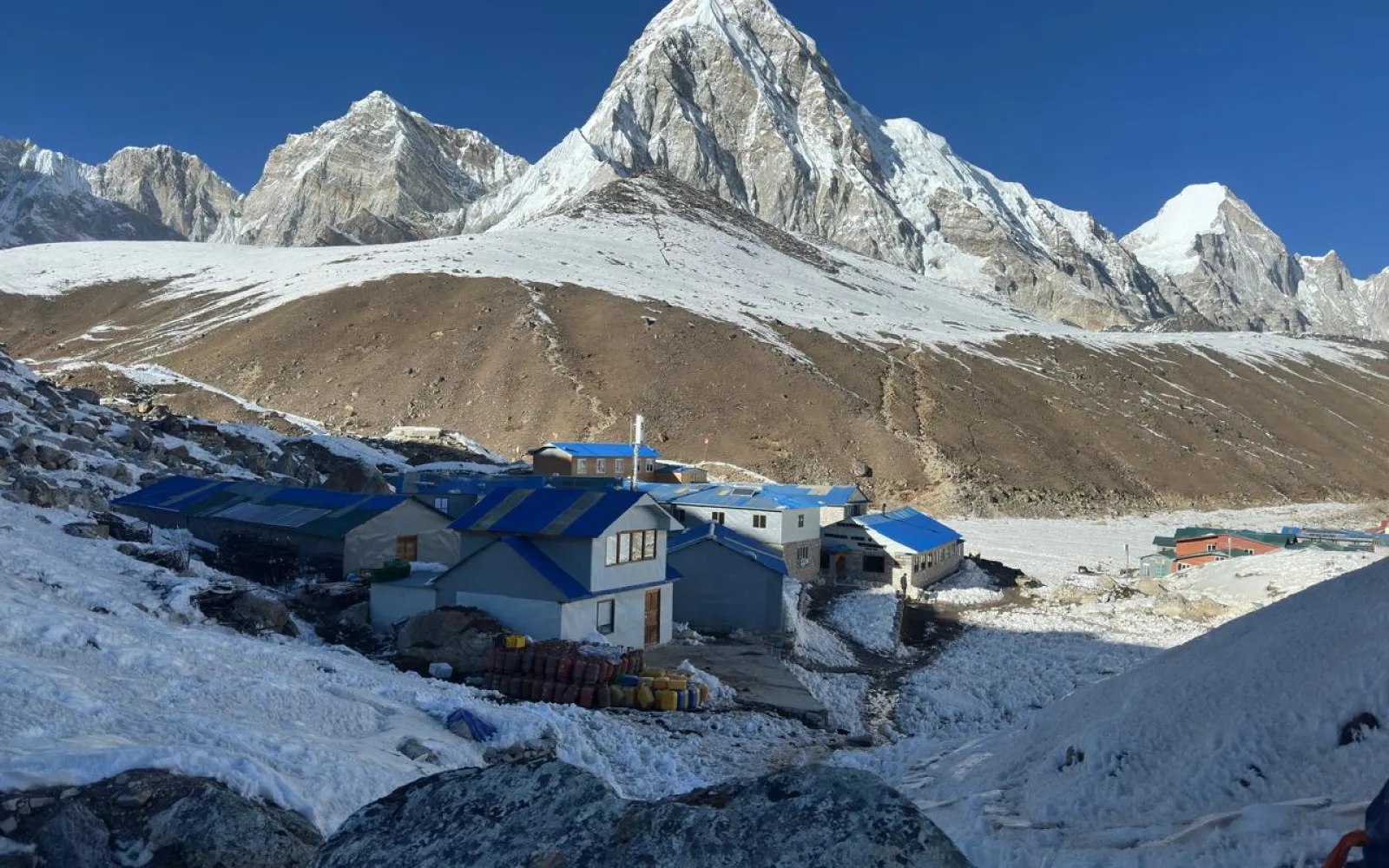
Yes, it is possible to trek to Everest Base Camp in winter (including December, January and February). Good preparation, appropriate gear and a changeable travel plan are essential as the weather can worsen and the trek becomes more demanding with increasing altitude.
Whilst the Everest Base Camp trek is generally less busy in winter than in spring and autumn, it can offer a calmer atmosphere and beautiful snowy scenery. Mountain views are frequently good too if the weather is favorable.
As well as being less busy in winter, trekking in Nepal can also present difficulties. Above Namche Bazaar, for example, trekkers may face issues such as snow, ice, and high winds. Reduced daylight hours can also impact on treks.
Whilst January is typically the coldest month in the Everest region, December and February may be marginally more favorable for trekking.
However, temperature and weather will differ depending on altitude and so it is not always safe to assume that February will consistently be milder and easier than January.
As well as cooler temperatures, in winter certain parts of the trek can become iced. Furthermore, both the number of trekkers and the operation of teahouses can be impacted by the season.
Winter considerations and what they involve
Temperature Significantly reduced temperatures, especially above the village of Dingboche Snowfall
There can be snowfall – particularly at higher altitudes
Trail Paths, stones and areas can be iced and/or covered in snow
Daylight
Shorter trekking hours so earlier departures may be necessary Teahouses Whilst some may close or only partially operate Mountain views Very often good where the weather is favorable.
However, this is by no means assured. Flights into Lukla disruption or non-operation can occur as a result of reduced visibility and unfavorable weather.
How to Prepare for a Winter Trek
Good preparation is key when trekking to Everest Base Camp in winter. Appropriate clothing, gear and a degree of adaptability are all important in response to the weather.
Clothing: Thermal undergarments, fleeces and down insulated jackets together with gloves and a warm head covering should all be taken.
Footwear: Good quality waterproof hiking boots should be worn. Additional grip can also be beneficial where there is ice.
Sleeping: As rooms in teahouses are often not heated, a suitable sleeping bag is advisable.
Adaptability: Extra time should be allowed for any weather related disruption, reduced speed and/or travel plan amendments.
Altitude: Ascend gradually and allow for suitable acclimatization days.
Insurance: Ensure that your insurance policy allows for high altitude trekking and helicopter rescue, as appropriate for your trip.
In fact, Haven Holidays Pvt. Ltd. recognizes the logistical issues associated with the Khumbu trek and seasonal factors. Our local experts can advise on how best to tailor an individual’s travel arrangements, including places to stay and daily treks, to fit in with prevailing winter conditions.
Now, this article explores the nature of the trek to Everest Base Camp in December, January and February. Monthly weather, temperature, snowfall, accommodation, safety and preparation are all discussed.
Whilst it is possible to trek to Everest Base Camp (at 5,364m), this can be a more challenging experience than in spring and autumn. An individual’s capability to trek to Everest Base Camp will be influenced by prevailing weather and trail conditions, together with their own level of physical fitness and acclimatization.
While the typical trek generally commences in Lukla and continues via Phakding, Namche Bazaar, Tengboche, Dingboche, Lobuche and Gorakshep, winter can cause certain elements of this to be more arduous.
Compared to upper areas, the Lukla-Phakding-Namche Bazaar section of the trek is usually less prone to regular snowfall. Nevertheless, dark forest tracks, stone stairways and moist areas can become iced – especially in the morning.
Above Namche Bazaar, the environment is typically more open and temperatures will usually decrease with increasing altitude. The journey to Tengboche comprises forest tracks, bridges and steep areas. Beyond Dingboche, the terrain becomes even more open and is further exposed to chilly, breezy conditions.
Approaching Gorakshep and then Everest Base Camp can be especially difficult following periods of snowfall. The track involves uneven, stoney areas. Again, snow and/or ice can impede a trekker’s speed and also heighten the likelihood of them losing their footing.
Locations and winter weather conditions
Places| Approximate altitude | Estimated winter conditions
Lukla | 2,860m Cold temperatures; sporadic frost and/or snow
Phakding |2,610m | Generally less exposed to snow. Nonetheless, dark tracks can become iced, particularly in the morning.
Namche Bazaar |3,440m |Chilly temperatures; sporadic snowfall Tengboche
3,860m |Iced dark forest tracks; plus frost and/or ice
Dingboche |4,410m |Open, breezy environment; and cold temperatures
Lobuche| 4,910m| Very cold temperatures; and/or iced tracks
Gorakshep |5,164m |Brutely cold; iced ground; and/or snowfall
Everest Base Camp |5,364m Exposure to cold; stoney and iced terrain; and/or snowfall
Note: Altitudes are given as approximate values. Winter conditions can also fluctuate greatly from day-to-day.
Which Sections of the Winter Trek Need Special Attention?
Certain areas of the trek can demand heightened care as a result of openness, unevenness and/or altitude. Above Dingboche in particular, both colder temperatures and less wind protection exist.
Namche to Tengboche: The track involves forest tracks, stone stairways and open areas. Additionally, iced ground can cause dark tracks to become iced – again particularly in the morning.
Tengboche to Dingboche: After passing through Pangboche, the terrain progressively becomes more open. People may also recognize that both wind strength and cold intensify as altitude increases.
Dingboche to Lobuche: The environment becomes progressively drier. Furthermore, the track involves stoney areas around the Thukla area. Cold winds and/or snow can further complicate this part of the trek.
Lobuche to Gorakshep: This high altitude section comprises uneven glacial land and stoney areas. Once again, snow and/or ice can impede travel speed. Careful foot placement is also important.
Gorakshep to Everest Base Camp: The last leg of the trek involves travelling along a rugged track across glacial moraine. Given that conditions can alter rapidly, it is good to seek local advice before undertaking this stage.
Whilst the season and volume of snow are both factors, it is also important for a guide and/or local lodge operators to evaluate current conditions before progressing to higher altitudes.
Influencing Factors
Factor | Relevance
Snowfall | Heavy snow can obscure the track and cause trekkers to encounter difficulties
Ice | Ice can heighten the likelihood of someone slipping or falling
Wind and visibility | Open areas can become unsafe if there are high wind speeds and/or poor visibility
Teahouses | Where teahouses are closed, overnight stays may need to be re-arranged
Fitness level | Both physical tiredness and altitude related issues can influence a person’s trekking capability Acclimatization | Gradual ascent can help avoid altitude related sickness
Local advice | Guides and lodge operators can share valuable information regarding up-to-date track conditions
Importantly, a knowledgeable local guide can evaluate conditions, adapt trek times and suggest alternative routes where necessary. Despite this, a guide cannot wholly mitigate against winter specific concerns and there is no assurance that Everest Base Camp will necessarily be reachable.
Actually, should snowfall, ice or visibility prevent safe travel, it may be necessary to pause, amend your travel plans or even retrace your steps. Even with expert guiding and adequate preparation, there is no absolute assurance that Everest Base Camp can be reached. Safety should always be the priority.
Who can trek in the Everest region in winter?
Those able to undertake lengthy treks, and who are able to cope with cold and variable mountain conditions, can all trek in the Everest region in winter. Previous trekking and/or high-altitude experience is useful as treks can often need to be walked more slowly in winter.
Actually, suitably prepared novices can also trek in the Everest region in winter. Good acclimatization, together with professional guidance and sufficient contingency time for bad weather, will further aid novices’ confidence in high altitude trekking.
Whilst not suitable for everybody, winter trekking can prove unsuitable for those who do not cope well with cold conditions or who prefer more consistent travel conditions.
Consequently, it is important to evaluate your fitness, experience and suitability for simple mountain lodgings prior to deciding upon a winter trek.
Who is well suited to winter trekking?
People with trekking experience – may be more at ease with lengthy treks, ascents and variable conditions.
Physically prepared novices - can trek in the Everest region in winter if suitably prepared, with a progressive trek plan and professional guidance.
Those able to be flexible – are better placed to incorporate extra days in their plans to allow for bad weather and potential alterations.
Cold weather trekkers – may find it easier to cope in winter if they are accustomed to and can use thermal clothing and sleeping arrangements.
Responsible trekkers – are better placed to retreat from the trail if conditions become unsafe.
Consider your capacity for trekking for around 5-7 hours per day. Even though physical fitness is important, good acclimatization is still key in preventing altitude illness.
What is different about trekking in winter?
Compared to spring and autumn, winter trekking in the Everest region is less busy in many places. Nevertheless, colder temperatures, together with the potential for snow, mean that further preparation is required.
Generally, the main trek route has more visitors in spring and autumn. Moreover, during winter, some lodge owners and employees may relocate to lower altitudes. As a consequence, there can be fewer lodge options in certain locations.
Furthermore, shaded areas can continue to be covered in ice even after sunrise. Consequently, trekkers may come across icy stairways or patches of ice, even if the surrounding environment appears dry.
Winter v Spring and autumn
Trek factor | Winter | Spring and autumn |
Level of trek busyness| Generally less busy| More busy (particularly in peak months)
Temperature| Much colder, particularly at night| Generally more moderate
Potential for snow and ice |Increased likelihood of treks being icy or covered in snow| Occasionally at higher altitudes, depending on the weather
Availability of lodgings| Some may close or reduce facilities |Generally greater range of lodgings is available
Mountain views| Potentially excellent on sunny days| Often good, but not always
Length of daylight |Shorter days| Longer days
Preparation for trekking| Greater emphasis on cold weather preparation |More standard trek preparation
Flexibility| Especially important due to potential for bad weather and alterations in lodgings| Still important, but winter can pose further obstacles in this area
What to consider when trekking in winter
Ensure that you can complete daily treks before evening temperatures fall.
Investigate lodge availability both prior to and during your journey towards higher villages.
Utilise thermal clothing as temperatures can fluctuate between sunny and shaded areas.
Include contingency days in your plan to allow for impacts of snow and flight delays on your travel.
Obey local recommendations regarding sections of the trail which may be adversely affected by snow and/or ice.
Whilst neither better nor worse than spring and autumn, winter is a distinct season for trekking. Consequently, your preparation should be appropriate for the season.
December, January and February can all be used for a winter trek to Everest Base Camp. Nonetheless, the weather can differ between these months. December is the start of winter. January is typically the coldest month and February then begins to transition into spring.
Meanwhile, your cold tolerance, trekking experience and flexibility will all influence which month is best for you. Consideration should also be given to snow, lodge availability and flight delays.
Everest Base Camp Trekking in December
As the start of winter in the Everest region, temperatures steadily decrease throughout December. Initial months can therefore provide reasonably good trekking conditions. Nevertheless, high altitude areas continue to be very cold.
Mountain views can be excellent when the weather is good and the generally less busy nature of the trail provides a calmer atmosphere. Nonetheless, there is potential for snowfall and this is likely around places such as Dingboche, Lobuche and Gorakshep.
Furthermore, lodge availability must be investigated as some may scale back or even close for the winter. This is particularly pertinent towards the end of December as numbers of trekkers may also diminish in the upper reaches of the Khumbu region.
What to expect in December
Weather Generally cold and increasingly wintery, particularly towards the end of the month.
Mountain views Mountains can be clearly viewed on good days. However, as with all mountain regions, cloud cover and/or snow can occur.
Snow Potential for snowfall. Again, this can differ from year to year and is more likely at higher altitudes.
Level of busyness Generally less busy than in spring and autumn trekking months.
Lodging Availability can be restricted as some lodges may reduce or cease operations. In advance, it is therefore good to investigate options.
Trek conditions Morning frost and sporadic ice can influence trekking.
Providing trekkers wish to experience a less busy trek prior to the height of winter, early December can be suitable. Despite this, travelers must still prepare for very cold conditions as even above Namche Bazaar, conditions can be tough.
Everest Base Camp Trekking in January
Generally, January is the coldest month in the Everest region and so can present one of the most challenging times to trek to Everest Base Camp in winter. Night-time temperatures can often plummet well below freezing and this is especially the case around Lobuche and Gorakshep.
Moreover, snowfall and ice can further complicate trekking in higher regions. For example, the rocky trail between Lobuche and Gorakshep can become slick if snow or ice forms on uneven ground.
As previously mentioned, lodge availability can also be an issue as some may close or reduce facilities. Thus, it is advisable to establish which lodges will be open for you to stay in prior to departing lower villages.
What to expect in January
Weather- Usually the coldest of all winter months.
Night-time temperatures- Frequently very cold at Dingboche, Lobuche and Gorakshep.
Snow- Potential for snowfall. Higher altitude areas are especially susceptible to winter weather.
Level of busyness- Much quieter than in peak trek months.
Lodging- Similar to above, availability can be restricted.
Trek conditions- Snow, ice and frost can all contribute to a slower, more challenging trek.
In conclusion, well experienced and suitably prepared trekkers are best placed to trek in January. Individuals must be able to tolerate extreme cold and be adaptable. Good quality sleeping arrangements and professional support are also particularly important.
Everest Base Camp Trekking in February
Although still a winter month, February sees temperatures in the Everest region begin to rise towards the end of the month. Furthermore, although the first half of the month can still be very cold, later months may provide marginally more tolerable daytime temperatures.
Meanwhile, good visibility and snowy mountain backdrops can make February a pleasant month in which to trek. Nevertheless, as in other winter months, snowfall, wind and icy areas can occur, particularly at higher altitudes.
In fact, late February is also the period in which the trek transitions into spring. Despite this, spring-like conditions should not be expected along the whole trek as night-time temperatures remain low and higher altitude locations can still be affected by winter weather.
What to expect in February
Weather Continued cold, although there may be a steady warming trend towards the end of the month.
Mountain views Clear days are possible. Yet, as with all mountain regions, weather can be unpredictable.
Snow- Potential for snowfall.
Level of busyness- Usually less busy than in spring, although numbers may increase towards the late month.
Lodging- Again, this will depend on both lodge policy and seasonality.
Trek conditions- Frost and snow can persist and so trekking can be affected. Again, this is more likely at higher altitudes.
In summary, February can be a good choice for those wishing to trek in a less busy environment and also to move towards the spring season. As such, trekkers should still utilize full winter clothing and check local conditions prior to setting off.
Which winter month should You Choose?
Whilst there is no definitive ‘best’ month for a winter trek to Everest Base Camp, December, January and February each have their own benefits and difficulties.
December may be appropriate if you wish to:
Experience a less busy trek prior to the height of winter.
Enjoy good mountain views where weather conditions are good.
Undertake a distinctive winter trek. Plus, there can still be good flexibility in early months.
January may be appropriate if you want to:
Experience the most tranquil winter trekking conditions.
Undertake a challenging trek having suitably prepared for cold weather.
Experience further solitude (provided that lodge and trek conditions are suitable).
February may be appropriate if you want to:
Experience a winter trek which is also approaching spring.
Benefit from a steady warming of temperatures towards the end of the month.
Experience a relatively less busy trek ahead of the more hectic spring trek season.
Comparison of winter months
Aspect| December| January| February
Temperature | Very cold | Generally coldest |Gradually warming towards end of month
Snow| Potential |Potential for heavier snowfall
Potential Level of busyness| Low| Very low| Low to moderate Lodging availability| Variable| Potentially more restricted |Variable
Trek conditions| Weather dependent| Often more challenging| Weather dependent
Preparation for trek |Full winter clothing |Strong cold weather preparation |Full winter clothing
Important, please note that this is general seasonal information experienced by our team in the field. Snow, temperature and lodge availability will depend on local weather and on business decisions.
In conclusion, many travelers may wish to trek in either early December or late February. But again, there is no guarantee that these months will necessarily be less demanding. Your chosen month should depend on your experience, cold tolerance and flexibility.
Winter weather in the Everest region is typically associated with cold nights and mornings, the potential for snowfall and brisk winds, particularly at higher altitudes. Although many days can be dry in winter, weather can rapidly alter as different weather systems affect the mountains.
Actually, temperatures will also depend on altitude, sunshine and wind speed. Even though sunny days in lower villages (such as Lukla and Namche Bazaar) can be reasonably warm, shaded areas can be markedly cooler. This is particularly the case in December and January.
As you trek on to Dingboche, Lobuche and Gorakshep, temperatures generally fall further and the environment becomes more exposed. Suitable clothing is therefore necessary to counteract both low temperatures and wind-chill.
Daytime temperatures – lower and higher altitudes
Generally, sunny days in lower villages can provide relatively temperate daytime temperatures. However, as mentioned above, both mornings and shaded areas can be cool. Again, this is especially true in December and January.
Above Tengboche, temperatures become even colder. Moreover, exposure and wind can combine to create unpleasant circumstances, even for brief periods of rest in areas such as Dingboche and Lobuche.
Meanwhile, it is also important to recognize that the human body generates heat through physical exertion. Therefore, once you stop for lunch or to take photographs, for instance, your body can rapidly lose heat. This is further exacerbated if your clothing is moist from perspiration.
Typical daytime temperatures
Location| Approx. altitude| Indicative winter daytime temperature
Lukla| 2,860m| 5-10°C
Namche Bazaar| 3,440m| 2-7°C
Tengboche| 3,860m| 0-5°C
Dingboche| 4,410m| -5-3°C
Lobuche| 4,910m| -8-0°C
Gorakshep| 5,164m -10--3°C
Kindly, bear in mind that these are only indicative temperature ranges for planning purposes. They are not actual mean temperatures and are not guaranteed. In fact, temperatures can often be even lower, especially if there is snow, cloud cover and/or wind.
How to remain comfortable when trekking in winter
Wear a ‘wicking’ base layer so that you can effectively manage perspiration whilst ascending.
Add a fleecy or thermal middle layer for added warmth in cooler weather.
Use a waterproof and windproof outer layer for extra protection in exposed areas.
Ensure that you have access to warm gloves, hat and neck covering.
Alter your layers as necessary during trekking so as not to sweat too much.
Don an insulating jacket when resting for extended periods as your body loses heat when you are not moving.
As conditions can swiftly alter, good layering facilities are especially valuable when trekking. Although you may feel sufficiently warm whilst ascending towards Namche, for example, extra thermal protection will be required if you are resting in an exposed area.
Night-time temperatures – higher altitudes
Night-time temperatures can often plummet well below freezing in higher villages along the Everest Base Camp Trek. Again, altitude and exposure are key reasons why Dingboche, Lobuche and Gorakshep are particularly cold.
Indeed, in Gorakshep for example, it can be so cold that even simple tasks such as leaving your bed or walking to the dining room can be uncomfortable. Water bottles can also freeze and, despite the provision of blankets, unheated bedrooms can be extremely cold.
In addition to, good quality sleeping bags and thermal clothing are therefore essential. Although some lodges do provide blankets, these can differ in both availability and warmth. Hence, travelers should not solely rely on lodge provision for warmth.
Indicative night-time temperatures
Location| Approx. altitude| Indicative winter night-time temperature
Lukla| 2,860m| -5-0°C
Namche Bazaar| 3,440m| -8--3°C
Tengboche| 3,860m| -10--5°C
Dingboche| 4,410m| -15--10°C
Lobuche| 4,910m| -18--12°C
Gorakshep| 5,164m| -20--15°C
As with the day-time temperatures, these are only indicative ranges for planning purposes. Actual night-time temperatures can be even lower and will again depend on prevailing weather conditions.
How to stay warm at night
Sleeping bag- Ensure that you have a sleeping bag which is rated for winter and appropriate for anticipated temperatures.
Thermal clothing- Sleep in dry base layers and thermal socks.
Insulating jacket- Have your down sleeping jacket to hand for extra warmth on cold night-time and early morning occasions.
Gloves and hat- Use these for added warmth when exploring the lodge or using the toilet during the night.
Dry clothing -Change out of damp trekking clothes.
Warm drinks- Ensure that you drink sufficient fluids during the day. Then, take advantage of warm drinks where these are available.
Cold night-time temperatures can interfere with both sleep and subsequent recuperation, particularly after lengthy trekking days. Therefore, suitable lodgings and sleeping provisions should form part of your winter preparation.
Wind, sun and Changing Winter Weather
Wind can greatly enhance the perception of coldness that is felt, even if air temperatures are not extremely low. Such wind-chill is especially prevalent in exposed locations including those around Dingboche, Lobuche and Gorakshep.
Although daytime sun can provide some source of heat, this does not eliminate the potential for cold weather and/or abrupt weather changes.
In addition, cloud cover and/or snow can hinder views, particularly in exposed locations, and so it can be more challenging to recognize the correct section of track.
Furthermore, trekkers should also take care of their skin and eyes as bright sunlight and reflected light from snow can be discomforting. Sunglasses, sunscreen and lip balm are all beneficial for use throughout the winter trek.
Managing winter weather
Wind- Wear a windproof outer jacket, especially in exposed locations.
Sun -Apply sun cream and wear sunglasses offering UV protection.
Snow reflection- Wear suitable sunglasses when travelling on snowy areas.
Dryness- Lip and skin health can be maintained with the use of lip balm and moisturizer.
Changing visibility- Adhere to your guide’s recommendations and avoid advancing into unsafe situations.
Cold pauses- Don an insulating layer prior to longer rest periods.
Here, mountain weather can change rapidly in winter. Thus, in addition to reviewing the weather forecast, local on-trail information and regular contact with guides and lodge personnel are also key in determining whether or not to continue trekking.
Does it snow on the Everest Base Camp Trek in winter? And how is the trail?
It can snow on the Everest Base Camp Trek in December, January and February. Again, this is not likely to occur year-round and can therefore differ depending on prevailing weather conditions.
Whilst the lower trails around Lukla and Phakding may not be badly affected by snow, there is the potential for snow and for ground to freeze further up the trail, for example at Dingboche. Hence, trekkers should be prepared for variable conditions.
Snow and freezing
Namche Bazaar – occasional snow and shaded freezing ground.
Tengboche – frost and potential snow.
Dingboche – sections of snow and exposed freezing ground.
Lobuche – increased likelihood of both snow and freezing.
Gorakshep – freezing ground and potential for snow.
Everest Base Camp – snow and ice. Ground can also be uneven and made of moraine (rocky debris) from glaciers.
Walking on icy and snowy ground
Walking on icy and/or snowy ground is often one of the key issues relating to winter trekking. Stone steps, shaded and rocky ground can all become icy and so trekkers may wish to pace their walking accordingly, particularly in the morning.
For example, the track from Lobuche to Gorakshep involves walking over uneven rocky ground. Snow and ice can then further impact on ground stability. Appropriate footwear and cautious walking are therefore important.
Essential gear and tips
Wear waterproof and well supported trekking shoes which also have good traction.
Consider using microspikes if conditions indicate that these might be of use.
Employ trekking poles to assist with balance.
Walk at an appropriate speed and avoid hurriedly crossing icy areas.
Obey your guide’s suggestions regarding any route changes or decisions to return.
Ensure that extra socks are kept dry as dampness causes discomfort when it is cold.
In addition to, microspikes can effectively be used for walking on appropriate icy ground. However, they cannot replace specialist mountaineering gear for steeper and more challenging ground. It will be up to your guide to evaluate conditions and so determine if extra gear for better traction is suitable.
Can bad weather and/or snow affect trekking?
Heavy snow, strong winds and/or poor weather can all impact on, and even cause temporary closure of, trekking in the Everest area. Such weather can specifically influence travel to and from Gorakshep and Everest Base Camp. Furthermore, Lukla flights can also be impacted by poor weather.
Weather related impacts on trekking
New snow can obscure trail signs and also cause trekkers to walk more slowly.
Ice can develop and so render steep and/or exposed ground hazardous.
Poor weather can hinder navigation.
Strong winds can further expose trekkers to cold, especially at higher altitudes.
Lukla flight cancellations can in turn influence both arrival and departure times.
Furthermore, if teahouses are closed then alternative sleeping arrangements may need to be sought.
More importantly, local guides, lodge owners and trekking agencies can often provide valuable information relating to recent snowfall and trail conditions. Yet it is impossible to ensure that the trek will always be open during your planned period of travel.
Whilst it is important to endeavor to reach Everest Base Camp, safety is of prime concern. Thus, if conditions become unsafe it is appropriately for trekkers to decide to wait, to modify their travel plans or to return.
Benefits of winter trekking
Compared to the busier spring and autumn months, winter provides trekkers with a different experience. Despite the cold and potential for snow, suitably prepared individuals can appreciate the tranquil nature of the trails, alongside the stunning Himalayan views.
Lower levels of trekkers
Generally, there are fewer trekkers travelling in the winter compared to spring and autumn. Consequently, villages such as Namche Bazaar, Dingboche and Lobuche can be calmer, especially in January.
Here, this can enable trekkers to more fully appreciate the area. Nevertheless, numbers can again increase around holiday times and in good weather.
Advantages of lower trekkers volumes
Experience a more tranquil environment in the Khumbu region.
Devote greater time to appreciating Himalayan and village scenery.
Avoid some of the busier trail conditions that can exist during peak periods.
Enjoy a calmer setting within select teahouses and restaurants.
Whilst there may be fewer trekkers, this does not always equate to improved facilities. During the winter, some lodges may even choose to close. Hence, villages can also suffer from a reduction in facilities.
Magnificent Winter Himalayas
Sections of the Khumbu region are beautifully presented in the winter.
White-capped mountains, frosted rivers and snowy ground all create very different vistas to those seen in the spring and summer.
Where possible, trekkers can also view Everest, Lhotse, Nuptse and Ama Dablam. Moreover, villages including Tengboche, Dingboche and Lobuche frequently present particularly handsome sights post-snowfall.
Winter highlights
White topped mountains encircling the Khumbu Valley.
Traditional Sherpa villages in front of impressive Himalayan backdrops.
Frosted rivers and sections of the trek.
Magnificent views of Ama Dablam from various points along the trail.
A special wintry ambience at Tengboche Monastery.
Whilst the mountain views can be superb, these can sometimes be affected by cloud cover and/or snow. Hence, trekkers should value the winter Himalayan views, but should not expect consistently unimpeded sight lines.
More tranquil teahouses
Again, lower volumes of trekkers can result in a more tranquil environment within some teahouses. Trekkers can then often more easily engage in conversation with lodge owners and further experience local hospitality. This can in turn facilitate greater insight into the day-to-day lives of the Khumbu region.
Additionally, restaurant areas may be less busy than in, for example, October and April. However, again, some lodges provide lessened facilities and/or may even close. Higher altitude lodges are particularly susceptible to this.
Expectations for winter teahouses
More relaxing restaurant settings.
Enhanced scope for interaction with lodge owners.
Potentially fewer sleeping options at particular villages.
Hot water and heating provision may be restricted at some lodges.
Rooms can also be chilly, particularly at higher altitudes.
Prior to your trip it is advisable to verify which teahouses will be open. Local guides and/or trekking agencies can often assist with this and can also advise on suitable places for overnight stays.
An alternative Himalayan adventure
Winter can provide a unique method of exploring the Everest area. It is an especially appealing option for trekkers who favor more tranquil environments and who are able to tolerate cold conditions. Compared to the busier spring and autumn months, the winter trek can often feel more secluded and peaceful.
Nevertheless, winter trekking does demand trekkers to be patient. Weather, icy ground and flight impacts can all influence day-to-day travel. Successfully navigating these issues can form a highly enjoyable aspect of a Himalayan adventure for suitably prepared trekkers.
Reasons for EBC winter trekking
Trekkers favor a more tranquil environment and lower volumes of fellow trekkers.
They wish to witness wintry Himalayan views.
They relish undertaking demanding outdoor activities, even in cold weather.
They have adaptable travelling dates and so can accommodate weather related delays.
They desire to explore the Khumbu region outside of peak times.
Although winter is not necessarily the optimal travelling time for all people, especially those new to trekking who are not confident in cold environments, with suitable preparation, local advice and adaptable travel plans, it can offer an exciting alternative to the usual trekking seasons.
7. Are Teahouses and Lodges Open and Are Flights Available in Winter?
Whilst accommodation, food and transport are usually available for the Everest Base Camp Trek in winter, these can be more restricted in comparison to those available in spring and autumn.
Again, whilst many teahouses are open in winter, some higher altitude lodges may also close due to both lower numbers of trekkers and colder weather.
Prior to a winter trek, it is advisable to investigate what accommodation, transport and facilities are available. A local trekking agency can assist with this. They can investigate which lodges are open in winter and then suggest suitable places to stay on your trek.
Are Teahouses Open?
Many teahouses are open in winter in villages such as Phakding, Namche Bazaar and Tengboche. However, there is often a smaller range of accommodation available at Dingboche, Lobuche and Gorakshep, especially in January.
Whilst some lodge owners and workers descend to a lower altitude during the coldest months, others continue trading albeit with restricted facilities. Thus, not all lodges displayed on a trekking map can be assumed to be open for business in winter.
Winter Accommodation
Location |Winter accommodation| Details to check
Lukla| Usually a number of accommodation options| Rooms and flight information
Phakding| Often some lodges are open |Heating and food provision
Namche Bazaar| Usually a good range of accommodation options |Rooms and hot showers
Tengboche| Fewer options than Namche| Information on accommodation
Dingboche| Possibly some lodges are open with restricted facilities| Open lodges and food provision
Lobuche| Limited accommodation options| Confirm accommodation availability from Dingboche
Gorakshep| Very limited accommodation options| Confirm accommodation availability and current circumstances
Accommodation Tips
Try Learning where you will be staying, especially at higher altitudes.
Ascertain whether blankets, food and electricity points are provided.
Find out if hot showers are available – note that water pipes and taps can freeze.
In addition to lodge-provided blankets, take a suitable sleeping bag.
Be prepared for accommodation availability to differ from your expectations.
Importantly, a local guide can also liaise with lodge proprietors to investigate their accommodation provision. This is especially beneficial on the section of trek between Dingboche and Gorakshep as the number of open lodges can be restricted and thus affect available accommodation.
Food and Water Provision in Winter
Generally, food can still be obtained from open teahouses. Nevertheless, the range on offer may be more restricted. Most lodges serve similar trek food, for example dal bhat, noodles, fried rice, potatoes and porridge.
As it is a good source of carbohydrates, dal bhat is often served and can even be served on a refilling basis. However, food provision can become more restricted at higher altitudes.
Therefore, if you have particular dietary requirements, it is advisable to convey these in advance to lodges.
Typical Winter Food
Dal bhat (rice, lentils and vegetables).
Vegetable or noodle soup.
Fried rice and boiled potatoes.
Porridge, pancakes and eggs (where available).
Tea, coffee and other hot drinks.
Water provision also needs consideration. Water pipes and taps can freeze in extremely cold weather. It is, therefore, important to ensure that safe water is provided by your accommodation. Appropriate water treatment should also be carried out where needed.
Therefore, a re-usable water bottle should be taken. An insulated version can also be beneficial to avoid water freezing. Furthermore, never drink untreated water from streams as clear mountain stream water is not always safe to consume.
Are Flights to Lukla Available in Winter?
Generally, flights to Lukla are available in winter, subject to favorable weather and operating conditions. However, poor weather, including cloud cover, high winds and poor visibility, can result in flight delays and cancellations.
Depending on the season and airline, flights can originate from either Kathmandu or Ramechhap. Furthermore, the take-off airport may alter depending on operating circumstances. Hence, it is important to verify current information prior to travel.
Factors That Can Impact Lukla Flights in Winter
Low cloud cover- Poor visibility can hinder safe flight operations.
High winds- Can cause flight delays and cancellations.
Snowfall- Can impact both airport and flight operations.
Changing weather conditions- can result in altered flight timetabling.
Operating factors- Can influence flight departures.
Aircraft availability- can lead to revised flight timetables following disruption.
Preparing for Potential Flight Issues
Wherever possible, allow for one or two extra days in your program.
Avoid arranging an international flight directly after your intended return date from Lukla.
Ensure that you are aware of your flight details and take-off airport.
Pack hand luggage containing key medication and valuables.
Obey airline and airport instructions during flight delays.
Although a trek can still proceed despite flight delays, such delays can impact a traveller’s programme. Thus, adaptable planning is especially important in winter.
Other Facilities and Items to Investigate
Whilst basic facilities are often accessible from open teahouses, these can be less consistently available at higher altitudes. Extra charges may apply for electricity, and both electricity provision and hot showers can be subject to time restrictions. In addition, extreme cold can also impact facility provision.
Generally, heating is provided in shared areas such as dining rooms. As such, it is important to be prepared for cold rooms, particularly at Lobuche and Gorakshep.
Winter Facilities and Items
Facility/Item | Expectation
Electricity | Generally available in lodges. Additional charges may apply for electricity point use.
Wi-Fi |Provision can be inconsistent and is not always dependable.
Hot showers | May not be available or may be restricted at higher altitudes.
Heating |Usually provided in communal areas.
Mobile phone signal | Signal strength can vary along the trek.
Drinkable water | Safe water provision should be organised or water should be treated.
ATMs | Access to these is not possible, particularly beyond Namche.
Meanwhile, given that card payment and ATM access become progressively more restricted beyond Namche Bazaar, it is advisable to take sufficient Nepalese currency.
Also, pack key personal items including toiletries, medication and power banks. Further, bring any specialist items that you may require.
Generally, most of the standard trek can be travelled in winter and suitable facilities are accessible. However, these should never be presumed. Advance investigation into both transport and accommodation is a good way to facilitate a trek.
8. Is the Everest Base Camp Trek Safe in Winter? What are the Main Issues?
It is possible to trek to Everest Base Camp in winter. However, extra care is needed due to cold weather, snow and icy tracks.
Although good preparation and local guidance can enhance safety, winter weather can be highly changeable and sometimes necessitates alterations to a programme.
Here, cold weather, altitude sickness and safe navigation over potentially icy pathways are key areas of concern for trekkers. Therefore, it is important to be aware of these issues and then to act in accordance with both your physical state and prevailing track conditions.
Risk of Altitude Sickness
As well as in other seasons, altitude sickness can occur in winter. Greater altitude equates to a reduction in available oxygen, irrespective of external temperature.
Common symptoms of acute mountain sickness include headaches, sickness, light-headedness and tiredness. As such, if a trekker experiences these symptoms, they should notify somebody even if they feel that they may simply be suffering from cold or fatigue-related issues.
Common Symptoms of Altitude Sickness
Issue | Possible indicators | Action to take
Mild AMS | Headache, sickness, light-headedness and/or tiredness |Cease ascending, Rest and observe symptoms| Progressive AMS| Increasing headache, vomiting and/or increasing weakness, Obtain medical evaluation, Do not continue ascending.
Possible HACE| Confusion, aberrant behaviour, extreme sleepiness or unsteady walking |Receive emergency aid and descend immediately.
Possible HAPE| Difficulty breathing at rest, a persistent cough, a feeling of chest tightness and/or extreme tiredness |Receive emergency aid and descend immediately.
Meanwhile, both HACE and HAPE can be life threatening and so prompt medical intervention is vital. Should severe symptoms occur, there should be no delay in seeking help and ascending to the next village should not be attempted.
In addition to, good acclimatization is especially crucial for trekkers travelling on the Everest Base Camp winter track.
Moreover, most standard programmes incorporate acclimatization days at and around Namche Bazaar and Dingboche. These allow trekkers to adapt incrementally to higher altitudes.
Altitude Safety
Ascend gradually and do not rapidly increase the altitude of your sleeping area.
Include appropriate acclimatization days within your program.
Trek at a comfortable speed and refrain from over-exertion.
Ensure that you drink and eat sufficiently.
Immediately advise your guide of any altitude-related concerns.
Never ascend if experiencing worsening altitude sickness symptoms.
Whilst cold weather does not protect against altitude sickness and good physical health does not ensure total immunity, established altitude safety practise should be adhered to. Moreover, professional medical advice should be sought if altitude sickness occurs.
Risks of Hypothermia and Frostbite
Hypothermia and frostbite are further key concerns for trekkers in cold weather. Hypothermia results from a person’s body temperature falling below its ability to generate heat. Frostbite is the freezing of body tissue.
Actually, extended periods of time in cold, damp and/or windy environments can increase the risk of hypothermia and/or frostbite. For instance, a trekker may feel relatively cozy during an ascent, yet become extremely cold if they stop in an open area and become wet.
Signs of Cold-Related Issues
If hypothermia is suspected, the affected person should be relocated to a sheltered area. Wet clothing should then be removed and the person gently warmed. At the same time, urgent medical aid should be arranged. Do not massage or apply intense heat to frostbitten areas.
Reducing Cold-Related Risks
Wear appropriate clothing comprising moisture-absorbing under-layers and thermal protection.
Take waterproof gloves and warm socks and wear a suitable head covering.
Store additional clothing in waterproof bags to keep it dry.
Protect bare skin from extreme cold and wind.
Replace damp clothes during extended halts.
Consume food regularly and drink sufficient liquids.
Be alert to potential cold-related issues and promptly advise your guide.
Good layered clothing is especially useful given that sunny and cold, breezy conditions can both exist on a trek.
However, even with suitable clothing, it is not possible to wholly eradicate cold related risks. Thus, endeavors should be made to avoid lengthy periods in extreme cold and/or wind.
Slippery Track Conditions, Snow and Poor Visibility
Tracks on the Everest Base Camp winter trek can become slippery as a result of snow and cold weather. Stone steps, shady forest tracks and rock faces can all become more hazardous in such conditions.
Areas at higher altitudes, for example at Dingboche, Lobuche and Gorakshep, can also prove especially difficult to navigate. This is due to more exposed and uneven terrain. Moreover, snowfall and/or cloud cover can impair visibility and so complicate track navigation.
Common Winter Track Issues
Ice on shaded pathways and stone steps.
Snow on uneven rocky areas.
Icy places near streams and bridges.
Exposed areas subject to strong winds.
Poor visibility through snowfall and/or cloud cover.
Tips for Safer Trekking
Wear well-gripping and adequately supportive trekking footwear.
Utilize microspikes in locally appropriate icy conditions.
Employ trekking poles for extra stability on uneven tracks.
Trek at a steady pace and avoid speeding down slopes.
Maintain a safe distance from other trekkers on narrow, icy areas.
Obey your guide’s advice regarding navigation when visibility and/or track conditions are adversely affected.
Although microspikes can enhance traction on suitable icy areas, they are not always the most suitable equipment.
Thus, your guide should evaluate local track conditions and then advise which equipment to use when approaching demanding track areas.
Importance of an Experienced Guide and Programme Adaptability
Meanwhile, an experienced local guide can effectively organize a winter trek by assessing track conditions, investigating accommodation availability and modifying daily trekking plans. Furthermore, an informed guide can detect early indications of altitude sickness and facilitate appropriate support.
In addition to, local knowledge is particularly helpful when trekkers’ programmes are affected by snowfall and/or accommodation closure. For example, a guide may contact lodge proprietors prior to departing Dingboche in order to ascertain whether lodges are open for business in Lobuche and/or Gorakshep.
Despite a guide’s efforts, it is not possible to wholly avoid risks and they cannot always ensure that trekkers can be evacuated.
Likewise, travelers themselves must truthfully convey their health status, obey safety advice and be prepared to adapt their program in response to prevailing conditions.
How a Guide Promotes Trek Safety
Checks up-to-date local weather and track information.
Assesses and modifies trekking conditions and departure times.
Monitors trekkers for signs of altitude sickness.
Investigates and arranges alternative accommodation.
Helps to organise communication and facilitate emergency aid.
Advises on when it is most prudent to wait, descend or modify a program.
Why a Program Should Be Adaptable in Winter
Preparation | Reason
Additional days| Allows for Lukla flight delays and weather-related issues.
Acclimatization days| Enables progressive adaptation to greater altitudes.
Appropriate insurance Offers financial security for covered medical and rescue situations.
Emergency contact information Aids in the organisation of support in more remote regions.
Alternative planning Facilitates programme amendment where tracks and/or accommodation are no longer available.
Local guidance Provides updated information on weather and track conditions.
Here, it is important to confirm that your travel insurance provides coverage for trekking at the highest altitude that you will be encountering, as well as for emergency helicopter rescue.
In addition, you should be familiar with your insurance policy’s exclusions, authorization requirements and emergency support procedures. Unfortunately, in all cases, insurance coverage is not automatically provided.
With suitable awareness of the issues involved, winter trekking can prove highly enjoyable. Gradual acclimatization, appropriate cold-weather clothing, local guidance and sound decision making are all more significant considerations than sticking rigidly to a pre-determined program.
9. What to Pack for your Everest Base Camp Winter Trek
Because temperatures can become significantly below freezing at higher altitudes, it is important to pack suitable items. Appropriate clothing and footwear are required, and it is also important to minimize the weight of your pack.
Meanwhile, layering is often a good solution for trekkers. Whilst ascending, you may not feel the need for extra warmth but may require an insulated jacket if you are in a cold or windy area.
Essential Winter Clothing
Your clothing should protect you from cold, wind and sporadic snow. Layering (thermal undergarments, plus insulating and outer garments) is often a more adaptable solution than one heavy garment.
Recommended clothing
Thermal undergarments – to avoid sweat becoming in contact with your skin.
Insulated mid-layer – for extra warmth.
Down jacket – for use in cold morning and evening air and at higher altitudes.
Outer garment – a waterproof and windproof jacket to defend against snow, rain and wind.
Trekking trousers and thermal leggings – for extra warmth.
Several pairs of warm trekking socks – including dry back-up pairs.
Insulated and waterproof gloves.
Warm hat, neck gaiter and balaclava – to protect bare skin.
Actually, layering can be especially beneficial at Dingboche, Lobuche and Gorakshep due to the rapidly fluctuating temperatures and wind. Furthermore, secondary clothing should be stored in watertight bags to ensure it remains dry.
Winter Footwear and Related Items
Appropriate footwear is important as the ground, rocks and pathways can become covered in ice. Ensure that your footwear is waterproof and has good traction. Also, ensure that your socks are sufficiently thick for added warmth.
Essential footwear and items
Waterproof, highly-traction footwear with good ankle support.
Microspikes or other traction devices (depending on the prevailing trail conditions).
Gaiters – to stop snow entering your footwear.
UV-protective eyewear – to minimise glare from snow.
Sunscreen and SPF lip balm.
Trekking poles – to improve stability on uneven and/or icy sections.
Whilst microspikes can be a good solution for certain icy pathways, they are not always essential. Your guide will be able to evaluate the prevailing conditions and so suggest the most appropriate traction solution for you prior to encountering challenging terrain.
Sleeping and Other Items
As the bedrooms in teahouses are typically not centrally heated, it is good practice to bring your own sleeping bag even if some lodges supply blankets. This is because the quality of the latter can vary.
Recommended sleeping and other items
Equipment Type | Reason for needing the item ---
Winter sleeping bag | For warmth in cold, non-heated rooms.
Sleeping bag liner | To enhance warmth and maintain sleeping bag hygiene.
Head-torch | For early mornings and night-time.
Power bank | To charge electronic items.
Thermally-insulated flask | To help prevent water in the flask from freezing.
Personal medication | To ensure that you have access to your usual medication.
Basic first aid | For treating minor injuries and ailments.
Water purification mechanism | To purify water for consumption.
In addition to the above, pack toiletries, hand sanitiser, personal papers and some light food. Daypacks are a good place to store key items such as medication, insurance information and valuables, rather than your main case.
What to Rent and What to Bring With You
There are rental and retail outlets in Kathmandu (especially in the Thamel district) selling trekking equipment.
Consequently, there is no need for you to purchase all of the items that you will require for your winter trek in advance of your Nepal trip.
Nevertheless, it is important to evaluate the quality and insulation properties of rented equipment. Usually, it is preferable to source your own clothing, footwear and medication.
Equipment to Rent/Bring With You
Sleeping bag - Bring or rent a suitable winter sleeping bag.
Down jacket - Bring or rent an appropriately insulated down jacket.
Trekking poles - Bring your own or rent.
Microspikes - Obtain based on prevailing trail conditions.
Thermal undergarments -Bring your own.
Footwear - Bring well-fitting and broken-in trekking footwear.
Personal medication - Bring your own medication.
Sunglasses and sun cream - Bring suitable items.
Before Renting Items in Kathmandu
Confirm the sleeping bag’s temperature rating and evaluate its general quality.
Investigate any faulty zip mechanisms and diminished insulation of down jackets.
Test trekking poles and ensure that their clasp mechanisms function correctly.
If rented footwear is going to be used, establish that it is a good fit with your trekking socks.
Ascertain whether sleeping items are provided as part of your trekking package.
In conclusion, careful planning of your packing list will enable you to remain warm and also to minimize your pack size. Whilst good footwear, dry clothing, insulation and personal safety items should always be given priority, secondary items are often superfluous and so should be limited.
10. How to Prepare and Plan for your Winter Everest Base Camp Trek?
As well as physical preparation, further considerations are required for a winter trek. These include equipment, sleeping arrangements, acclimatization and potential issues with travel. Although good planning can enhance structure, it is not possible to eliminate all mountain related concerns with careful preparation.
Ideally, international trekkers should plan their Nepal trips several months in advance so that they can organize flights, insurance and equipment. Furthermore, extra days can be incorporated into a trip to allow for potential alterations to weather and transport provision.
Setting up a Suitable Winter Trek Route
Your route should enable progressive ascension, allow for good acclimatization and recognize the effect of varying weather. It is also important not to rush your trek as your body must acclimatize as you ascend to higher sleeping altitudes.
Typically, Namche Bazaar and Dingboche are incorporated within trekkers’ itineraries as acclimatization points. This is important as ascending too swiftly can heighten susceptibility to altitude related illness.
Key Issues to Consider when Planning
Include an acclimatization day in Namche Bazaar.
Integrate a further appropriate acclimatization day in the vicinity of Dingboche.
Avoid successive days of large increases in sleeping altitude.
Establish sensible daily trekking times and recognise that winter conditions can slow your pace.
Ascertain ahead of time the availability of lodges in the area en route to Lobuche and Gorakshep.
Allow extra days for potential weather and Lukla flight related issues.
Typical Trek Structure
Trek Section | Approximate Time Spent Trekking | Planning Point
Lukla to Phakding | 3-4 hours | Ascend at a steady pace and avoid rushing.
Phakding to Namche Bazaar | 5-7 hours | Allow time for the steep incline.
Namche acclimatisation | 1 day off | Undertake suitable acclimatisation activities.
Namche to Tengboche | 5-6 hours | Be prepared for colder temperatures.
Tengboche to Dingboche | 5-6 hours | Ascend to greater altitudes progressively.
Dingboche acclimatisation | 1 day off | Do not unnecessarily increase sleeping altitude.
Dingboche to Lobuche | 5-6 hours | Evaluate weather and trail conditions.
Lobuche to Gorakshep | 3-4 hours | Exercise caution on uneven ground.
Gorakshep to Everest Base Camp | Variable | Investigate local conditions prior to departure.
Important: Estimated trekking times will vary based on an individual’s fitness, prevailing weather and trail conditions together with rest periods. Furthermore, planning should also incorporate details of the return journey and transport provision.
Physical Preparation
Good physical health will aid your trek as you will be frequently ascending, and will walk for extended periods. However, physical fitness does not entirely prevent altitude related illness and so a progressive route must still be followed.
Meanwhile, commence physical preparation approximately eight to twelve weeks before your trip, again depending on your present level of fitness. Ideally, this should involve a mix of walking, cardio and leg strengthening exercises.
Good Physical Preparation Methods
Walk, and incrementally increase both the distance and period of your walks.
Hike on hilly and/or uneven ground.
Climb stairs to build leg strength and cardio capacity.
Carry out leg strengthening exercises such as squats, lunges and step-ups.
Trek with a daypack akin to that which you will be using on your trip.
Take rest days to avoid over-exercising.
For instance, you can analyze how your body copes with lengthy walking periods by going on weekend treks whilst wearing a daypack. However, again, new trekkers should progressively build up their physical preparation.
Experience a Local Guide and Select a Trustworthy Trekking Agency
Local guides can be of great assistance, particularly in the winter months as both lodges and trails can be subject to change. Guides can also help to manage daily affairs, and monitor and advise on your wellbeing. In addition, they can liaise with lodge owners.
To evaluate trekking agencies, investigate their registration status and the range of services they offer. It is also important to ascertain their experience of organizing treks in the Khumbu area.
Further, you should be clear regarding what is encompassed within a particular trekking package (for example, transport, lodges, permits, guiding, portering and emergency provision).
Information to Establish when Evaluating Agencies
Agency Registration - Establish whether the agency is registered and has the correct authorisations.
Guide Experience - Enquire about a guide’s experience of leading treks along the Everest Base Camp route in the winter months.
Guide Qualifications |-Ascertain whether a guide holds relevant trekking and first-aid qualifications.
Guide and Porter Insurance - Investigate the insurance provisions for guides and porters.
Emergency Procedures - Find out how the agency deals with sickness, delays and emergency evacuation.
Package Details -Obtain a detailed description of the services and extra charges included.
Lodge Availability Evaluation Methods - Identify how an agency analyses lodge availability in the winter months.
More importantly, a trustworthy trekking agency should not only be able to detail the advantages and disadvantages of winter treks, but will also be able to provide accurate information about cold weather, possible delays and the potential for changes to your route.
Arrange Travel Insurance and Contingency Planning
Travel insurance is a key element of preparation for a high altitude winter trek. However, standard travel insurance may not extend to covering treks at high altitudes and/or helicopter evacuations. Consequently, it is important to review insurance policies thoroughly.
In addition to,ensure that your insurance covers treks at the highest altitude that you intend to undertake, as well as emergency medical attention and helicopter evacuation (and also medical repatriation if necessary).
Moreover, examine what is excluded from your insurance – for example, altitude related illness, pre-existing medical conditions, bad weather and activities which may necessitate prior authorization.
Insurance and Contingency Planning Points
Establish that your insurance policy covers high altitude treks (up to at least 5,364 metres).
Confirm whether your insurance covers helicopter evacuations.
Ascertain the extent of medical cover and medical repatriation provision.
Note down your insurer’s emergency contact details.
Include your policy number and emergency contact information.
Inform someone at home about your trip and contingency provisions.
Allow extra days for potential Lukla flight issues.
Actually, helicopter evacuations are influenced by a variety of factors including weather, visibility, helicopter availability and landing site conditions, as well as authorisation for such an evacuation.
Thus, even if you are covered by insurance, there is no definite timescale for when you will be rescued and decisions will need to be made in line with the prevailing circumstances.
Permits and Trek Requirements
To undertake the Everest Base Camp Trek, individuals must obtain relevant permits for both the protected area and local municipality. Generally, international trekkers will require a Sagarmatha National Park and a Khumbu Pasang Lhamu Rural Municipality entry permit.
Actually, these permits are verified at specific locations along the trek. Consequently, trekkers should ensure that they are carrying the correct permits. As permit charges and processes can alter, it is advisable to verify the most up-to-date information prior to travel.
These two permits cost Rs 6000 total, each Rs. 3000.
Key Permits for the Everest Base Camp Trek
Permit | Function
Sagarmatha National Park entry permit | For entry to the Sagarmatha National Park.
Khumbu Pasang Lhamu Rural Municipality entry permit | For meeting the local entry requirements for the Khumbu region.
Prior to Commencing your Trek
Confirm current permit charges and procedures.
Ensure that you have your passport and relevant identification.
Keep copies of your permits to hand.
Ascertain the most recent trek and guide related requirements.
Ask your trekking agency to clarify which permits and processes are included within your package.
Here, a competent local trekking agency will often be able to organize suitable permits for you and provide information regarding current entry requirements.
Nevertheless, do not assume that information presented on the internet regarding permits and trek requirements will always still be applicable as these can change.
Generally, good preparation for a winter trek will involve thorough planning, physical preparation, appropriate equipment and access to dependable local support.
Combined with progressive acclimatization and adaptable travel planning, this will enable you to better comprehend the issues that may arise on your winter Everest Base Camp Trek.
Conclusion – Should I trek to Everest Base Camp in winter?
Whilst it is possible, trekking to Everest Base Camp does present more difficulties in winter (including December, January and February) than in the favored warmer seasons of spring and autumn. Appropriate preparation, clothing and an adaptable program is therefore required.
Actually, many people enjoy the more tranquil nature of the Everest Base Camp Trek in winter. As there are generally fewer trekkers, you can appreciate the stunning, snowy Himalayas and relax in villages and teahouses.
Nonetheless, there are further issues to contend with in winter such as low temperatures, sporadic snow and slippery paths. Accommodation options also tend to be fewer at higher altitudes. Poor weather can cause flight delays and even prevent flights from Lukla. As previously discussed, altitude related concerns can occur at any time of year.
More importantly, good preparation is key. Ensure that you have appropriate winter clothing and sturdy trekking shoes.
In addition to, establish a progressive programme which includes suitable acclimatization days in both Namche Bazaar and Dingboche.
Moreover, extra days should also be incorporated to allow for any unforeseen impact of the weather and/or transport issues. High altitude trekking, medical emergencies and helicopter rescue should all be covered by your travel insurance.
Furthermore, it is advisable to employ a knowledgeable local guide. Being acquainted with the Khumbu area enables a guide to analyze and respond to evolving trail situations.
Similarly, they can also source suitable accommodation and modify programs as required. Whilst no guide can remove all mountain related dangers and there are no assurances that you will successfully complete the trek to Everest Base Camp, local expertise and good preparation can assist in facilitating your expedition.
Generally, the Everest Base Camp winter trek is most appropriate for those who are at ease in cold environments, fit enough to walk at high altitude and able to modify their program.
If you favor a more tranquil setting and are keen for a more difficult Himalayan adventure, then winter can provide a highly enjoyable period in which to explore the Everest area.
If you are intending to undertake an Everest Base Camp Trek in winter, Haven Holidays Pvt. Ltd can assist you. We can provide expert local guides, suitable place of stays and thoughtfully devised programs.
Please get in touch to talk about your ideal travel dates, winter trekking preparations and to design your Everest Base Camp program.
Frequently Asked Questions (FAQs)
1. Can I trek to Everest Base Camp in December?
Yes, you can trek to Everest Base Camp in December if well prepared for winter conditions. Typically, early December is easier than later in the month as it is less cold. You should expect cold nights and there may be snow at higher altitudes. Numbers of trekkers also reduce. Ensure that you research teahouse availability and bring appropriate thermal clothing.
2. Can I trek to Everest Base Camp in January?
Whilst possible, trekking to Everest Base Camp in January needs good planning as this is typically the coldest month. It can be very cold at night and paths may freeze where there has been snow. Some higher altitude lodges may also be unavailable so again, research both trail and accommodation availability prior to travel.
3. Can I trek to Everest Base Camp in February?
Experienced trekkers can still successfully trek to Everest Base Camp in February. Despite this, cold mornings and nights and sporadic snow can occur. From later in the month, temperatures often start to rise. Investigate snowfall in areas such as Gorakshep and higher ground and be prepared for possible weather related disruptions.
4. How cold is Everest Base Camp in winter?
In winter, daytime temperatures can be sub-zero at Gorakshep and Everest Base Camp. Night-time temperatures can even reach as low as -15°C and below in particularly cold periods. Wind can also intensify the perception of cold. Thermal clothing, gloves and a suitable sleeping bag together with appropriate footwear will all be important.
5. Can it snow while trekking to Everest Base Camp?
Yes, it can snow whilst trekking to Everest Base Camp in December, January and February. Again, higher altitude areas are more likely to experience snow. Annual snowfall will differ and is influenced by prevailing weather. New falls can cover trails and cause ice formation which can in turn slow your progress. Research localized snow conditions before proceeding.
6. Is Everest Base Camp closed in winter?
Although Everest Base Camp is not automatically shut in winter, people can trek there where conditions (including those of the path and local facilities) permit. However, trekkers may at times face disruption due to heavy snow, wind or unsuitable path conditions. Each day, consult local guides and lodge staff regarding circumstances before heading out.
7. Are teahouses available while doing Everest Base Camp Trek in winter?
Generally, numerous teahouses are accessible in winter. However, some higher altitude lodges may be either unavailability or provide restricted facilities. January and February can also see more variable availability. Therefore, it is advisable to pre-research accommodation availability, particularly in areas such as Lobuche and Gorakshep.
8. Is the Everest Base Camp Trek more difficult in winter?
Winter trekking to Everest Base Camp does present extra difficulty. Cold temperatures, potential snow and icy paths all contribute. Reduced daylight hours also apply. Again, especially in open and/or snowy areas, treks can last longer. Good fitness, winter-appropriate gear, progressive acclimatizing and the presence of an experienced guide can all aid your winter trek.
9. Can I trek to Everest Base Camp in winter as a beginner?
Novice trekkers can attempt a winter trek to Everest Base Camp if they are well prepared physically, have a suitable travel plan and possess suitable winter gear. Nevertheless, winter trekking is generally more challenging than in spring or autumn. Ensure that you acclimatize and seek expert, local guidance.
10. Are there flights to Lukla in winter?
Typically, flights to Lukla do run in winter, subject to favorable weather and flying conditions. Nevertheless, poor weather such as fog, wind, snow and reduced visibility can occasionally result in flight disruptions or even stoppages. Furthermore, do not organize international travel immediately upon arrival back at Lukla from your return flight. It is also wise to include one or two extra days in your travel schedule.
11. Do I need a guide for my Everest Base Camp Winter trek?
Overseas trekkers must employ a qualified guide via a recognized trekking agency in line with Nepal’s trekking guidelines. An experienced local guide is especially advantageous in winter as they can assess path conditions, book accommodation and recognize altitude related issues. They can also organize support in the event of unexpected bad weather or other problems.
12. Which sleeping bag is best for a winter trek to Everest Base Camp?
Most trekkers will find a sleeping bag with a comfort range of between -15°C and -20°C to be sufficiently warm for a winter trek to Everest Base Camp. This will, of course, depend upon individual sensitivity to cold and anticipated climatic conditions. Always refer to the comfort range rather than the extreme range as this is not a safe aspiration for normal sleeping. A sleeping bag liner can also provide extra heat.
Our travel experts are ready to assist you with any questions.
Send us a message.Have a question before you book? Send your enquiry below and our travel experts will get back with the required information.