TIMS stands for Trekkers' Information Management System which was launched on 1st January 2008 by the joint initiative of Trekking Agencies Association of Nepal (TAAN) and Nepal Tourism Board (NTB).
Moreover, the system was designed to keep track of trekkers' information, facilitate rescue operations, and help authorities monitor trekking activities.
Why Was TIMS Introduced?
| Purpose | Main Function |
| Trekker safety | Records trekker and itinerary details |
| Rescue support | Facilitates identification during rescue operations |
| Monitoring | Maintains trekking-area information |
| Regulation | Helps regulate unauthorized trekking operations |
Likewise, the trekker's personal details, passport information, nationality, contact information and itinerary were originally registered through the TIMS system.
Thus, the system created a centralized record that could aid authorities and trekking agencies during accidents or natural disasters.
Current TIMS Cost ( though it is not in practice in reality)
| Trekker Category | Current Fee |
| SAARC nationals | NPR 1,000 |
| Other foreign nationals | NPR 2,000 |
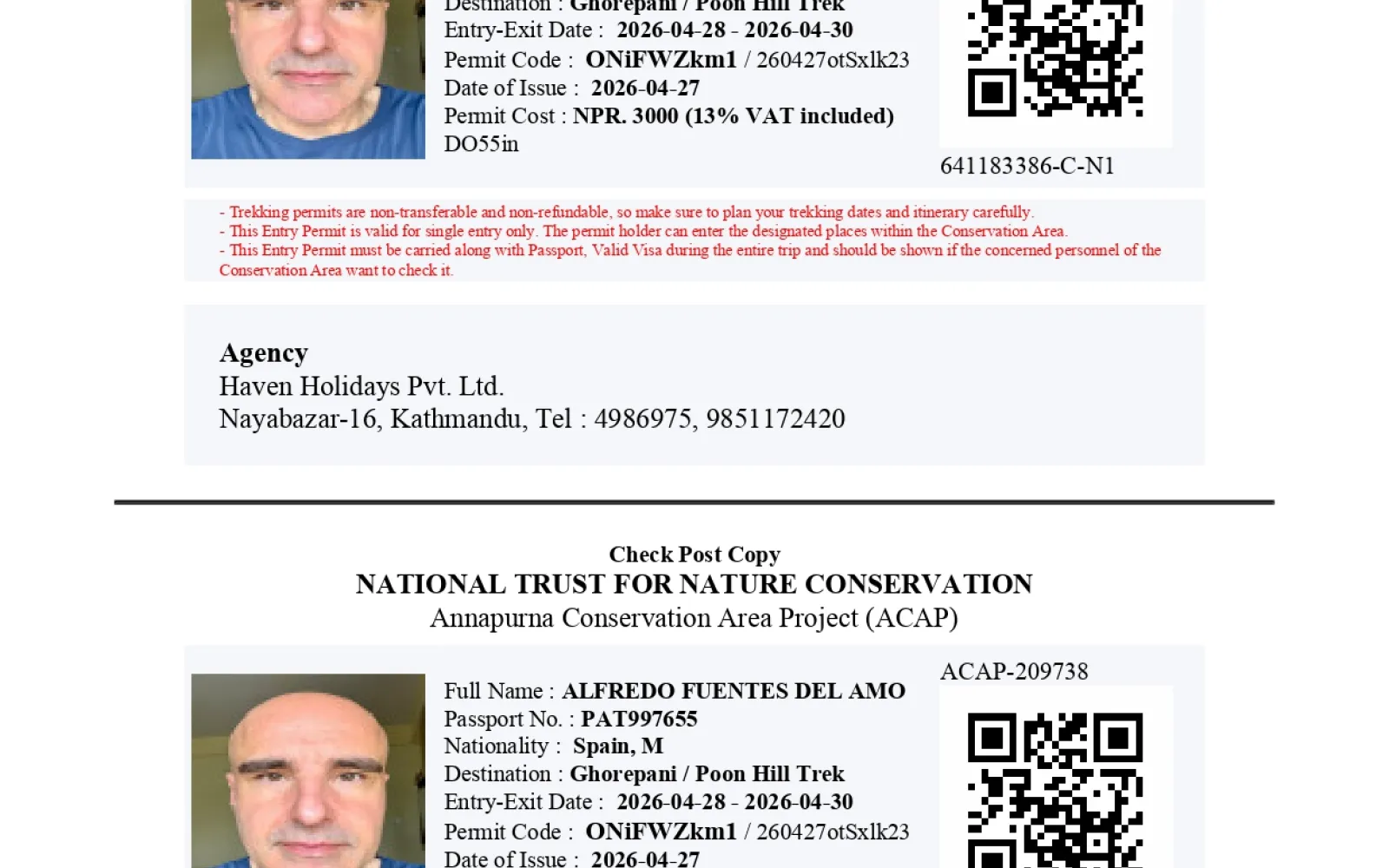
Here, TIMS is currently issued electronically by a registered trekking agency through online payment by the trekker using available payment services such as ConnectIPS or NepalPay.
Then, an electronic TIMS card together with a QR code is issued to the trekker.
Where Is TIMS Obtained?
Through a Government-registered trekking agency
Online agency registration and payment
Electronic TIMS card with QR code
Required routes depend on the current NTB provision
Thus, trekkers should determine their specific route before determining TIMS applicability.
Both Yes/No, TIMS is still required on many major trekking routes in Nepal which is published on Nepal Tourism Board Official Site, therefore it is incorrect to claim that TIMS cards have been totally replaced by local area permits.
But, the bitter reality is that no TIMS card is in practice in Nepal for trekking in Nepal right now. (23/09/2026)
Nevertheless, according to the current Nepal Tourism Board provision, routes covering Annapurna, Langtang, Manaslu, Everest, Kanchenjunga, Makalu, Mustang and several other regions are mentioned under the guide-and-TIMS requirement.
Here, this proves that there is a bid conflict between Nepal Tourism Board and TAAN about the implementation of TIMS.
Current Situation by Trekking Area
| Trekking Area | TIMS Situation |
| Annapurna | Required under current NTB listing |
| Langtang | Required under current NTB listing |
| Manaslu | Required under current NTB listing |
| Kanchenjunga | Required under current NTB listing |
| Makalu | Required under current NTB listing |
| Everest/Khumbu | Current route-permit practice differs |
| Restricted areas | Separate restricted-area permits apply |
However, the standard Everest Base Camp route through Khumbu is currently covered by the Khumbu Pasang Lhamu Rural Municipality permit instead of a TIMS card according to current 2026 permit information whereas the official NTB TIMS page still mentions Everest routes under its TIMS provision.
What Should Trekkers Do?
Check the exact trekking route before departure
Use a local trekking company which is registered where TIMS is required
Do not assume that a local entry permit replaces TIMS everywhere
For EBC, check the current Khumbu permit arrangement before paying for TIMS
Thus, the best approach is to verify the current requirement for a specific route rather than relying on older websites or general statements.
Currently, you wouldn't normally need a separate TIMS Card for the standard Everest Base Camp trek through the Khumbu region, but would instead pay the Khumbu Pasang Lhamu Rural Municipality entry permit fee often taken as the local replacement for TIMS on this route.
Current EBC Permit Requirements
| Permit | Current Fee for Foreigners | Purpose |
| Khumbu Pasang Lhamu Rural Municipality | NPR 3,000 | Local-area entry |
| Sagarmatha National Park | NPR 3,000 | National park entry |
| TIMS Card | Not normally required | Replaced locally on the Khumbu route |
Moreover, the Khumbu local permit costs NPR 3,000 for foreign trekkers in current 2026 practice, and Sagarmatha National Park entry is NPR 3,000.
Where Is the Khumbu Permit Obtained?
Lukla Tourist Information/permit counter
Monjo checkpoint when entering the national park
Usually arranged by your local trekking company
Passport details are required
However, the Nepal Tourism Board's general TIMS page still officially shows Everest Base Camp among routes requiring TIMS so trekkers shouldn't rely on an old or generic TIMS statement.
Therefore, for the EBC trek, double-check the latest requirement with your registered local trekking company before departure as the system can change with government or local authority decisions.
4. Do You Need TIMS Card for Manaslu Circuit Trek?
Currently there's not a separate TIMS Card being used for the Manaslu Circuit Trek, instead it's covered by the Manaslu Restricted Area Permit (RAP), Manaslu Conservation Area Permit, Annapurna Conservation Area Permit and the Chumnubri Rural Municipality local development/entry fee.
Current Manaslu Permit Structure
| Permit / Fee | 2026 Foreign Trekker Cost | Main Purpose |
| Manaslu RAP | USD 100 first 7 days in autumn and Spring | Restricted-area entry |
| MCAP | NPR 3,000 | Manaslu Conservation Area |
| ACAP | NPR 3,000 | Annapurna Conservation Area |
| Chumnubri local fee | About NPR 1,000 | Local-area development/entry |
| Separate TIMS | Not normally required in practice | RAP provides route registration |
Moreover, the local fee is generally collected around Jagat while the main permits are arranged through a registered trekking agency.
Important Points for Trekkers
A licensed guide remains mandatory
The RAP must be arranged through a registered agency
MCAP and ACAP are also required for the standard circuit
Tsum Valley requires an additional restricted-area permit
The local fee is sometimes described as the Chum-Nubri/Tsum-Nubri local fee
However, the current Nepal Tourism Board TIMS page still officially shows Manaslu Circuit Trek as a route requiring TIMS, creating a difference between the general official listing and current route-level practice.
Therefore, before your Manaslu trek, double-check the latest permit arrangement with your registered local trekking company rather than paying separately for TIMS based on an old website.
5. Do You Need TIMS Card for Annapurna Region Trek?
As of now (23/09/2026), a separate TIMS Card is generally not being enforced on the standard Annapurna trekking routes.
However, the Nepal Tourism Board's current general TIMS page still lists Annapurna Circuit, ABC, Poon Hill-ABC, Khopra and Mardi Himal under the TIMS requirement, therefore official and field practices are not perfectly aligned.
Current Annapurna Permit Situation
Trekking area | Current Practical Situation
Annapurna Base Camp |TIMs generally not checked
Poon Hill | TIMs generally not checked
Mardi Himal | TIMs generally not checked
Annapurna Circuit | TIMs generally not checked
ACAP | Required and Checked
Moreover, the Annapurna Conservation Area Permit (ACAP) continues to be essential, with the current NTB fee for foreign nationals being NPR 3,000.
What Should Trekkers Do?
Carry your passport and trekking documents
Obtain the required ACAP permit
Trek with a licensed guide under the current trekking rules
Let your registered local trekking company confirm the latest TIMS requirement
Recheck before departure as enforcement can change
Therefore, for standard Annapurna routes, do not assume TIMS is currently being checked, but also do not describe its removal as a permanently established nationwide rule. The official NTB listing can change, and the route-level enforcement may be updated during the trekking season.
6. Do You Need TIMS Card for Langtang Valley Trek?
No, current 2026 practice indicates that TIMS is not required for the Langtang Valley Trek, although now in a digital format as e-TIMS can be obtained.
However, the statement that TIMS has already been completely replaced by a local entry card would not be correct for the standard Langtang Valley route at present.
Current Langtang Permit Situation
Permit | Current Requirement | Foreign Trekker Cost
Langtang National Park | Required | NPR 3,000
Digital e-TIMS | Currently required as per NTB but not in practice | NPR 2,000
Restricted-area permit | Only for applicable extensions Varies/not really required for Langtang Valley Trek
Moreover, the Langtang National Park entry fee for foreign nationals is currently NPR 3,000, separate from TIMS.
Important Points for Langtang Trekkers
Arrange e-TIMS through a registered trekking agency ( if applicable, not applicable recently 23/09/2026)
Carry your passport and permit details
Obtain the Langtang National Park entry permit
Additional permits apply for restricted areas such as parts of the upper region
Check the latest rule before departure
However, Nepal's TIMS system is still evolving, and enforcement can change between seasons or checkpoints.
Therefore, your local trekking company should verify the latest requirement before issuing your permits, rather than relying on older information saying that TIMS has already been removed.
7. Do You Need TIMS Card for Restricted Area Trekking in Nepal?
No, because TIMS is not required for both restricted and protected trekking routes in Nepal right now (23/09/2026 — but it is not accurate to say that local-area entry cards have replaced TIMS.
In addition, note that restricted areas usually require a separate Special Trekking Permit from the Department of Immigration, while local rural municipalities also sometimes levy local entry or development fees.
Current Permit Structure
| Requirement | Purpose | Examples |
| TIMS | Trekker information and safety monitoring | Numerous trekking routes ( not in practice recently) |
| Restricted Area Permit | Controlled-area access | Upper Mustang, Manaslu, Upper Dolpo |
| Conservation Area Permit | Protected-area entry | MCAP, ACAP, KCA |
| Local-area fee | Local administration/development | Some rural municipalities |
However, this can vary depending on the route, because local-area fees do not usually cancel TIMS or the Restricted Area Permit.
For example, the current official permit schedule lists Chumnubri, Upper Mustang, Upper Dolpa, Humla, Manang and other restricted areas with separate trekking-permit requirements and fees.
Examples of Current Restricted-Area Fees
Manaslu Restricted Area: USD 100 per person/week in September–November.
Tsum Valley: USD 40 per person/week in September–November.
Upper Mustang: USD 50 per person/day.
Upper Dolpo: USD 50 per person/day.
Humla: USD 50 per person/week.
Therefore, note that trekkers should always clarify the exact requirements with a local registered trekking company before departing, because TIMS, restricted-area permits, conservation permits and local fees can sometimes be required together.
8. How Long Has TIMS Been Replaced by Local Area Entry Cards?
Though TIMS has not been officially replaced by Tourism Board Nepal but the local area entry cards have already replaced the TIMS for the past four or five years.
In fact, the current official information confirms that the revised TIMS provision began on March 31, 2023, requiring a trekking guide plus the TIMS issued by agencies on specific routes.
However, trekkers need not worry about the entra cost for TIMS because it is no longer practice on the trail (23/09/2026).
TIMS Timeline
| Period | Development |
| January 1, 2008 | TIMS introduced by TAAN and NTB |
| 2021–2022 | Local permit and trekking-practice variations in different areas |
| March 31, 2023 | Revised TIMS provision comes into force |
| 2026 | TIMS still in force on many routes by NTB but not in practice on the trail |
In addition, note that local governments have imposed or collected local entry, development or conservation-related fees in some areas, but these should not be considered an official replacement for TIMS as per Nepal Tourism Board.
In fact, TAAN points out that TIMS was originally introduced to collect information on trekkers for safety, rescue and monitoring purposes, while the current NTB system also issues electronic TIMS cards with QR codes.
What Should Trekkers Know?
TIMS was introduced in 2008, not four or five years ago.
The main changes to TIMS only took place this year (as of March 31, 2023).
Local-area fees are usually separate and vary depending on the route.
Some areas may have unofficial or varying practices.
No TIMS Card is in practice now ( 23/09/2026)
9. Final Words
The TIMS system is currently going through a period of change, and its implementation is not consistent across every trekking region in Nepal.
In fact, TIMS Card is not in practice right now in Nepal for trekking. ( 23/09/2026)
Therefore, trekkers should not yet assume that TIMS has disappeared completely based on the use of local entry fees or permit arrangements being used by some routes.
And the fact that the Nepal Tourism Board still officially lists TIMS for many of the major trekking routes which is contradictory. The practice of TIMS is not in practice in the field.
Could TIMS Come Into Practice Again in 2027?
| Situation | What to Expect |
| 2026 | Rules and enforcement are still changing |
| 2027 | Further changes are possible |
| Nationwide return | No official confirmation currently |
| Local permits | May continue on selected routes |
| e-TIMS | May continue where currently implemented |
Moreover, there is currently no confirmed official announcement yet that TIMS will return nationwide in 2027.
But since trekking-permit rules in Nepal can be changed by the Nepal Tourism Board, the local government, TAAN, or local governments, the requirement should always be checked again before each trekking season.
In fact, there is a conflict between TAAN and Nepal Tourism Board about the practice of TIMS Card for trekking in Nepal.
However, trekkers trekking in Nepal must not stress on the extra fees for TIMS Card (23/09/2026).
What Should Trekkers Do?
Check the latest permit rules before departure.
Confirm requirements with a registered local trekking company.
Don't rely on older TIMS information online.
Keep your passport and trekking documents available.
Check the rules again if travelling in 2027.
Therefore, there is no reliable basis for stating that TIMS will definitely return in 2027 yet, but a rule change is possible. For a 2027 trek, the most accurate option is to confirm the requirement shortly before departure since the system is still evolving.
FAQs
1. Do You Need a TIMS Card for Trekking in Nepal in 2026?
A TIMS Card is no longer in practice on some major trekking routes and is now route-specific, so trekkers should not just assume they need a TIMS Card because older Nepal info says so.
2. Has the TIMS Card Been Replaced by Local Area Permits in Nepal?
On some trekking regions local permits or fees have been introduced, with the clearest example being the Everest/Khumbu region where trekkers currently collect the Khumbu Pasang Lhamu Rural Municipality local entry permit (not a TIMS Card), in addition to the necessary Sagarmatha National Park entry permit.
3. Do You Need a TIMS Card for the Everest Base Camp Trek?
For the Everest Base Camp TrekTIMS is currently not in practice, and foreign trekkers normally need the Sagarmatha National Park entry permit and Khumbu Pasang Lhamu Rural Municipality local entry permit (along the Everest trekking route).
4. What Permits Do You Need Instead of TIMS for Everest Base Camp?
For the standard Everest Base Camp Trek, you should arrange the necessary local and protected area permits rather than a TIMS Card, including Khumbu Pasang Lhamu Rural Municipality entry permit, and Sagarmatha National Park entry permit (with the current foreigner Sagarmatha National Park fee shown by the Nepal Tourism Board at NPR 3,000).
5. What Is the Khumbu Pasang Lhamu Rural Municipality Local Entry Permit?
The Khumbu Pasang Lhamu Rural Municipality permit is a local area permit for the Everest/Khumbu region, separate from the Sagarmatha National Park permit and collected locally on the route, providing the local authority's required entry documents for trekkers visiting the Khumbu area.
6. Do Annapurna and Other Trekking Regions Still Require TIMS?
The answer is not the same across every region, as Nepal's trekking permit system is currently changing, and enforcement may vary on different routes and checkpoints.
Therefore, trekkers wishing to go to Annapurna, Langtang, Manaslu, Kanchenjunga or another region should check the current requirements with a registered trekking agency or the relevant local authority before departure, rather than applying an Everest rule to every trek.
7. Why Do Some Websites Still Say That TIMS Is Mandatory?
Many sites show the 2023 TIMS regulation (licensed guides and agency-issued TIMS Cards introduced for many trekking routes), and the Nepal Tourism Board's current TIMS page shows this framework, which is why travellers can find conflicting information online when local checkpoint practice has changed in some trekking regions.
8. Can the TIMS Card Come Into Practice Again in Nepal?
Yes, regulations on trekking can change, and the current system is evolving. Therefore, trekkers wishing to plan for 2027 or later should check the latest requirements before departure, particularly as the Nepal Tourism Board's published TIMS info and current regional checkpoint practice are not yet in complete alignment.
9. Do You Need a Local Area Permit Even If You Do Not Need TIMS?
Yes - not needing a TIMS Card does not mean a trekker can enter every trekking region without permits; protected areas and local governments may require separate entrance fees or local permits, so the documents required will vary depending on the route (Everest requiring the local Khumbu permit and Sagarmatha National Park entry).
10. What Should Trekkers Check Before Starting a Trek in Nepal?
Trekkers should check the requirements for their specific route, protected area and local municipality immediately before the trek, rather than assuming that an old article saying 'TIMS is mandatory' means they need to do the same. Check whether the route currently requires a local area permit, national park/conservation area entry permit, restricted area permit, guide or other documents.

Our travel experts are ready to assist you with any questions.
Send us a message.Have a question before you book? Send your enquiry below and our travel experts will get back with the required information.