
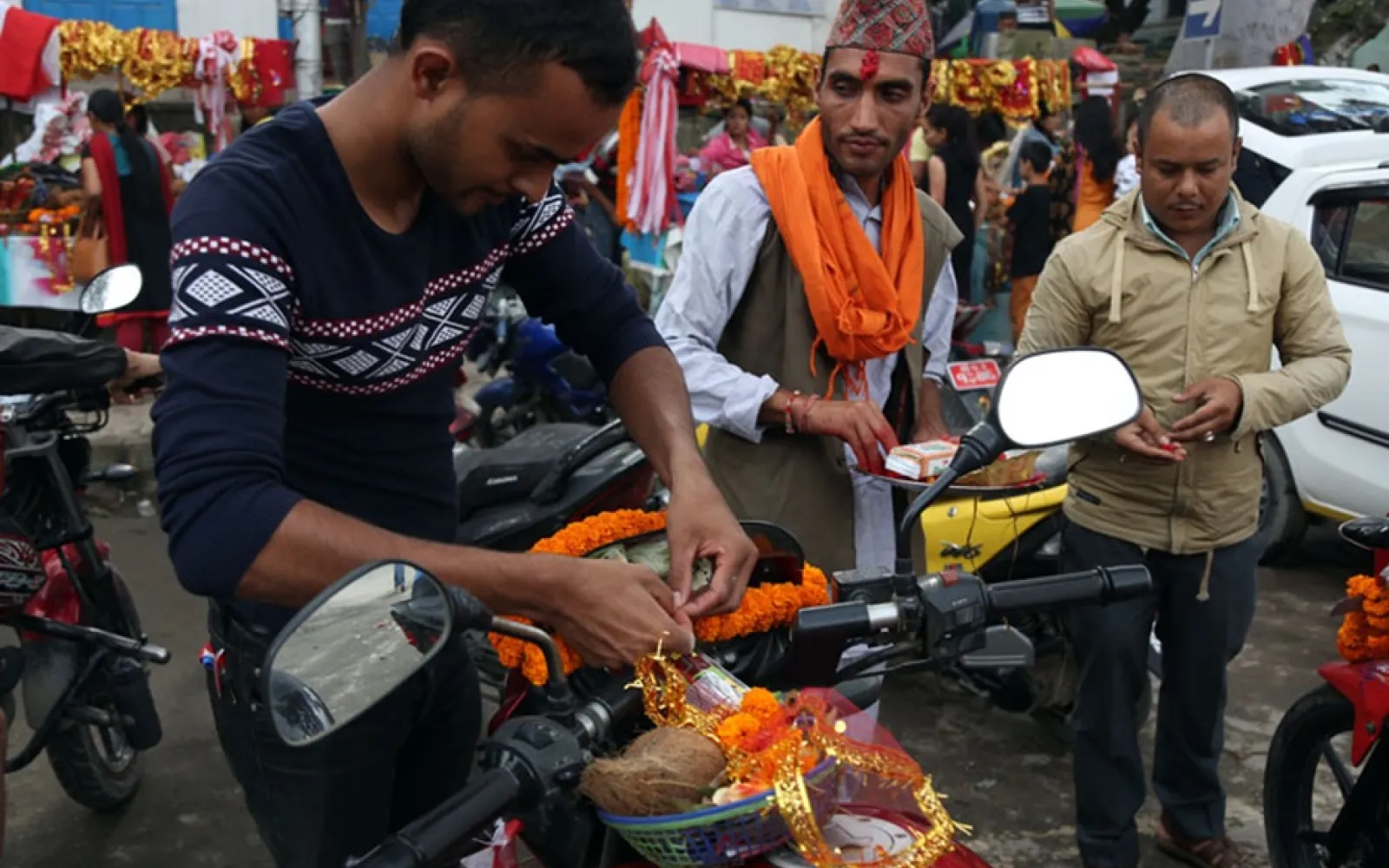
Vishwakarma Puja, also known as Vishwakarma Parba, is a Hindu festival dedicated to Lord Vishwakarma. The day is celebrated annually in Nepal on Ashwin Sankranti, the first day of the month of Ashwin, which falls around September 17 according to the solar calendar.
In Hindu mythology and scriptures, Lord Vishwakarma is believed to be the divine architect and craftsman associated with architecture, craftsmanship, construction, utensils, and machinery. He is traditionally described as creating weapons for the gods, magnificent buildings and palaces, and the legendary city of Dwarka.
In Nepal, Vishwakarma Puja is strongly associated with workshops, factories, mechanical workshops, artisans, and vehicles because workers worship the objects they use in their work and believe that Lord Vishwakarma protects them from occupational hazards. Workplaces are cleaned and decorated, while images or idols of the deity may be placed where workers worship machines, tools, and other equipment.
More specifically, this day is also about devotion to work and respect for the instruments used in daily activities. Devotees believe that worshipping their tools and equipment helps ensure their durability and safe operation.
Vishwakarma Puja is, therefore, not only a festival associated with machines but also a celebration of craftsmanship, technology, labour, and respect for the means of livelihood. The celebration connects religious practices with the tools and equipment people depend on for their work.
The festival is observed across Nepal, especially in industries, workshops, factories, garages, transport companies, and other institutions. People celebrate by decorating their workplaces and offering prayers for safe and successful work.
Overview of the Main Elements of the Festival
Main deity:
Lord Vishwakarma
Main day:
Ashwin Sankranti
Usual date:
September 17
Main association:
Craftsmanship, architecture, machinery, and skilled labour
Main participants:
Artisans, mechanics, workers, and trade communities
Worship objects:
Tools, machines, equipment, and vehicles
Workplace practice:
Cleaning and decorating workshops
Faith-based practice:
Prayer for safe and successful work
Other names:
Vishwakarma Parba or Vishwakarma Puja
Related observance:
Vastu Day
Most importantly, Vishwakarma Puja holds great significance in Nepal because it connects religion with occupational skills. Modern professions such as mechanics, welding, engineering, vehicle operation, and technical work are important means of livelihood, and the festival recognizes the value of these skills.
Therefore, the day remains significant as a religious and cultural event that brings together various skilled labour communities.
Main celebrators:
Artisans and craftsmen, mechanics, welders, industrial workers, and factory workers.
Vishwakarma Puja is predominantly celebrated by artisans, craftsmen, mechanics, welders, industrial workers, and factory workers in Nepal. These people are commonly found in workshops, factories, garages, transport firms, and other institutions associated with machinery and technical work.
Meanwhile, the worship of tools and machines is not limited to a few trades. Mechanics may worship the vehicles and engines they work with, while welders may worship welding machines and other equipment used in their profession.
Main Categories of People Who Celebrate the Festival
Artisans and craftsmen – hand tools and craft equipment
Mechanics – vehicles, engines, and mechanical tools
Welders and metalworkers – welding machines and metal equipment
Factory workers – machinery and equipment
Engineers and technicians – technical instruments
Vehicle owners – cars, buses, trucks, motorcycles, and other vehicles
Industrial businesses – factory machinery and equipment
Workshop owners – tools, machines, and the workshop
Other skilled workers – equipment associated with their work
Likewise, vehicle worship is also common during Vishwakarma Puja, as people decorate their vehicles and worship them as tools of trade and means of transport. Vehicles are considered important tools that support work and daily activities, and therefore many people show them respect through religious practices.
In addition, factory workers and workshop employees may observe the day collectively because the workplace becomes the center of the celebration. Workers gather to decorate the workplace, make offerings to an image or idol of Lord Vishwakarma, and conduct puja rituals for their machines and tools before resuming their regular activities.
However, Vishwakarma Puja is not exclusively limited to people who work in workshops or factories because other members of the public may also participate. The largest community of devotees consists of people whose livelihoods depend on craftsmanship, machinery, tools, construction, transport, or other technical skills.
In conclusion, the festival is widely observed in India by industrial workers, artisans, and craftsmen, while Nepal has its own local traditions and practices. In Nepal, the objects most commonly worshipped include vehicles, machinery, equipment, and workshops, making the festival particularly relevant to modern workers.
Vishwakarma Puja is celebrated primarily by workshop owners, factory owners, garage owners, industrialists, and people who work with tools, machines, and technical equipment. The puja falls on Ashwin Sankranti and involves the worship of Lord Vishwakarma along with the tools and equipment associated with a person's work or business.
Before the puja begins, workshop and factory owners usually clean and decorate their workshops, factories, garages, or other workplaces. Images or temporary idols of Lord Vishwakarma may be installed at the workplace, while tools, machinery, equipment, and vehicles are cleaned and prepared for worship.
Moreover, the main ritual of Vishwakarma Puja involves offering prayers to Lord Vishwakarma and worshipping the tools and equipment used for daily work. Depending on workplace and family traditions, worshippers may offer flowers, colours, fruits, incense, lamps, food, and other puja items before the deity and equipment.
Likewise, vehicles play an important role in Vishwakarma Puja in Nepal, particularly among drivers, transport businesses, mechanics, and vehicle owners. Cars, buses, trucks, motorcycles, and other vehicles are often washed and decorated with flowers, festoons, or coloured cloth before being worshipped as important means of work and transportation.
In addition, factories and large workshops may arrange the celebration collectively because many workers share the same machinery and equipment. The workplace can become a community venue where workers participate in the puja, receive blessings, and celebrate together.
Common Practices During Vishwakarma Puja
| Practice | How it is observed |
| Cleaning workplace | Workshops, factories, garages, and equipment are cleaned before puja. |
| Decoration | Workplaces, machines, and vehicles are decorated. |
| Installation of deity | An image or temporary idol of Lord Vishwakarma may be installed for worship. |
| Worship of tools | Tools and machinery are cleaned and included in the puja. |
| Worship of vehicles | Vehicles are washed, decorated, and worshipped as means of work and transport. |
| Offerings | Flowers, incense, lamps, food, colours, and other puja items may be offered. |
| Workplace gathering | Workers and owners participate jointly. |
| Immersion of idols | Temporary clay or sand idols may later be immersed according to local tradition. |
Note: Temporary idols are not used in all workplaces, and local traditions vary according to workplace, family customs, and location. Where temporary clay or sand idols of Lord Vishwakarma are installed, their immersion in river water may form part of the local tradition.
Likewise, the celebration has a practical connection with the workplace because people take this opportunity to show respect for the tools and equipment that contribute to their livelihoods. Thus, Vishwakarma Puja combines religious faith with craftsmanship, the workplace environment, and a sense of community among workers in contemporary Nepal.
Why Is Vishwakarma Puja Celebrated?
Vishwakarma Puja is celebrated to honour Lord Vishwakarma, who is regarded in Hindu religious tradition as a divine architect, craftsman, and patron of skilled work. The festival therefore holds special significance for artisans, mechanics, metalworkers, welders, factory workers, technicians, and other professionals who depend on tools, machinery, and expertise for their livelihoods.
An important purpose of the festival is to express respect for the tools and equipment used for work. Devotees traditionally believe that worshipping these tools and equipment will help protect them from damage, ensure their durability, and bring success to their work, although these are matters of religious belief rather than scientific proof.
Likewise, the festival signifies the value of skill, craftsmanship, creativity, and hard work. Lord Vishwakarma, as a traditional deity associated with architecture and divine craftsmanship, represents dedication to skilled work and the desire for safety and success.
Main Reasons for Celebrating Vishwakarma Puja
| Reason | Cultural and religious significance |
| To honour Lord Vishwakarma | Worship of the traditional deity and patron of skilled work. |
| To respect tools | Acknowledgement of the importance of tools and equipment in skilled work. |
| To pray for safe work | Devotees seek protection and safety while using tools and machinery. |
| To seek success | Workers pray for successful work and livelihood. |
| To protect equipment | Religious belief that worship supports durability and protects tools from damage. |
| To honour craftsmanship | Recognition of skill, expertise, and creative labour. |
| To bring workers together | A joint celebration with fellow workers and colleagues. |
| To connect tradition with modern work | Extension of religious tradition to modern machinery and technology. |
Another significant aspect is the worship of vehicles and modern machinery because many people depend on them for transportation and livelihood. This has enabled the Vishwakarma Puja tradition to extend beyond traditional craftsmanship to workshops, factories, garages, and the transport sector in Nepal.
More importantly, Vishwakarma Puja is also observed as Vastu Day or Vastu Diwas in connection with traditional architectural knowledge. Current accounts in Nepal associate Vishwakarma with architecture and Vastu traditions, although the historical development of these religious concepts should be distinguished from mythological descriptions.
Culturally, the festival provides an opportunity for people to acknowledge the value of hard work and the skills required to create products, transport goods, construct buildings, and develop technology. Thus, Vishwakarma Puja continues to unite religious faith with respect for skilled work, craftsmanship, technology, and the means by which people earn their livelihoods.
What Myth Is Popular About Vishwakarma Puja?
The most popular religious belief about Vishwakarma presents him as the divine architect, craftsman, and creator of extraordinary constructions and weapons in Hindu mythology. He is associated with divine creativity and expert craftsmanship, and references to Vishwakarma appear in Vedic scriptures, including the Rigveda.
According to Hindu mythology, Vishwakarma was the creator of magnificent cities, palaces, weapons, and other constructions for the gods. Various religious traditions attribute many legendary structures and objects to him, including Dwarka, the city associated with Lord Krishna, and Indraprastha, the capital of the Pandavas.
Popular Stories Associated with Lord Vishwakarma
| Mythological Story | Traditional Belief |
| Divine architect | Vishwakarma is viewed as the architect and craftsman of the gods. |
| Construction of Dwarka | He is traditionally known as the creator of the legendary city of Dwarka for Lord Krishna. |
| Indraprastha | Hindu mythology links him to the creation of the Pandavas' magnificent palace and city. |
| Divine weapons | He is traditionally attributed with creating or crafting important weapons of Hindu deities. |
| Heavenly structures | He is associated with the creation of palaces and other extraordinary heavenly constructions. |
| Vastu and architecture | He is traditionally linked with architecture, construction, and Vastu knowledge. |
More importantly, one popular story claims that Lord Krishna commissioned Vishwakarma to construct the city of Dwarka, which became his magnificent fortified city. This story belongs to Hindu religious tradition and should not be interpreted as an independently verified historical account.
Another popular tradition links Vishwakarma with the creation of important divine weapons, including the Sudarshana Chakra of Lord Vishnu, the Trishula of Lord Shiva, the lance of Lord Kartikeya, and others. Such stories emphasise his role as a master craftsman serving the gods.
Likewise, Nepali religious traditions view Vishwakarma as an expert in architecture and Vastu. Some modern accounts also attribute the Sthapatya Veda and ancient architectural knowledge to him; however, claims about the texts and their authorship belong to the sphere of traditional religious belief rather than verifiable history.
These stories help explain why workers traditionally worship their tools, machines, vehicles, and other equipment during Vishwakarma Puja. The underlying religious idea emphasises respect for skill, creativity, construction, and the instruments and machines used in work.
Therefore, Vishwakarma Puja mythology is closely connected with the modern practices of the festival. The legendary divine craftsman has become a symbol for artisans, mechanics, engineers, technicians, and other skilled workers and professionals, allowing ancient religious traditions to remain connected with modern craftsmanship and technology.
What Is the Cultural and Religious Significance of Vishwakarma Puja?
Vishwakarma Puja has both cultural and religious significance for Nepalis because it combines Hindu worship with the values of craftsmanship, skilled labour, tools, machinery, architecture, and modern technology. The festival venerates Lord Vishwakarma as the divine architect while also giving workers an opportunity to express gratitude for the tools and equipment through which they earn their livelihoods.
From a religious perspective, Vishwakarma Puja involves worshipping Lord Vishwakarma and praying for a prosperous, safe, and successful year of work. At the same time, the tradition involves worshipping tools and machinery with the belief that such practices bring good fortune, durability, stability, and protection from malfunctioning, although such claims are not objectively verifiable.
Religious and Cultural Significance
| Significance | Meaning
| Worship of Lord Vishwakarma | Honours the traditional divine architect and craftsman. |
| Respect for skilled work | Acknowledges craftsmanship, technical knowledge, and skills. |
| Worship of tools | Expresses gratitude for the means of livelihood. |
| Machinery worship | Combines traditional values with modern technology. |
| Workplace safety | Devotees pray for safety and prosperity in workplaces. |
| Prosperity | Workers seek blessings for successful and profitable livelihoods. |
| Vastu tradition | The festival is connected with Vastu architectural traditions. |
| Community participation | The festival involves workers, businesses, families, and communities. |
| Cultural continuity | The tradition acknowledges the relevance of craftsmanship in the modern workplace. |
Additionally, the cultural and religious significance of Vishwakarma Puja is particularly important for artisans, mechanics, metalworkers, welders, factory workers, technicians, drivers, and other skilled workers who participate in worshipping tools, machines, and vehicles and decorating their workplaces.
Moreover, Vishwakarma Puja gives cultural recognition to craftsmanship and the value of labour, rather than focusing only on the final products of manufacturing and services. In the same way, it has a particular connection with vehicles, which is evident in the way Nepalis worship and decorate cars, buses, trucks, motorcycles, and other vehicles.
Likewise, Vishwakarma Puja is also popularly known as Vastu Day or Vastu Diwas, and the festival is associated with Vastu traditions. It is reported that Vastu Day is observed by Vastu experts in Nepal in connection with scholars and saints associated with Vastu Shastra.
On a broader cultural level, Vishwakarma Puja combines an ancient religious tradition with the values of hard work among Nepali people, including those working in modern industrial and commercial environments. Thus, the festival remains popular as a day of devotion, gratitude, and respect for the tools and technologies with which people work and earn their livelihoods.
Final Words
Vishwakarma Puja is a significant event that combines Hindu religion with craftsmanship, skilled labour, tools, machinery, architecture, and modern technology. When this special day is celebrated in Nepal, people not only pray to Lord Vishwakarma but also express gratitude for the objects and means of labour, machinery, vehicles, and other tools used in their work and daily life.
Meanwhile, one cultural belief found in Nepal is that tools and objects can have a soul, and therefore they should be treated with respect and gratitude. For this reason, people often clean and decorate the tools and objects used in manufacturing, workshops, offices, and other workplaces.
In this regard, Vishwakarma Puja combines religious traditions with a special occasion for workers to recognise their hard work throughout the year. Whether people observe the occasion primarily for religious or workplace reasons, Vishwakarma Puja remains an important cultural event in Nepal.
Likewise, Vishwakarma Puja is a notable example of how ancient rituals and beliefs can survive and adapt to modern conditions. The objects of worship during this festival can include vehicles, buses, motorcycles, cars, buildings, machines, computers, technical equipment, and various tools.
Tools and machines now play a crucial role in most occupations because they help people perform their daily work. Therefore, apart from its religious aspects, the festival also expresses gratitude for tools and machines while appreciating skilled labour, craftsmanship, and technology.
In this regard, Vishwakarma Puja is not only a religious festival but also an opportunity to show respect for tools and machinery in the workplace. Technical devices and tools are part of everyday life for many people in Nepal, making this festival relevant and memorable.
Apart from religious observance, people may participate in the celebration for cultural and community reasons. For tourists who are travelling or trekking in Nepal, witnessing Vishwakarma Puja can provide an opportunity to learn about one aspect of Nepali culture and understand how traditional beliefs are connected with modern work and technology.
What is Vishwakarma Puja?
Vishwakarma Puja (or Vishwakarma Jayanti) is a holiday in Hinduism, in honour of Lord Vishwakarma – the God of architecture and craftsmanship. It is mostly celebrated in Nepal, and amongst workers, mechanics, artisans, engineers, and other workers, including factory workers, drivers, technicians, and people connected to tools, machines, and vehicles.
Vishwakarma Puja is usually celebrated on Ashoj 1 (mid September) – in 2026, it is on September 17. On the day, people decorate, clean and perform puja on various machines, tools, vehicles, and equipment. Similarly, people offer and pray for incense, flowers, fruits, sweets, and various gifts.
How is Vishwakarma Puja observed in Nepal?
Vishwakarma Puja is mainly celebrated on the workplaces. So most factories, workshops, garages, enterprises, business, and employers and employees engage in various rituals: decorating and clean the machines and equipment, tools, and make puja.
Workers may bring their cars and fresh tools and equipment they have bought for the occasion to the local temples and Shaktipeeths in order to receive blessings. Also, on this day, people get prasad, and employers may arrange and invite people to a party.
Who celebrates Vishwakarma Puja?
There are many groups and communities who mostly celebrate it – those connected to work and building professions and working and using machines, equipments and tools, cars, and other things.
So – Mechanics, carpenters, blacksmiths, welders, and electricians celebrate it. Also, factory owners, workers, engineers, drivers, machinery operatives, artisans, technologists, builders, and constructors, businessmen, workshops owners and workers – the list is quite large.
However, as we live in a modern and progressive world, anyone may take part and appreciate the work Vishwakarma has done and that he supports his living.
Do people get holidays on the day of Vishwakarma Puja?
Actually, it is not considered as a public holiday, and the Ministry of Home Affairs has not given it as a public holiday on the 2083 BS holiday list.
However, people generally have it off or get a half-day off from their works specially in factories, workshops, garage, and businesses owners. So people may say that it is a working and business holiday.
Who is worshipped on the occasion of Vishwakarma Puja?
We honour Lord Vishwakarma on this day in terms of religion and we also worship what he creates or made. So workers also worship tools, machines, vehicles, equipment, technologies and various things with which they work. Hence it makes it really special and different from other festivals. The puja is held to express happiness about craftsmanship, engineering skills and technical solutions and equipment’s that help people earn their livelihoods.
Also, the Vishwakarma Puja festival creates scope for workers, employers, builders, entrepreneurs, engineers to thank those things, without which they could not do their work. People really make special care and clean and decorate things they use in their livelihoods.
What myth is related to Vishwakarma Puja?
Vishwakarma is the God of architecture and craftsmanship. Many Hindu texts and literature tell stories about Vishwakarma creating things and places, however, there is not much agreement on his stories.
The Rigveda contains the oldest references to the legendary figure of a creator name Vishvakarman – and later Hindu texts and literature have different version of the legend behind Vishwakarma creation.
The traditions behind the stories tell us that he constructed the Lanka and Dwarka, Indra’s heavenly city the Pushpaka Vimana and its amazing weapons. So it would appear, that the stories behind Vishwakarma Puja tell us more about his work as a genius architect, builder, and craftsman. There are indeed a wide variety of legends behind the creation that Vishwakarma has undertaken.
What is the cultural and religious importance of Vishwakarma Puja?
Vishwakarma Puja’s religious importance is that we appreciate the craftsmanship and seek blessings of Vishwakarma for happy, easy, and prosperous work. This day’s cultural importance is that we also appreciate the livelihood and work, machines, techniques and craftsmanship, tools, and other equipments that helps people earn their living.
Additionally, in Nepal, this day is also important culturally because people care and love, respect the works and tools and machinery that helps them earn their livelihood. So they clean, decorate, and do various things to show this respect and this appreciation.

Our travel experts are ready to assist you with any questions.
Send us a message.Have a question before you book? Send your enquiry below and our travel experts will get back with the required information.