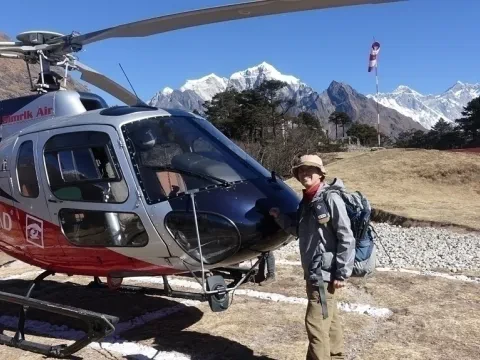
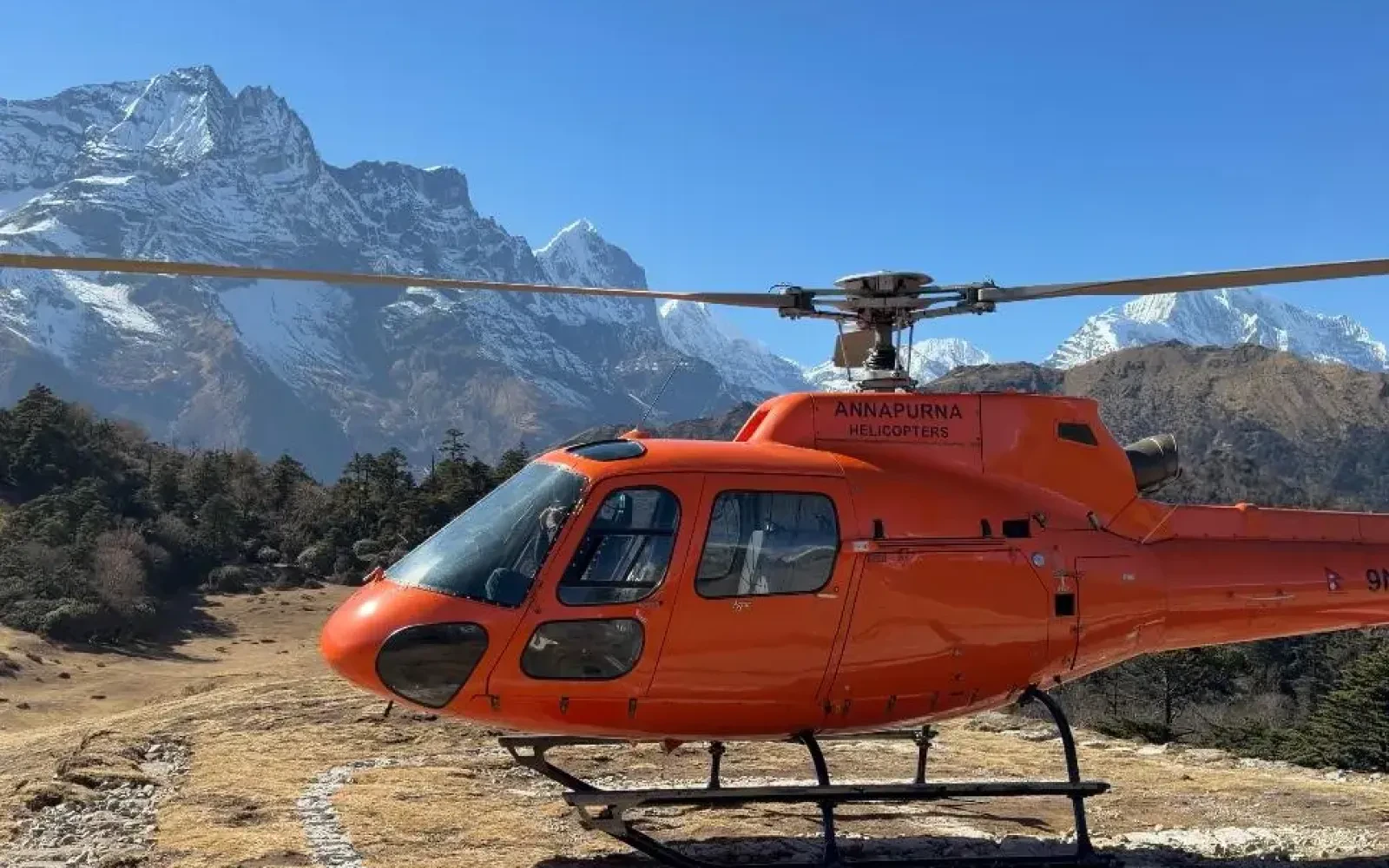
The Everest Helicopter Tour is a helicopter scenic flight from Kathmandu to the Everest region and is the best option for those who wish to experience the Himalayas without spending days for Everest Base Camp Trek along the high-altitude trails. Likewise, an Everest Helicopter Tour is a great option for those with a short time frame.
Meanwhile, the Everest Helicopter Tour typically starts in Kathmandu (1,400 m) and proceeds to Lukla (2,860 m) from where it heads to the Khumbu region. During the scenic flight, one can enjoy views of Namche Bazaar (3,440 m), Tengboche (3,860 m), and the Everest Base Camp.
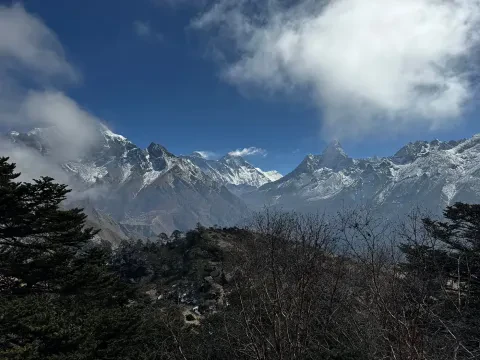
During the flight, one can enjoy a spectacular view of Mount Everest (8,849 m), Lhotse (8,516 m), Nuptse (7,861 m), Pumori (7,161 m), and Ama Dablam (6,812 m). According to the tour package, the helicopter lands at Kala Patthar (5,545 m) or flies over it.
Likewise, the helicopter subsequently lands at Hotel Everest View (3,880 m), where one can marvel at the mountain views, take photos, and have breakfast, depending on the tour package.
Highlights :
Thus, the Everest Helicopter Tour from Kathmandu is a fantastic opportunity to enjoy sublime aerial views, high-altitude vantage points, and a Himalayan adventure, all within a day, 4-5 hours.
There are two types of Everest Helicopter Tour from Kathmandu. The tours are similar in most aspects except that one involves a stop at Kala Patthar while the other does not.
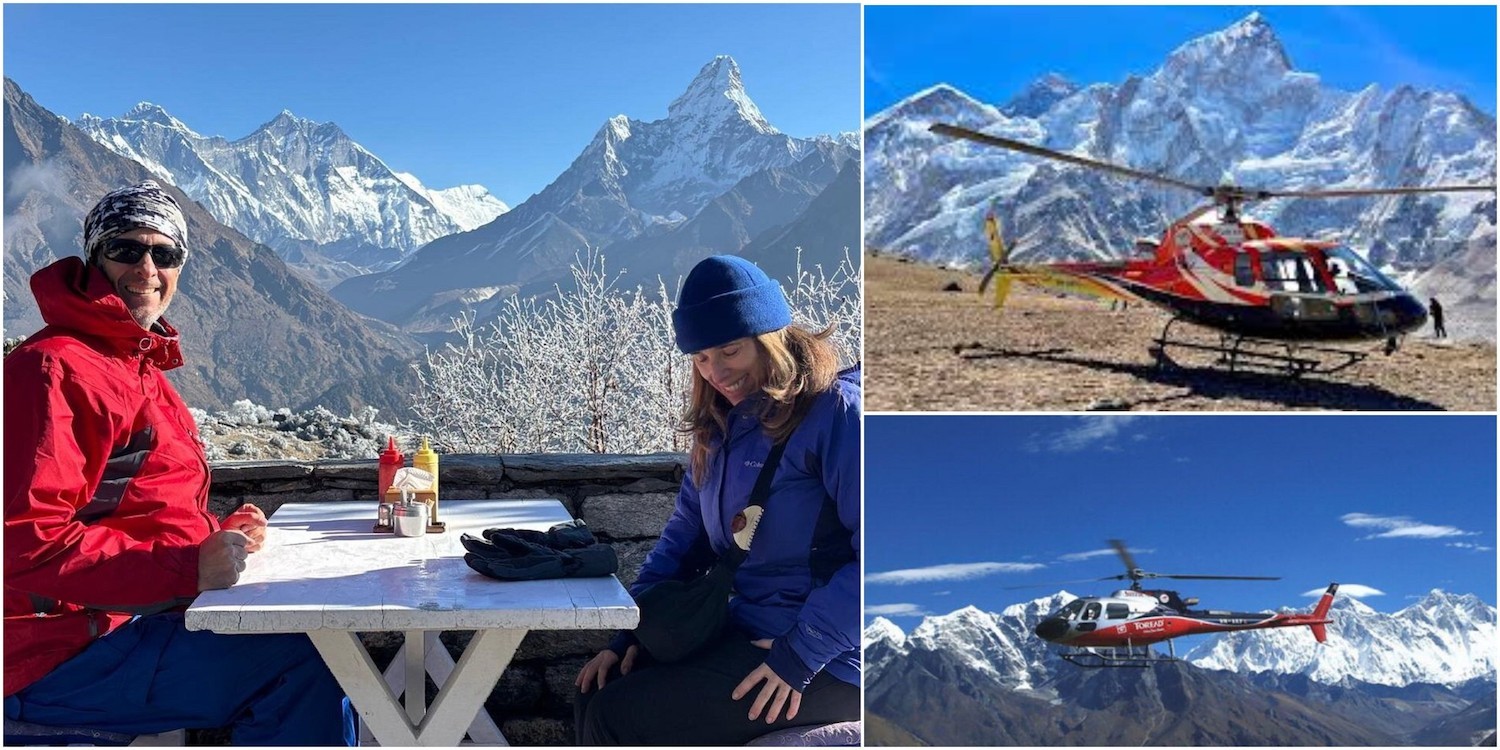
The Everest Flyover and Hotel Everest View Landing helicopter tour begin their flight from Kathmandu (1,400 m) and typically head to Lukla (2,860 m). The helicopter then progresses to the Khumbu region, offering views of Namche Bazaar (3,440 m) and Tengboche (3,860 m).
Meanwhile, the helicopter subsequently flies over the Everest Base Camp (5,364 m) and Kala Patthar (5,545 m) before landing at the Hotel Everest View (3,880 m). At the hotel, one can enjoy the mountain views and have breakfast, if the tour package includes it.
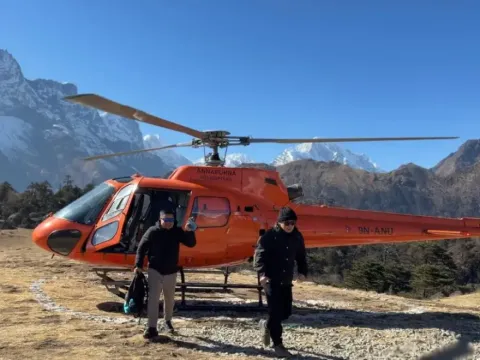
The Kala Patthar Landing + Hotel Everest View Landing helicopter tour is similar to the previous tour except that it lands at Kala Patthar (5,545 m). Likewise, this tour option provides a more comprehensive experience as it allows one to have a closer view of Everest from Kala Patthar (5,545 m).
After departing from Kathmandu (1,400 m) and flying to Lukla (2,860 m), the helicopter proceeds to the Khumbu region. It, subsequently, flies over Namche Bazaar (3,440 m) and Tengboche (3,860 m). The helicopter then flies over the Everest Base Camp (5,364 m) and Kala Patthar (5,545 m).
At this point, the helicopter lands at Kala Patthar (5,545 m) for a short time before proceeding to the Hotel Everest View (3,880 m). Finally, the helicopter returns to Kathmandu (1,400 m).
| Flyover Tour | Kala Patthar Landing Tour |
|---|---|
| Kathmandu (1,400 m) | Kathmandu (1,400 m) |
| Lukla (2,860 m) | Lukla (2,860 m) |
| Namche Bazaar (3,440 m) | Namche Bazaar (3,440 m) |
| Tengboche (3,860 m) | Tengboche (3,860 m) |
| Everest BC (5,364 m) | Everest BC (5,364 m) |
| Kala Patthar Flyover (5,545 m) | Kala Patthar Landing (5,545 m) |
| Hotel Everest View Landing (3,880 m) | Hotel Everest View Landing (3,880 m) |
As mentioned, the primary difference between the Kala Patthar Landing and Flyover Tour is that the former involves a landing at Kala Patthar while the latter only flies over it.
During the Kala Patthar Landing + Hotel Everest View Landing tour option, the helicopter flies over the Everest region. It, subsequently, touches down at Kala Patthar (5,545 m), giving passengers an opportunity to marvel at the scenery from ground level.
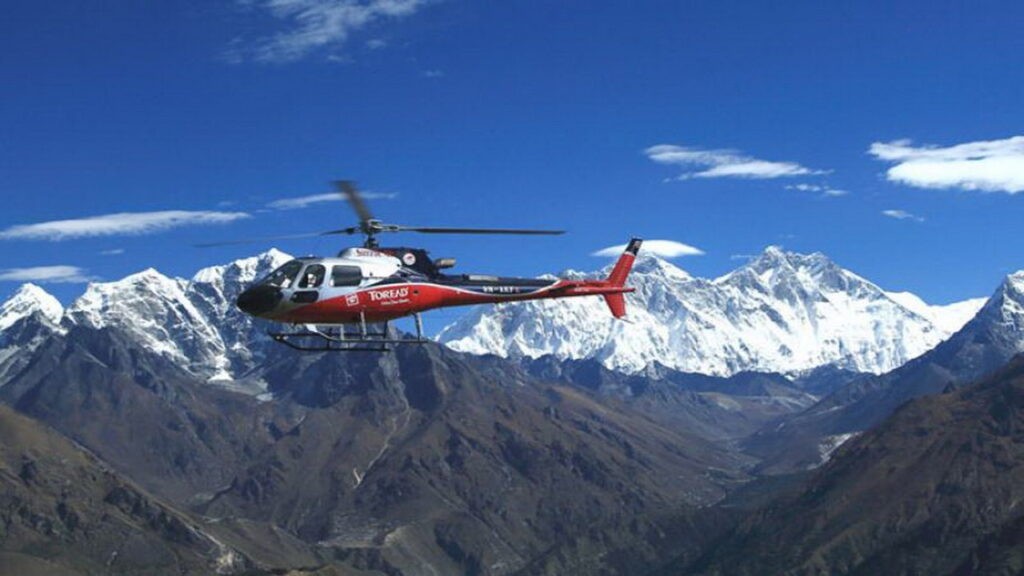
Notably, Kala Patthar provides spectacular views of Mount Everest (8,849 m).
After departing from Kala Patthar, the helicopter lands at the Hotel Everest View (3,880 m), where one can enjoy breakfast and panoramic views of the region.
On the other hand, the Everest Flyover + Hotel Everest View Landing tour option does not involve a stop at Kala Patthar.
Instead, the helicopter flies over the Everest Base Camp (5,364 m) and Kala Patthar (5,545 m) and proceeds to the Hotel Everest View (3,880 m).
Therefore, the two tours are virtually similar except that the Kala Patthar Landing + Hotel Everest View Landing tour option provides a closer view of the Everest region.
| Kala Patthar Landingv | Flyover Tour |
|---|---|
| Kathmandu (1,400 m) | Kathmandu (1,400 m) |
| Lukla (2,860 m) | Lukla (2,860 m) |
| Namche (3,440 m) | Namche (3,440 m) |
| Tengboche (3,860 m) | Tengboche (3,860 m) |
| Everest BC (5,364 m) | Everest BC (5,364 m) |
| Kala Patthar Landing (5,545 m) | No Kala Patthar (5,545 m) Landing |
| Hotel Everest View (3,880 m) | Hotel Everest View (3,880 m) |
In short, it is recommended to go with the Kala Patthar Landing + Hotel Everest View Landing tour option as it offers the ultimate adventure.
On the other hand, the Everest Flyover + Hotel Everest View Landing tour option is perfect for those who prefer comfort while enjoying the spectacular views of the Himalayas.
There can be two landings in an Everest Helicopter Tour with Kala Patthar, but it depends on the option that you choose.
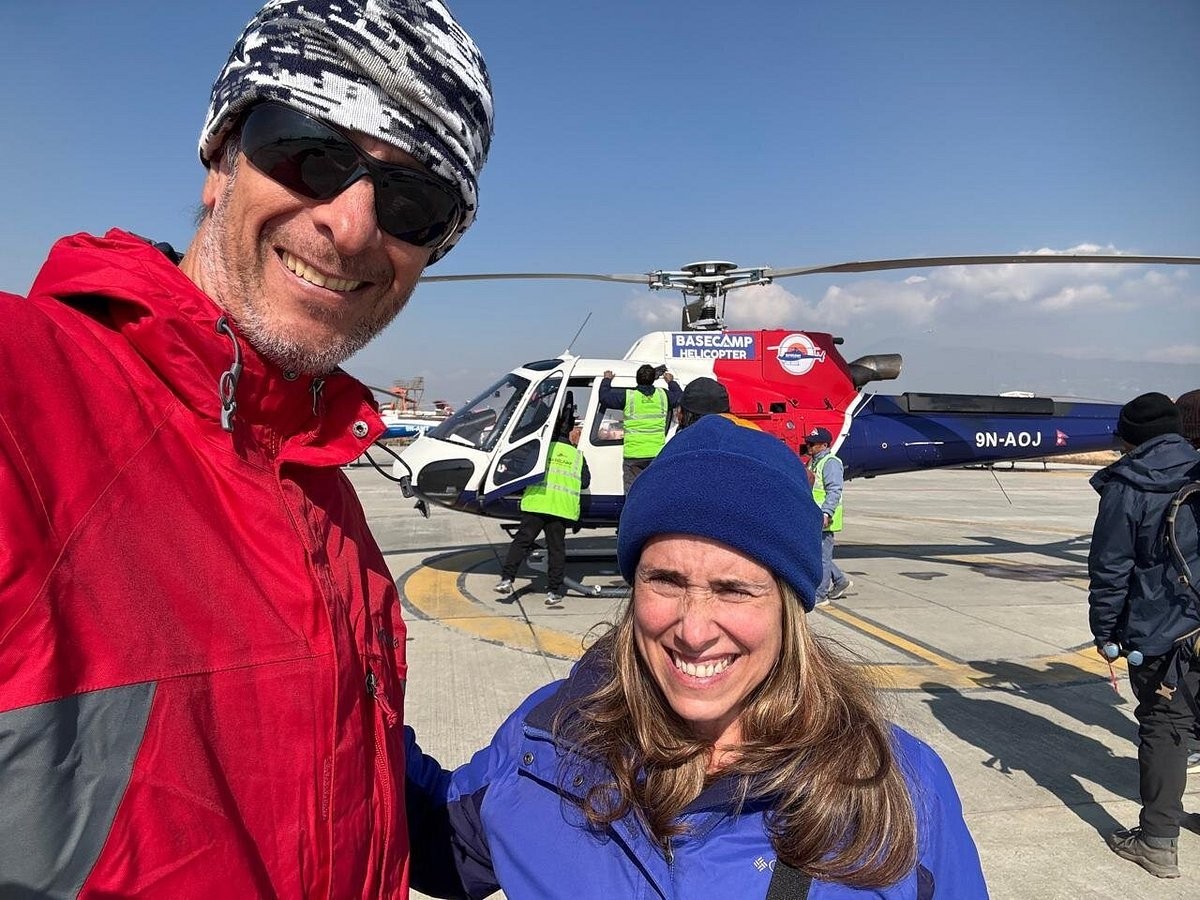
Here, the first landing, which is the highest, is at Kala Patthar (5,545 m), which offers only a short stop for sightseeing and photography followed by a landing at lower altitudes in Hotel Everest View (3,880 m) for extended exploration and breakfast if the breakfast option is chosen.
An Everest Helicopter Tour , typically, includes a stop for refueling at Lukla (2,860 m). However, this is more of an operational stop for the crew, and hence landing for the purposes of the tour is considered only two: the short sightseeing one at Kala Patthar and the longer one at Hotel Everest View (3,880 m).
Kala Patthar (5,545 m) – short sightseeing and photography stop. Hotel Everest View (3,880 m) – a longer stop for views and breakfast.
If you select the Flyover + Hotel Everest View Tour, the helicopter does not land at all at Kala Patthar but rather flies over the Everest Base Camp and Kala Patthar while heading to Hotel Everest View.
| Tour option | Landing |
|---|---|
| Kala Patthar Landing Tour | Kala Patthar landing (5,545 m) + Hotel Everest View (3,880 m) |
| Flyover Tour | Hotel Everest View (3,880 m) |
| Operational stop | Lukla (2,860 m) for refueling. |
The Everest Helicopter Tour usually takes 5-6 hours to complete from your Kathmandu hotel to your Kathmandu hotel, depending on the tours, the departure time, the weather, refueling, and the time spent at each stop. Most tour operators advertise tours that take four to six hours with some of the itineraries taking up to six hours.
Meanwhile, the EBC Helicopter tours generally involve picking you up at your hotel in the early hours of the morning and driving you to the airport. After briefings and weighing, the helicopter takes off and flies to Lukla (2,860 m) with a possible short stop for refueling en route.
It, then, flies over the Khumbu region and stops briefly to sightsee around the regions of Namche Bazaar (3,440 m) and Tengboche (3,860 m) before reaching the Everest Base Camp (5,364 m) and Kala Patthar (5,545 m).
The helicopter, then, descends to Hotel Everest View (3,880 m) where you can enjoy breakfast and photographs of the region before returning to Kathmandu (1,400 m).
Approximate timing :
Thus, you can take in the magnificence of the Everest region on a single morning or afternoon without spending an entire week trekking on the trails.
A helicopter landing at Kala Patthar has significantly more stringent weight limits than those for lower-altitude landings because of the high altitude of Kala Patthar. Hence, the weight limit is significantly reduced due to the reduced air pressure at 5,545 m.
Here, the current operators report a maximum permissible landing weight of around 220–240 kg depending on the helicopter, fuel, and the operator’s risk assessment.
Likewise, one operator even specifies 220 kg landing weight for Kala Patthar for their helicopters, with another giving a range of around 220–240 kg.
As a result, only two people plus the pilot are allowed on the Kala Patthar landing for most operators because of this reduced permissible landing weight.
It, therefore, follows that if the combined passenger weight is less than a certain threshold, more than one passenger can be accommodated.
Important weight facts :
Overweight passengers or groups: may need to take more than one round-trip, depending on the operator’s policies.
If there are four or five people going together, for instance, the helicopter might take two people at a time to Kala Patthar. The other people, while waiting at a lower altitude, have the option of getting on a different helicopter, depending on the operator.
Note that the permissible landing weight of 220–240 kg is not necessarily a hard and fast rule. Every operator weighs passengers according to the flight conditions and the helicopter they use, and passengers should give them an accurate weight before take-off.
The helicopter lands at Kala Patthar (5,545 m), not at Everest Base Camp (5,364 m), as part of the Everest Helicopter Tour. The helicopter usually flies over or near the Everest Base Camp before reaching the Kala Patthar landing point.
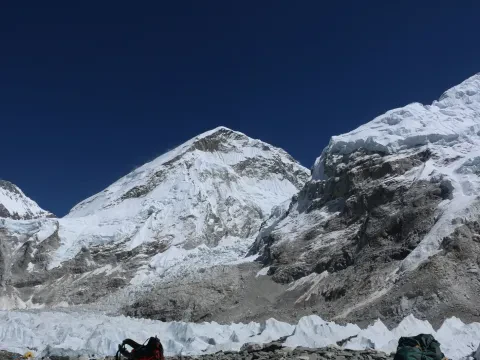
Here, a stone outcrop overlooking the Everest Base Camp region known as Kala Patthar provides more excellent views of Mount Everest and the surrounding peaks than the Everest Base Camp itself.
However, it should be noted that the Everest Base Camp is on the Khumbu Glacier, and commercial helicopter landings are not standard operations there.
So, in this regard, we understand that the name Everest Base Camp Helicopter Tour refers to a flight over the Everest Base Camp region, not the option to land at the Everest Base Camp itself.
Key points :
Thus, if you want a helicopter tour that lands near Everest Base Camp, you must specifically request one since Kala Patthar is the most popular viewpoint.
Nevertheless, the final judgment on the landing is determined by the weather, aircraft, weight, and safety regulations.
The helicopter landing at Kala Patthar typically lasts about 15–20 minutes, depending on the weather, wind, and aircraft performance. Some agencies offer about 10–15 minutes, while others claim to give 15–20 minutes, so it might differ on the day of your Everest Helicopter Tour.
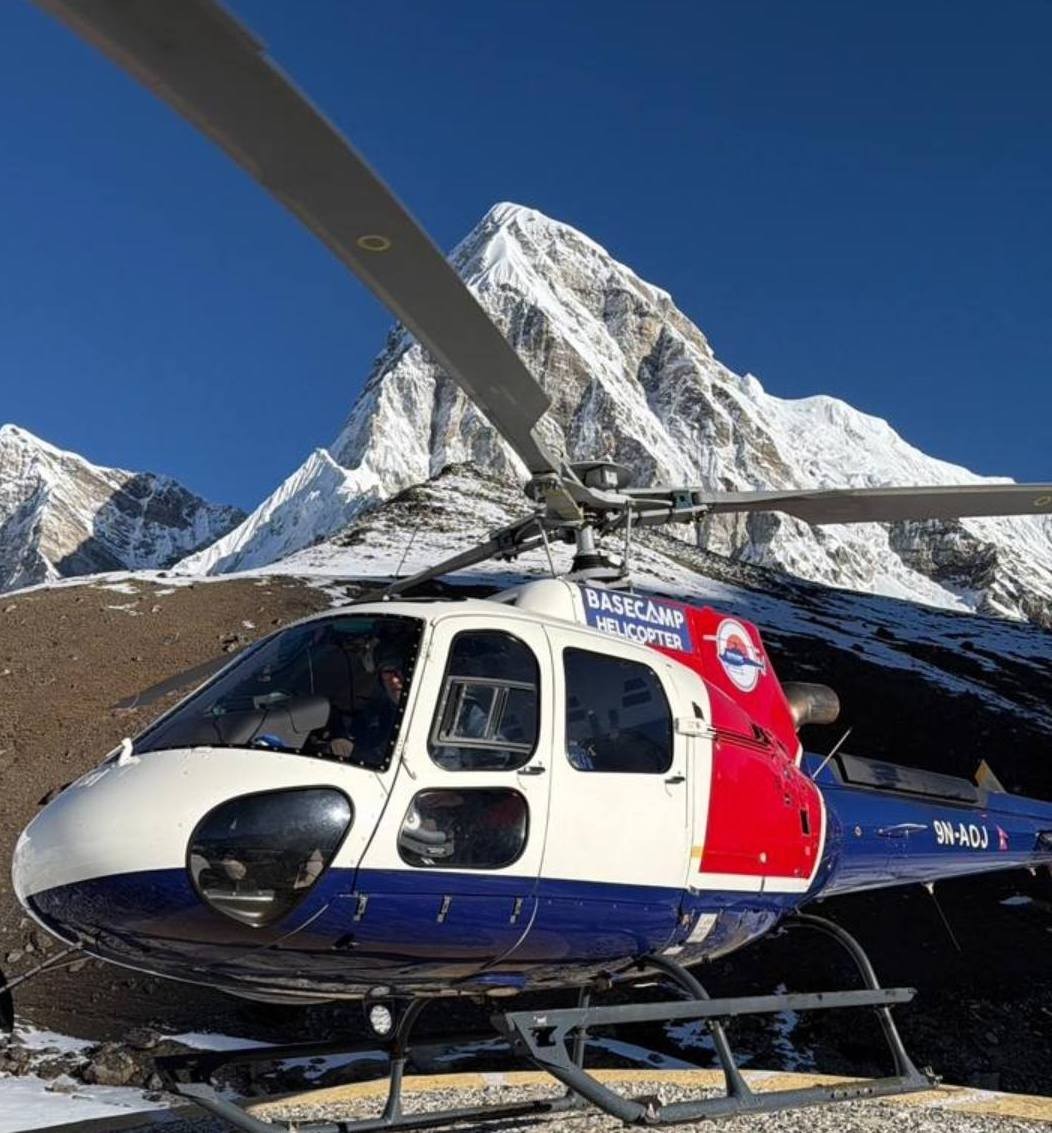
Here, the short landing gives you enough time to capture some incredible photos of Mount Everest and the surrounding valleys and peaks because the ground is at a height of 5,545 meters. Remember that the air at this altitude is not thick as it is in Kathmandu (1,400 m), so you must restrict yourself to walking only.
While landing at Kala Patthar, you can capture incredible photos of Mount Everest (8,849 m), Lhotse (8,516 m), Nuptse (7,861 m), Pumori (7,161 m), and Ama Dablam (6,812 m) (Everest Helicopter Tour).
What can you do in 15–20 minutes?
But, you cannot expect to have a long walk or sightseeing tour at Kala Patthar because of the altitude. Instead, you have enough time to capture a few pictures and enjoy the Himalayan panorama while you are there. Your pilot and crew determine when it is safe to return to the helicopter.
An Everest Helicopter Tour can enable you to see some of the most renowned Himalayan summits in the world. However, seeing the mountains is dependent on the weather, so it is essential to have clear skies while taking an Everest Helicopter Tour. On a cloudless morning, you can witness the panoramic Himalayan vista and snap some amazing pictures on your Everest Helicopter Tour
Regarding the Everest Helicopter Tour, Mount Everest (8,849 m) is the most crucial mountain because its snow-capped peak presents an incredible view from Kala Patthar (5,545 m).
Here are the mountains you can see during your Everest Helicopter Tour:
In addition to the mountains, the helicopter tour also gives you a glimpse of the Khumbu Glacier, Khumbu Icefall, Sherpa villages, monasteries, and other Himalayan valleys including Sagarmatha National Park.
In general, an Everest Helicopter Tour lets you see much more than just the famous Everest peak.
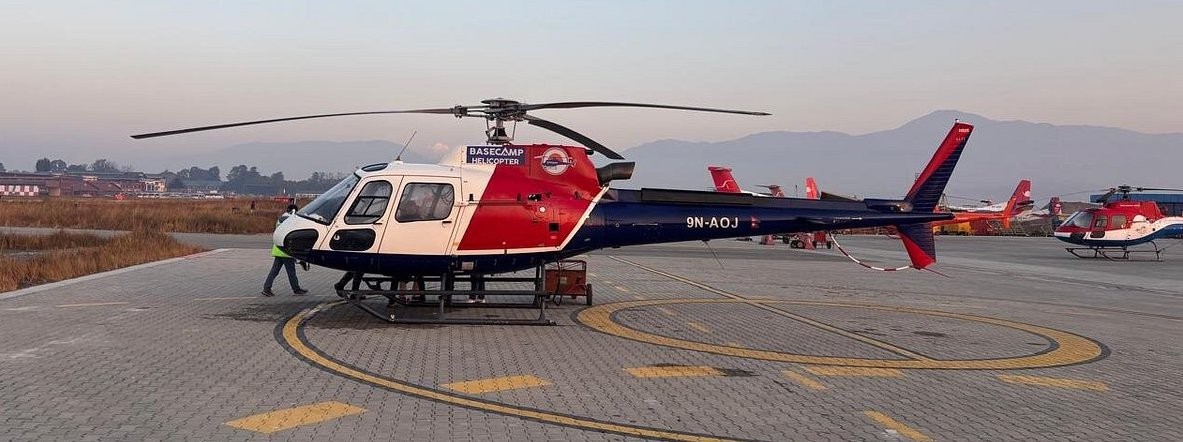
The cost of an Everest Heli Tour from Kathmandu is primarily determined by three factors – whether the tour is a shared flyover, Kala Patthar landing, or private helicopter tour.
In the case of Haven Holidays Nepal, the shared flyover tour costs USD 1,195 per person while the Kala Patthar landing is priced at USD 1,675 per person. The private helicopter tour, meanwhile, has a price tag of USD 6,500 per helicopter. The prices should be further verified at the time of booking since helicopter tours can be seasonal and the operators may adjust the pricing in accordance with the demand and costs. Haven Holidays Nepal, for instance, currently has the same pricing on its Everest helicopter tour page.
| Tour option | Cost |
|---|---|
| Everest Flyover – Sharing | USD 1,195 per person |
| Kala Patthar Landing – Sharing | USD 1,675 per person |
| Private Everest Helicopter – Kala Patthar Landing | USD 6,500 per helicopter |
For USD 1,195 per person, the tour option is ideal for those wishing to experience an aerial view of Mount Everest without a Kala Patthar landing. The flight will fly over the Everest Base Camp and Kala Patthar area and normally make a stop at the Hotel Everest View.
Likewise, the other popular choice is the USD 1,675 Kala Patthar landing tour option with a flight stop at Kala Patthar followed by a stop at the Hotel Everest View.
With regards to the prices, they are roughly in line with the current market prices, with other operators advertising different rates for similar services, so it is important to pay attention to what is included in the price.
A Kala Patthar landing tour option costs USD 1,675 per person booked on the Haven Holidays Nepal sharing package. This is a more comprehensive Everest tour experience as it involves the pilot landing the helicopter at the Kala Patthar (5,545 m) in the morning. The flight generally takes off from Kathmandu and heads towards the Khumbu region and the Everest Base Camp while also taking a detour to the Kala Patthar.
Here, the short stop is made at the Kala Patthar and the helicopter then descends to the Hotel Everest View (3,880 m). Here, tourists have the option to take pictures of the mountain range, enjoy the landscape while having breakfast if it is included in the tour.
Like the other operators, the USD 1,675 rate is in line with the current market prices in terms of a shared Kala Patthar landing experience and the services included.
Kala Patthar Landing Cost :
In fact, the private option can be a great choice for families and small groups of friends since the cost of USD 6,500 is for the helicopter itself. That makes it cheaper for each person to travel if the group is larger in numbers.
Of course, the stop at the Kala Patthar is dependent on the weather conditions, wind speed, and passenger load among other factors and no responsible company should guarantee them at any given time. This is why the final confirmation of the sightseeing tour is usually done on the day of arrival in Kathmandu.
An Everest helicopter flyover tour option costs USD 1,195 on the Haven Holidays Nepal sharing package. This is the most affordable tour option, allowing tourists to experience a short flight over the Everest region. The flight path takes the tourists over Everest Base Camp (5,364 m) and Kala Patthar (5,545 m) as the helicopter takes a detour towards the EBC region.
Unlike the Kala Patthar landing option, the tourist do not have the opportunity to land at the peak.
Instead, the helicopter lands at the Hotel Everest View (3,880 m) where the guests can walk outside and take pictures of the mountains and enjoy their breakfast if it is included in the tour package.
Flyover Tour Cost :
The flyover option is, therefore, more suitable for those who wish to have a more scenic view and prefer comfort while still seeing the highlight of the Everest region. On the other hand, those willing to pay an extra USD 480 per person for the Kala Patthar landing will get an unobstructed view of the mountain range.
To summarize, USD 1,195 is the price for the Everest Base Camp Flyover Tour, USD 1,675 is the cost of the Kala Patthar Landing, and USD 6,500 is the price of a private helicopter option.
Yes. Permits are needed for the Everest region, and the tour is organized on the territory of Sagarmatha National Park. Therefore, certain entry arrangements must be made in any case.
Meanwhile, you need to obtain two permits for Everest Helicopter Tour: Sagarmatha National Park Entry Permit and Pashang Lhamu Rural Municipality Local Area Entry Permit. These cost NPRs. 6000 in total.
Normally, an authorized local operator or the company that has booked your helicopter tour takes care of permits and related documentation. It is essential to provide your passport data and other information the company asks for.
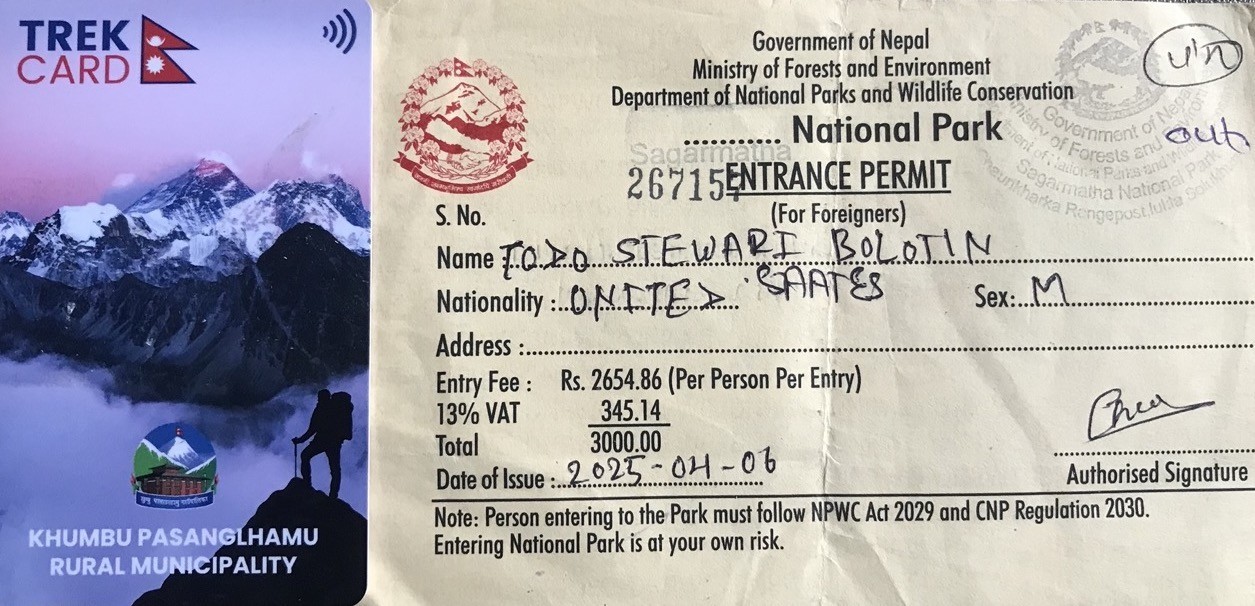
Here, the Everest Helicopter Tour is not a trek; therefore, you will not have to apply for trekking permits to visit Everest individually and on foot. The operator is the one who arranges permits for the helicopter tour.
Documents to have at hand include your passport, its copy, tour confirmation, travel insurance policy, emergency contact information, and other papers the company asks for.
Note that the use of drones requires special permission, which is not included in standard tours. If you want to fly a drone, you may have to apply for permission through the appropriate national park authorities.
Thus, make sure that your booked operator is legally registered and offers all necessary permits for your helicopter tour.
You should not carry a large backpack on your tour. You are to understand that the Everest Helicopter Tour involves very high altitudes. The temperature is low, therefore, it is better to wear several warm layers of clothing.
At places like Kala Patthar (5,545 m), the air may be freezing and rather wet, which makes layers of clothing a wise choice. Thermal wear, a fleece or a down jacket, and a windbreaker would be a good combination.
As for shoes, it is better to choose closed comfortable ones, since you may have to walk around the place where the helicopter lands.
Here is a list of items you may want to bring with you:
Similarly, it is advisable to avoid bringing anything unimportant, since weight is limited. Some operators impose a baggage restriction. A small daypack is a good idea, as you will only have to carry it at the places where you will alight from the helicopter.
Likewise, it is particularly important to bring warm clothes and sunglasses for Kala Patthar. At 5,545 m, it can be extremely cold and sunny at the same time. Thus, there is a risk of getting a serious sunburn and suffering from the cold.
Besides, you should obey the helicopter pilot and avoid bringing any unnecessary items in the helicopter. Here are the most common things that people tend to bring on an Everest Helicopter Tour:
Although it is possible to get altitude sickness, a day tour is not dangerous. The main thing is to know what altitude sickness is and how to avoid it. Altitude sickness occurs due to the reduced amount of oxygen at higher altitudes.
As for the Everest Helicopter Tour, you may only find yourself at great heights during the landing, and that is the only way to get altitude sickness.
However, the flight from Kathmandu (1,400 m) to Kala Patthar (>5,500 m) is rather sudden. The highest point of the tour Everest Helicopter Tour is Kala Patthar. The altitude of the Everest Base Camp Hotel is 3,880 m.
While the Everest Base Camp (EBC) is 5,364 m, Hotel Everest View is 3,880 m. The amount of oxygen at altitudes above 5,000 m is significantly lower than at sea level.
Thus, an altitude sickness can occur only when landing at Kala Patthar, and it is a high likelihood if you are not used to it. The reason is that your body has not had enough time to adapt to the new altitude. The most common symptoms of altitude sickness include headache, dizziness, trouble sleeping (insomnia), nausea, and vomiting. The sickness may also cause loss of appetite, fatigue, and rapid heartbeat.
Despite some people being more susceptible to it, being physically fit does not necessarily mean that a person does not get altitude sickness.
How to prevent altitude sickness?
According to the recommendations of the CDC, rapid ascent to great altitudes increases the risks of altitude sickness, while trips with short stays at high altitudes followed by a return to a lower altitude are less dangerous. Those who sleep overnight at the Everest Base Camp (EBC) or at higher altitudes are at greater risk of altitude sickness than those who only land at the Everest Base Camp (EBC) or Kala Patthar.
Mainly, the most dangerous altitude sicknesses, like high-altitude pulmonary edema and high-altitude cerebral edema, are rare on day tours.
Nevertheless, the symptoms of altitude sickness can arise suddenly and should not be ignored. The best remedy for altitude sickness is to descend to a lower altitude. Report your condition to the pilot or a guide without fail.
Yes, and no. As regulated by the Civil Aviation Authority of Nepal (CAAN), helicopter operators are required to have standard procedures and equipment for flight operations, including emergency procedures and equipment.
However, it is more appropriate to phrase this as systems and procedures for safety and contingency, rather than “always have a second helicopter in case of emergency.” There is no guarantee that a tour operator will have a second aircraft ready for an Everest Base Camp tour.
Prior to departure, the crew checks the weather, the condition of the aircraft, the weight of the passengers, and the fuel.
In addition, the pilot can choose to deviate from the planned itinerary if the situation requires. Most importantly, the pilot’s decision always overrides the published itinerary. Therefore,
| Safety measure | Purpose |
|---|---|
| Experienced mountain pilot | High-altitude flying expertise |
| Weather checking | Avoiding dangerous wind, cloudiness, and reduced visibility |
| Passenger weight check | Safe lift |
| Aircraft inspection | Confirmation of aircraft condition |
| Emergency procedures | Procedures for abnormal situations |
| Communication systems | Aircraft communication |
| Emergency equipment | Passenger and crew support in case of emergency |
| Alternative landing decisions | Avoiding unsafe landing conditions |
Additionally, CAAN requires that operators shall have aircraft operating manuals, emergency procedures, checklists, and necessary safety equipment.
Furthermore, crewmember training includes emergency evacuation procedures and use of applicable emergency and lifesaving equipment.
In conclusion, go with an established and professional helicopter tour operator with an excellent safety record. Never ask a pilot to land at Kala Patthar if the weather, wind, aircraft weight, or any other condition makes such a landing unsafe. Now, let us turn to the next frequently asked question. Here we go.
As mentioned earlier, an Everest Helicopter Tour is a short one. Nevertheless, it is important to prepare properly to make the most out of the tour. For example, remember that a helicopter tour can fly over 5,000 m, and factors such as the weather forecast, clothing, and body weight should be considered.
Also, it is important to choose the tour type and landing site wisely: if you want an unparalleled experience, it is better to go with the Kala Pattar option, while if you want to enjoy a more comfortable and less strenuous tour, you can choose an Everest Helicopter Tour with a hotel landing:
| Tip | Why it matters |
|---|---|
| Ask for an early morning flight | More likely to see mountain views due to favorable morning weather |
| Check the weather forecast | Flights are significantly affected by weather |
| Give an accurate body weight | Extra caution is needed due to the high altitude, and helicopters have reduced lifting capacity |
| Wear warm clothes | It can be very cold at Kala Patthar landing |
| Bring sunglasses | They will protect your eyes from snow and glare |
| Put on sunscreen | The sun’s radiation is very strong at higher altitudes |
| Take a camera with you | You will want to take pictures of the mountains |
| Do not bring many things | The helicopter’s carrying capacity is limited |
| Drink plenty of water | It will help you feel better at higher altitudes |
| Do not drink alcohol | It will dehydrate you |
| Be prepared to move slowly | It will reduce altitude sickness effects |
| Follow the crew’s instructions | The safety of the passengers comes first |
| Keep your passport with you | It is needed for your identification |
| Leave extra time | The flight can be delayed due to bad weather |
| Leave a flexible schedule | The flight might change to another day |
If you want to have the best possible view, go with the Kala Patthar option. Hotel landing is much lower and safer: Kala Patthar reaches an altitude of 5,545 m, while Hotel Everest View only reaches 3,880 m.
However, it is important to understand that high-altitude flying is associated with significant risks for both the crew and the aircraft. Remember that the current operators have emphasized the importance of good weather and aircraft performance for Kala Patthar landings.
Most importantly, make sure to understand that while itinerary flexibility is important, it should not be pursued at the expense of safety. Therefore, if the pilot decides that the Kala Patthar landing is unsafe, it is better to postpone the flight or take alternative measures, such as a hotel landing.
Finally, make sure you choose a reliable operator that complies with the rules and regulations set by CAAN. In particular, make sure to familiarize yourself with CAAN’s specialized helicopter-safety management system.
Important: The Everest Helicopter Tour is not just about the Kala Patthar landing: it is about a great experience at the highest altitudes in a safe and comfortable manner.
1. What is the Everest Helicopter Tour from Kathmandu?
The Everest Helicopter Tour from Kathmandu is one-day Himalayan adventure offering breathtaking views of the Mount Everest region. The tour departs from Kathmandu and usually includes sightseeing over Lukla, Namche, Everest Base Camp, and Kala Patthar.
Here, most tours also offer to see the Hotel Everest View. The tour allows to witness the incredible view of the Everest area without spending weeks on a trek.
2. How long does the Everest Helicopter Tour from Kathmandu take?
The Everest Helicopter Tour from Kathmandu typically takes 5-6 hours with one or more layovers in Kathmandu and Lukla. Most tours start early in the morning and return the same day around lunchtime or later. The tour usually covers Kathmandu, Lukla, the Everest region, Kala Patthar, and/or Hotel Everest View.
3. Does the Everest Helicopter Tour land at Everest Base Camp?
No. Commercial flights do not offer to land at Everest Base Camp. Most common Everest Base Camp Helicopter Tour consists of flying over the Everest Base Camp and landing at Kala Patthar when the weather conditions allow.
The Kala Patthar offers an incredible view of the Mount Everest, the Khumbu Glacier, and Lhotse, Nuptse, and other surrounding peaks.
4. Where does the Everest Helicopter Tour land?
The landing site for the Everest Helicopter Tour varies depending on the weather, aviation regulations, fuel, and helicopter performance, among other factors. For tours that offer a landing, Kala Patthar at 5,545 meters is the highest point in the Everest Helicopter Tour.
Most tours also include a stop at the Hotel Everest View at 3,880 meters for a morning tea or breakfast.
5. Can I visit Kala Patthar by helicopter from Kathmandu?
Yes. The Kala Patthar Helicopter Tour option from Kathmandu is one of the shortest ways to experience the Everest region. The helicopter tour usually flies over the Khumbu and lands at Kala Patthar for a while.
The sightseeing tour offers spectacular views of Mount Everest and other surrounding Himalayan peaks without trekking for days.
6. What mountains can I see during the Everest Helicopter Tour?
7. Is the Everest Helicopter Tour from Kathmandu safe?
Yes. The Everest Helicopter Tour from Kathmandu is relatively safe when operated by a certified operator under appropriate conditions. Additional safety measures include the experience of mountain pilots, aircrafts maintenance, weather assessment, safety briefings, and emergency equipment. The Everest Helicopter Tour might be canceled or delayed due to unfavorable weather conditions.
8. Can I get altitude sickness during an Everest Helicopter Tour?
Yes. There is a possibility of getting altitude sickness during an Everest Helicopter Tour, especially since the flight ascends to higher altitudes rapidly. It is advisable to stay hydrated, avoid using alcohol, and avoid strenuous activities during the flight.
Moreover, inform the crew immediately if you feel severe headache, vomiting, nausea, extreme tiredness, or difficulty sleeping and breathing.
9. Do I need trekking experience for an Everest Helicopter Tour?
No. There is no need for trekking experience for an Everest Helicopter Tour from Kathmandu.
Unlike the Everest Base Camp trek, an Everest Helicopter Tour involves minimal hiking and is doable by anyone with average health. However, it is advisable to be prepared for the short walks during the tour. The tour is a good option for families, seniors, photography lovers, and other inexperienced trekkers.
10. What is the best time for Everest Helicopter Tour from Kathmandu?
The best time to take an Everest Helicopter Tour from Kathmandu is during the dry seasons; spring (March to May) and autumn (September to November). These seasons offer the clearest mountain views. It is advisable to take an early morning tour since the mountain weather changes rapidly.
The tour can also be taken during the winter, but it is best to avoid the monsoon season. Also, the month of January and February are still good for Everest Helicopter Tour from Kathmandu.
11. What happens if the Everest Helicopter Tour is canceled due to weather?
Under poor weather conditions, the Everest Helicopter Tour from Kathmandu can be cancelled, delayed, or rescheduled.
Actually, the mountain weather is unpredictable, especially near the landing sites, which makes it unsafe to fly.
Therefore, it is advisable to have extra days in your Kathmandu itinerary in case of cancellation. Additionally, make sure you understand a tour operator’s policy on refunds and rescheduling before booking.
12. Do I need permits for the Everest Helicopter Tour?
Yes. The landing tours in the Everest region require permits, including the Sagarmatha National Park Entry Permit and other local permit ( Pashang Lhamu Rural Municipality Entry Permit. These requirements depend on the tour itinerary and landing sites.
However, a reliable tour operator usually handles the permits on your behalf and informs you of what to do.
13. What should I bring for an Everest Helicopter Tour?
For an Everest Helicopter Tour from Kathmandu, you should bring your passport, warm clothing, sunglasses, sunscreen, camera, water, and comfortable clothes and shoes.
Likewise, it is advisable to bring light clothing since temperatures can be extremely cold at the higher altitudes. You should also check your operator’s baggage policy and note that there are weight restrictions for the helicopter.
14. Is breakfast included in the Everest Helicopter Tour?
A breakfast or refreshment stop is usually included in most Everest Helicopter Tour packages, especially for tours that involve landing at the Hotel Everest View.
The Hotel Everest View is a popular place to take photographs while enjoying panoramic mountain views. However, it is advisable to check what meals and other services are included in your tour package.
15. How much does an Everest Helicopter Tour from Kathmandu cost?
The Everest Helicopter Tour cost from Kathmandu varies depending on the tour operator, the time of year, shared or private charters, and other factors. For instance, current prices for shared tours start at around USD 1,195per person for flyover and 1675 USD for Landing at Kalapatthar.
16. What is the difference between a shared and private Everest helicopter tour?
A shared Everest Helicopter Tour allows you to share the costs with other passengers, unlike a private tour where you have the whole aircraft for yourself. The shared tours are cheaper than private ones, but the latter offers more flexibility and convenience. The private tours are perfect for families, couples, photographers, and groups of friends.
17. Can children and older travelers take the Everest Helicopter Tour?
Yes. Most children and older people can take an Everest Helicopter Tour from Kathmandu.
However, special considerations must be made at higher altitudes such as Kala Patthar. For instance, it is advisable to consult a doctor if you have heart problems, lung diseases, asthma, pregnancy, and other related conditions.
Children and older people should also speak to their doctor before taking the tour.
18. Is the Everest Helicopter Tour suitable for photography?
Yes. The Everest Helicopter Tour from Kathmandu is the best option for capturing the magnificent views of the Himalayas and Mount Everest.
Meanwhile, you will have an opportunity to take amazing photos of Mount Everest, Lhotse, Nuptse, Ama Dablam, the Khumbu Glacier, and the Sherpa village from the comfort of the helicopter. You can also get fantastic portraits at the Hotel Everest View.
However, it is advisable to bring extra batteries as the low temperatures can drain batteries quickly.
19. What safety equipment is available during the Everest Helicopter Tour?
Most reliable Everest Helicopter Tour operators ensure that their aircrafts are well maintained and have the necessary safety equipment.
Moreover, the pilots are professional and experienced in flying in the mountainous conditions. The helicopter might also carry additional oxygen and emergency medical supplies if needed.
On the other hand, the pilots will assess the weather and other conditions before taking off. In case of unfavorable conditions, they can decide to cancel or reschedule the tour.
20. Why should I choose Everest Helicopter Tour from Kathmandu?
The Everest Helicopter Tour from Kathmandu is the best option for short trips to Nepal to replace Everest Base Camp Trek, and for people who want to see the Everest region without trekking for two weeks. The tour allows you to see the Kala Patthar, Everest Base Camp, Hotel Everest View, and the amazing Khumbu Glacier in less than a day.
Our travel experts are ready to assist you with any questions.
Send us a message.Have a question before you book? Send your enquiry below and our travel experts will get back with the required information.