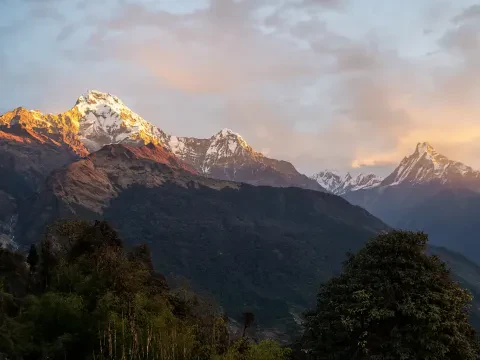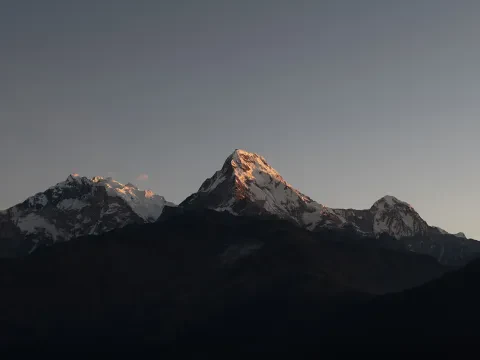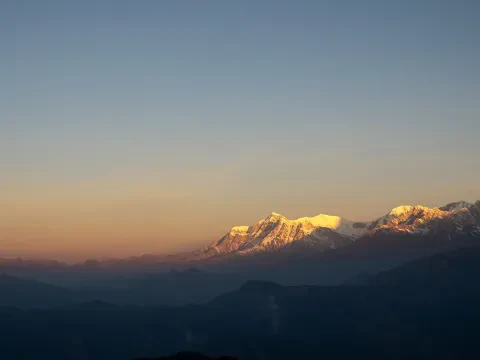
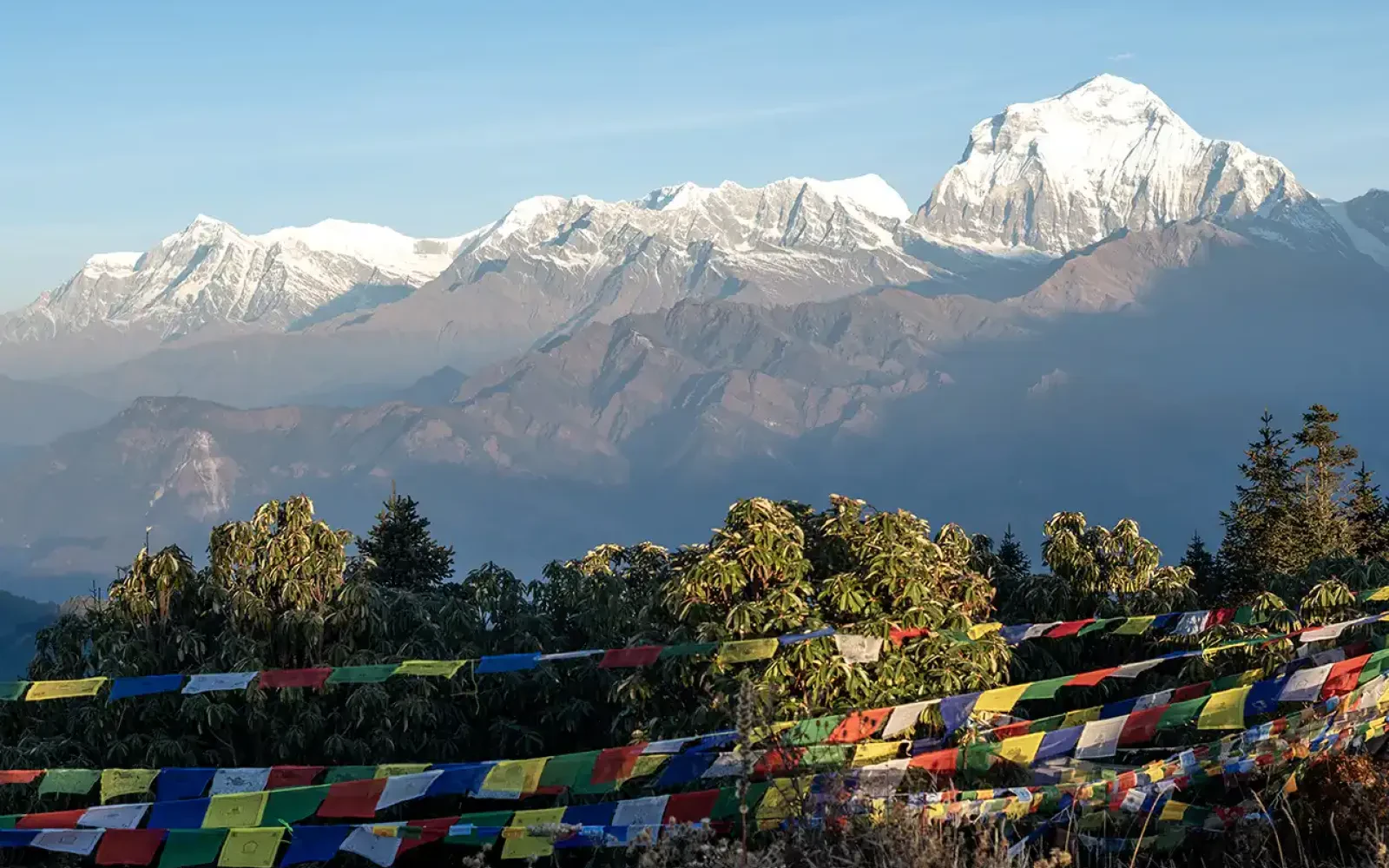
The Ghorepani Poon Hill Trek Nepal is a short and easy Himalayan trekking trail in the Annapurna region which covers mountain views, Rhododendron forests, traditional villages, and sunrise view from Poon Hill, while the maximum elevation reaches 3,210 meters.
The typical route gently climbs from Pokhara towards Ghorepani, via Tikehdhunga and Ulleri, before reaching to Poon Hill and going down to Tadapani and Ghandruk.
| Place | Elevation | Experience |
|---|---|---|
| Pokhara | 822 m | Trek gateway |
| Nayapul | 1,070 m | Traditional trailhead |
| Tikhedhunga | 1,540 m | Riverside village |
| Ulleri | 2,050 m | Stone staircase |
| Banthanti | 2,210 m | Forest settlement |
| Nangethanti | 2,460 m | Forest trail |
| Ghorepani | 2,860-2,874 m | Mountain village |
| Poon Hill | 3,210 m | Sunrise viewpoint |
| Tadapani | 2,630 m | Forest and mountain views |
| Ghandruk | 1,940-2,012 m | Gurung village |
Important: Elevations are approximate and can vary on different sources, so it is better to use the figures in your specific itinerary.
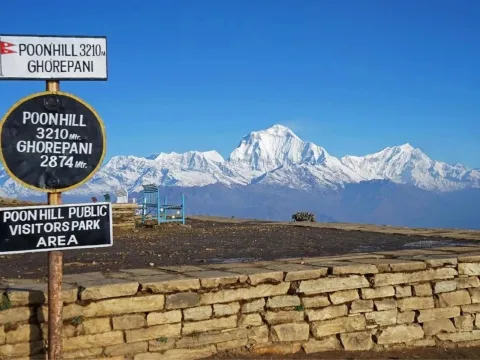
The trek offers a variety of experiences within a short distance:
The short trek can be done in different variations from shorter trekking itineraries with transport assistance, to longer walking itineraries. So, it is important to understand, that it is possible to have a 3-day, 4-day, or 5-day options, depending on the availability of time, fitness levels, and comfort.
In general, the Ghorepani Poon Hill Trek Nepal is excellent for a short Himalayan experience because it offers a great combination of accessibility, mountain views, and cultural insights with a relatively lower maximum altitude.
The Ghorepani Poon Hill Trek Nepal is worth considering if you are looking for a short Himalayan trek with beautiful scenery and cultural experiences.
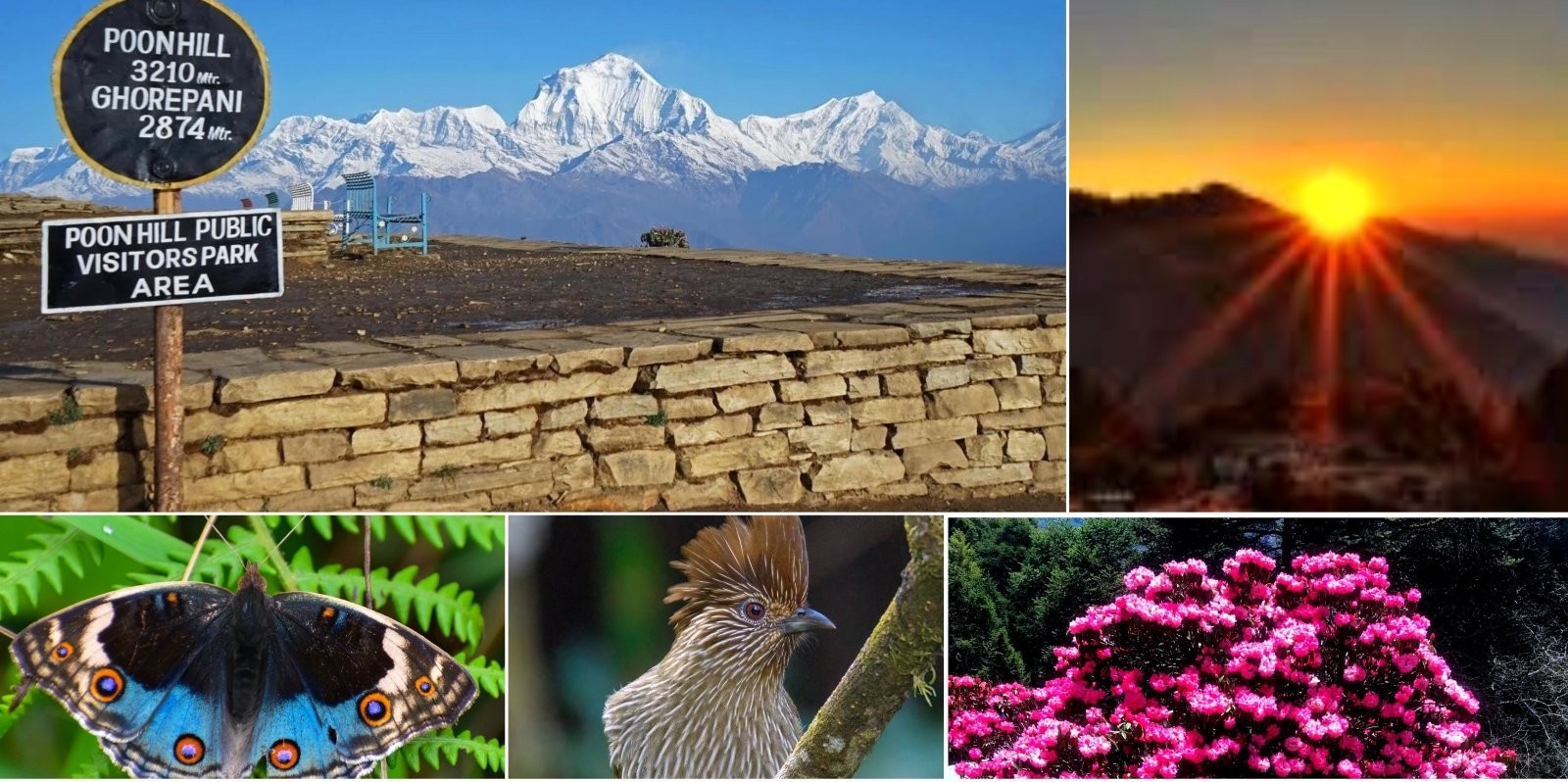
Here, the trail reaches Poon Hill at 3,210 meters, but the highest overnight stop is generally Ghorepani at around 2,860-2,874 meters.
So, it offers spectacular mountain views without the need to acclimatize to extreme altitudes.
What Are the Main Reasons to Go?
The trek can be suitable for:
However, the trek also involves some steep parts with stone steps, and the long walk to Poon Hill for sunrise can be challenging.
Thus, the Ghorepani Poon Hill Trek Nepal is a great choice, for those
who seek a short Himalayan trek with a combination of mountain views, cultural experiences, and relatively accessible trails near Pokhara.
The Ghorepani Poon Hill Trek in Nepal is normally 3-5 days long round trip from Pokhara, depending on the available time, walking rhythm, itinerary and road access.
Currently, trekking agencies tend to provide both short transport-assisted itineraries and more leisurely 4-5 days packages.
| Duration | Best For | Time Summary |
|---|---|---|
| 3 Days | Limited Free Time | Quick and Practical |
| 4 Days | Most Common | Comfortable and Popular |
| 5 Days | Leisurely Pace | More Exploring Time |
A 3-day Poon Hill trek is good when you only have limited free time for a trek. With available road transport, you could drive from Pokhara towards Ulleri or other accessible places, trek to Ghorepani, Poon Hill (sunrise), Tadapani, Ghandruk and drive back.
With the 4-day Poon Hill trek, you have more walking days and can enjoy the walk, mountain views, villages and teahouses at a relaxed pace.
A 5-day Poon Hill trek is great for travelers who prefer a slow pace and want to explore the area. You have more free time to walk around, take photos and explore villages. Notwithstanding, the 5-day walks are not longer than required and the rhythm is unhurried.
Your total walking duration will normally depend on :
Therefore, a 3-day duration is good for a short, fast and active trek, and the 4 or 5-day is more relaxing and leisurely.
The cost of Ghorepani Poon Hill trek in Nepal is approximately USD 214-355 per person for a 3-5 day standard package with Haven Holidays Nepal.
However, the final price depends on the number of trekking days, itinerary, transport, accommodation and group size.
In addition, current market 2026 prices also vary significantly for Poon Hill budget, standard and premium packages, depending on the inclusions.
| Duration | Approx. Cost Per Person | Difference |
|---|---|---|
| 3 Days | USD 214-255 | Shorter itinerary and accommodation |
| 4 Days | USD 255-305 | More walking and accommodation days |
| 5 Days | USD 305-355 | Leisurely duration and extra services |
Importantly, the above prices are indicative range packages and the final quotation will depend on the group size, season, transport and accommodation.
The total price range covers the main services provided during the trek :
You should also plan and budget for extra costs that are not involved in the total package cost, such as :
Therefore, the USD 214-355 price range provides a realistic budget approximation for a 3-5 day guided Ghorepani Poon Hill Trek in Nepal, depending on the selected day package and services.
language: easy to moderate, but not effortless, since the Ulleri stone steps and pre-dawn Poon Hill climb can be tiring.
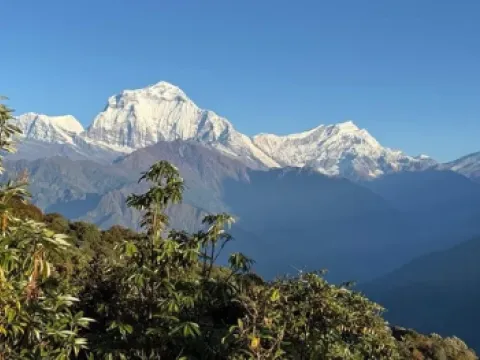
The Ghorepani Poon-Hill Trek Nepal is an easy to moderate trek. It doesn’t require technical climbing ability or equipment, but it does require reasonable fitness due to the substantial amount of walking and the stone steps, etc., that you will encounter.
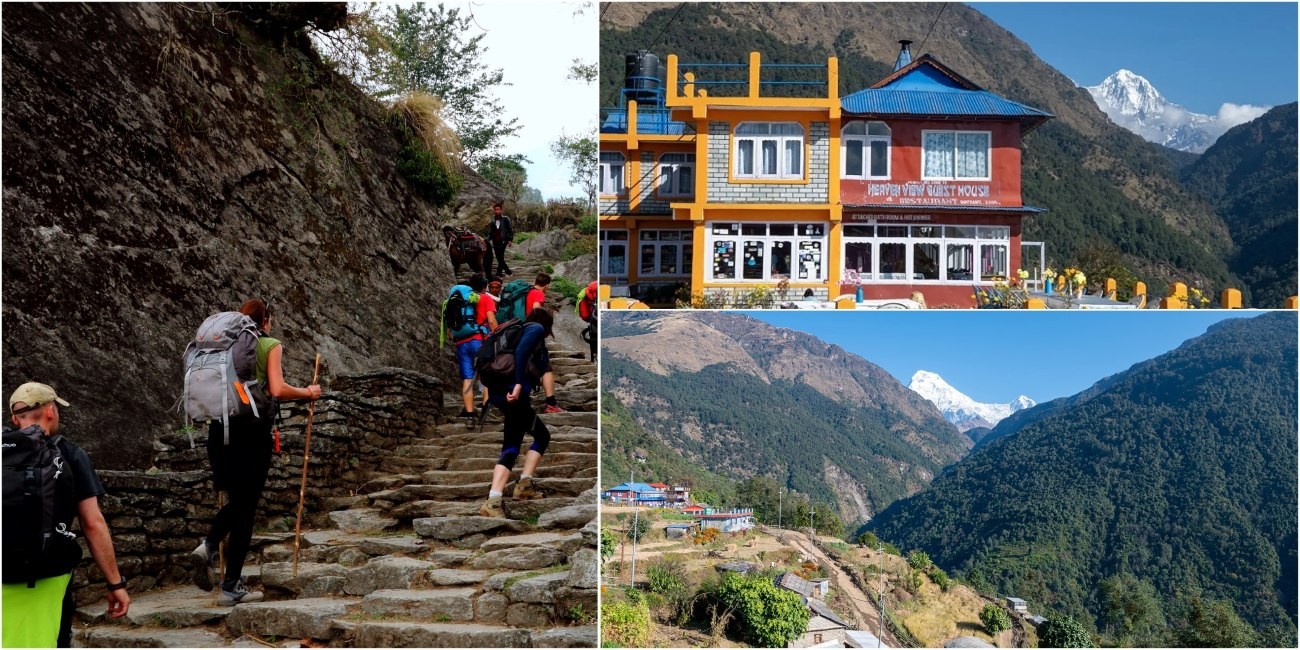
| Difficulty factor | Level | What to expect |
|---|---|---|
| Overall difficulty | Easy to Moderate | Reasonably easy with decent fitness |
| Highest point | 3,210 m | Poon Hill |
| Daily walking | Approximately 4-7 hours | Depending on itinerary |
| Terrain | Moderate | Stone steps, trails in the forest, uneven ground |
| Technical climbing | None | No technical climbing, climbing equipment or skills required |
| Altitude challenge | Low to moderate | Highest point is 3,210 m |
| Most challenging sections | Ulleri and Poon Hill | Steep stone steps and early morning climb |
Here, the most significant physical challenge of this trek is the long stone staircase near Tikhedhunga and Ulleri, which is reasonably steep.
Also, the climb from Ghorepani to Poon Hill early in the morning might be challenging and tiring.
The main challenges are :
Poon Hill reaches an altitude of 3,210 m, while Ghorepani is approximately 2,860–2,874 m. Thus, the altitude is generally not as significant as on other Himalayan treks, like the Annapurna Base Camp or the Annapurna Circuit, although this can vary from person to person.
However, remember to walk at a steady pace and keep hydrated. Moreover, inform your guide if you have any issues with severe headaches, dizziness, nausea, and problems with breathing.
The best way to prepare for this trek is to condition your legs in advance by:
In general, the trek is not significantly demanding for reasonably fit people, but it should not be considered an easy walk either. With decent preparation and an appropriate itinerary, The Ghorepani Poon Hill Trek is a fantastic opportunity to experience the Himalayas.
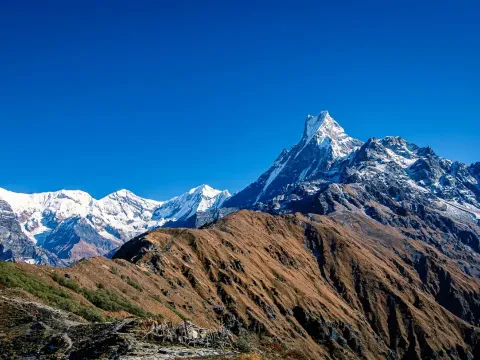
The answer is big YES, beginners can do the Ghorepani Poon Hill Trek Nepal, as it is an easy to moderate Himalayan trek without requiring any technical climbing skills or previous trekking experience. However, it is necessary for less experienced trekkers to have a reasonable level of fitness since some parts of the trail are moderately challenging.
| Beginner-friendly feature | Why it matters |
|---|---|
| Max. elevation 3,210 m | Lower than most Himalayan treks |
| No technical climbing | No climbing skills required |
| Teahouse accommodation | Accommodation available along the trail |
| Accommodation in villages | Easier access to food and other amenities |
| Shorter itinerary | Usually 3-5 days |
| Well-developed trails | Mostly easy to navigate |
| Accessible transport | Jeeps available (Pokhara-Ulleri-Ghandruk-Pokhara) to shorten the distance between some parts of the trail |
The most significant physical challenge for less experienced trekkers on this route is the Ulleri stone staircase, which demands a certain level of fitness.
However, one can escape the section from Tikhedhunga to Ulleri by jeep ride from Pokhara to Banthanti/Ulleri in dry seasons.
Moreover, the climb from Ghorepani to Poon Hill is also moderately challenging since it takes place before sunrise and can be cold and tiring.
Less experienced trekkers should condition themselves for several weeks before departure. In particular, regular walking and climbing stairs will make the stone staircase much easier to navigate.
Pay attention to:
In general, a 3-day itinerary can be suitable for fit beginners, particularly when using accessible transport.
However, a 4- or 5-day version is more suitable for first-time trekkers since it provides a more relaxed schedule with fewer walking hours per day.
Thus, less experienced trekkers may want to consider the Ghorepani Poon Hill Trek, since it is a great opportunity to see the Himalayas. However, a suitable level of fitness will make the most of this breathtaking trek.
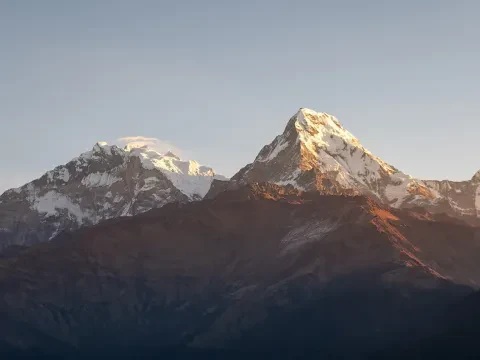
Both elderly travelers and children can do the Ghorepani Poon Hill Trek Nepal with a well-prepared itinerary. The trek is generally easy to moderate, without technical climbing, and the highest point is Poon Hill at 3,210 meters.
The path is generally appropriate for families, as there are established trails, regular villages, and teahouse accommodations along the way.
However, children, and older travelers should be prepared to walk at their own pace, as long stone stairways can be extremely fatiguing.
| Traveler Type | Suitability | Recommended Approach |
|---|---|---|
| Young children | Yes With planning | Shorter walking days |
| School-age children | Yes With breaks | Regular breaks and steady pace |
| Teenagers | Yes | Normal preparation |
| Active seniors | Yes | Comfortable pace |
| Old seniors | Yes (on a case-by-case basis) | Private itinerary |
The Ulleri stone staircase is traditionally the most challenging part of the trek physically. There are thousands of stone steps to walk up, and the morning walk from Ghorepani to Poon Hill can be surprisingly taxing.
Families, therefore, might want to consider :
Ghorepani is approximately 2,860-2,874 m. Poon Hill is 3,210 m. This is not considered a high altitude trek, compared to other Himalayan activities, but travelers of all ages should be prepared for potentially unexpected altitude reactions, and notify a guide if they feel unwell.
Therefore, this is why Poon Hill can be an incredible multigenerational trek, but the itinerary should generally be based on the pace of its slowest or youngest member rather than the oldest.
The distance from Pokhara to Poon Hill varies depending on the route, and the type of transportation. Traditionally, this trek is done as a 4-day or 5-day multi-day activity, with the drive from Pokhara to Nayapul being approximately 40 km, and the trek from Nayapul to Poon Hill being approximately 22 km, for a combined distance of 62 km.
Meanwhile, private and road access have improved in recent years, however, with some 2027 itineraries including a private 4WD from Pokhara towards Ghorepani, which can significantly reduce the overall amount of walking and be better suited for shorter itineraries.
| Section | Approx. Distance | Approx. Duration |
|---|---|---|
| Pokhara → Nayapul | 40 km by road | 1.5-2 hours |
| Nayapul → Ulleri | 10-11 km | Trekking (5-6 hrs.) |
| Ulleri → Ghorepani | 9-10 km | Trekking (5-6 hrs.) |
| Ghorepani → Poon Hill | 1.5 km one way | 45-60 minutes |
| Poon Hill → Ghorepani | 1.5 km | 45-60 minutes |
| Pokhara → Poon Hill | 62 km (combined) | 2-3 days |
Yes. There is currently sufficient road access for suitable 4WD vehicles to reach Ghorepani from Pokhara, with one of the routes going through Ulleri taking approximately 4-5 hours, depending on road conditions. Vehicles cannot reach Poon Hill specifically, as that requires walking at the end.
A classical itinerary includes more walking, and therefore takes longer overall. In 2027, with new road access, a 3-day Ghorepani Poon Hill itinerary can include Ghorepani, Poon Hill, Tadapani, and Ghandruk, and a 4-5 day trek would be more relaxed.
In other words, the distance is less relevant than the type of itinerary and transportation you choose for your trek. Families or individuals looking for a shorter and more accessible option might want to consider a transport-assisted multi-day Ghorepani Poon Hill trek, or a longer one, depending on availability and preferences.
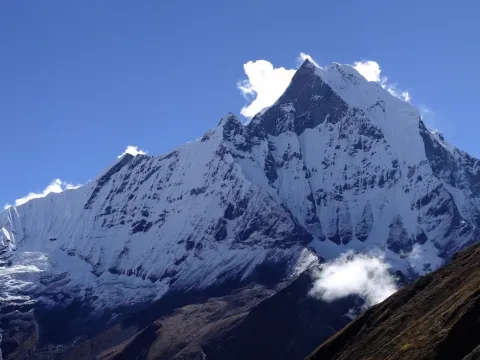
Ghorepani Poon Hill Trek Nepal takes you through the Annapurna Conservation Area, so you will need to obtain an Annapurna Conservation Area Permit (ACAP).
In 2026, this costs NPR 3,000 for foreign nationals and NPR 1,000 for SAARC nationals, with children under 10 is not charged.
| Permit/Requirement | 2026 Status | Purpose |
|---|---|
| ACAP | Required | For entry to Annapurna Conservation Area |
| TIMS | Have changed rules | For trekker registration and safety reasons |
| Restricted Area Permit | Not needed | Poon Hill is not a restricted area |
| Local fees | May apply (Poon Hill) | On local rules |
In conclusion, the ACAP is the key permit for trekking to Poon Hill as Ghorepani is located in the Annapurna Conservation Area. The permit should be carried throughout the trip and presented on request at checkpoints.
TIMS rules have changed and current 2026 sources disagree. Some sources currently claim TIMS is no longer needed, while other trekking sites still list TIMS as a requirement for Poon Hill. Please, do not consider TIMS as necessarily required for your 2027 package until the latest government or NTB/TAAN guidelines are confirmed.
For the 2027 trek, people should check:

Yes, a guided package with Haven Holidays Nepal can arrange the required trekking permits as part of the trekking service, making the process simpler for clients since the guide or agency can take care of permit procedures before entering the trekking area.
So, the most important permit to think about when planning a Ghorepani Poon Hill Trek 2027 is the ACAP, while TIMS requirements should be checked again before the trip.
The best time for Ghorepani Poon Hill Trek Nepal is often considered to be in spring and autumn. March to May provides pleasant trekking weather and spectacular rhododendron blooms, while September to November usually has clearer mountain vistas after the monsoon season.
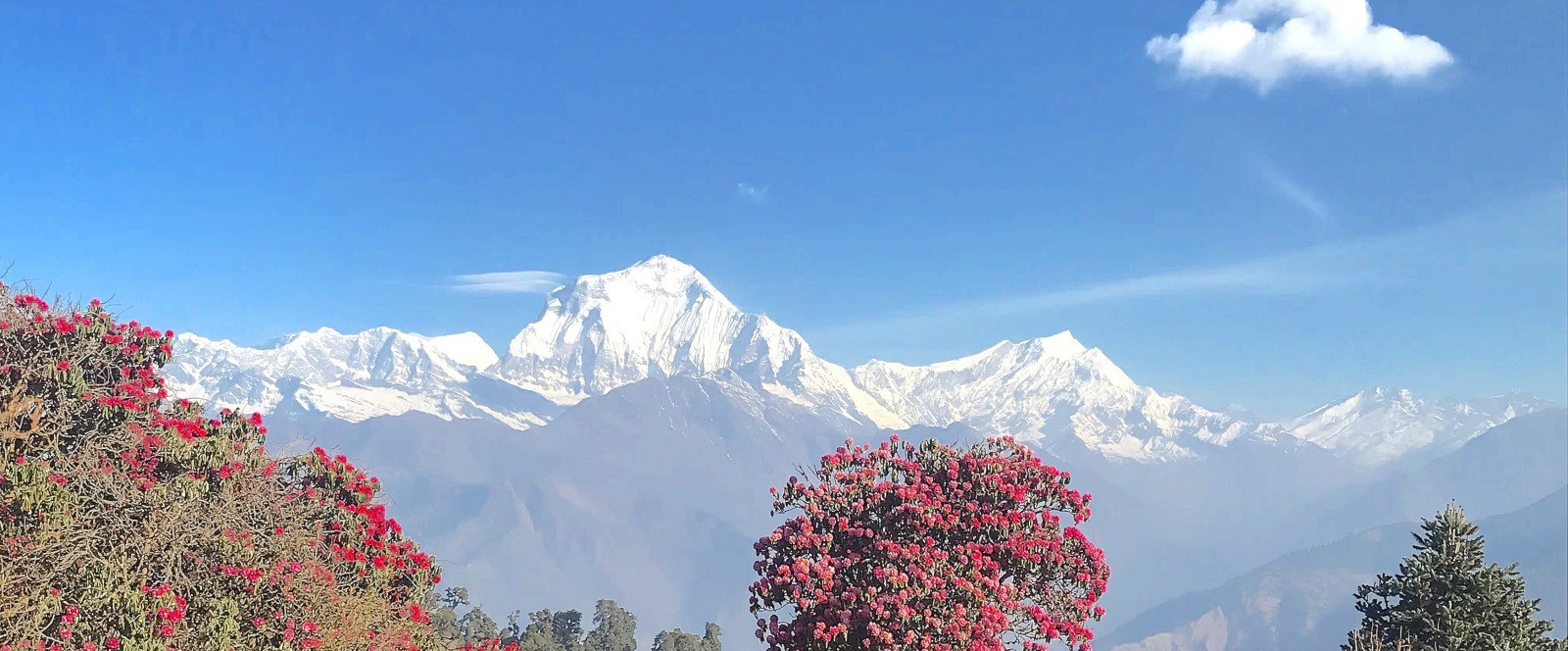
In addition, the main monsoon period in Nepal typically runs from June to September, with October and November generally being the driest and clearest months.
| Season | Months | Trekking Conditions | Recommendation |
|---|---|---|
| Spring | March–May | Clear mornings, flower blooms, pleasant days | Excellent |
| Monsoon | June–August | Rainy, cloudy, slippery trails | Less suitable |
| Autumn | September–November | Clear skies, great mountain views | Excellent |
| Winter | December–February | Chilly mornings, possible snowfall | Possible with preparation |
Spring is a special season as rhododendrons flower profusely throughout many forested areas. March and April can provide excellent blooming displays while May can get quite warm at lower altitudes, so it is a good option for seeing mountain vistas and enjoying rhododendron blooms.
September slowly becomes drier after the monsoon season, and October and November generally have the best visibility. Clear mornings are especially beneficial for a Poon Hill sunrise and observing the Annapurna and Dhaulagiri mountain ranges.
Yes, it is possible to trek during the winter as the route does not go to extreme Himalayan heights, but morning temperatures around Ghorepani and Poon Hill can be quite chilly, so warm clothing, gloves, a hat, and good insulated shoes are essential.
The period from June to August is generally not so good for trekking as rain can make the trail surfaces slippery and reduce visibility of the mountains. Heavy monsoon rains can also cause road closures and complications with travel plans, so flexibility is important.
For the Ghorepani Poon Hill Trek 2027, October–November and March–April are excellent seasons for trekking with great views and comfortable weather conditions, as well as a high chance of seeing the spectacular Poon Hill sunrise.
Packing for the Ghorepani Poon Hill Trek Nepal is relatively simple as this is a short teahouse trek. However, the route reaches Poon Hill at 3,210 m and weather can change quickly, so expect cold mornings, rain, sun and long stone steps.
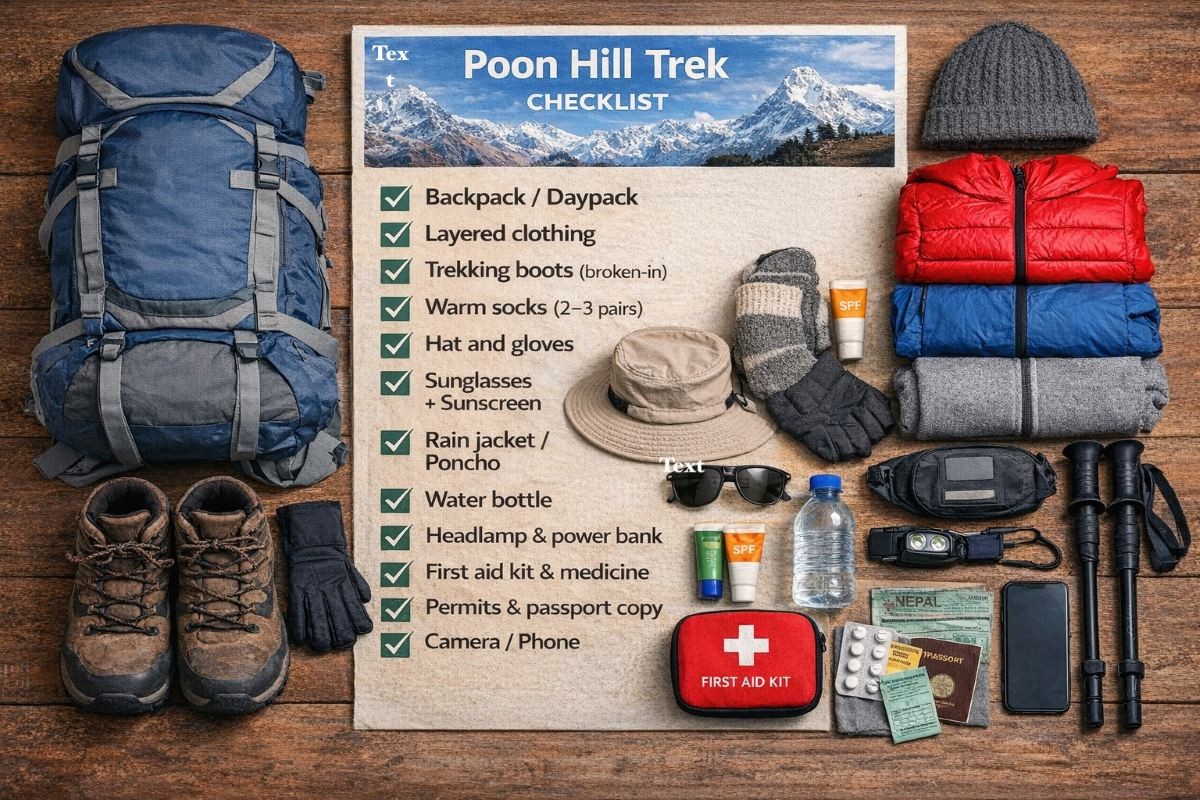
| Category | What to Pack | Why You Need It |
|---|---|---|
| Clothing | T-shirts, trekking pants | Comfortable for daytime walking |
| Warm layers | Fleece, warm jacket, thermal wear | Cold mornings and nights |
| Rain gear | Waterproof jacket, trousers | Protection from rain |
| Footwear | Broken-in trekking shoes | For stone and uneven trails |
| Headwear | Sun hat, warm beanie | Protection from sun and cold |
| Gloves | Warm trekking gloves | For Poon Hill sunrise |
| Sun protection | Sunglasses, sunscreen, lip balm | Protection from strong mountain sun |
| Backpack | 25–35 L daypack | For daily trekking essentials |
| Trekking poles | Adjustable poles | For stone steps and descents |
| Water | Reusable bottles | For daily hydration |
| Electronics | Phone, power bank, charger | For communication and photos |
| Personal items | Toiletries, medicines, towel | For daily needs |
| Documents | Passport, insurance, permits | For trek administration |
Layering in warm clothes is better than carrying one very heavy jacket, so pack a fleece, insulated jacket, thermal layer, gloves and warm hat to stay warm at night and for the Poon Hill sunrise which begins before dawn.
A headlamp is important for the early morning climb to Poon Hill. You should also carry a rain cover, small first-aid kit, reusable water bottle, sunscreen, sunglasses and trekking poles.
Likewise, a sleeping bag can provide additional warmth in colder months, although teahouses provide beds and blankets, so make sure to carry or rent a suitable sleeping bag if you are winter trekking.
Smart Packing Tips :
Most importantly, you do not need camping tents, cooking equipment or technical climbing gear for the standard route. The established teahouse system provides accommodation and meals along the main trekking route.
The Ghorepani Poon Hill Trek mainly uses local teahouses and mountain lodges. Accommodation is generally comfortable for a trekking route, but facilities vary between villages, with better options in Ghorepani and Ghandruk and more basic facilities in Tadapani.
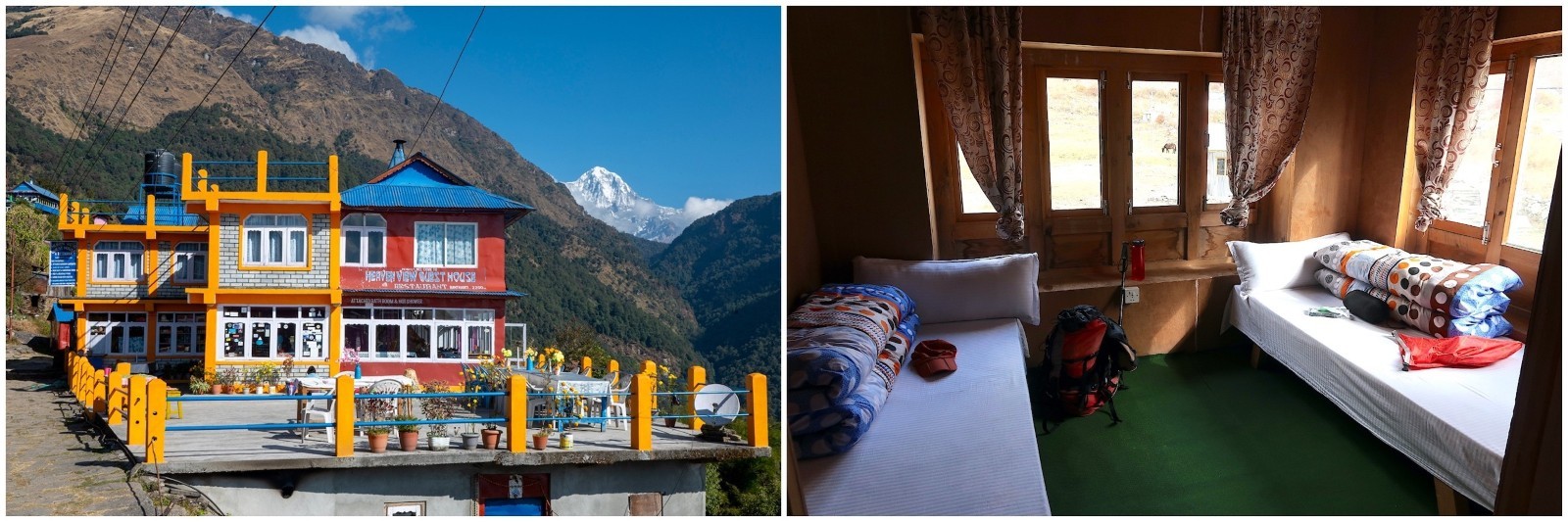
| Location | Elevation | Accommodation & Facilities |
|---|---|---|
| Ghorepani | 2,860 m | Better lodges, twin rooms, some attached bathrooms, hot showers, Wi-Fi and charging |
| Tadapani | 2,630 m | More basic teahouses, twin rooms, mostly shared bathrooms, basic hot showers |
| Ghandruk | 1,940–1,960 m | Better-developed lodges, private/twin rooms, some attached bathrooms, hot showers and Wi-Fi |
In conclusion, Ghorepani has many lodges as it is the main overnight stop before the Poon Hill sunrise. Ghandruk is also a larger and better-developed village, while Tadapani has fewer accommodation choices and can get busy in peak seasons.
Most rooms are twin-sharing, with beds, mattresses, pillows and blankets. Some better lodges provide attached bathrooms, but shared bathrooms are commonly available, particularly in more basic properties and in Tadapani.
Likewise, hot showers and charging facilities are generally available, but may cost extra charges. Wi-Fi is also available in major villages, but quality can vary.
The Ghorepani Poon Hill route has a surprisingly broad trekking menu as it is well connected with Pokhara.
Common meals include :
Importantly, Dal bhat is a particularly practical choice as it provides a filling meal for long walking days.
Ghorepani and Ghandruk offer better facilities and more accommodation choices, while Tadapani provides a simpler mountain-lodge experience.
Likewise, trekkers wanting more comfort should consider a package that selects better lodges and confirms facilities such as attached bathrooms and hot showers before departing.
Yes, during the dry season running from October through May, you can take a jeep from Pokhara to Ghorepani through the Pokhara-Nayapul region and mountain road to Ulleri and Ghorepani, with journey time depending on the road conditions, weather, traffic, and the state of the jeep route.
Meanwhile, Jeep ride from Pokhara is a great option for those who do a 3-day Ghorepani Poon Hill Trek, however, the road conditions are unpredictable and variable with the weather, so make sure to get to the final destination point before the road closure due to rain or landslides.
The altitude sickness danger during a Ghorepani Poon Hill Trek is relatively low as Ghorepani is situated between 2,860 – 2,874 m (9,400 – 9,430 ft) and Poon Hill is 3,210 m (10,531 ft) high.
However, everyone reacts differently to the altitude, and some of the most common altitude sickness symptoms include headache, dizziness, tiredness, loss of appetite, nausea, and vomiting.
Moreover, make sure not to confuse altitude sickness with other common illnesses, as high altitude often comes with cold seasons, so the symptoms such as headache, nausea, runny or stuffy nose, sneezing, and sore throat are often mistaken for the common cold.
Additionally, the altitude sickness may also be accompanied by shortness of breath and trouble sleeping at night.
Therefore, I recommend a walk at a slow pace on the first day of the trek, staying hydrated, eating well, and resting when needed.
If the altitude sickness persists, consult your trek guide, and in severe cases, seek emergency medical care.
The Ghorepani Poon Hill Trek is relatively low risk of serious altitude sickness as the highest point is Poon Hill at 3,210 m (10,531 ft) and the main overnight stay at Ghorepani is around 2,860–2,874 m.
Meanwhile, altitude affects everyone differently, so you might experience some mild symptoms like dizziness, tiredness, headache, decreased appetite, nausea, or minor stomach discomfort.
| Location | Elevation | Altitude concern |
|---|---|---|
| Pokhara | 822 m | Very low |
| Ulleri | 2,050 m | Low |
| Banthanti | 2,210 m | Low |
| Ghorepani | 2,860–2,874 m | Moderate |
| Poon Hill | 3,210 m | Mild altitude symptoms possible |
| Tadapani | 2,630 m | Lower after descent |
| Ghandruk | 1,940 m | Low |
In conclusion, the morning walk from Ghorepani to Poon Hill takes around 45–60 minutes, then you return to Ghorepani before heading towards Tadapani, so your time at the highest altitude is relatively brief.
Here, this gradual pattern of ascending and descending makes the trek considerably less taxing in terms of altitude than routes requiring multiple nights above 4,000 m.
You might experience :
In addition to, these symptoms can also be caused by lengthy walking periods, dehydration, cold weather, lack of sleep, and inadequate nutrition, so make sure not to assume altitude sickness.
Nevertheless, if symptoms persist or worsen, you should stop, descend to a lower altitude, and give your guide a call.
How to Reduce the Risk ?
Try to walk at a steady, unhurried pace rather than rushing to reach Ghorepani, and make sure to drink plenty of clean water during the day as well as eating regular meals.
Similarly, avoid alcohol at higher altitudes, get enough sleep, and let your guide know of any persistent headaches, nausea, dizziness, or unusual fatigue.
Moreover, symptoms like severe headache, persistent vomiting, confusion, difficulty walking, or shortness of breath at rest should never be ignored, and you should not ascend further if you are experiencing them. In these cases, immediate descent and medical assistance may be necessary.
Is Poon Hill Suitable for Beginners ?
Poon Hill is generally seen as a great introduction to Himalayan trekking since there is no technical climbing and the route passes villages and teahouses.
Likewise, the primary physical challenge for many beginners is actually the stone staircase near Ulleri with current route guides reporting over 3,000 steps on the classic approach.
Therefore, you do not need to worry about altitude sickness on the Poon Hill trek, but you should still take basic precautions as the route goes above 3,000 m. With a steady pace, adequate hydration, sufficient sleep, and the help of a professional guide, most well-prepared trekkers can enjoy the Poon Hill trek.
The Poon Hill trek does not require technical climbing skills, but you should prepare for many hours of walking, uphill climbs, downhill walks, uneven paths, and long stone staircases. The classic route is easy to moderate, but the Ulleri part can be quite challenging, so make sure to prepare correctly to make the most of the trek.
Start preparing at least 4–6 weeks before the trek, especially if you do not walk or exercise often, and build up to longer walking sessions rather than doing intensive exercising a few days before the trek.
Likewise, focus on walking, hill walking, stair climbing, and simple leg strengthening as these activities best replicate the physical demands of the Poon Hill trek.
| Preparation | What to Do ? |
|---|---|
| Walking | 1–3 hours regularly |
| Stair training | Practice stairs uphill and downhill |
| Hiking | Include hills or inclined trails |
| Leg strength | Squats, lunges, step-ups |
| Cardio | Walking, cycling, jogging |
| Final week | Reduce heavy training and rest well |
In summary, the Ulleri staircase is one of the parts of the trek where preparation really pays off, since the classic route has more than 3,000 stone steps on a consecutive climb.
Remember to use shorter, steady steps, take regular short breaks, and make use of trekking poles to reduce strain on your knees and legs.
Pack according to the season, but your everyday clothing should include quick-dry T-shirts, trekking pants, thermal wear, a fleece, a warm or insulated jacket, waterproof rainwear, trekking socks, gloves, and a warm hat.
Importantly, do not forget comfortable broken-in trekking shoes, a 25–35L daypack, trekking poles, a headlamp, water bottles, sunglasses, sunscreen, personal medicine, a first-aid kit, and a power bank.
Essential packing checklist :
The climb to Poon Hill at 3,210 m starts before sunrise, so make sure your headlamp is within reach and your warm clothes are prepared the night before. The climb takes roughly 45–60 minutes and mornings can be very cold, so make sure to pack gloves, a warm jacket, and suitable layers.
You do not need camping tents, cooking gear, or technical climbing equipment since the Ghorepani route has teahouses and lodges along the main trekking parts.
Therefore, only pack what you truly need and have a porter carry your main luggage if you want to keep your daypack light.
Do not rush the trek just because the route is described as easy to moderate, since steady pacing is more comfortable and allows you to enjoy the views and the villages.
With regular walking practice, suitable footwear, smart packing, and a flexible schedule, the Poon Hill trek is a realistic target even for first-time trekkers.
Poon Hill trek is worth doing, especially if you want to see the Himalayas within a short 3-5 day itineration and avoid a long high-altitude expedition.
Meanwhile, the trek offers spectacular mountain views, sunrise scenery, rhododendron forests, and local village experiences with the highest point considerably lower than many other Himalayan routes.
| Highlight | Why It Matters ? |
|---|---|
| Poon Hill sunrise | Panoramic Himalayan views at 3,210 m |
| Annapurna views | Close views of major peaks |
| Dhaulagiri views | One of the major highlights from Poon Hill |
| Rhododendron forests | Especially attractive in spring |
| Gurung and Magar villages | Cultural experience along the trail |
| Short duration | Suitable for travelers with limited time |
| Teahouse facilities | No camping equipment required |
| Moderate difficulty | Suitable for many beginners with preparation |
| Easy access from Pokhara | Convenient starting point |
| Flexible itinerary | Can be planned for 3-5 days |
The route is a particular favorite among first-time trekkers since it does not involve technical climbing, but there are villages and teahouses along the way.
However, beginners should not underestimate the stone steps near Ulleri, the early morning Poon Hill climb, or repeated walking uphill and downhill.
The trek is more than a mountain viewpoint since the route winds through forests, hills, valleys, villages, and over suspension bridges.
Moreover, the experience varies greatly along the trail from the lower hills near Pokhara and Nayapul, through the rhododendron forests around Ghorepani, to the Gurung culture of Ghandruk.
The Poon Hill trek is good for:
In fact, the trek can be adjusted to fit your available time as a 3-day itinerary can be more active while 4-5 days allows a slower pace and more time in the villages. Private transportation can make the schedule more flexible while a guide and porter can make the walking days more comfortable and assist along the trail.
If you want a short, scenic, cultural, and relatively easy Himalayan trekking experience in Nepal near Pokhara city, Poon Hill trek is worth your time.
With the right preparation, a well-planned itinerary, comfortable accommodation, and a professional local team such as Haven Holidays Nepal, you can enjoy the sunrise, view, forests, and village life without the risks of longer high-altitude treks.
1. How long is Ghorepani Poon Hill Trek from Pokhara?
Ghorepani Poon Hill trek from Pokhara is usually 3-5 days, depending on the route, transportation options and walking pace. A 3-day walk is best for shorter visits, while 4-5 days can be spent exploring the trekking villages and enjoying the views from Poon Hill.
2. How much does Ghorepani Poon Hill Trek cost from Pokhara?
The cost of this trek from Pokhara varies from USD 215-455 on average, depending on the itineraries and inclusions. Shared vehicles and standard teahouses will keep costs lower, while a private jeep, better accommodation, private guide and porter, or a longer 4-5 day itinerary will increase the cost.
3. What permits are required for Ghorepani Poon Hill Trek?
Ghorepani Poon Hill trek requires the appropriate Annapurna Conservation Area Permit (ACAP) and TIMS card, as per the current Nepal Tourism Board information and Poon Hill-ABC route regulations. These requirements are subject to change, so make sure to check the latest permit information before your trek.
4. How much do Ghorepani Poon Hill Trek permits cost?
The cost of permits to trek to Poon Hill mainly consists of the Annapurna Conservation Area entry fee and TIMS fee, both of which are subject to change.
As per Nepal Tourism Board, Annapurna Conservation Area entry fee for foreign nationals is NPR 2,000/person. TIMS regulations and costs vary, so make sure to double-check the total cost before your trek.
5. Can I trek to Poon Hill in winter?
Yes, you can go to Poon Hill trek in winter, as the season is generally cold and there may be snow or ice on some stretches.
However, the trek is still possible year-round with the right gear and warm clothing, and it offers great opportunities for sunrise views and mountain photography in clear winter weather.
6. Is Ghorepani Poon Hill Trek suitable for beginners?
The Poon Hill trek is a great option for first-time trekkers and those with a moderate fitness level, as it involves mostly moderate trekking with few steep slopes and stairs. Poon Hill is about 3,210 m above sea level, so beginners should keep a steady pace and be prepared to walk for several hours a day.
7. Why should I trek to Ghorepani Poon Hill?
You should trek to Ghorepani Poon Hill if you are looking for an easy Himalayan trekking experience with spectacular sunrise views and mountain vistas.
Meanwhile, this trek offers you the chance to see the Annapurna and Dhaulagiri mountain ranges, explore rhododendron forests and traditional Gurung and Magar villages, and enjoy the local rural Nepali lifestyle. Poon Hill is especially known for its sunrise views over the Himalayas.
8. Is spring the best time for Ghorepani Poon Hill Trek?
Ghorepani Poon Hill trek is a year-round activity, but spring season (March to May) is considered the best time for views and trekking weather.
Moreover, Autumn season is also a great time to trek, with high chances of clear mountain views, while the winter season is colder and more likely to have snow and ice.
9. Can I get private accommodation during Ghorepani Poon Hill Trek Nepal?
You can get private accommodation during the Poon Hill trek, as most trekking lodges are located in the trekking villages of Ghorepani and Ghandruk.
Book a room in advance if you want a private room, as accommodation options can fill up quickly during peak trekking season.
Our travel experts are ready to assist you with any questions.
Send us a message.Have a question before you book? Send your enquiry below and our travel experts will get back with the required information.