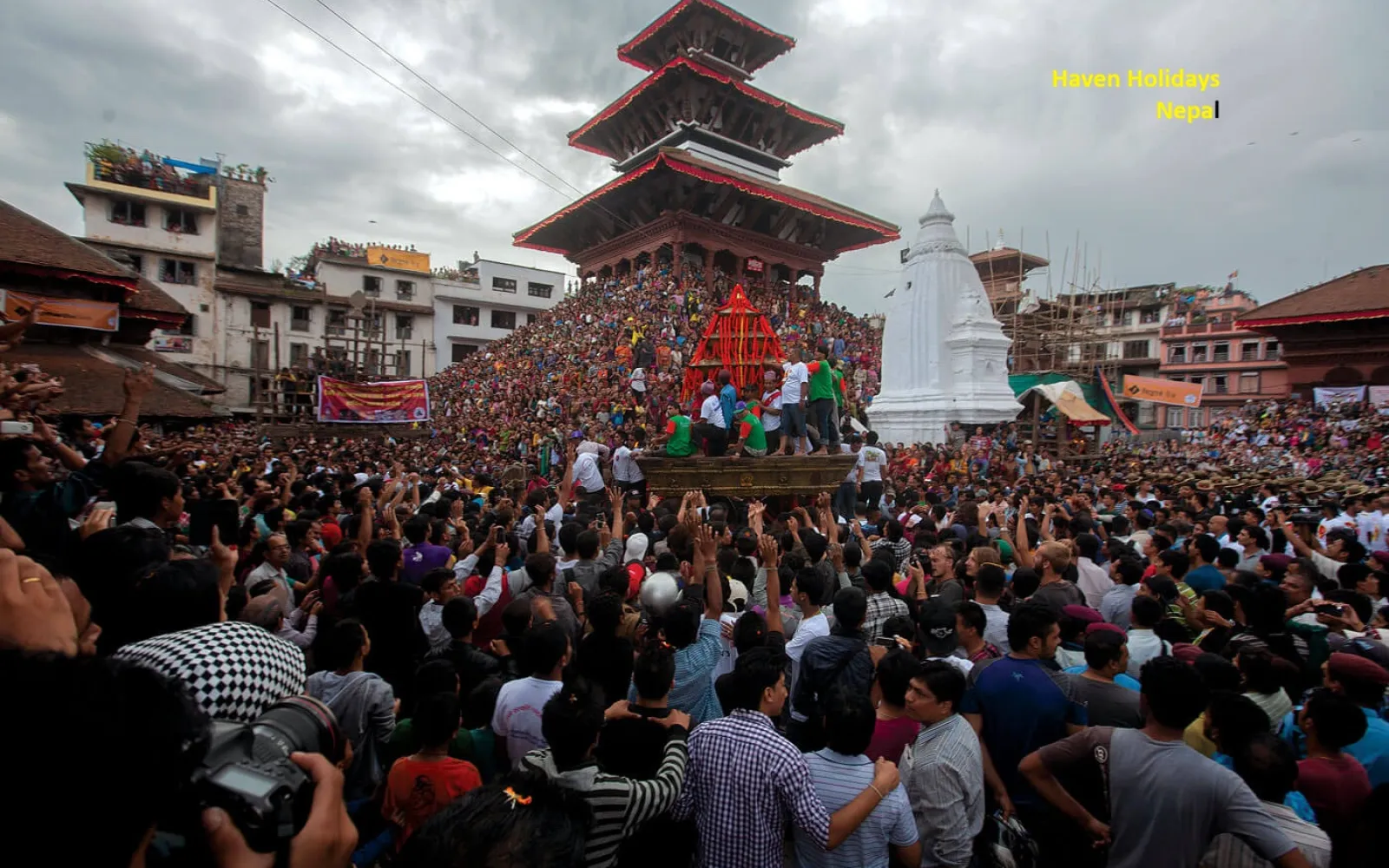
Today, people of Kathmandu valley wraps Indra Jatra up with various rituals especially dedicated to living goddess Kumari. Actually, it started 8 days before, on the day of 18 Sep, 2026.
Meanwhile, the Newari people of Kathmandu observe it for 8 days with joy, happiness and various exciting religious ceremonies throughout each day.
Today, 25/09/2026 is the final day if Indra this year(2026) and they observed the most special celebrations across the Kathmandu valley despite continuous rainfall in all over Nepal.
The Indra Jatra festival is an eight-day long celebration in Kathmandu in September mainly by the Newar people of the Kathmandu Valley.
Actually, this festival is linked to the Hindu deity Indra, the king of heaven and the god of rain, and local tradition says the festival began when he came to Kathmandu in the form of a human to find an herb that could cure diseases
Meanwhile, the festival starts with the raising of a wooden pole bearing Indra’s flag on Basantapur , Kathmandu Durbar Square in front of the old Hanuman Dhoka Palace.
During this time, Kathmandu’s streets and squares are full of religious rituals, processions, music, dance, and community celebrations.
| Festival Feature | Description |
|---|---|
| Indra’s flagpole | A wooden pole with Indra’s flag raised in Basantapur |
| Kumari chariot | The Living Goddess’s procession through old Kathmandu |
| Ganesh and Bhairav | Two other chariots accompany the Kumari procession |
| Lakhey dances | Traditional masked dances performed in the streets |
| Oil lamps | Light up the evenings of historic temples and Kathmandu’s palace square |
| Akash Bhairav | The large head of the deity is displayed at Indra Chowk |
| Closing ceremony | The Indra flagpole is taken down with religious rituals |
On visiting Indra Jatra, one can see:
In addition, the Indra Jatra festival connects Kathmandu’s religion and its urban landscape.
So, a Kathmandu cultural tour is not only about visiting monuments but also about experiencing the living heritage of the valley.
A Kathmandu Valley Cultural Tour features not only ancient temples, palaces, stupa monuments, and squares but also the living traditions of Kathmandu, Patan, and Bhaktapur, where religious practices, festivals, rituals, architecture, music, art, and community life share a rich cultural heritage.
Meanwhile, the Kathmandu Valley is recognized by UNESCO for its ‘heritage of outstanding universal value’ with its historic monument zones and the living cultural traditions of the Newar people.
Similarly, the Kathmandu Valley festival of Indra Jatra is part of the valley’s living heritage because this eight-day celebration revives the ancient Kathmandu street culture through chariot processions, masked dances, religious rituals, traditional music, and oil lamps.
Cultural Experience What visitors can experience:
Key highlights:
Thus, the Indra Jatra festival helps travelers realize that Kathmandu’s cultural heritage is not only about its monuments but also about its people, traditions, festivals, streets, courtyards, music, and rituals.
The Indra Jatra begins with raising a pinewood pole with Indra’s flag at the Basantapur Square, in front of the old Hanuman Dhoka Palace.
In traditional beliefs, the festival is related to the myth about Indra coming down from heaven in human form in search of an herb.
| Feature | Description |
|---|---|
| Indra Jatra / Yenya | Major Newar festival of Kathmandu |
| Kumari chariot | Procession of the Living Goddess |
| Lakhey dance | Traditional masked street performance |
| Traditional drums | Sound accompanying religious processions and dances |
| Oil lamps | Light up temples and historic buildings |
| Akash Bhairab | Sacred image on public display at Indra Chowk |
Cultural significance:
Thus, the Indra Jatra is more than just a show for tourists – it is a living cultural and religious tradition of Kathmandu’s people, incorporating unique Kathmandu’s rituals, urban life, beliefs, and art.
Indra Jatra is a living example of how the Kathmandu’s religious festival is staged in and around the Durbar Square and other significant cultural heritage sites of the Kathmandu Valley.
Actually, this festival uses the Basantapur Square, Hanuman Dhoka, old temples and courtyards, and streets of the old town as a stage for a traditional religious drama.
According to Nepal Tourism Board, the Indra Jatra “starts at Basantapur Square with the raising of a pole with a flag of Indra and the Kumari procession starts from the Hanuman Dhoka and passes through the streets of Kathmandu”.
| Heritage Connection | Description |
|---|---|
| Hanuman Dhoka | Historic royal palace and the place for the festival’s activities |
| Basantapur Square | The place of the festival’s opening – raising the pole |
| Kathmandu Durbar Square | Temples, courtyards, rituals, and crowds of people |
| Kumari procession | Living religious tradition in the heart of Kathmandu |
| Old Kathmandu streets | Community and traditional cultural expression |
| UNESCO World Heritage Kathmandu Value | ancient religious and cultural traditions expressed through rituals and festivals |
Other reasons why the connection between Indra Jatra and Kathmandu Durbar Square is important:
Thus, the Indra Jatra festival is an essential experience when visiting Kathmandu Durbar Square and the UNESCO Kathmandu Valley World Heritage property.
The festival begins with the raising of a pinewood pole bearing Indra's flag, at Basantapur Square, in front of the old Hanuman Dhoka Palace. Later, the Kumari chariot leads a large procession through the old city, accompanied by smaller chariots for Ganesh and Bhairav.
| What You Can See | What It Represents |
|---|---|
| Indra's ceremonial pole | Beginning of the festival |
| Kumari chariot | Procession of the Living Goddess |
| Ganesh and Bhairav chariots | Important religious representations |
| Lakhey masked dances | Traditional Newar performance |
| Akash Bhairav | Sacred deity displayed publicly |
| Swet Bhairav | Festival-time religious display |
| Oil lamps | Illumination of historic shrines and buildings |
| Traditional drums | Music accompanying dances and processions |
Must-see experiences during the festival include:
Moreover, the festival is crowded with devotees, performers, musicians and onlookers, so it is important to be respectful of religious ceremonies rather than treating them as entertainment for tourists.
During the Indra Jatra, the Kumari figure takes on a starring role in one of the Kathmandu Valley's major public religious events.
Here, the Nepal Tourism Board points out that the Living Goddess is taken around the streets of the old city in her chariot, accompanied by Ganesh and Bhairav chariots.
| Kumari Experience | Cultural Meaning |
|---|---|
| Kumari Ghar | Traditional residence of Kathmandu's Kumari |
| Kumari chariot | Public religious procession during Indra Jatra |
| Taleju tradition | Kumari represents the goddess Taleju |
| Newar Shakya tradition | Traditional community from which Kathmandu's Kumari is selected |
| Hindu and Buddhist reverence | Kumari is respected across both traditions |
Observations visitors can make about Kumari include:
In addition, the Kumari experience brings together religious beliefs, traditional communities, urban architecture and festival celebrations in a unique way.
Moreover, the Kathmandu Valley's cultural heritage is thus preserved through the living traditions of its people and their ancient urban centers.
Importantly, visitors should not treat Kumari or her attendants as objects for selfies or other disrespectful behaviour, but should listen to any guidance from a local tour guide, who can explain the significance of Kumari and help navigate the festival experience.
The Kathmandu Durbar Square has the most direct connection with Indra Jatra because the festival starts at Basantapur, right in front of the Hanuman Dhoka Palace.
Meanwhile, the Kumari chariot procession, Lakhey dances, religious ceremonies and illuminated temples also contribute to turning the surrounding old city into a lively place during the festival.
| Heritage Site | Cultural Experience |
|---|---|
| Kathmandu Durbar Square | Indra Jatra, Kumari, palaces and temples |
| Swayambhunath | Buddhist heritage and hilltop stupa |
| Boudhanath | Tibetan Buddhist traditions and pilgrimage |
| Pashupatinath | Hindu religious heritage and rituals |
| Patan Durbar Square | Newar art, temples and architecture |
| Bhaktapur Durbar Square | Medieval Newar city and Medieval Newar city and craftsmanship |
| Changu Narayan | Ancient temple and Newar heritage |
A cultural tour might include:
Hence, combining Indra Jatra with the cultural heritage sites offers a more rounded view of Kathmandu Valley's cultures, architectures, religions and traditional urban life.
At Haven Holidays, the cultural tour could combine the main heritage sites with time to witness the Indra Jatra festivities around Kathmandu Durbar Square and the old city streets.
Here, the program involve the Kumari procession, traditional masked dances, religious ceremonies, illuminated temples and other festival events depending on the daily schedule.
| Tour Component | Possible Experience |
|---|---|
| Kathmandu Durbar Square | Main Indra Jatra atmosphere |
| Kumari | Chariot procession and religious tradition |
| Old Kathmandu | Processions, music and street rituals |
| Swayambhunath | Buddhist heritage |
| Boudhanath | Buddhist pilgrimage culture |
| Pashupatinath | Hindu religious heritage |
| Patan/Bhaktapur | Newar architecture and traditional life |
Things to note while planning the Indra Jatra tour:
Moreover, the UNESCO has recognized the festivals and rituals as elements of the cultural values of the Kathmandu Valley World Heritage property.
Hence, experiencing Indra Jatra in combination with the Kathmandu Valley's monuments allows travelers to see both: the ancient structures and the living traditions that enrich the cultural heritage of this place.
Indra Jatra follows the traditional lunar calendar and the event's date will change every year. The festival usually takes place in August or September, while Nepal Tourism Board describes the festival as an eight-day event which takes place in September and currently lists the festival on 6 September 2026.
Here, travelers considering a cultural tour with Indra Jatra should, therefore, consult the festival's official calendar in the year of travel before making flight and hotel bookings.
Thus, Indra Jatra is particularly valuable to visitors who hope to see Kathmandu's traditional squares, temples, courtyards, and streets transformed into a vibrant religious and cultural center.
| Year | Indra Jatra Timing | Planning Advice |
|---|---|---|
| 2026 | 6 September | Check the official annual schedule |
| 2027 | Date to be confirmed | Verify before booking |
| Every year | August or September | Follows the lunar calendar |
Why visit during Indra Jatra?
Moreover, the festival offers the chance to learn more about Kathmandu's cultural heritage by visiting the monuments and observing the traditions.
Here, UNESCO observes that the cultural values of the Kathmandu Valley are connected with legends, rituals, and festivals.
Therefore, the best time to visit Kathmandu is during the Indra Jatra festival, although travelers should confirm the dates for the year of travel rather than a specific calendar day.
The Kathmandu valley sightseeing tour is about discovering historic monuments, temples, palaces, stupas, and other cultural heritage of the Kathmandu Valley.
Here, travelers on a cultural tour with Indra Jatra will experience a different Kathmandu, where the festival's rituals, processions, music, dances, and worship transform the squares and streets into a unique living center of tradition.
Meanwhile, Kathmandu Durbar Square is of particular significance during the Indra Jatra festival, where Basantapur and the surrounding squares become the focus of the event.
Moreover, the Kumari chariot, Lakhey masked dances, traditional drums, religious rituals, and large crowds create an entirely different experience compared to a standard sightseeing tour of Kathmandu.
| Regular Sightseeing | Indra Jatra Cultural Experience |
|---|---|
| Views historic architecture | Sees heritage spaces actively used |
| Visits temples and palaces | Observes religious ceremonies |
| Learns historical background | Experiences living traditions |
| Takes architectural photographs | Watches processions and performances |
| Follows a fixed itinerary | Requires flexibility around festival activities |
| Usually quieter | Large crowds and community gatherings |
During Indra Jatra, travelers can:
Moreover, UNESCO observes that the Kathmandu Valley's cultural significance is connected with rituals, festivals, and traditional urban life.
Therefore, a cultural tour with Indra Jatra is different from a regular Kathmandu sightseeing tour because it allows travelers to experience the living traditions of the Kathmandu Valley.
Generally, the Indra Jatra crowd gathers in the streets around Basantapur, Hanuman Dhoka, Indra Chowk and the old city streets as part of the chariot processions.
Therefore, the travelers should arrive early and allow extra time as the processions and crowds impact the flow of traffic in the historic city.
Additionally, visitors are advised to dress modestly and understand that Indra Jatra is a living religious festival and not a public spectacle.
Before visiting Indra Jatra, tourists should: What to remember:
Etiquette and customs to respect as a visitor during Indra Jatra:
According to the Nepal Tourism Board, special attention should be given to seeking permission before taking photos of religious ceremonies and respecting local customs.
Therefore, the best advice for tourists is to observe, be patient and let the Indra Jatra magic happen.
Meanwhile, the local guide will interpret the deities, chariots and masked dances, temples, courtyards, Kumari and the Newar culture, while showing the festival crowds and navigating the busy streets of old Kathmandu.
Actually, the Indra Jatra festival involves religious ceremonies and processions, which may appear confusing to unprepared visitors.
Without local guide With knowledgeable local guide:
Local guide can show and tell:
Besides interpreting the festival’s significance, a local guide will connect the history of the monuments with the living traditions of the Kathmandu Valley residents.
In other words, the Indra Jatra experience becomes more than festival observations and photo opportunities.
Kathmandu Valley's cultural identity has developed from historic Newar settlements, Hindu and Buddhist traditions, religious rituals, craftsmanship, music, dance, food and seasonal festivals.
Here, UNESCO specifically acknowledges the unique cultural traditions of the Newars and coexistence of Hinduism and Buddhism in Kathmandu Valley.
Meanwhile, travelers can experience different festivals depending on travel dates and location.
For example, Gai Jatra is celebrated to remember deceased loved ones, while Rato Machindranath Jatra in Patan is a chariot festival associated with rain, harvest and prosperity.
| Festival / Tradition | Cultural Experience |
|---|---|
| Indra Jatra | Chariots, Lakhey dances, Kumari and rituals |
| Gai Jatra | Processions remembering deceased family members |
| Rato Machindranath Jatra | Long chariot procession in Patan |
| Mha Puja | Newar ritual of self-worship during Tihar |
| Newar cuisine | Traditional dishes and community feasts |
| Paubha art | Traditional Newar religious painting |
| Dhime music | Traditional drums used during festivals |
Visitors can also explore:
Moreover, each tradition reflects a different dimension of Kathmandu Valley's cultural identity.
Therefore, a Kathmandu Valley Cultural Tour can be designed around the season, festival calendar, heritage sites and local communities rather than monuments.
Meanwhile, Kathmandu Valley should not only be experienced through its temples, palaces, stupas and historic architecture as its cultural significance also lives on in rituals, festivals, craftsmanship, music and community.
Here, UNESCO acknowledges Kathmandu Valley's heritage as closely associated with legends, rituals and festivals.
Mainly, Indra Jatra is a fitting example of this connection. Historic places around Hanuman Dhoka and Kathmandu Durbar Square come alive during the festival with chariot processions, religious ceremonies, traditional music, masked dances and community gatherings.
| Heritage Experience | What It Helps Visitors Understand ? |
|---|---|
| Kathmandu Durbar Square | Royal history and living festivals |
| Indra Jatra | Newar religious and community traditions |
| Kumari tradition | Living religious heritage |
| Swayambhunath & Boudhanath | Buddhist traditions |
| Pashupatinath | Hindu religious heritage |
| Patan & Bhaktapur | Newar architecture and craftsmanship |
| Local guide | Meaning behind places, rituals and customs |
A meaningful cultural experience includes:
Moreover, a local guide helps visitors understand what they see rather than simply going from one attraction to another.
Therefore, a Kathmandu Valley Cultural Tour that combines UNESCO heritage sites with living festivals such as Indra Jatra can offer deeper and more authentic understanding of Kathmandu's continuing cultural life.
Indra Jatra, also called Yenya, is an eight-day festival mostly enjoyed by the Newar inhabitants of Kathmandu Valley. This festival is dedicated to the Hindu deity Indra, god of rain and harvest, while also incorporating Buddhist and Hindu rituals, chariot processions, masked dances, music, and community celebrations.
Indra Jatra is a major annual event that happens in September (the date varies depending on the lunar calendar). The eight-day festival officially begins when the wooden Yosin or lingam pole is erected at Basantapur and ends when this pole is dismantled.
Indra Jatra is celebrated across Kathmandu Valley with the main attractions concentrated in Kathmandu Durbar Square, Basantapur, Hanuman Dhoka, Indra Chowk, and the surrounding areas.
Here, the Kumari chariot and other processions move through old Kathmandu streets, and temples, palace courtyards, shrines, and squares are also part of the festival.
The Kumari (Living Goddess) is one of the major attractions of the Indra Jatra festival. She is ceremoniously seated in a chariot and taken on an eight-day journey through the old streets of Kathmandu.
Her procession is accompanied by the chariots of Ganesh and Bhairav and includes elements of religious rituals, music, crowds, and street-side offerings.
During this event, the Kumari is taken in a chariot through some of the oldest streets and neighborhoods of Kathmandu. Crowds of people come out to see the procession and receive blessings from the goddess. The ceremony also involves the chariots of Ganesh and Bhairav, Lakhey dances, music, and other rituals.
Lakhey is one of the most famous masked dances performed during the Indra Jatra festival. Dancers wear traditional costumes and are accompanied by music and drums. Other dances and performances also take place, including Pulukisi, which is part of the ritual dance-drama narrating the legends about the avatars of Vishnu.
The Yosin (or lingam) is a tall wooden pole decorated with Indra's flag, which is erected at Basantapur at the start of the festival. This event officially marks the beginning of the Indra Jatra celebrations, and the pole is later dismantled with ritual observances.
Visitors can enjoy a variety of cultural experiences, including the Kumari procession, Lakhey dances, music, traditional costumes, and decorated temples. An Indra Jatra tour combines elements of Nepal's Hindu and Buddhist traditions with ancient royal rituals.
In addition, a cultural tour provides an opportunity to explore historic temples, palaces, and urban squares of the old Kathmandu.
Indra Jatra is not a UNESCO World Heritage Site, but many cultural events take place in the Kathmandu Durbar Square area, which is a UNESCO World Heritage Site.
In this way, the Indra Jatra festival is part of the rich cultural heritage of Kathmandu Valley.
Indra Jatra is a large festival, which means that streets get crowded, and the traffic can be redirected or stopped. For this reason, it is best to plan your transportation and time carefully.
Moreover, be respectful of any religious rituals and keep your belongings safe; in addition, it is a good idea to hire a local cultural tour guide.
Our travel experts are ready to assist you with any questions.
Send us a message.Have a question before you book? Send your enquiry below and our travel experts will get back with the required information.