For an high level Himalayan adventure, knowing the lay of the land is your strongest card. One of the most geographically diverse treks on Earth, the Manaslu Circuit elevation chart lays out a route that doesn't let you jump directly into the thin air. Instead, this journey has you working for every meter of elevation gain, progressing from deep subtropical river gorges all the way up into the oxygen-deprived, sub-zero environment of the high Himalayas.
Looking at an inclusive altitude profile before lacing up your boots is instrumental in realizing the sheer range of Manaslu trek elevation variations that await you. Across the roughly two weeks of your journey, you'll traverse through lush rhododendron and pine forests, witness stunning waterfalls, meet locals in traditional Tibetan-Buddhist villages, and finally stand on the barren glacial moraine atop Larkya Pass (5106m). Adapting to these vastly different environments requires careful pacing, as your body must constantly adjust to monumental changes in pressure and temperature.
Key Altitude Features of the Manaslu Profile:
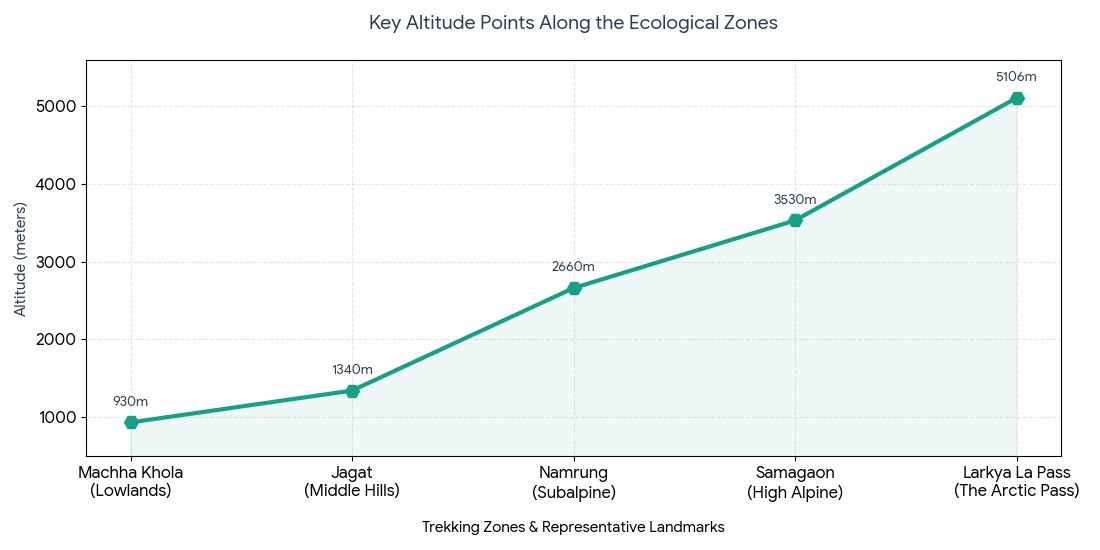
| Trekking Zone | Representative Village / Landmark | Altitude (Meters) | Altitude (Feet) | Main Ecological Environment |
|---|---|---|
| Lowlands Start | Machha Khola | 930 m | 3,051 ft | Subtropical forest & river canyon |
| Middle Hills | Jagat (Checkpost) | 1,340 m | 4,396 ft | Temperate broadleaf zone |
| Subalpine | Namrung | 2,660 m | 8,727 ft | Cool temperate pine & rhododendron |
| High Alpine | Samagaon | 3,530 m | 11,581 ft | Alpine scrub & Buddhist highlands |
| The Arctic Pass | Larkya La Pass | 5,106 m | 16,752 ft | Glacial moraine & permafrost |
Here, the actual start to your high-altitude adventure is a challenging, day-long overland drive. You'll depart from the capital city and follow a road that snakes along rushing rivers and past terraced farmlands and rural communities. While many people used to start further down the trail, the road network has been extended, and most modern itineraries skip the historic Soti Khola starting altitude and begin their main trek in a deeper point within the Budhi Gandaki valley, Machhakhola.
Logistic Particulars of the Route:
| Route Option / Milestone | Specific Altitude (Meters) | Specific Altitude (Feet) | Physiological Effect on Trekkers |
|---|---|---|
| Kathmandu Valley | 1,400 m | 4,593 ft | Baseline from which to depart. |
| Soti Khola (historic start) | 710 m | 2,329 ft | Humid lowlands; largely bypassed now. |
| Machha Khola (modern start) | 930 m | 3,051 ft | Oxygen-rich launching point; good for warming up. |
Golden Acclimatization Rule: The most important principle in mountain safety is to always: Climb high, sleep low. Trek to a higher altitude in the afternoon so that your body adapts to the lower oxygen, then descend to sleep in a lower position so it can recuperate and build endurance for the challenges ahead.
The Convenience of an All-Inclusive Trek: If you wish to take the guesswork out of your Himalayan adventure, you can let Haven Holidays Pvt. Ltd. Plan everything for you. Our treks are meticulously planned by experienced local experts who understand high-altitude logistics and have mapped out safe, clear routes so you can concentrate on the amazing journey ahead. Get in touch with our team today to plan your unique Manaslu experience!
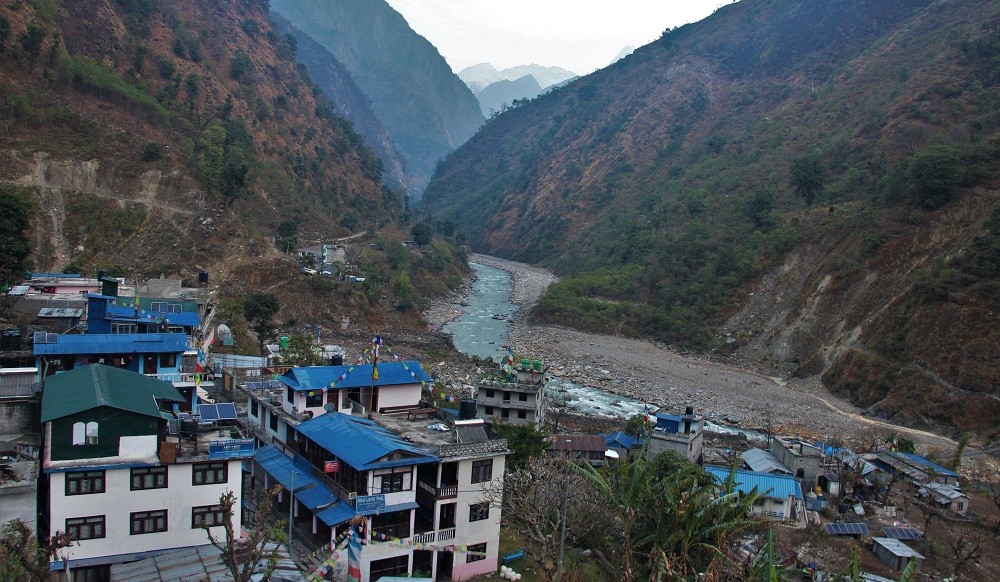
When you leave the lower valleys, lace up your boots and you will be transported to the truly magical, deeper canyon terrain. The Budhi Gandaki river trail takes you along a path cut into steep, vertical cliffs. Along this part of the trek, you'll pass through Tatopani and make your way, progressively uphill.
Actually, this part of the expedition is characterized by dizzyingly beautiful suspension bridges over the roaring, glacier fed river. Although you'll still find yourself in sub tropical, verdant surroundings, and you'll see cascading waterfalls everywhere, the gradual daily ascent of this portion of the trek begins to quietly establish the cardiovascular basis you'll need for higher altitudes.
Main Characteristics of Lower Gorge Terrain :
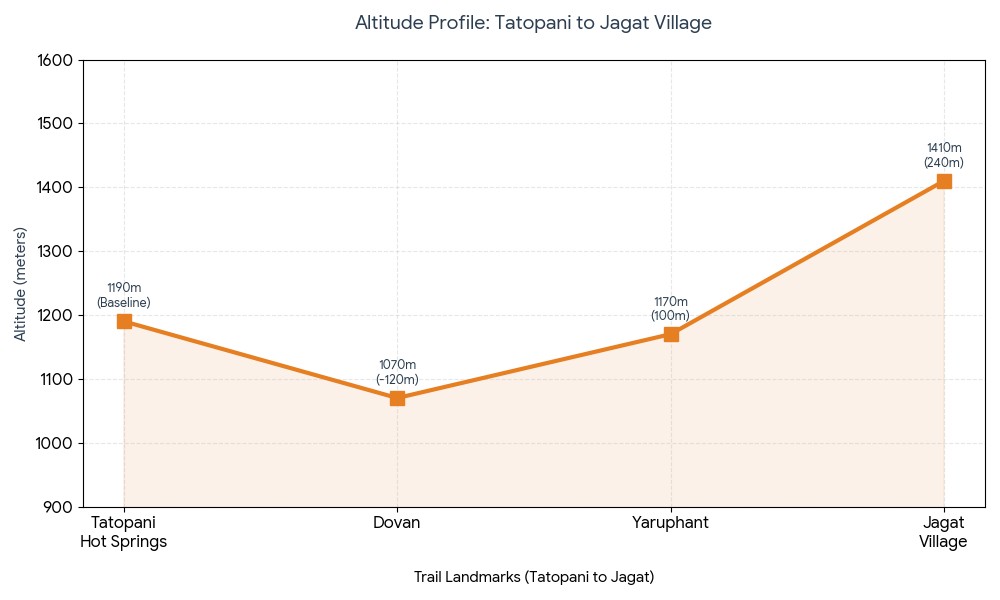
| Trail Landmark / Stop | Meters | Feet | Rise from previous section | Notes & Experience |
|---|---|---|
| Tatopani Hot Springs | 1,190 m | 3,904 ft | Baseline | Hot springs with water seeping from cliffs, humid and steamy. |
| Dovan | 1,070 m | 3,510 ft | -120 m (Dip down) | Drop down and climb back up with the crossing of a major tributary bridge. |
| Yaruphant | 1,170 m | 3,838 ft | +100 m | Flats along the riverbed of river stones followed by stone steps. |
| Jagat Village | 1,410 m | 4,625 ft | +240 m | Village that serves as the "gateway" of the Restricted area, paved with stones. |
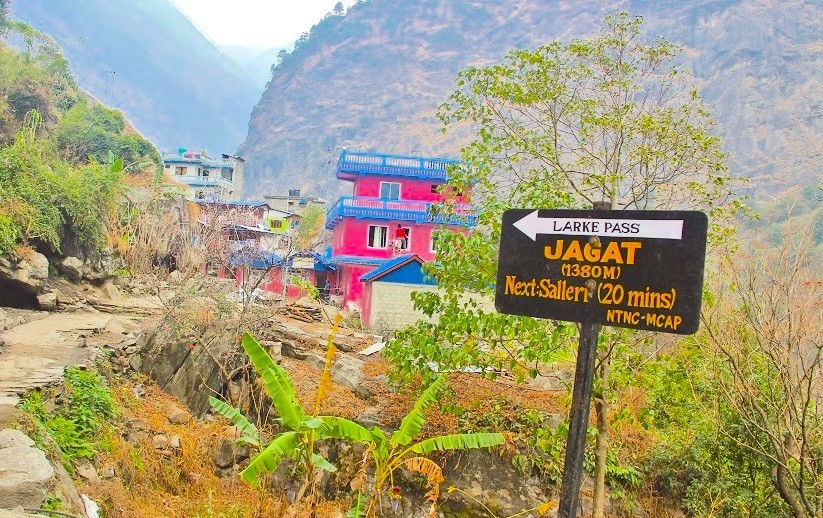
Once you arrive at Jagat village elevation, you have crossed another threshold of the trek. This is where you must have your restricted area documentation checked by local officials. You have officially entered an invisible boundary. You'll notice a change as the subtropical scenery gradually gives way to dense forests of bamboo and pine, and the first clear signs of Tibetan-Buddhist culture emerge. This part of the trek is demanding; a strenuous climb takes you over 2500m to the point where the atmosphere becomes perceptibly thinner and a true change in environment sets in.
Defining Altitude Landmarks :
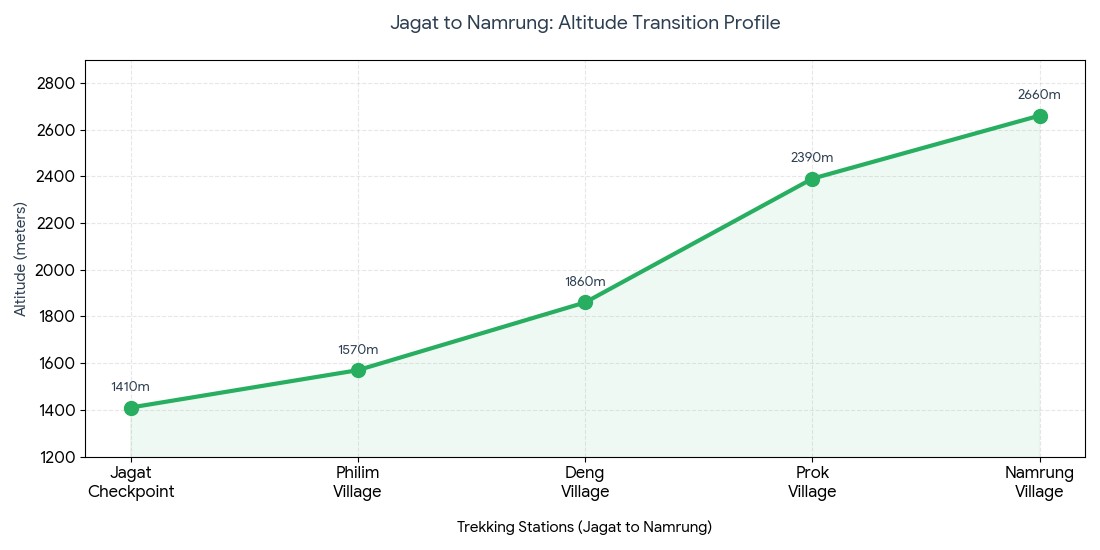
| Trekking Station | Meters | Feet | Total Altitude Gained | Oxygen / Climate |
|---|---|---|
| Jagat Checkpoint | 1,410 m | 4,625 ft | Start | Sub tropical, 100% oxygen density. |
| Philim village | 1,570 m | 5,150 ft | +160 m | Wide Gurung village located above large waterfalls. |
| Deng village | 1,860 m | 6,102 ft | +290 m | Crossroads between trekking routes in the middle altitude. |
| Prok village | 2,390 m | 7,841 ft | +530 m | Higher plateau with old monasteries and views. |
| Namrung village | 2,660 m | 8,727 ft | +270 m | Sub alpine zone, frigid morning air, low oxygen density. |
Expert Acclimatization Tip: The most basic and critical rule of mountain travel: Climb high, sleep low. Pushing to higher altitudes during the day ensures your system adjusts to the thin air while allowing your body to rest at a lower, more comfortable altitude overnight, building acclimatization over time.
Full Trek Experience Guarantee: Leave the worry of trip logistics and Manaslu Trek route planning to the local experts at Haven Holidays Pvt. Ltd.. Our treks are designed by knowledgeable local guides who understand every nuance of high-altitude travel, ensuring your trip is as safe and enjoyable as possible while you experience the breathtaking beauty of the Himalayas. Contact us today to plan your custom Manaslu adventure.
Once you ascend beyond the subalpine confines of Namrung, the route suddenly erupts into the expansive, glacial carved Nubri Valley. Here the scenery radically transforms from forests and farms into windswept, high-altitude landscapes bordering extensive barley fields and traditional stone dwellings. Steadily ascending along this high valley will bring you directly to Lho village, a central religious and cultural heart for the Nubri people of the region.
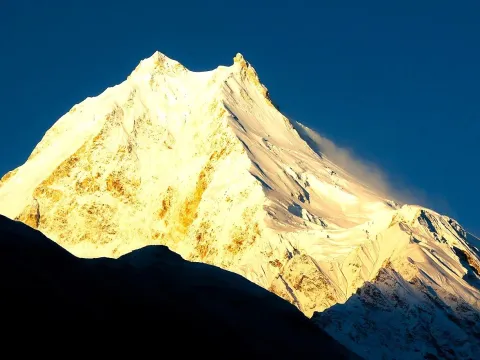
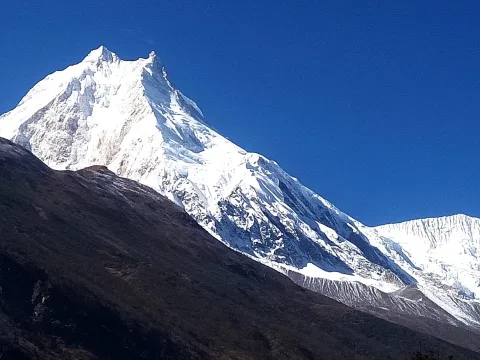
Actually, the high point for the day is Ribung Monastery, a striking complex set high on a hill above the village; but for all trekkers, Lho presents your first glimpse of the magnificent double peaked summit of Mount Manaslu (8163m) looming directly above the valley floor.
Key sights to expect when entering the Nubri:
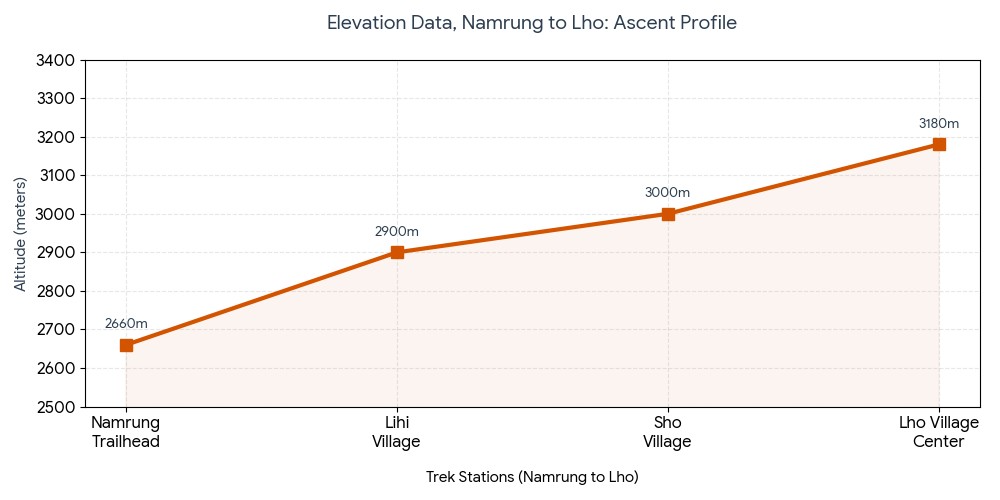
| Trek Station / Milestone | Altitude (m) | Altitude (ft) | Change in Elevation | Atmosphere / Landscape |
|---|---|---|
| Namrung Trailhead | 2660 | 8727 | Baseline | Pine forests, morning frost is possible on the path |
| Lihi Village | 2900 | 9514 | +240m | Barley fields, multi tiered chortens |
| Sho Village | 3000 | 9842 | +100m | Higher altitude, crisper air |
| Lho Village Center | 3180 | 10433 | +180m | Nubri capital hub, epic Manaslu views |
After passing through Lho, you continue along the valley floor, climbing steadily until you reach the vast stone houses of Sama Gaon. Located at 3,530 meters (approximately 11,581 ft), Sama Gaon serves as a crucial physiological resting point in your expedition.
As the human body takes time to adjust to this elevation, ascending past it quickly is extremely risky; thus, establishing a strategic Manaslu acclimatization day routine at Sama Gaon before you ascend above 4,000m is essential.
Key high-altitude excursions for Sama Gaon:
| Destination | Peak Altitude (m) | Peak Altitude (ft) | Effective Altitude | Purpose & Strategy |
|---|---|---|
| Sama Gaon Lodge | 3530 | 11581 | 65% of sea level | Rest & recovery zone; maintain high liquid intake. |
| Birendra Glacial Lake | 3450 | 11318 | 66% of sea level | Active low-impact recovery for muscle flexibility. |
| Pungyen Gompa Ridge | 3870 | 12696 | 63% of sea level | Moderate altitude exposure to promote lung capacity. |
| Manaslu Base Camp | 4400 | 14435 | 59% of sea level | Intense altitude stress to prep for Larkya Pass. |
| Return to Sama Gaon | 3530 | 11581 | 65% of sea level | High quality sleep and stable heart rate recovery. |
The Golden Rule of Mountain Safety: The primary mantra on any high-altitude journey is to always climb high, sleep low. This strategy requires you to exert yourself at an increased altitude during the day, forcing your body to adapt to the lower pressure, and then to descend to sleep at a lower elevation where recovery is easier. This practice is absolutely crucial for safely ascending the perilous Larkya Pass.
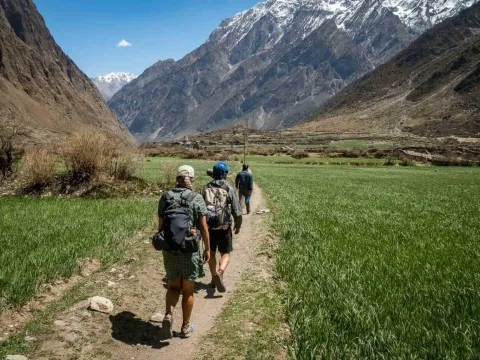
In the high Himalayas, acclimatization is not a passive activity-it is an active process requiring carefully thought-out movement. A vital part of rest in Sama Gaon is making strategically planned side treks that train your lungs and blood vessels. This will push you to a considerably thinner atmosphere and prompt your body to produce the oxygen-carrying red blood cells it will need before you retreat to your comfortable low-altitude lodge for the night.
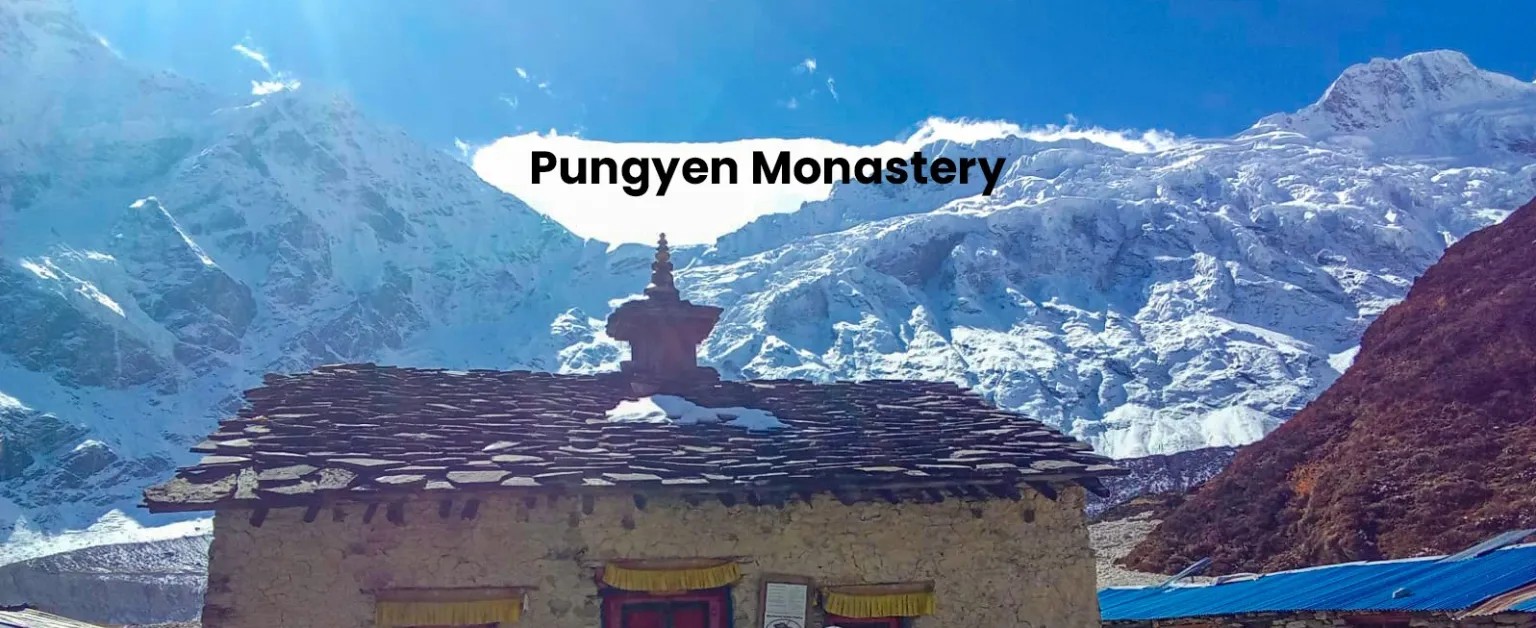
Each of the two alternative paths takes a radically different path; on the trek to the Manaslu Base Camp altitude, you will ascend through a treacherous, nearly vertical climb of rough glacial moraine as favored by elite climbing teams, whereas the Pungyen Gompa trek elevation provides a more relaxed and culturally enriched ramble through a broad alpine valley ending at an ancient, secluded monastery right under Manaslu's frozen eastern face.
Physiological Advantages of these Adaptation Treks :
| Side Trek Route | Highest Altitude (M) / Highest Altitude (ft) | Approx Round-Trip Time | Terrain & Main Difficulty |
|---|---|---|
| Birendra Tal Lake | 3,450 m / 11,318 ft | 1.5 – 2 hrs | Level, rocky single-track; no great challenge. |
| Pungyen Gompa | 4,050 m / 13,287 ft | 5 – 6 hrs | Smooth meadow ascents; ancient stone monastery views. |
| Manaslu Base Camp | 4,800 m / 15,748 ft | 6 – 7 hrs | Very steep, rocky ridges; lose gravel and harsh winds. |
From Sama Gaon, you will once again begin trekking north. The Budhi Gandaki River will grow more sluggish as you climb. This section is not very long in terms of distance but feels long because of the thin air, which will make each footstep seem much more difficult. You will be traveling to Samdo, a tiny settlement of Tibetan refugees that was founded in the 1950s and is very close to the ancient border passes.
Actually, the village of Samdo village altitude, situated at 3,860 meters (12,664 ft), serves as your second acclimatization stop and final holding ground. The land around the village will be devoid of trees and transform into a stark, arctic tundra like landscape. This is a location in which it is crucial to spend an additional day or an extended afternoon resting, getting rehydrated, and preparing your winter clothing before heading off toward the frigid, empty land ahead of Larkya Pass.
Strategic Considerations at the Border Outpost :
| Trekking segment | Meters / feet | Vertical meters | percentage of sea level oxygen available |
|---|---|---|
| Sama Gaon Baseline | 3,530 m / 11,581 ft | 0 m | approx 65% |
| Larke Bazaar (ruins) | 3,650 m / 11,975 ft | +120 m | approx 64% |
| Samdo Village | 3,860 m / 12,664 ft | +210 m | approx 62% |
A seasoned climber's trick for acclimatization: "Climb high, sleep low" remains a definite rule regarding the safety. By forcing your body to adapt to a higher altitude during your acclimatization walk in the afternoon, you will strengthen it against the low oxygen levels before bringing it back down to a comfortable level to help your body recover and gain the endurance it will need for Larkya Pass.
Here, the trail then rises abruptly again from Samdo onto a stark, high alpine tundra and you have to trek across some iced over stream and some moraines of the Larkya Glacier and then you will reach Dharmasala, or commonly known as Larkye phedi (meaning 'foot of the pass').
At Dharmasala high camp elevation of 4,460 m (14,632 ft), Dharmasala is not really a settlement but it is just a temporary camp/staging point. This place consists of the stone huts and some permanent tents which provide an extremely basic but comfortable stay during the trek.
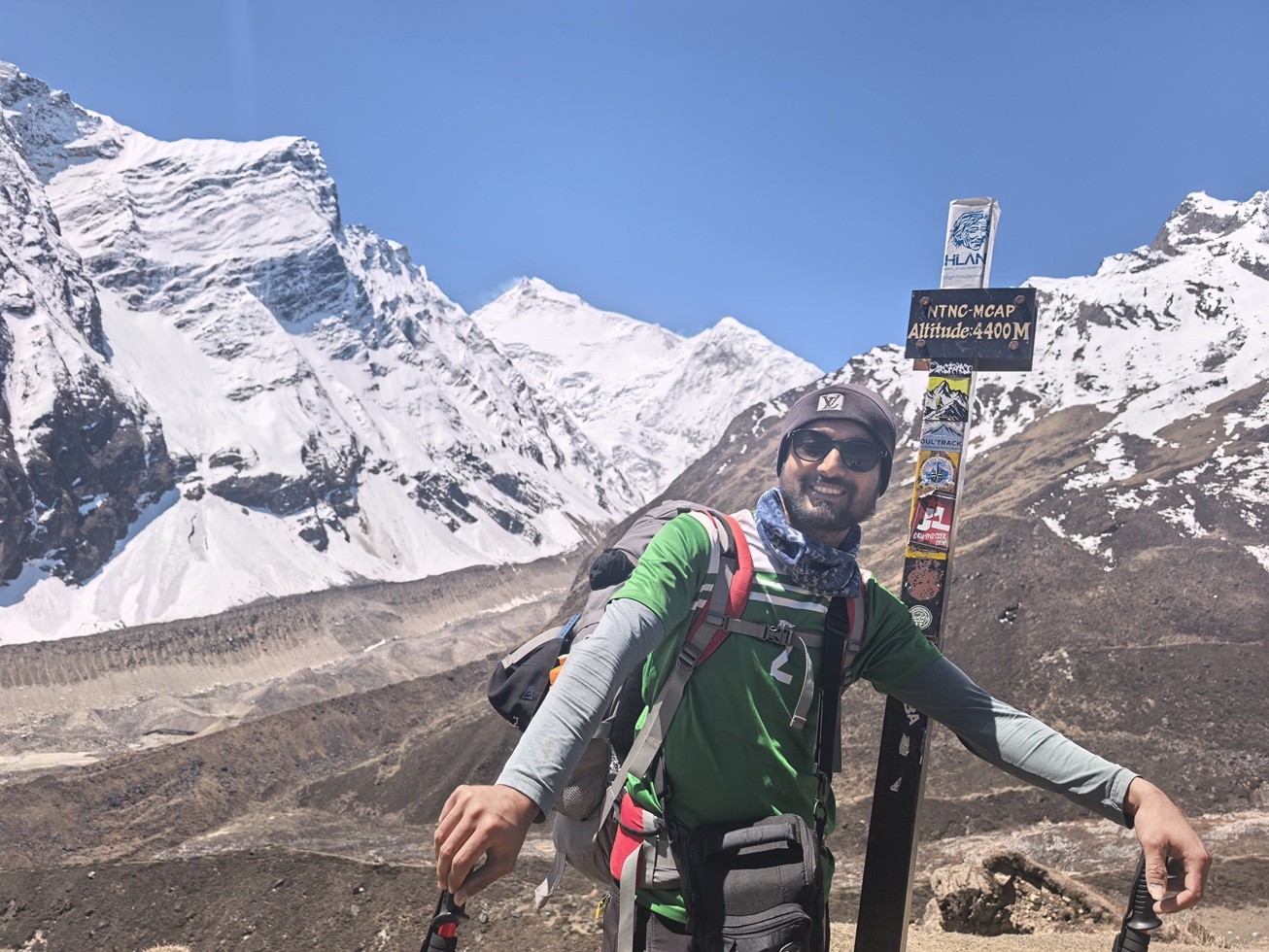
Likewise, the real challenge will be sleeping at the high altitude over 4000 m which would mean a significantly lower atmospheric oxygen level (nearly 57% less than sea level) and a single simple act like unbuckling your shoes could leave you gasping for breath. Therefore the primary purpose is nothing but rest and to be ready for the trek of the pass before dawn.
Survival and Comfort at High Camp :
Actually, this will be the ultimate point in the whole Manaslu Circuit trip. Trekking across Larkya Pass(5106m) is the test of your mental strength and endurance. In order to reach the pass safely you are expected to start at 3:30 am and be on the frozen trail by 4:30 am while trekking under the stars.
Starting early in the morning is essential to successfully reach the summit before afternoon, when harsh winds may cause you trouble, along with extreme weather shifts as you would traverse the pass.
While trekking to the highest point on Manaslu circuit you will need to trek along the moraine of the Larkya Glacier and continue walking over high altitude ice fields until you are faced with an almost vertical snow climb over series of steep switchbacks.
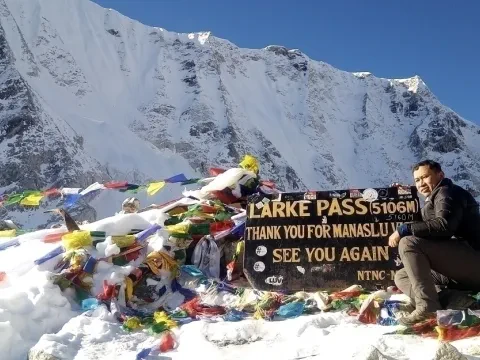
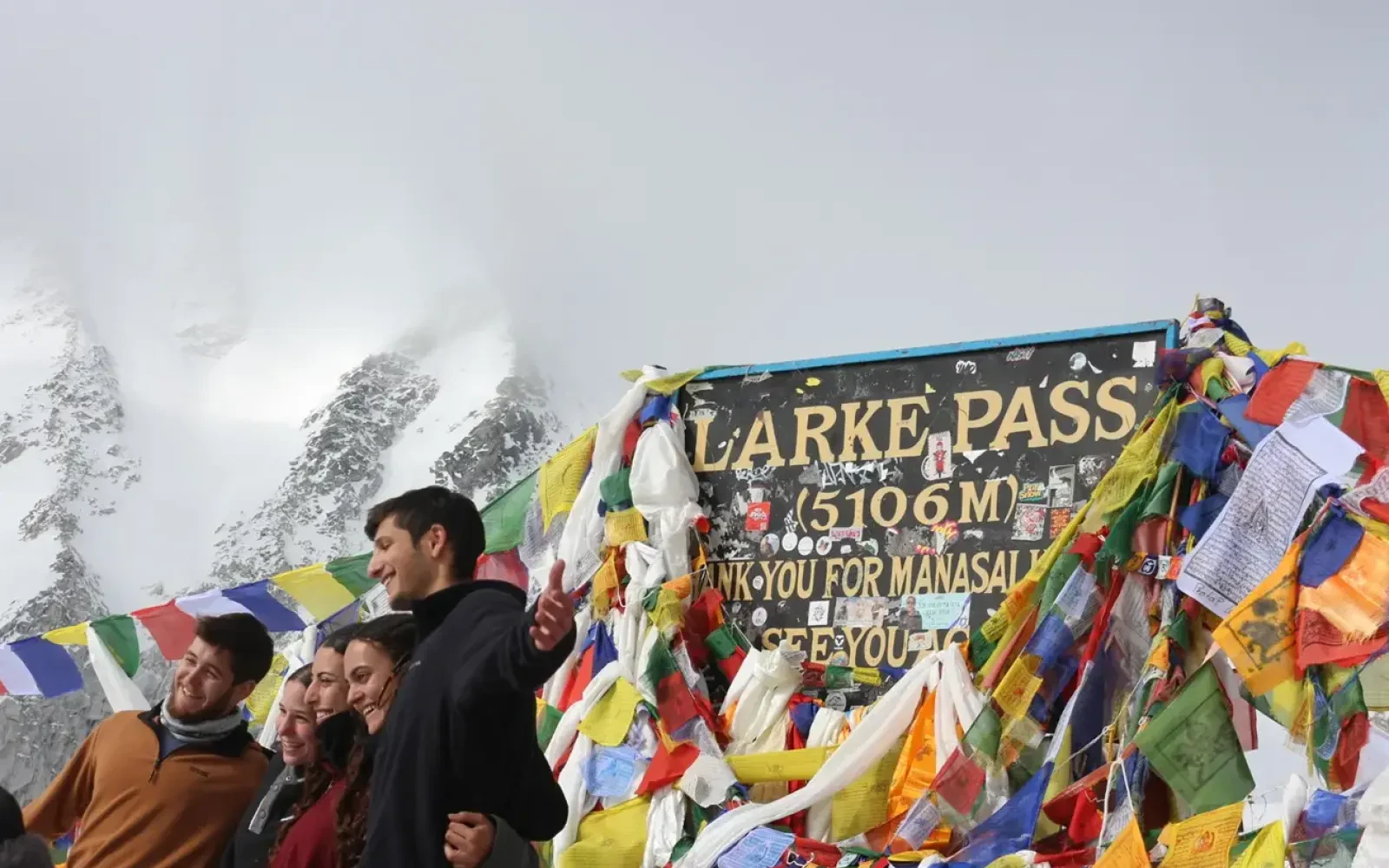
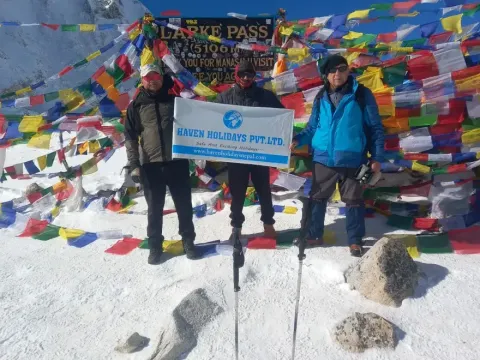
Finally after climbing for approximately 4-5 hours and gaining over 600 m you will reach the peak pass elevation of 5106 m (16,752 ft). The area around the pass is decorated with fluttering prayer flags and from there you can witness the most spectacular alpine panoramas with spectacular view of Himlung Himal (7,126m), Kang Guru (6,981m) and Annapurna II (7,937m).
However reaching the Larkya Pass height is only the beginning. You are then expected to descend 1400m steeply to the beautiful alpine meadow of Bhimthang (3,720m) which is also known as the descent of knee injuries.
Cold, Gear, and Pace management :
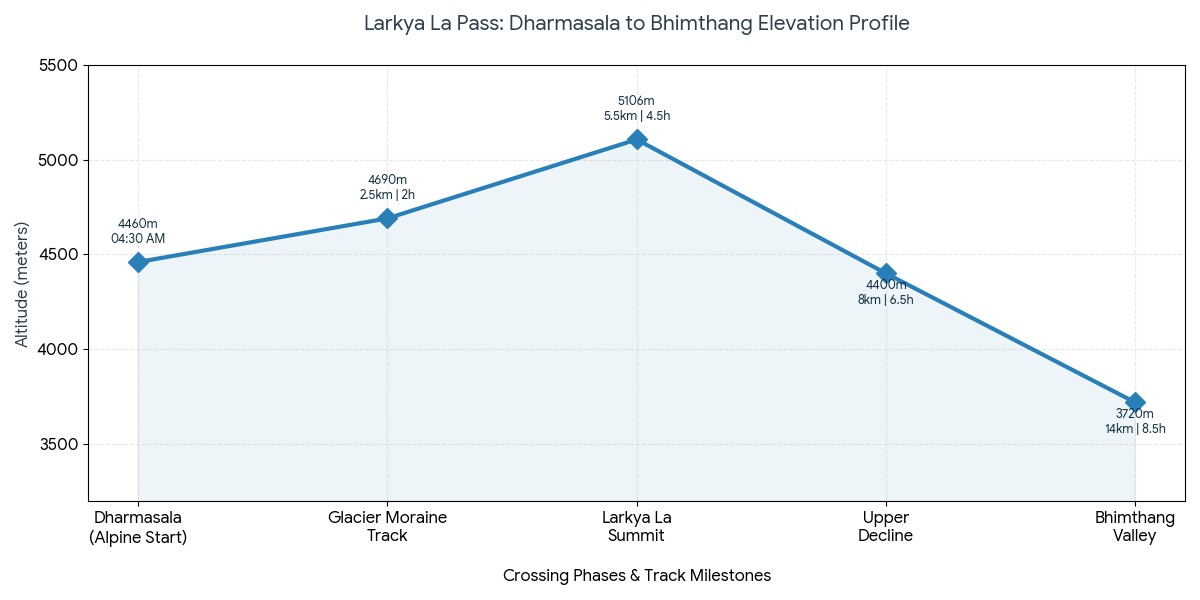
| Phase | Elevation | distance | Est time | Environment & conditions |
|---|---|---|
| Alpine start | 4460 m | 0 km | 04:30 AM | Freezing cold temperatures require good clothing, head lamp and walking over moraine rocks. |
| Glacier moraine track | 4690m | 2.5 km | 2 Hours | Following rock piles on the glacier, cold, and clear weather. |
| Summit | 5106m | 5.5 km | 4.5 Hours | The Summit, high wind, 51% of oxygen and breathtaking alpine sceneries. |
| Upper decline | 4400m | 8 km | 6.5 Hours | Steep and slippery scree, gravels or snowy terrain, requires excellent concentration and grip. |
| Bhimthang valley | 3720m | 14 km | 8.5 Hours | alpine meadow, rich oxygen and much less of the cold. |
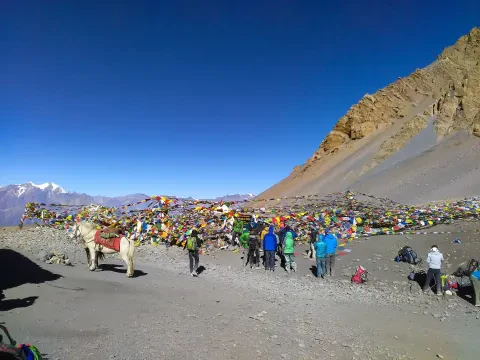
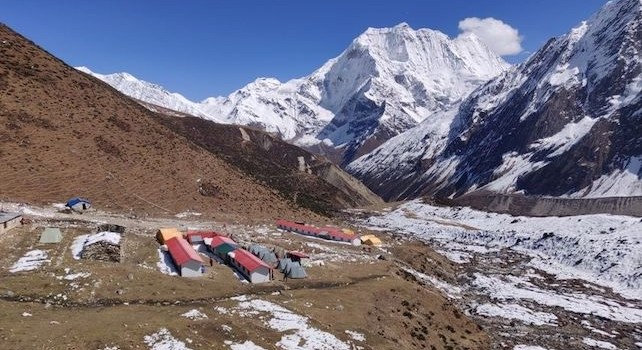
Reaching the summit of the Larkya pass is a huge and satisfying achievement but physically this is still not the end of the day's efforts. In particular, dropping down from high mountain terrain back into the Western valleys is a sustained and steep downhill trek that really puts your lower joints through their paces. It takes a tremendous amount of concentration to get from the ice and scree of the high altitude out towards the sub alpine pine forests that surround Bhimthang elevation at 3,720 m (~12,204 ft), and you will still be quite tired after a long high altitude day.
Coping with the Downhill:
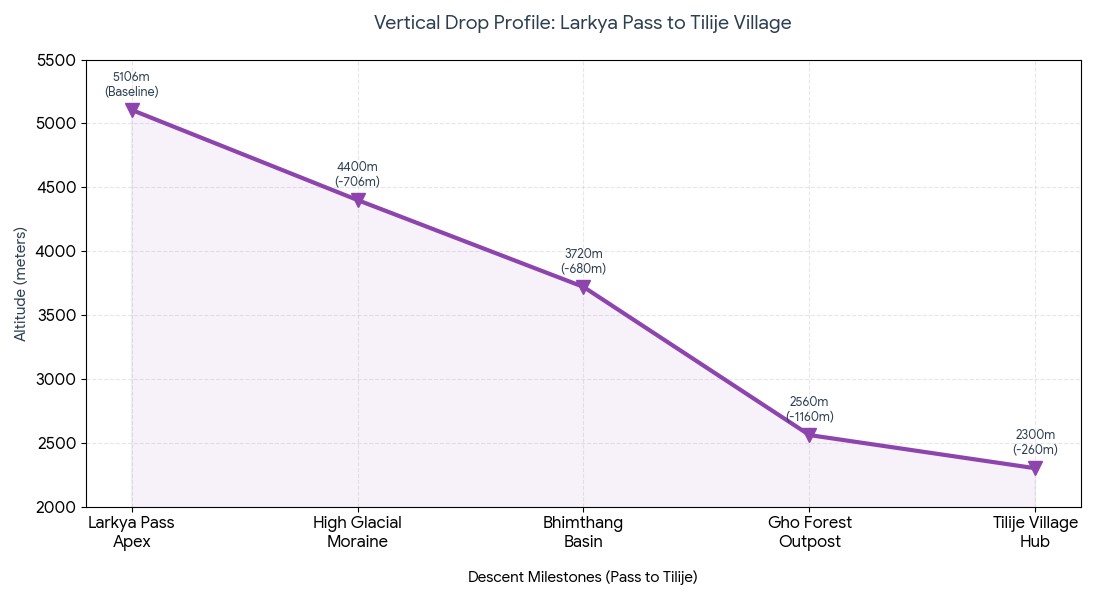
| Stage / Milestone | Target Altitude (m) / Target Altitude (ft) | Net elevation drop | Landscape / Physiological change |
|---|---|---|
| Larkya Pass Apex | 5106 m / 16752 ft | Baseline | Alpine Zone; Sub zero temperatures; micro spikes required for ice sections. |
| High Glacial Moraine | 4400 m / 14435 ft | -706 m | steepest section; trail follows unstable scree beside moraine. |
| Bhimthang Basin | 3720 m / 12204 ft | -680 m | first lodge stop; oxygen recovery begins. Sub alpine meadows. |
| Gho Forest Outpost | 2560 m / 8398 ft | -1160 m | Dense rhododendron and pine forest; Trail soft/muddy. |
| Tilije Village Hub | 2300 m / 7545 ft | -260 m | large settlement; warm climate; zone of safety. |
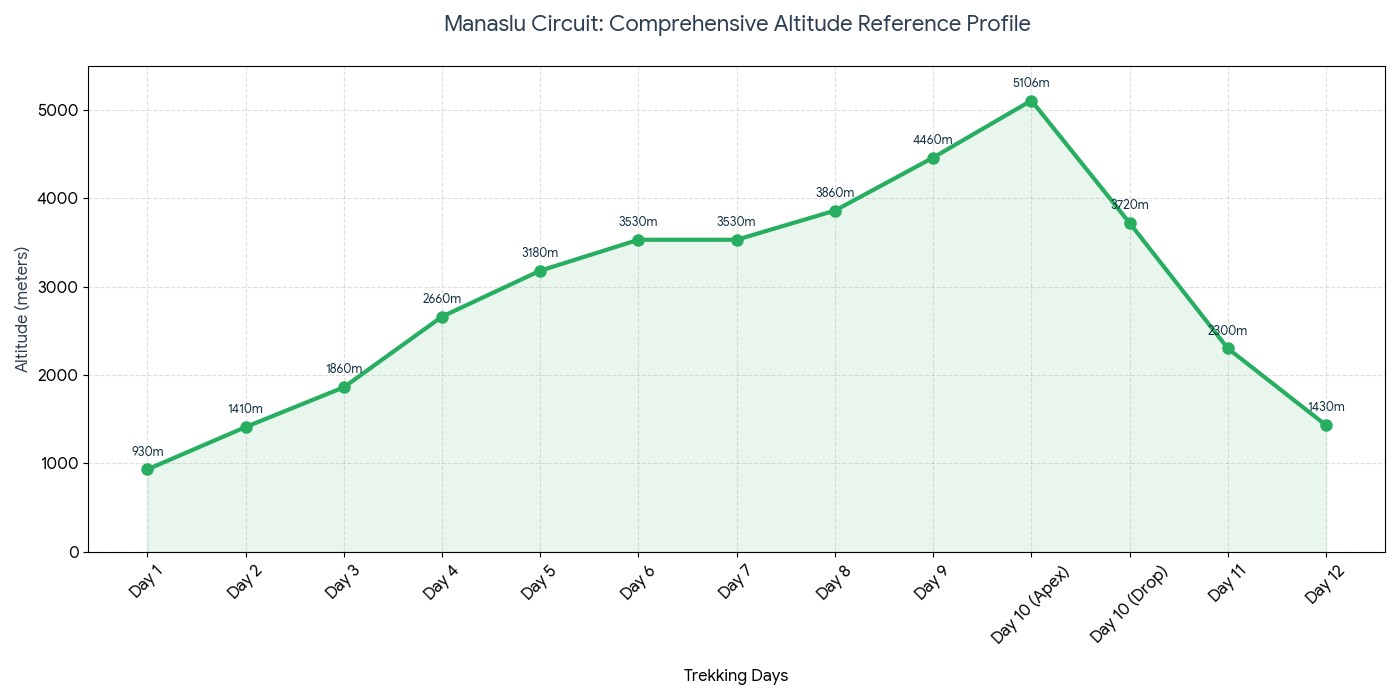
Meanwhile, the key to a successful and life changing trek around the Manaslu and Nubri/Tsum region is mastering the altitude variations. The Manaslu Circuit Trek takes a unique 'loop' route which ascends steeply up the Budhi Gandaki gorge and then drops more gently through the valley of the Marsyangdi River. Thus the Manaslu altitude summary in these regions forms an asymmetrical bell curve where the upward trek is slow and sustained, and the downhill portion steep and short.
Here, this safe trekking itinerary provides a structure for planning your physical preparation for Larkya Pass in relation to daily challenges on the trail.
Final tips for preparing your journey:
| Trekking day | The trail and stages | Altitude at end of day (m) | Altitude at end of day (ft) | Daily elevation change (m) |
|---|---|---|
| Day 1 | Kathmandu to Machha Khola. | 930m | 3051ft | +470 m (Driving gain) |
| Day 2 | Machha Khola to Jagat Village checkpoint. | 1410m | 4625ft | +480 m (gradual riverside) |
| Day 3 | Jagat village to Deng Restricted Entry point. | 1860m | 6102ft | +450 m (steep canyon walk) |
| Day 4 | Deng village to Namrung sub-alpine gateway. | 2660m | 8727ft | +800 m (steep forest walk) |
| Day 5 | Namrung to Lho village viewpoint. | 3180m | 10433ft | +520 m (early Manaslu views) |
| Day 6 | Lho village to Sama Gaon valley floor. | 3530m | 11581ft | +350 m (entry into Nubri Valley) |
| Day 7 | Rest day: Active side trips around Sama Gaon. | 3530m | 11581ft | 0 m (sleep low, walk high) |
| Day 8 | Sama Gaon to Samdo border outpost. | 3860m | 12664ft | +330 m (border walk, lower oxygen) |
| Day 9 | Samdo to Dharmasala high camp base. | 4460m | 14632ft | +600 m (overnight above 4000m) |
| Day 10 | Pass Day: Dharmasala over Larkya Pass. | 5106m | 16752ft | +646m to apex peak |
| Day 10(cont.) | Larkya Pass over the drop to Bhimthang basin. | 3720m | 12204ft | -1386m descent drop |
| Day 11 | Bhimthang basin to Tilije village. | 2300m | 7545ft | -1420 m (knee jarring descent) |
| Day 12 | Tilije to Dharapani, then drive to Besisahar. | 1430m | 4691ft | -870 m (end of foot trekking) |
In clonclusion, the Manaslu Circuit trek altitude profile takes you through incredibly deep river gorges to high, icy mountain passes. Being able to visualize how much and how quickly this altitude changes will enable you to plan a safe and enjoyable loop around Mt. Manaslu. So, plan to walk between 850m – 5106m above the sea level that is Machhakhola to Larkya Pass. In fact, you have to gain more than 4000m elevation in the entire trek in 10 days. For, this need a comprehensive physical training and mental stability.
1. At what altitude does the Manaslu Circuit trek begin?
A standard Manaslu Circuit trek itinerary begins either at Soti Khola or Machha Khola. Both villages are at a low elevation and offer fantastic introductions to the mountainous landscape; you will sleep over 870 meters (2,854 feet) high at Machha Khola which is great for easy acclimatization.
2. What is the highest elevation on the Manaslu Circuit trek?
The Manaslu Circuit trek peaks at a staggering altitude of 5,106 meters (16,752 feet), where the Larkya La Pass separates the Gorkha district from the Marsyangdi River valley. This stunning pass represents the highest point of your journey through the Manaslu Circuit trek altitude profile.
3. How fast is the altitude change along the Manaslu Circuit trek?
The landscape transitions quickly from a hot, subtropical riverside to alpine environments at high altitudes. Within the first five days of the Manaslu Circuit trek itinerary, you can gain over 2,500 meters, rising from less than 1,000 meters to above 3,500 meters, with tremendous variation.
4. Where are the best rest stops and acclimatization villages on the Manaslu Circuit trek?
The most suitable Manaslu Circuit trek itinerary requires overnight rests in the higher villages; we recommend two nights at Samagaon (3,530 meters) and one night at Samdo (3,860 meters). These villages offer incredible opportunities for acclimatization, preventing Acute Mountain Sickness (AMS) before the big pass day.
5. How high is Samagaon, and what are there to see and do?
Samagaon lies at a lofty 3,530 meters (11,581 feet) and offers numerous high-altitude day treks. Our popular choices include the stunning day hike up to Manaslu Base Camp (4,400 meters), or a visit to the beautiful Birendra Lake (3,450 meters). Rest days are often spent at Samagaon to cope with the Manaslu Circuit trek difficulty.
6. What is the altitude profile of the village Samdo?
Samdo is the last village on your route to Larkya La before it begins to climb toward the highest altitude, sitting at 3,860 meters (12,664 feet). This village's position, below the tree line, means you can spend one night here to increase your acclimatization significantly before pushing for the final climb the next day.
7. What altitude is Dharmasala / Larkya Phedi at?
Dharmasala, the base camp from which the ascent of Larkya La begins, is located at an extreme altitude of 4,460 meters (14,632 feet). This is the highest point where you will spend the night on your entire Manaslu Circuit trek altitude profile, so come prepared for cold, basic lodgings and a very early wake-up.
8. How long does it take to ascend Larkya La on the Manaslu Circuit trek?
The summit of Larkya La (5,106m) takes between 4 to 5 hours from Dharmasala, climbing 650 vertical meters as you tackle loose moraine, ice, and scree to reach the prayer flags. This part of the Manaslu Circuit trek difficulty will often start before sunrise.
9. What is the altitude profile of the descent from Larkya La?
After the initial strenuous climb up, the descent can also be arduous and physically demanding. Dropping a steep 1,516 meters, you will arrive in the village of Bimthang (3,590m), which can often involve knee-jarring walking through steep, loose moraine and over ice fields.
10. How does oxygen availability vary along the Manaslu Circuit trek?
At the trailhead, oxygen levels are normal at 100%, but as you ascend, this figure will begin to decrease significantly. For example, at 3,530 meters you'll find that the oxygen level is around 65%, while at 5,106 meters, you will only be breathing about 53% of normal levels, drastically affecting your pace.
11. Is the Manaslu Circuit trek suitable for beginners?
The Manaslu Circuit trek requires significant physical preparation and resilience. While fit beginners can complete it, the higher altitude, more remote wilderness, and sustained climbing are considerably more challenging than the Annapurna Circuit. You will need a strong cardio workout routine in the months prior.
12. What are the costs involved in the Manaslu Circuit trek permits?
Due to its status as a restricted area, the Manaslu Circuit trek cost is a factor that will be added to your budget. A restricted area permit for Manaslu will cost between $75-$100 USD, and you will also need MCAP and ACAP fees that are normally managed by the guiding agency you work with.
13. How do 'climb high, sleep low' principles apply on this trek?
During your time at Samagaon (3,530 meters), guides encourage "climbing high, sleeping low" to aid acclimatization. Day treks such as to Pungyen Gompa (4,050 meters) can increase your body's red blood cell production, helping you adjust to the thinning air before returning to sleep at your lodgings.
14. What are the key signs that you haven't acclimatized properly to the Manaslu altitude?
Failure to acclimatize to the Manaslu altitude profile can result in Acute Mountain Sickness (AMS). The symptoms include headaches, nausea, loss of appetite, and extreme fatigue. Resting, staying hydrated, and descending if these conditions persist or worsen is paramount.
15. Can helicopters be used for rescues on the Manaslu Circuit?
Yes, helicopter rescue services are available on the Manaslu Circuit. It is crucial to ensure your travel insurance includes comprehensive medical evacuation for high-altitude conditions up to 6,000 meters as this region is remote and helicopter rescue is the only feasible method for medical emergency recovery.
16. What is the overall walking distance of the Manaslu Circuit trek?
The full Manaslu Circuit trek distance averages about 177 kilometers (110 miles). You will generally walk between 12 to 15 kilometers a day as you ascend and descend through the dramatic Manaslu Circuit trek altitude profile, taking in stunning vistas along the way.
17. How does the weather change according to altitude on the Manaslu Circuit trek?
The weather along the trek varies considerably. You will encounter warm and humid conditions in the lower valleys, but as you climb, temperatures will drop sharply. Below 0C (32F) at night is expected from Samdo upwards, with snow being common on the higher passes like Larkya La.
18. What specific gear is recommended for the altitude variations and Larkya La?
For a safe trek through the Manaslu Circuit trek altitude profile, proper cold-weather gear is vital. This includes high-loft down jackets, thermal base layers, a windproof and waterproof outer shell, warm gloves and a beanie, polarized sunglasses (especially for Larkya La's snow glare), and micro-spikes or crampons for icy sections.
19. Where does the Manaslu Circuit trek altitude profile conclude?
Your 177 km loop around the world's eighth-highest peak concludes in Dharapani at 1,860 meters. At this point, you will join the popular Annapurna Circuit route, where you will be able to hire a jeep for the return journey back to Kathmandu.
20. Why must I be accompanied by a registered guide for the Manaslu Circuit trek?
As a restricted area, government regulations require that trekkers be at least in groups of two, and must be accompanied by a registered local guide for the entire duration of the Manaslu Circuit trek. This ensures your safety as you navigate challenging terrain and adhere to restricted area permit rules.
Our travel experts are ready to assist you with any questions.
Send us a message.Have a question before you book? Send your enquiry below and our travel experts will get back with the required information.