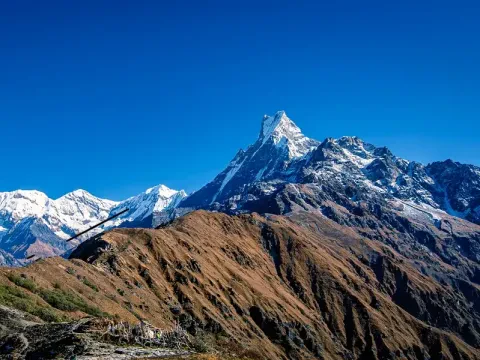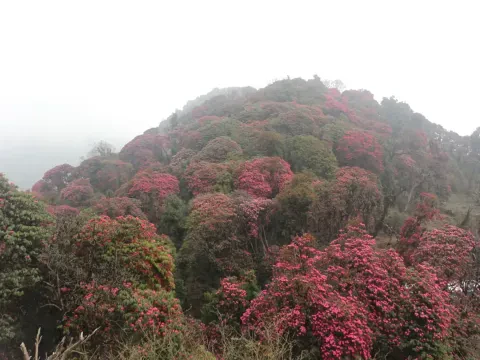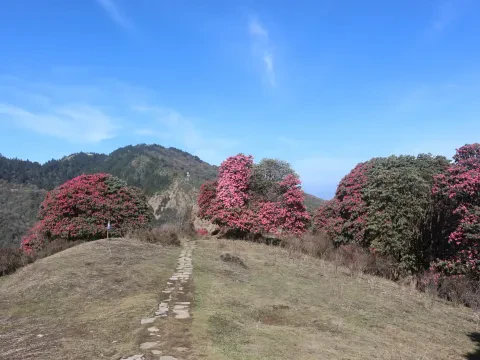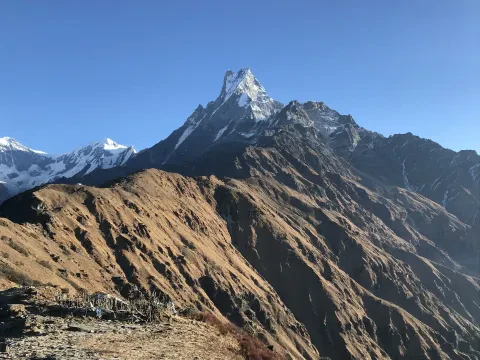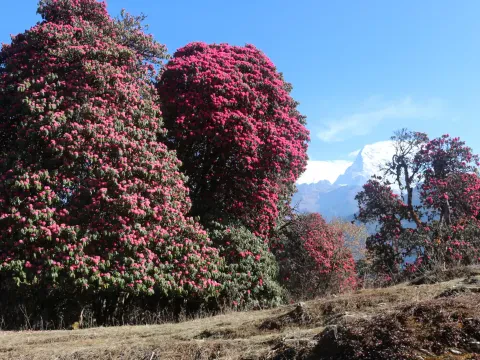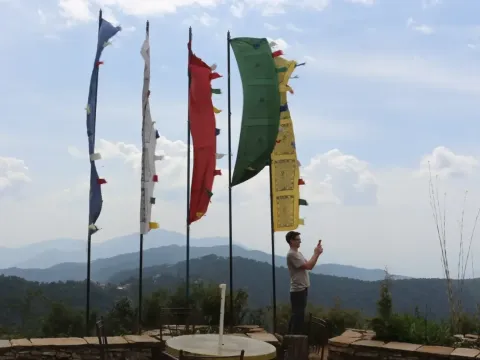
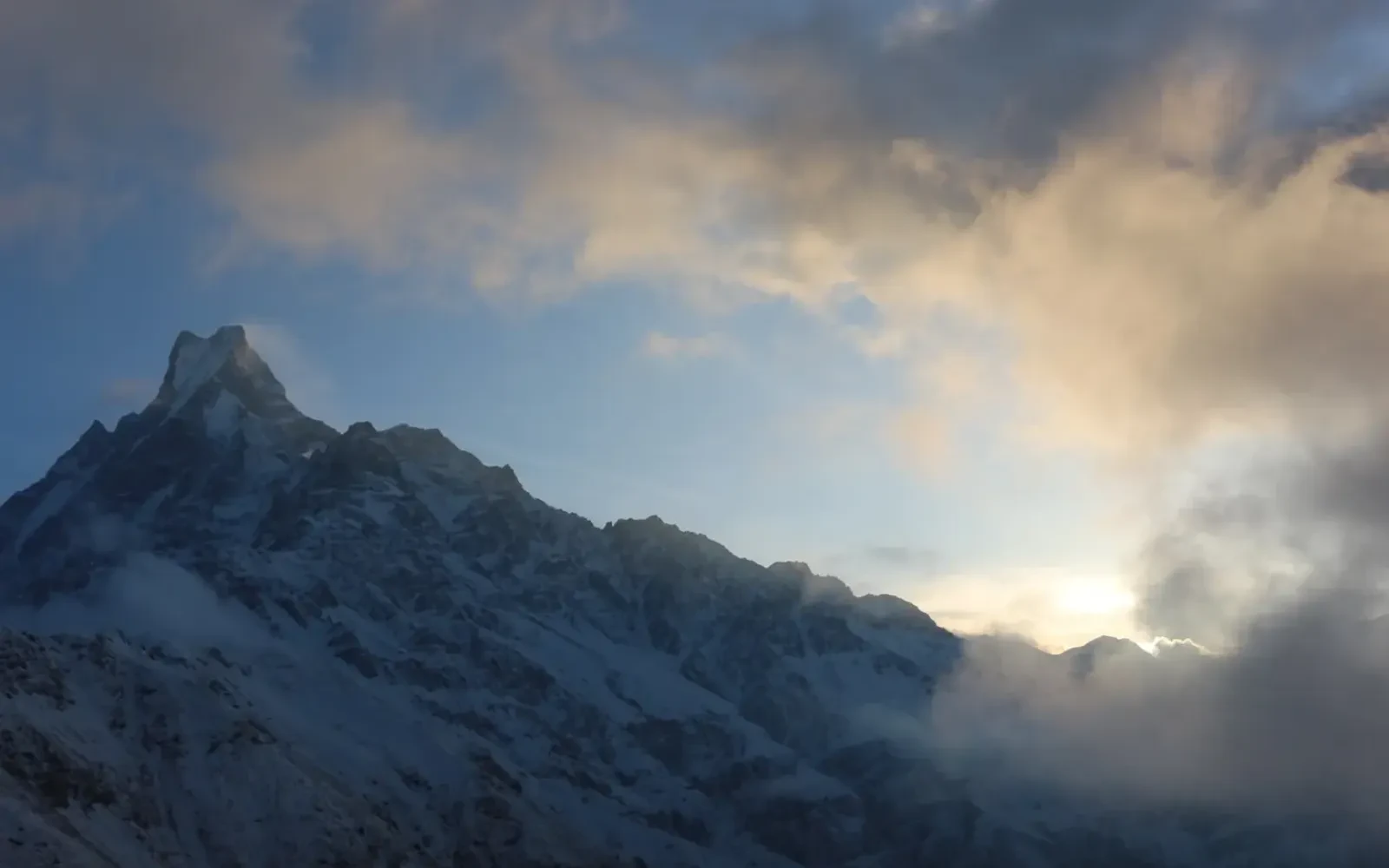
The Mardi Himal short trek 4 days is a great Himalayan adventure. Starting in Pokhara, the trail leads through subtropical foothills to alpine ridges. Beyond the forest, Machhapuchhre (Fishtail) rises to an astonishing 6993 meters above sea level.
Meanwhile, the 4-day Mardi Himal itinerary from Pokhara is the best option if you have a shorter time budget. During the Mardi Himal short trek, you can enjoy the views of rhododendron forests, traditional villages, and high Himalayan ridges. The Mardi Himal short trek 4 days usually peaks at around 4500 meters. This makes it a more demanding option as compared to a 5-7 day itinerary.
Here, the table below shows a suggested 4-day Mardi Himal trekking Itinerary with distances, camps, and approximate elevations.
| Day Itinerary | Approx. Elevation | Walking |
|---|---|---|
| 1 Pokhara – Kande – Forest camp | 2520 m | 1.30 hrs drive and 4-5 hrs trek |
| 2 Forest camp – High camp | 3580 m | 5-6 hrs |
| 3 High camp – Mardi Viewpoint/Base Camp – Low Camp | Up to 4500 m | 5-7 hrs |
| 4 Low Camp- Siding – Pokhara | 1700 – 822 m | 3 hrs. trek and 2 hrs. Drive |
Here, the distances and overnight camps may vary depending on a particular tour operator. The Mardi Himal Base Camp viewpoint at around 4500 meters is an optional extra on some itineraries.
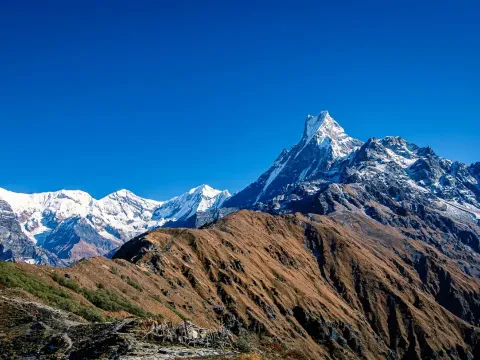
The short Mardi Himal trek is the best option if you have a limited time budget. Compared to longer itineraries, the 4-day trek allows you to see the ridges while limiting the days spent hiking at lower elevations.
Likewise, another benefit of a short Mardi Himal trek is that you reach higher elevations quickly, giving you fantastic views of the Machhapuchhre.
On this trekking itinerary, Mardi Himal, the highest peak, dominates the skyline at an astonishing 6993 meters above sea level. In addition to Machhapuchhre, the 4-day Mardi Himal trekking itinerary also allows you to see the Annapurna South (7219 m) and Hiunchuli (6441 m) peaks.
Here, the table below compares some of the features of a 4-day Mardi Himal trek and those of a longer trek.
| Feature | 4 - day trek | Longer trek (5-7 days) |
|---|---|---|
| Duration | 4 days | 5-7 days |
| Pacing | Faster | More relaxed |
| Fitness level | Higher | Easier |
| Forest experience | Shorter | Longer |
| High-ridge time | Excellent | More flexible |
| Acclimatization | Limited | Better |
| Side trips | Limited | More |
| Best for | Limited time | Leisurely trekking |
1. Excellent Mountain Views
The main advantage of a 4-day Mardi Himal trek is the fantastic mountain views. In particular, the high-ridge trail offers excellent panoramic views. On this trek, beautiful Machhapuchhre becomes the centerpiece.
In addition, it is possible to see the Annapurna South and Hiunchuli peaks. Moreover, higher you go on the trek, the more spectacular the views are.
2. Quieter Trail
Compared to other popular Annapurna region hikes, the Mardi Himal trail is quite popular. The trail passes through the forest and along the ridges.
As a result, the Mardi Himal trek is relatively quiet. In particular, the trail offers excellent solitude early in the mornings.
3. Efficient From Pokhara
Pokhara is a fantastic base for shorter hikes in the Annapurna region. In particular, road transport is more efficient, limiting the time spent walking at lower elevations.
As a result, a 4-day Mardi Himal trek from Pokhara becomes a viable option. This benefit is especially important if you have a limited time budget for your Nepal adventure.
4. Varied Landscape
A unique benefit of a Mardi Himal short trek is the variety of landscapes that can be seen on a single hike. In particular, you pass from one ecosystem to another as you make your way from the lower foothills to the high ridges. First, you walk through the forested lower foothills.
Then, you enter the rhododendron bushes. Further along the trail, the trek becomes more alpine. Finally, you enter the high ridges area and enjoy the fantastic views.
5. Fits a Fit Traveler
If you are a fit and want more demanding hikes, the 4-day Mardi Himal trek is a good option. In particular, you need to be able to walk long hikes per day. Steeper sections might also be challenging.
Moreover, the high elevation can also make the trek difficult. Thus, it is important to know that a 4-day Mardi Himal trek is more demanding than most other hikes in the Annapurna region.
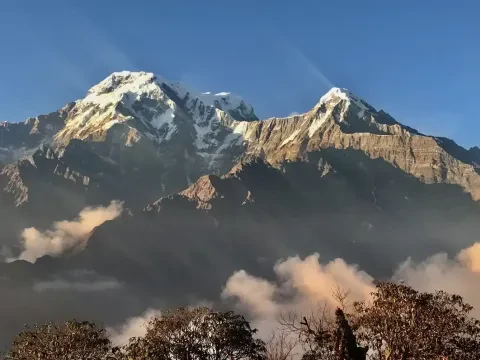
The Mardi Himal trek difficulty is generally moderate. However, the 4-day itinerary is more demanding than it seems due to steep forest trails, rapid altitude gains, and the long third day. Thus, it is vital to know what challenges the Mardi Himal trek from Pokhara entails.
Actually, the trail begins at Pokhara, around 822 m above sea level. The route gradually climbs and passes through Kande, Forest Camp, Low Camp, and High Camp. The latter is located at around 3,580 m. The optional Mardi Himal Base Camp viewpoint offers fantastic views from 4,500 m above sea level.
Mardi Himal Trek Difficulty :
1. Steep Forest Sections
2. Rapid Altitude Gains
3. Long Third Day
The third day’s hike is most challenging since trekkers should wake up early and climb to the high camp viewpoint. Once there, they enjoy the superb panorama before descending rapidly. Therefore, it is crucial to have an ample breakfast on the morning of day 3.
The Mardi Himal trek is not particularly strenuous, although a good level of fitness is necessary. In general, a reasonably fit person should be able to manage the 4-day trek comfortably.
However, it is vital to prepare for the Mardi Himal trail by training your legs for:
The Mardi Himal 4-day trek is suitable for:
However, it is not recommended for sedentary travelers. In addition, Mardi Himal trek from Pokhara is not suitable for inexperienced trekkers who dislike challenging ascents. If you are searching for an easy-paced trekking holiday, pick the 5-7 day option.
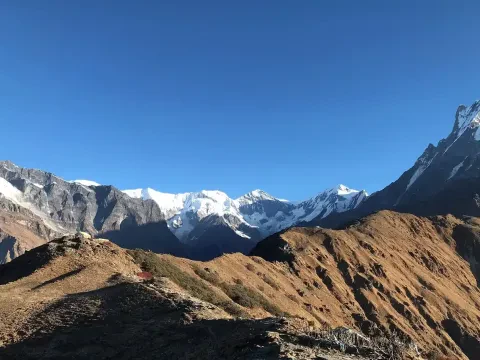
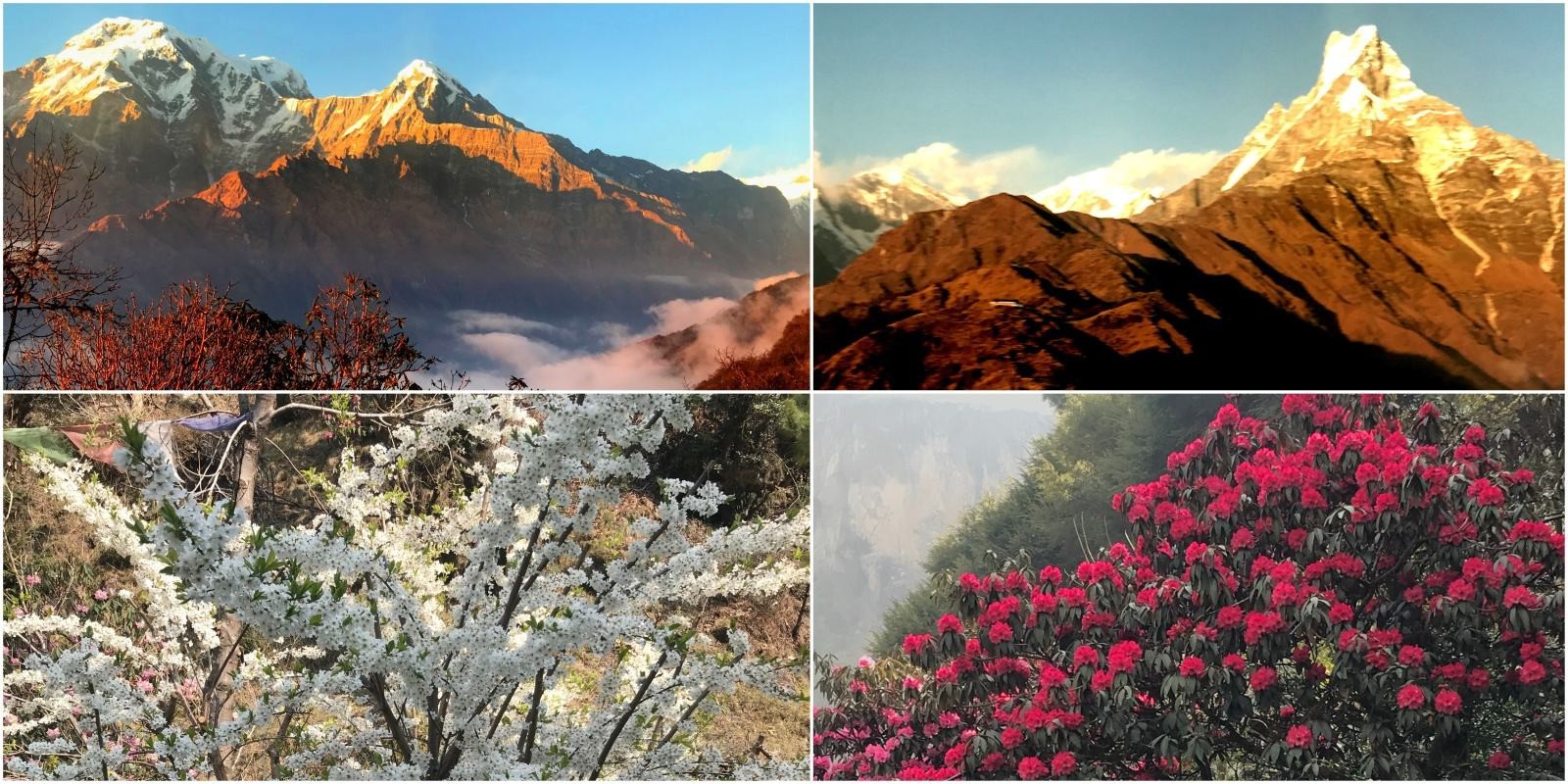
The best time to do the 4-day Mardi Himal trek is during spring or autumn. In general, the weather during these seasons is fine, and the mountain views are spectacular.
In addition, trekking during spring allows you to enjoy the colorful rhododendron forests.
| Season | Months | Weather | Mountain Views | Best Attraction |
|---|---|---|
| Spring | March – May | Mild & Warm | Excellent | Rhododendron |
| Autumn | September – November | Dry | Excellent | Sharp Himalayan panorama |
| Winter | December – February | Cold | Occasionally clear | Snowy peaks |
| Monsoon | June – August | Wet | Poor | Greenery |
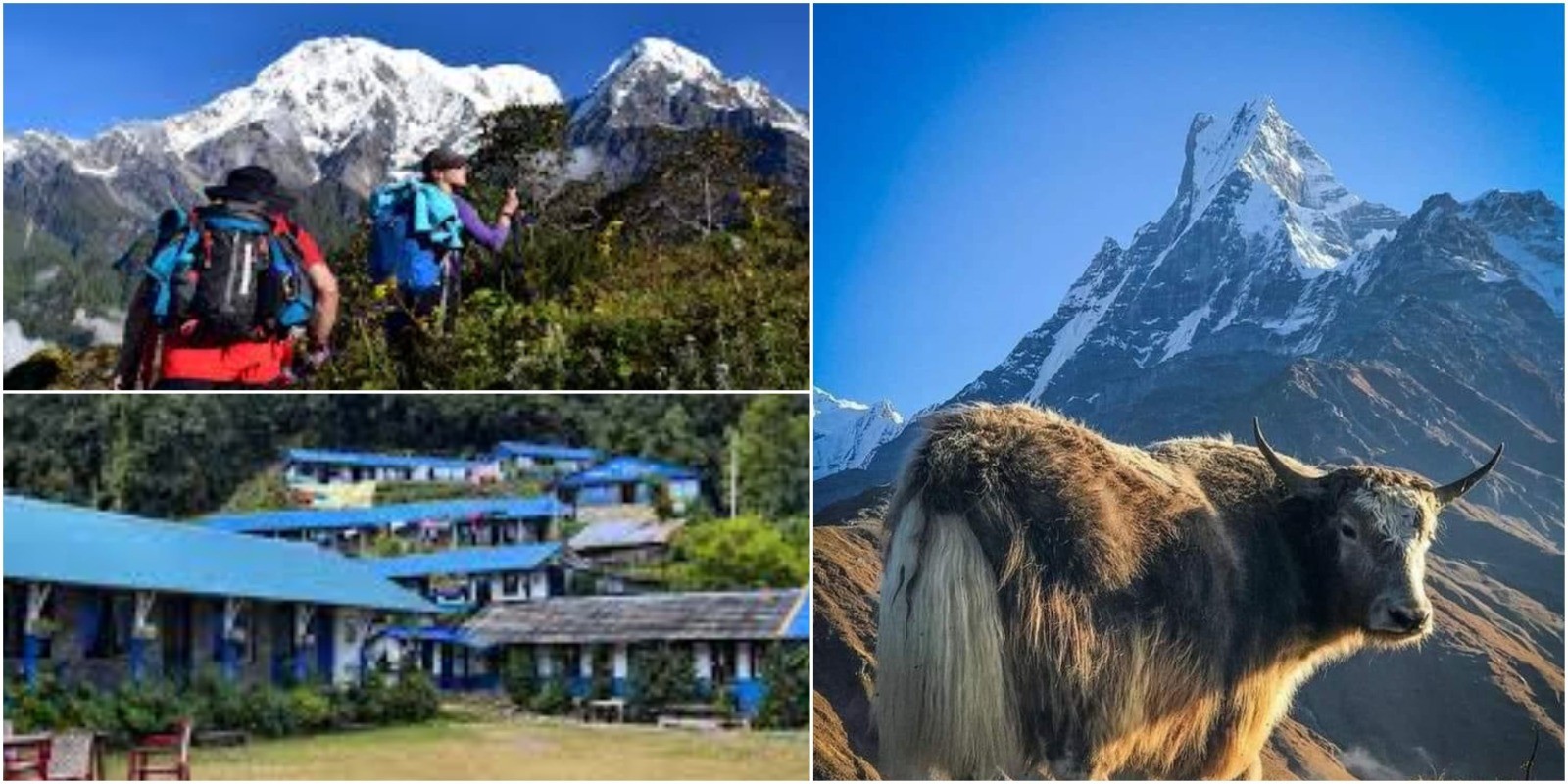
Winter is comparatively a good season for trekking in Nepal. It has colder temperatures, and the high camp area can get particularly frigid.
Moreover, the Mardi Himal trail can also be slippery in the higher altitudes (around 4,500 m). However, these conditions make for a unique winter trekking experience.
Here, the 3,580 m High Camp is particularly challenging during the colder months, requiring appropriate cold-weather gear. Meanwhile, the viewpoint at around 4,500 m is also inaccessible. As a result, it is crucial to check the weather forecast ahead of your trekking.
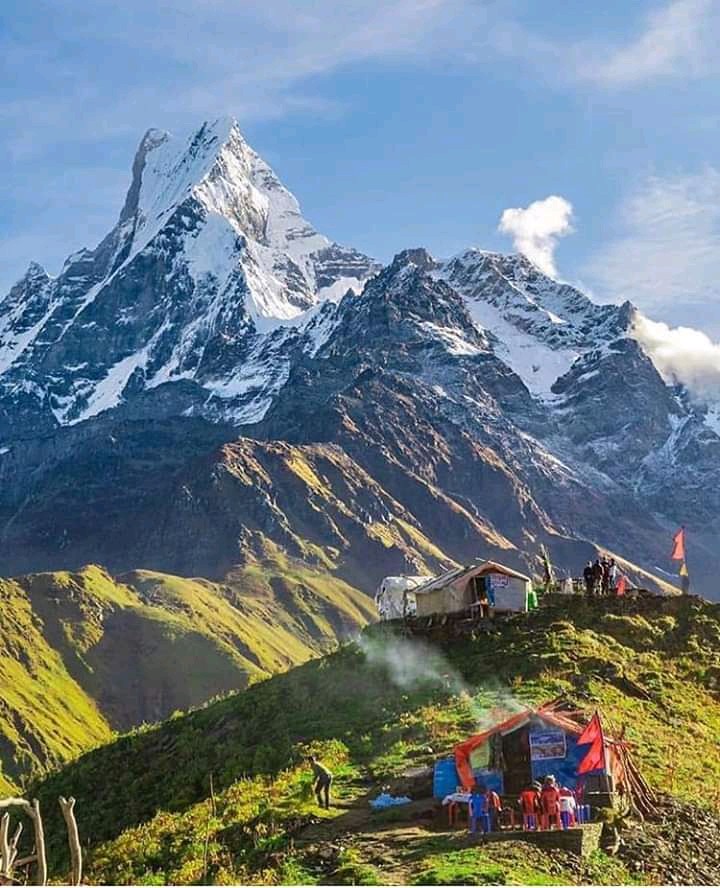
Additionally, the unpaved roads can turn into slippery mud, adding to the difficulties of the already challenging trail. Thus, it is essential to be particularly cautious during the rainy season.
| Your Preference | Best Season |
|---|---|
| Clear mountain views | October – November |
| Rhododendron forests | March – April |
| Fewer crowds | Winter |
| Warm weather | Spring |
| Snowy wonderland | Winter |
| Overall best trekking season | Autumn |
For most travelers, October – November provides the best combination of excellent mountain views, pleasant weather, and reasonably good road conditions.
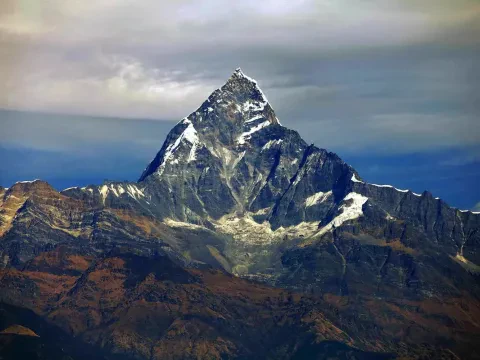
| Expense | Approximate Cost | Notes |
|---|---|
| Accommodation | US$8–20/night | Basic teahouse room |
| Food | US$20–35/day | Three main meals |
| Transport | US$40–90+ | Shared or private jeep |
| Guide | US$25–40/day | Licensed trekking guide |
| Porter | US$20–30/day | Optional service |
| Permits | Varies ACAP ( Rs.3000 for foreigners, Rs.1000 for SAARC Nationals) and applicable TIMS |
| Snacks/drinks | US$5–15/day | Tea, coffee, snacks |
| Miscellaneous | US$10–30 | Showers, charging, tips |
| Typical package | US$260–450+ | Depends on inclusions |
Here, these are approximate figures for a 4-day Mardi Himal trek cost. The actual expenses depend on the season, agencies, transport arrangements, and group size.
Therefore, joining other trekkers is an economical option.
A typical guided Mardi Himal Trek package includes the following:
What Makes the Trek More Expensive?
Recommended Budget :
You should also budget extra for the following:
In conclusion a transparent package with all inclusions makes the short Mardi Himal trek much easier to plan.
The main Mardi Himal Trek permit concerns the Annapurna Conservation Area and other trekking regulations. Since permit rules and fees are subject to change, it is a good idea to confirm the details before your arrival.
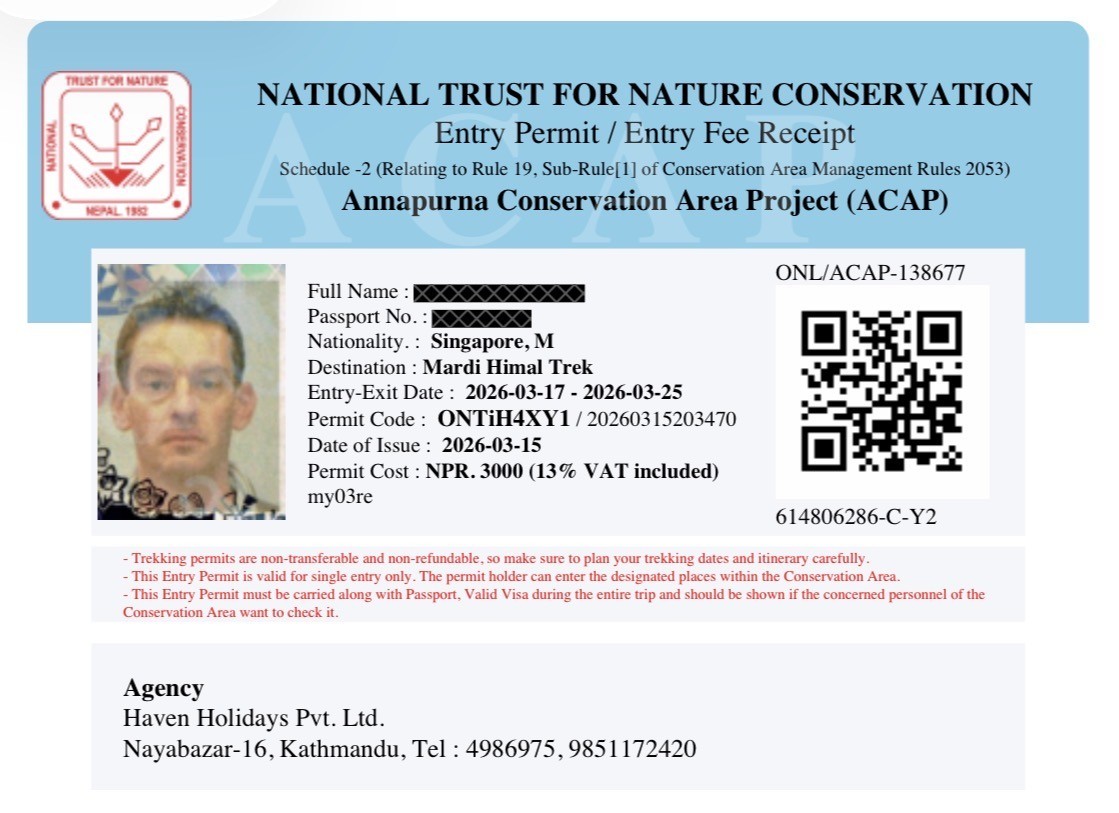
The Annapurna Conservation Area Entry Permit costs Rs. 3000 for foreigners and it costs Rs. 1000 for SAARC nationals.
| Requirement | Purpose | Where to Arrange ? |
|---|---|---|
| ACAP Permit | Annapurna Conservation Area entry | Pokhara / authorized trekking company office |
| TIMS | Trekker registration | Authorized trekking channels |
| Passport | Identity verification | Required for official records at office |
| Passport photos | Documentation | Where applicable |
| Trek itinerary | Route verification | Agency/permit office |
1. Annapurna Conservation Area Permit :
2. TIMS Card :
Where Can You Obtain Mardi Himal Permits?
You will typically need the following documents:
Permit Checks Along the Mardi Himal Trail :
Important Advice About Permit Fees :
If you book Mardi Himal Trek 4-day with Haven Holidays, the agency can double-check the permits and required documentation before your arrival.
Here, having your permits ready in Pokhara is always a good idea.
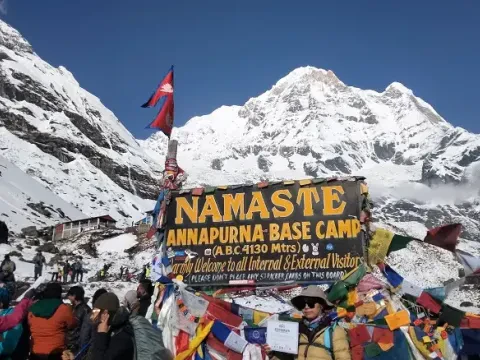
A good packing list for a 4-day Mardi Himal trek should include warm clothing, good footwear, and other essentials. The trail rises steeply from Pokhara (822 m) and reaches the High Camp at around 3,580 m. An optional side-trip to the Mardi Himal viewpoint from the High Camp reaches up to 4,500 m.
Therefore, it is advisable to pack warm clothing for the cold mornings and evenings and light clothing for warm afternoons. Likewise, good trekking boots are also essential as the upper trail involves rocky and uneven stretches.
| Gear | Reason for Inclusion | Priority |
|---|---|---|
| Trekking boots | Grip on rocky and uneven trails | Essential |
| Down/insulated jacket | Warmth at the High Camp | Essential |
| Fleece jacket | Mid-layer insulation | Essential |
| Thermal base layer | Warmth | Essential |
| Waterproof jacket | Protection from rain and wind | Essential |
| Trekking trousers | Comfort on a daily basis | Essential |
| Warm hat | Warmth | Essential |
| Gloves | Warmth at the High Camp | Essential |
| Warm socks | Comfort | Essential |
| Headlamp | Early morning hike to the viewpoint | Essential |
| Trekking poles | Assists in climbing and descending | Recommended |
| 30-40L backpack | Daily carry | Essential |
| Backpack rain cover | Protection from rain | Essential |
| Sunglasses | UV and snow protection | Essential |
| Sunscreen | High altitude UV protection | Essential |
| Water bottles | Daily hydration | Essential |
| Water purification | Contingency water treatment | Recommended |
| Personal medicines | As per individual needs | Essential |
| Basic first-aid kit | Treat minor injuries and blisters | Recommended |
| Power bank | Power backup in remote areas | Recommended |
| Camera/phone | Mountain photography | Optional |
| Dry bags | Protects electronics and clothing from moisture | Recommended |
Dress in Layers :
Prepare for High Camp :
Choose Good Footwear :
Pack for Early Morning Hike :
Do not overpack :
Day 1 of the Mardi Himal Forest Camp trek commences with a short drive from Pokhara (822 m). Depending on the route, the vehicle can either head towards Kande, Dhampus, or Pitam Deurali. The road trek saves a lot of time that would have been spent on foot had the trek started from Pokhara.
Here, the drive is comparatively short and reaches the trailhead within a few hours.
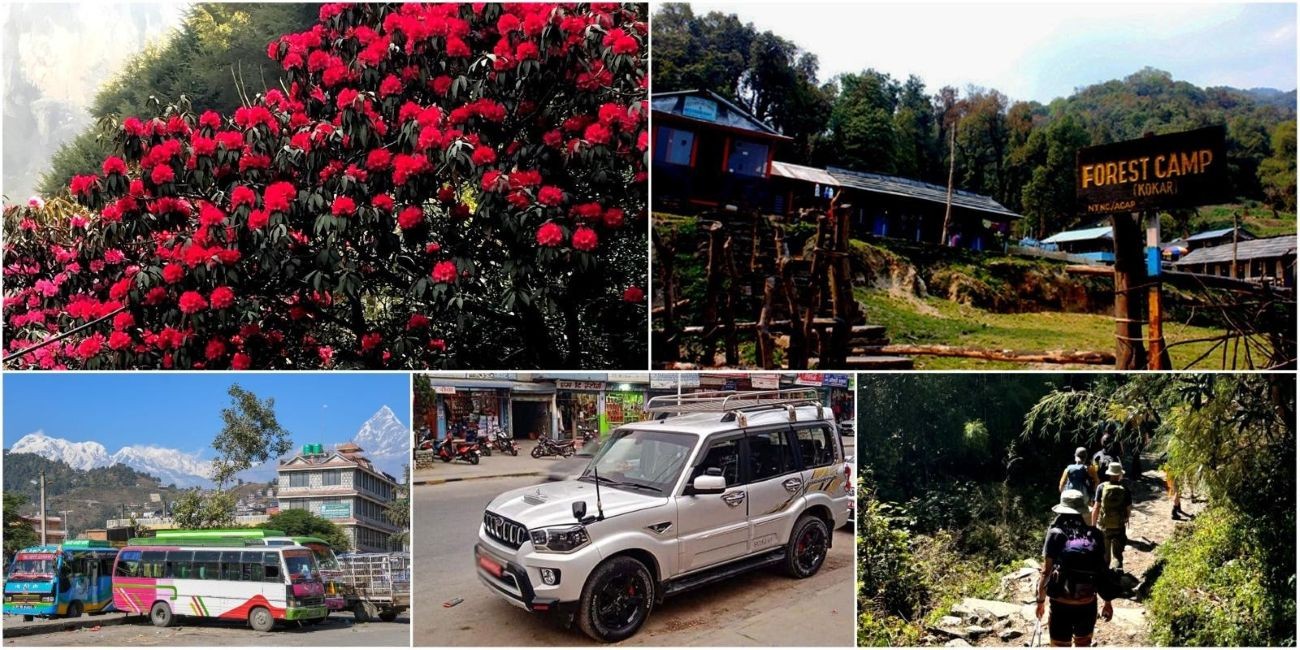
Day 1 Overview
Detail Information :
The day begins with a drive from Pokhara after breakfast. The road to Kande winds up the mountainous terrain. Kande is a popular trekking trailhead for several treks in the region.
The trail leads through dense forests of rhododendron, oak, and other mountain vegetation. The rhododendron forests are a special attraction, especially during the spring season when the rhododendrons bloom in full colors.
Similarly, the forest offers respite from the sun as well as a habitat for several bird species. The trail is not steep but gradually climbs up the mountain. Therefore, it is best to maintain a steady pace.
As the trail emerges from the forest, the first glimpses of the Himalayas open up. The view depends on the weather, but on a clear day, you can see the Machhapuchhre (6,993 m) peak, the Annapurna South (7,219 m) peak, and the Hiunchuli (6,441 m) peak.
Most importantly, the sight of the towering mountains is spectacular and marks the beginning of the Mardi Himal trek.
Eventually, you reach the Forest Camp at around 2,520-2,600 m. The Forest Camp is a small settlement surrounded by forests. There are teahouses offering accommodation and meals.
Here, the Forest Camp is comparatively less crowded than some of the other trekking camps in the region. After reaching the campsite, you can relax, have a warm meal, and prepare for the next day’s trek.
As the sun sets, the temperatures start to drop, so it is best to carry warm clothing for the night.
Day 1 of the Mardi Himal trek to Forest Camp from Pokhara is comparatively short and is a gentle introduction to the Mardi Himal trek.
Also, the day involves a short drive from Pokhara followed by a 4-5 hour trek through the rhododendron and oak forests. The trail offers beautiful mountain views, especially of the Machhapuchhre, Annapurna South, and Hiunchuli peaks.
Eventually, the trek leads to the Forest Camp at around 2,520-2,600 m.
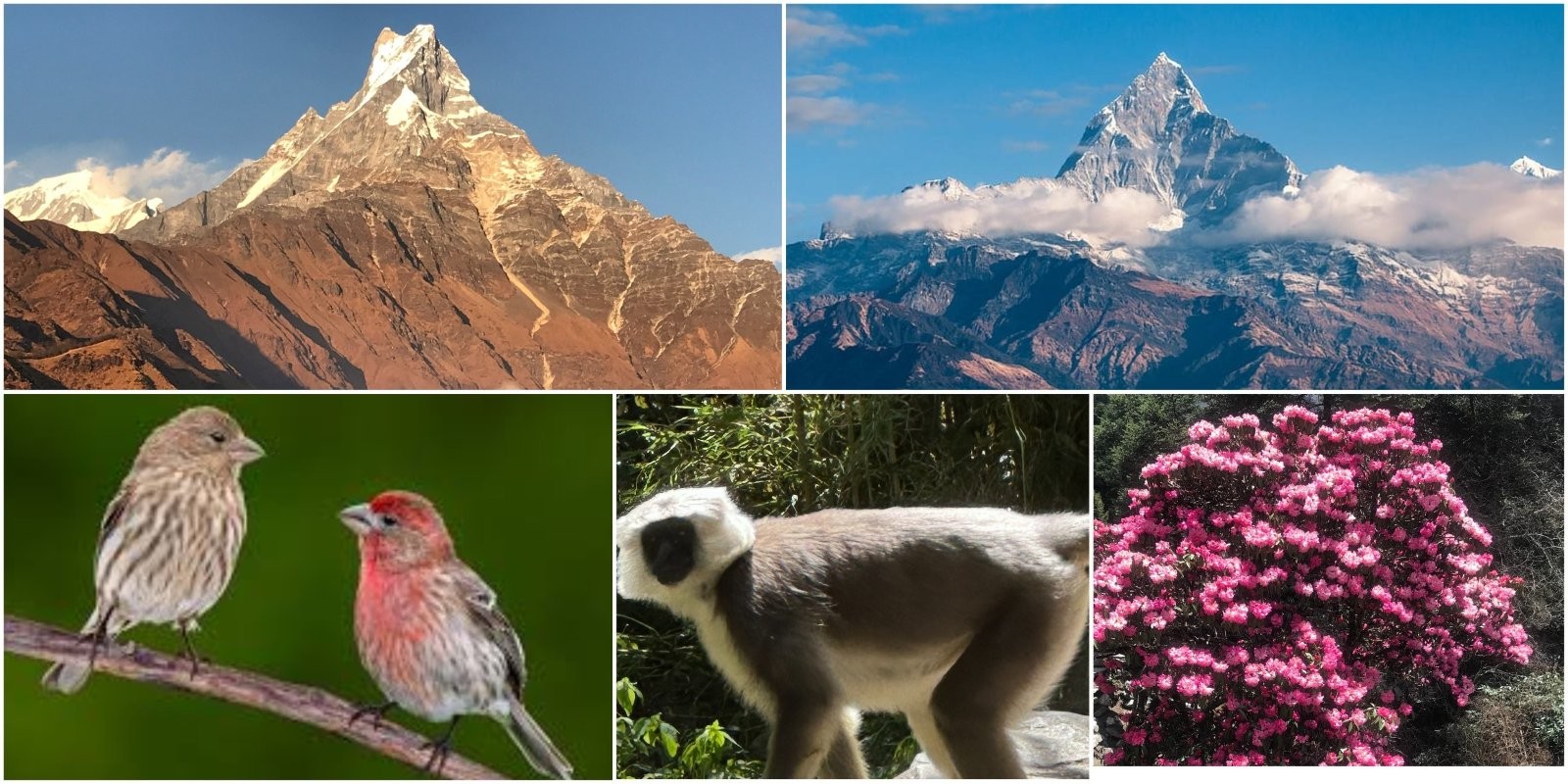
Meanwhile, we begin our trek from the Forest Camp at 2,520-2,600 m and ascend steadily to the High Camp at 3,580 m. Some variations of the itinerary and accommodation providers locate High Camp at 3,700-3,780 m, so the final elevation depends on the lodge and the specific route.
Day 2 At A Glance :
We start climbing the trail while it is still dark outside. The forest is dense at the start, with many rhododendrons dotting the trail. Oak trees are plentiful at the start of the hike as well.
As we continue ascending, the vegetation becomes shorter and sparser. Soon enough, we can see vast vistas of the surrounding peaks. The transition is slow but noticeable.
With higher ground offering more expansive views, the trail follows the Mardi Himal ridgelines, with mountain vistas taking the front seat. Machhapuchhre rises to 6,993 m and is most notable for taking the form of a fish tail at its summit. Annapurna South reaches 7,219 m, while Hiunchuli rises to 7,219 m. On a clear day, all of these peaks are visible and seem close to the trail.
| Mountain View | Elevation | Description to the Peak |
|---|---|
| Machhapuchhre | 6,993 m | Dramatic |
| Annapurna South | 7,219 m | Broad snowy face |
| Hiunchuli | 6,441 m | Impressive southern peak |
| Annapurna I | 8,091 m | Visible from specific vantage points |
Eventually, the forest opens up to reveal vast, rolling alpine vistas. High Camp is around 3,580-3,780 m, and each itinerary varies slightly, so the elevation depends on the accommodation provider.
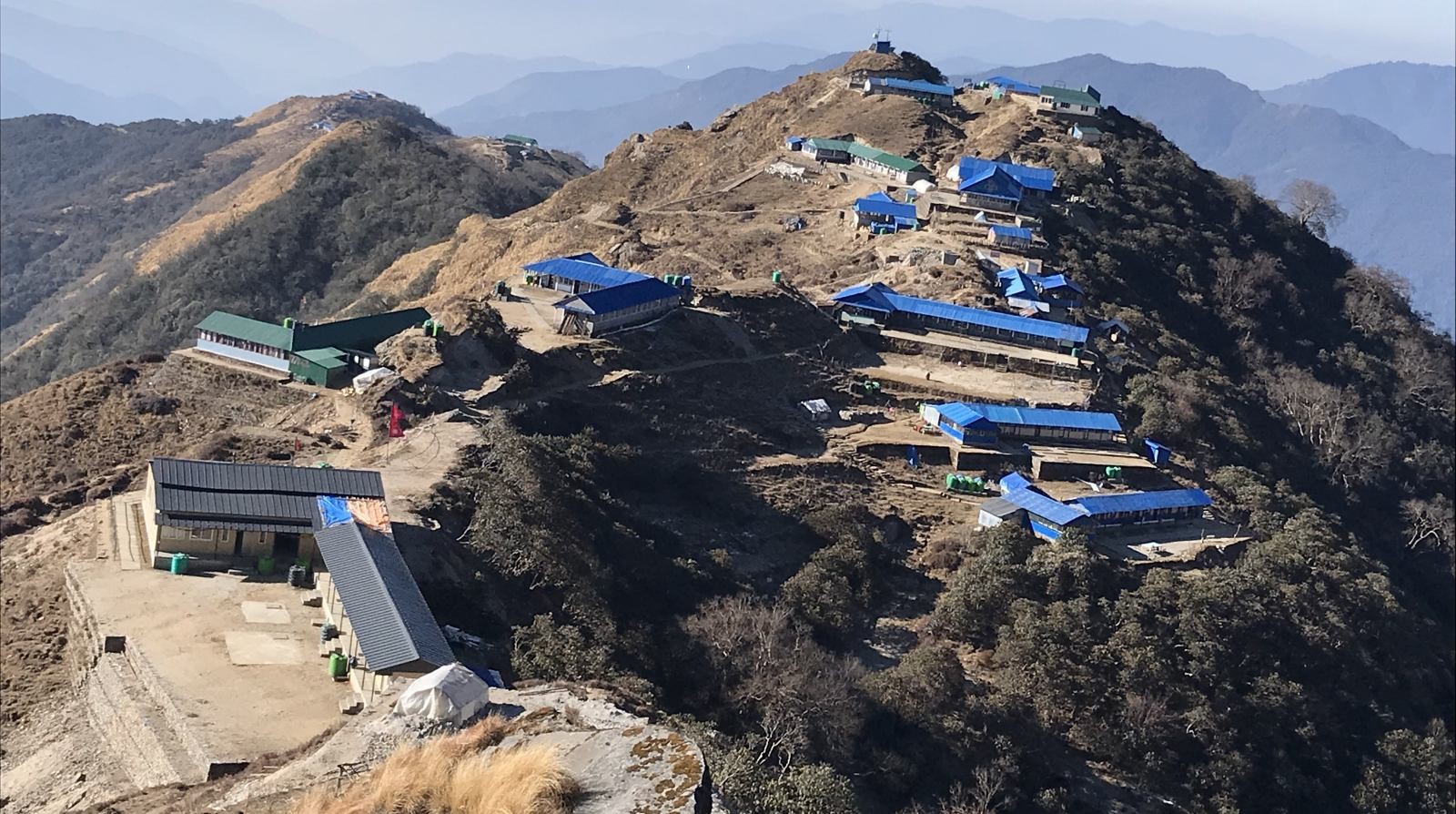
Moreover, the view from the High Camp is nothing short of spectacular. Peaks rise around the ridge from all angles, with clouds racing across distant summits. It can get quite chilly at night, so warm layers are recommended.
Check the weather forecast for the morning, grab your camera and a good headlamp, keep batteries warm during the night, drink lots of fluids during the day, and skip strenuous activities. You will likely awake before sunrise.
Day 2 ends with us at the lofty heights of the Mardi Himal ridge under the shadow of Nepal’s most recognizable peaks.
Day 3 is usually the most rewarding one on our Day 3 Mardi Himal Base Camp itinerary. We climb from the High Camp (3,580-3,780 m) to the upper viewpoints early in the morning to experience the sunrise over the Himalayas. The trail is rocky but offers incredible views.
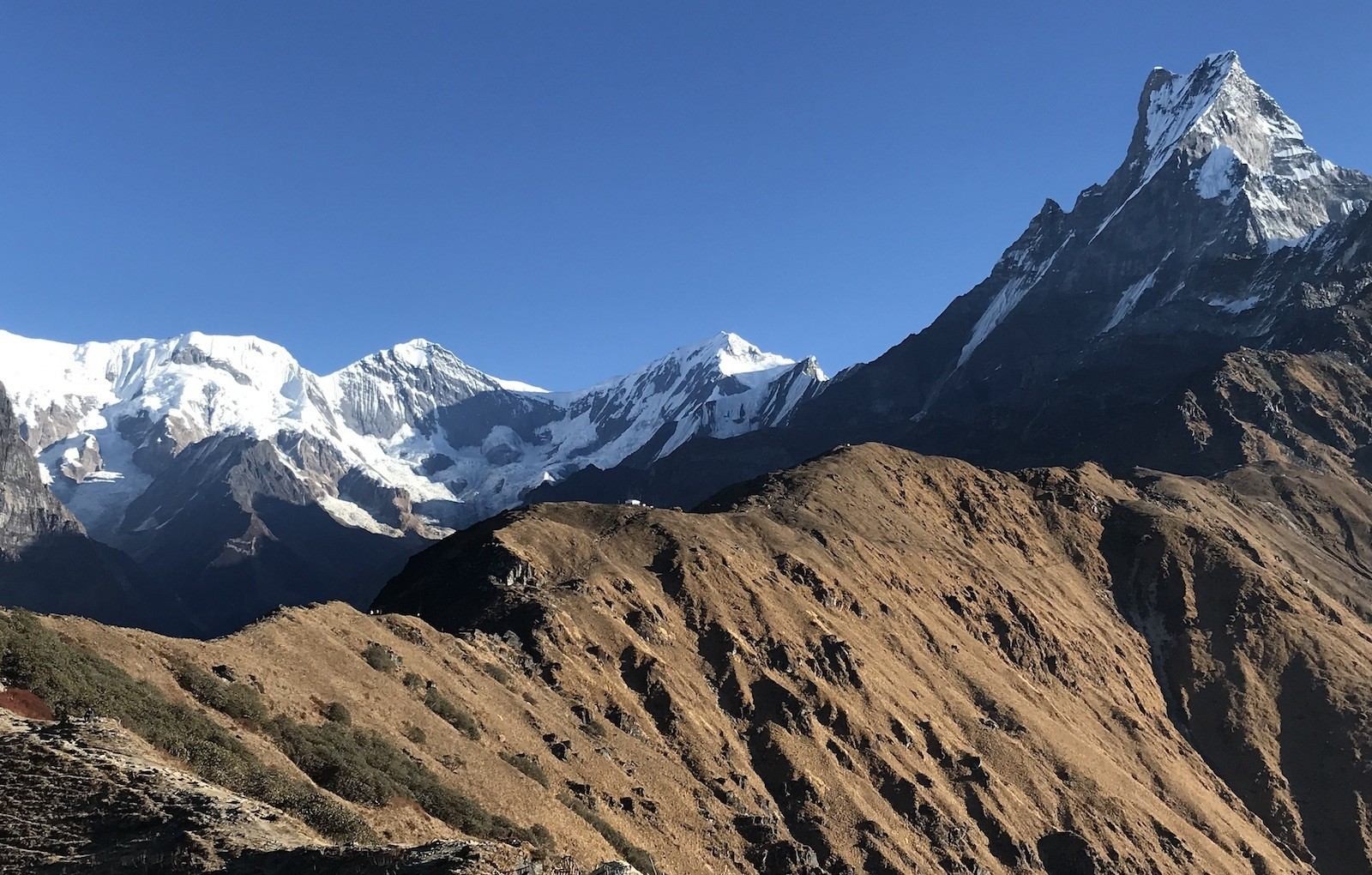
Depending on the itinerary, we may reach Upper Viewpoint at 4,200-4,500 m or Mardi Himal Base Camp at around 4,500 m. Some variations of the itinerary list the destination at 4,500 m as Mardi Himal Base Camp, while others name it the Upper Viewpoint.
On the way down, we can expect to spend several hours descending back to the Low Camp.
| Detail | Approximate Information |
|---|---|
| Starting point | High Camp – 3,580 - 3,780 m |
| Upper viewpoint | 4,200 - 4,500 m |
| Mardi Himal Base Camp | 4,500 m |
| Walking time | 7-9 hours |
| Terrain | Rocky, exposed, steep trail |
| Difficulty | Hard |
| Best experience | Sunrise and panoramic views |
| Descent | Low camp |
The early start has a good reason behind it - the morning views tend to be the best. The summit can be cloudy later in the day, so leaving the High Camp around 4:00-5:00 am is a good idea. Bring a good headlamp with extra batteries and dress warmly - it can get very cold before sunrise. Remember to walk at a steady pace and not to hyperventilate.
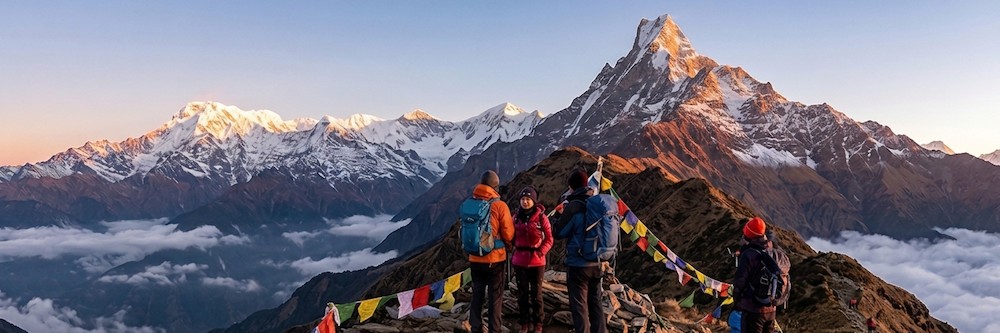
Ascending to the Upper Viewpoints
The trail becomes steeper and rockier as we progress towards the Upper Viewpoints. The trail is exposed, and trees become sparse at higher altitudes. The air is thin, so it is crucial to take it slow and steady.
At 4,200-4,500 m, we stop for sunrise, which offers spectacular views over the mountains. Machhapuchhreb rises to 6,993 m, with Annapurna South reaching 7,219 m and Hiunchuli rising to 6,441 m. Annapurna I takes a close second at 8,091 m. These remarkable views are best experienced from a good vantage point.
| Mountain | Approximate Elevation |
|---|---|
| Annapurna I | 8,091 m |
| Annapurna South | 7,219 m |
| Machhapuchhre | 6,993 m |
| Hiunchuli | 6,441 m |
As the sun rises, the mountains transform from blue-gray to golden white. The Mardi Himal ridge is a sight to behold, especially during sunrise, and is one of the highlights of the trip.
Many itineraries continue our climb to the Mardi Himal Base Camp at roughly 4,500 m.
However, the variation depends on the specific route taken since the highest point can be anywhere between 4,500 m.
Moreover, conditions on the trail matter as well - it is best to follow the advice of the local guide. Do not mistake the 4,500 m for a hard limit - if anything, it is a recommendation.
Importantly, make sure to descend as soon as possible if you start feeling ill. You will always have another day to attempt a higher viewpoint.
After enjoying the sunrise, we begin our descent back to the Low Camp. While the hike down is much easier on the legs, it is crucial to rest the muscles and not rush downhill.
Similarly, the rocks can be quite slippery, so it is a good idea to bring trekking sticks and use them when necessary. Long descents put a lot of stress on the knees, so it is a good idea to take it slow.
As we descend, the scenery transforms yet again - the alpine vegetation turns green, then merges with the forest.
Depending on the itinerary, we either arrive at or pass by the Low Camp at roughly 2,970 m. We spend the night at the Low Camp, being greeted by warm temperatures and a noticeable increase in vegetation.
After a long and strenuous day, we enjoy a good meal at the Low Camp, staying hydrated and well-fed.
Important Notes on Day 3:
While Day 3 is the hardest, it is also the most rewarding - it takes us to the highest altitudes, offers panoramic mountain views, and lets us enjoy a sunrise over the Mardi Himal ridge.
The views from Mardi Himal Base Camp are the ultimate highlight of this short trek. From the top of the ridge, Machhapuchhre (6,993 m) seems within reach. The iconic Fishtail summit takes center stage and is surrounded by a breathtaking Himalayan panorama on clear mornings.
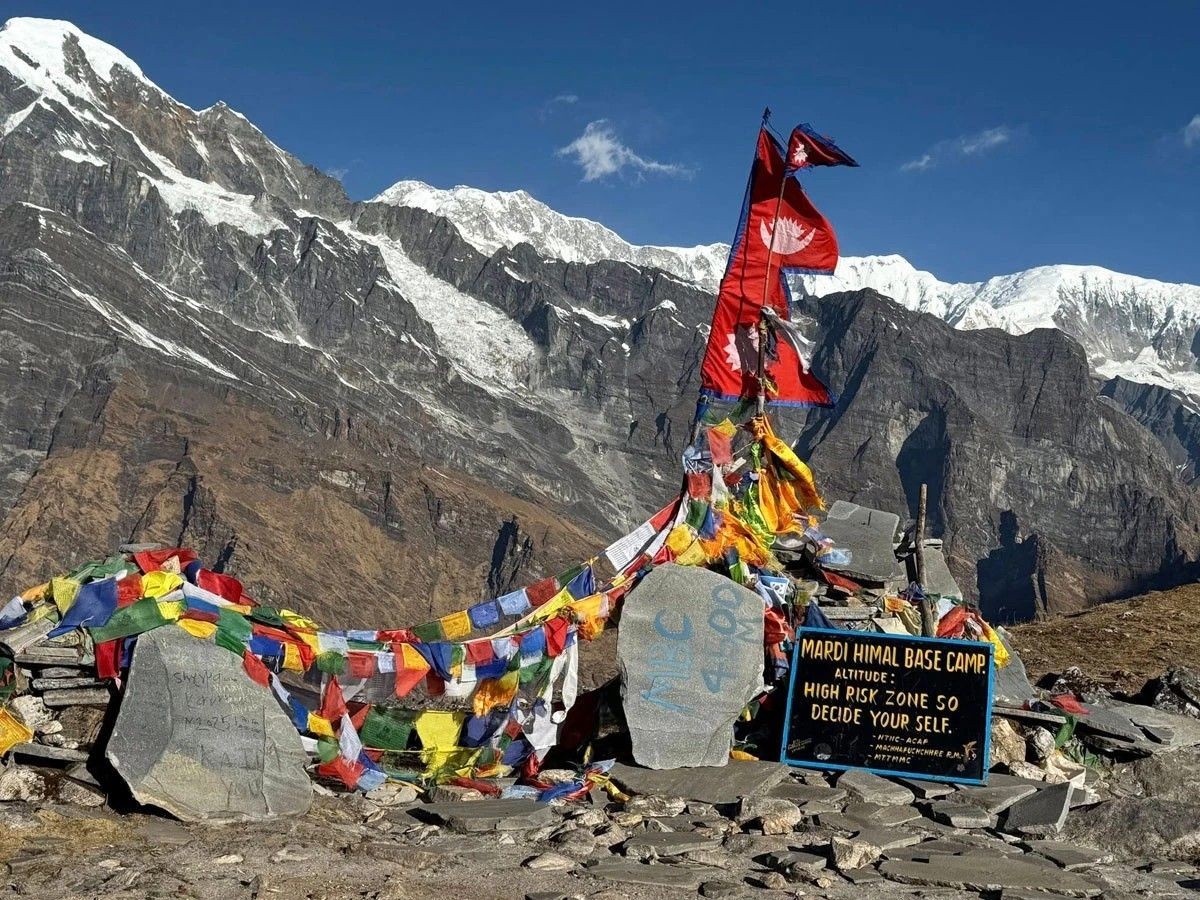
Here, the upper viewpoint is usually found at around 4,200–4,500 m, depending on the route and specific viewpoint. In many cases, the highest point is referred to as Mardi Himal Base Camp at around 4,500 m.
As such, it is important to confirm details with your tour operator, as the itineraries and elevation gain can vary slightly.
Major Mountain Views :
The Panorama of the Annapurna Range
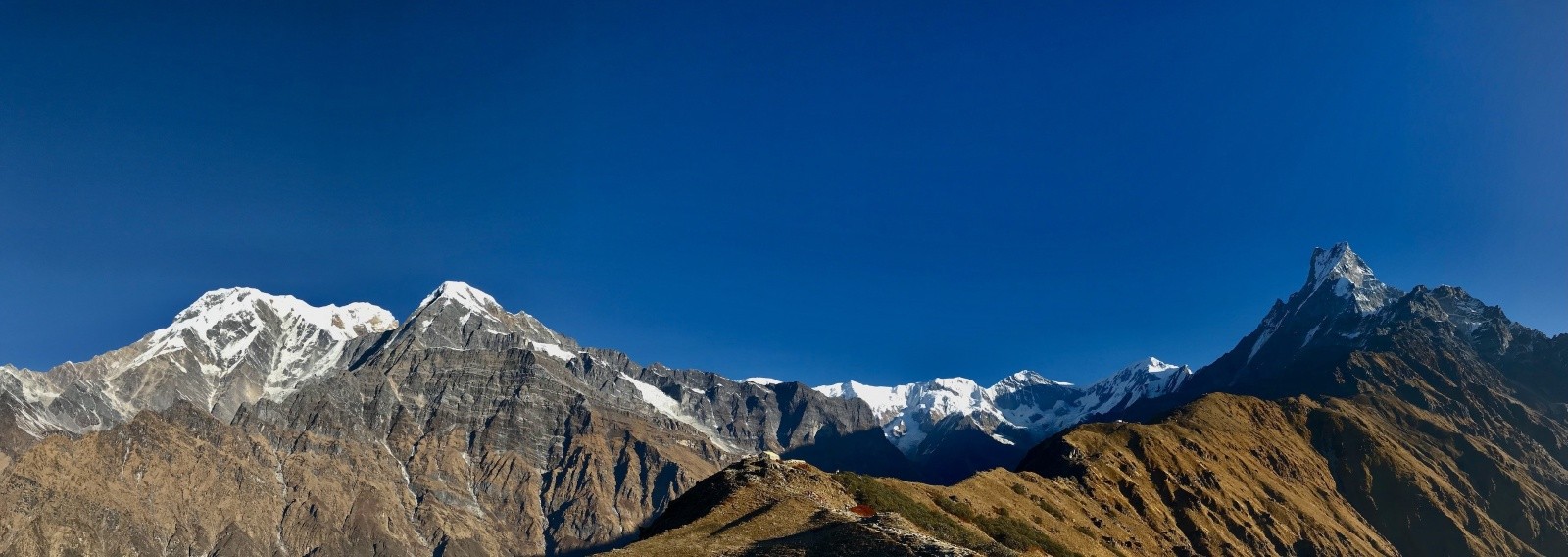
The view from the Mardi Himal ridge extends well beyond Machhapuchhre. The mountain range takes up most of the view, with the Annapurna massif dominating the skyline. The white summits are visible from the ridge on clear days.
Most importantly, the view is truly spectacular and offers a three-dimensional perspective. The contrast between the dark rocky ridges and the white snow-capped peaks is stunning. Another advantage of this viewpoint is that the best time to photograph is in the morning hours.
As such, it is always a good idea to start early if you want to experience the best time to visit this viewpoint as:
The ridge offers many opportunities for spectacular photos. You can frame the ridge as the foreground and capture Machhapuchhre as the background. Moreover, you can also use people as a reference to show the scale of the mountain. Meanwhile, it is always a good idea to use the golden-hour light for your photography. On the other hand, it is best to avoid shooting directly into the sun.
Here, a wide-angle lens is useful for capturing the entire panorama. On the other hand, a telephoto lens is good for isolating the mountain.
Here are some photography equipment essentials:
Cold weather can drain the battery, so it is best to keep your camera equipment warm during the early hours. Remember that this viewpoint is not just the end of your trek. It is the highlight of the Mardi Himal trekking tour.
Day 4 is an easy day that brings most trekkers back to familiar grounds. After spending a few days at high altitudes, you will be descending through forests on a relatively easy trail. The trail leads to the village of Sidding at around 1,700 m. Day 4 is much gentler than Day 3, but you should always take it easy on your legs.
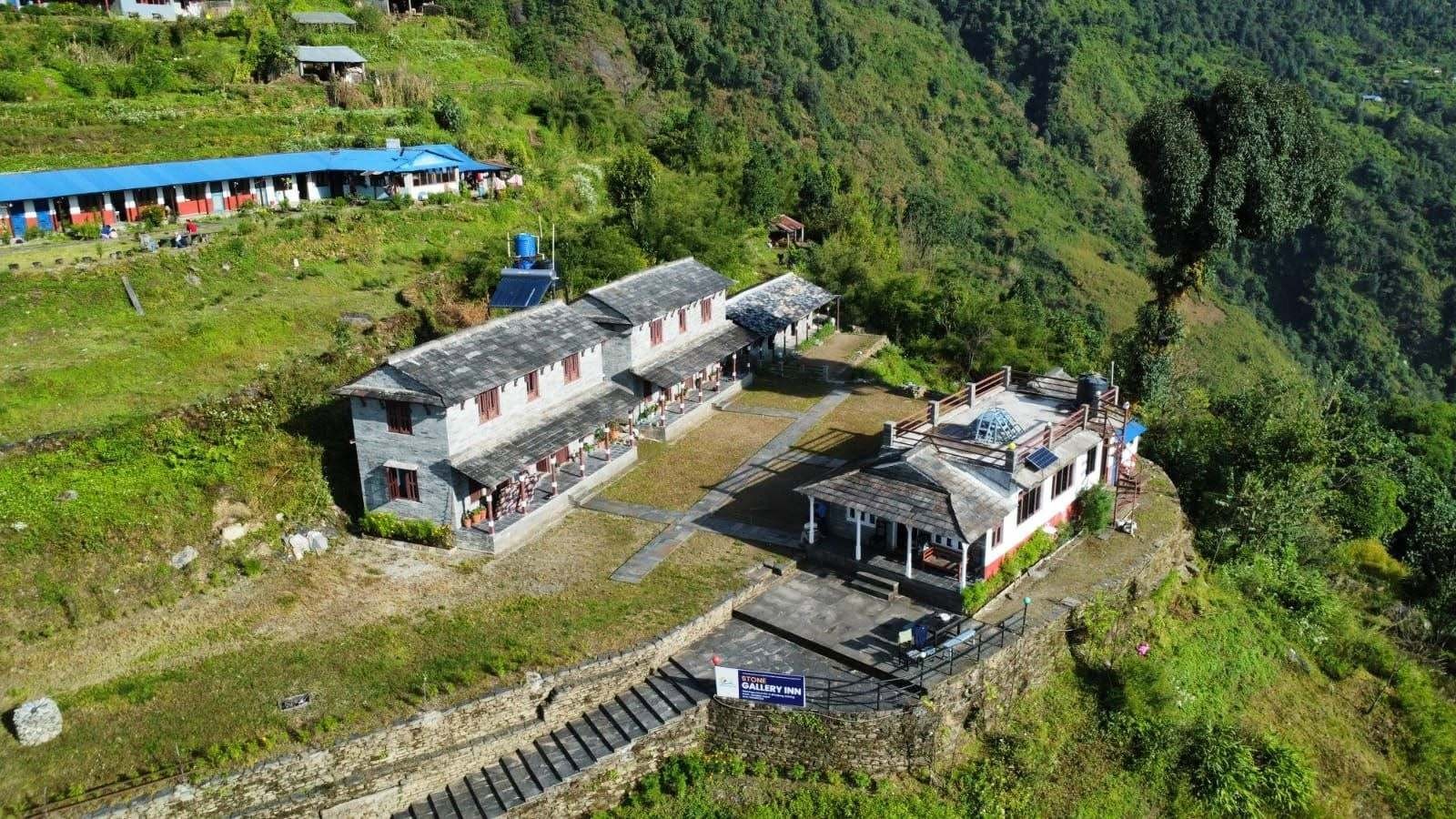
Day 4 at a Glance
Detail Information :
Descending Through Forests :
Arrival at Sidding Village
Eventually, you will arrive at the village of Sidding at around 1,700 m. Here, you will find a more traditional Himalayan village.
Here, the local houses are made of stone and wood. You will also find local teahouses offering food and drinks. This is a great place to take a break before heading back to Pokhara.
Likewise, you can also explore the village and have a chat with the locals. It is always a good idea to be respectful of the local community. You can also have your final meal in the mountain village.
You will usually depart for Pokhara after lunch. The road winds through mountain villages and passes through green hills. You will pass through Kalaimati and other local settlements like Lumbre and Lwang before you connect the main road at Hemja. The scenery is quite pretty as you pass by farmlands.
As you descend the mountain, the landscape gradually changes. You will eventually arrive at the city of Pokhara at around 822 m. The drive is not particularly long, but it can take longer depending on the road conditions.
As such, it is always a good idea to plan extra time for this leg of your trip.
Why Day 4 Is Special :
The Camps you pass through in Your Mardi Himal Trek-4 day
Pokhara – 822 m :
Finally, your journey ends where it began, but the experience is completely different. This short trek through the Mardi Himal range offers a unique adventure that includes high-altitude views, a close look at Machhapuchhre, and a chance to experience traditional Himalayan villages.
Likewise, the Mardi Himal trek starts near Pokhara at 822 m and climbs to High Camp at around 3,580-3,780 m. An optional side-trip to the upper viewpoint or Mardi Himal Base Camp reaches 4,200-4,500 m.
| Highlight | Elevation | Why it’s special ? |
|---|---|---|
| Machhapuchhre views | 6,993 m | Most beautiful Peak |
| Mardi Himal viewpoint | 4,200-4,500 m | Himalayan panorama |
| High Camp | 3,580-3,780 m | Sunrise views |
| Rhododendron forests | Low trail | Colorful flora |
| Open ridge walking | Upper trail | Exposed mountain ridge |
| Sidding village | Around 1,700 m | Rural village charm |
| Quiet trails | Throughout | Less crowded than ABC |
1. Dramatic Ridge Walking :
2. Close-Up Machhapuchhre Views :
3. Rhododendron and Oak Forests :
4. A Quieter Annapurna Trek :
| Mardi Himal Trek | ABC Trek |
|---|---|
| Generally less crowded | More crowded |
| Ridge walking | Annapurna Sanctuary |
| Closer views of Machhapuchhre | Spectacular views of Annapurna South |
| Beautiful forests | Beautiful forests |
| High point around 4,500 m | High point around 4,130 m |
| Unique trekking experience | Unique trekking experience with more crowds |
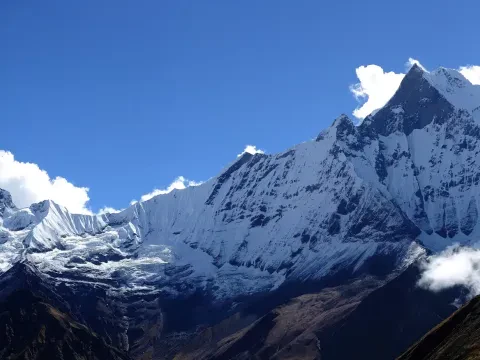
Altitude is a serious concern on the short Mardi Himal trek. The Mardi Himal trek climbs rapidly from Pokhara at 822 m to High Camp at around 3,580-3,780 m. The optional side-trip to the upper viewpoint reaches 4,200-4,500 m.
| Location | Approx. Elevation |
|---|---|
| Pokhara | 822 m |
| Kande | 1,770 m |
| Forest Camp | 2,520-2,600 m |
| Low Camp | 2,970 m |
| High Camp | 3,580-3,780 m |
| Upper Viewpoint | 4,200-4,500 m |
| Mardi Himal Base Camp | Approximately 4,500 m |
| Machhapuchhre | 6,993 m |
| Annapurna South | 7,219 m |
| Hiunchuli | 6,441 m |
1. Walk Slowly Above 3,000 m :
2. Stay Hydrated :
3. Know the Signs of Altitude Illness,
Common symptoms of altitude illness include:
4. Know When to Descend
5. Start Early :
6. Protect Your Knees :
7. Prepare for Rapid Weather Changes :
Make sure to pack the following items:
8. Know When to Turn Back :
Final Safety Checklist,
Before departing from High Camp, make sure to double-check the following:
The Mardi Himal trek is a fantastic adventure. However, it is important to remember that it is a high-altitude trek.
By following the above-mentioned tips, you can enjoy the spectacular views of the Mardi Himal range while keeping your safety in mind.
The tips for a short Mardi Himal tour are simple. First, if you want to enjoy it all, prepare properly and listen to your body. The four-day tour will take you through forests, ridges, and villages offering magnificent views of the Himalayas.
Here, hike from 822 m in Pokhara up to High Camp at about 3,580 – 3,780 m, and then, if you want, you can even go to explore Upper Viewpoint or Base Camp at approximately 4,200 – 4,500 m. So, you still have some time to prepare for such an adventure.
Here are a few final words of wisdom for your Mardi Himal trek.
1. Prepare Before Leaving Pokhara :
2. Leave Early on Day 3 to Viewpoint,
The most critical day is day 3. It is advisable to set off as early as possible, so plan to leave camp at around 4 – 5 am if the weather permits.
3. Reserve Accommodation in Advance
4. Use Trekking Sticks
5. Pack Thermal Clothes and Warm Accessories
6. Do Not Underestimate the Altitude
7. Hire a Local Guide if Possible
8. Get Travel Insurance that Covers Hiking and High Altitude
| Day Details | Approx. Elevation | Walking Time |
|---|---|---|
| Day 1 Pokhara → Forest Camp | 2,520 – 2,600 m | 4 – 5 hours |
| Day 2 Forest Camp → High Camp | 3,580 – 3,780 m | 5 – 7 hours |
| Day 3 High Camp → Viewpoint, Base Camp, Low Camp | 4,200 – 4,500 m | 7 – 9 hours |
| Day 4 Low Camp → Sidding → Pokhara | 1,700 m → 822 m | 3 – 4 hours |
Actually, these are only approximate figures for each day of the four-day trek. The actual distance may differ depending on the group’s pace and the weather.
Checklist Before Leaving for Mardi Himal Trek :
Finally, here is a piece of personal advice on Mardi Himal. This is a four-day hiking tour that takes you through forests, ridges, and villages offering unforgettable views of the Himalayas.
Moreover, it is a wonderful opportunity to witness the raw beauty of nature while trekking through rhododendron forests and enjoying spectacular views of Machhapuchhre (6,993 m) and the Annapurna range.
Most importantly, remember to prepare for a short Himalayan adventure by training ahead of time and leaving early. Nevertheless, the most crucial part is to enjoy the experience.
If you have been on a Mardi Himal trek, please share your favorite viewpoint or trail in the comment section below or can share by contacting us.
1. What is the Mardi Himal Short Trek 4-Day Itinerary?
The Mardi Himal Short Trek 4-Day Itinerary is a spectacular Himalayan short trek starting from Pokhara. This trail takes you through rhododendron forests, Low Camp, High Camp, and sensational views of Machhapuchhre, Annapurna South, and Hiunchuli. It is perfect for those who are looking for a short Mardi Himal trek from Pokhara with some fitness levels.
2. How much does the Mardi Himal Short Trek 4-Day cost?
The Mardi Himal Short Trek 4-Day cost is variable depending on the group size, means of transport, accommodation, meal plan, guide, and season.
For instance, some trekking agencies offer a guided Mardi Himal trek that includes permits, accommodation, meals, transport, and guide services.
Therefore, it is essential to compare what comes with the proposed Mardi Himal trek cost and what is not included rather than focusing only on the displayed price.
3. What is the best 4-day Mardi Himal Trek itinerary?
The best 4-day Mardi Himal Trek is a popular itinerary that starts with a drive from Pokhara to Kande followed by a trek to Forest Camp or Low Camp. Another day will take you to High Camp, and the following day will lead you to the upper viewpoint or Base Camp. On the last day, you will head down to Siding and drive back to Pokhara.
4. Where does the 4-day Mardi Himal Trek start?
The 4-day Mardi Himal trek usually starts from Pokhara. From Pokhara, you can drive towards Kande or any other trailhead and begin your climbing. For instance, Kande connects you to the Australian Camp and the forest ridge where most of the trail goes. Some travelers opt to start their Mardi Himal trek from Phedi or Pitam Deurali depending on the itinerary they choose. Overall, the Mardi Himal trekking starts vary depending on the chosen Mardi Himal short trek itinerary.
5. What is the highest altitude of the Mardi Himal 4-day trek?
The highest altitude of the Mardi Himal 4-day trek varies depending on the itinerary you choose
In general, Mardi Himal Base Camp reaches about 4,500 meters while the popular upper viewpoint is around 4,200 meters to 4,250 meters. High Camp is also between 3,550 meters and 3,900 meters. Thus, it is always necessary to do some trekking preparations to tackle such altitudes.
6. Is the Mardi Himal Short Trek difficult?
The Mardi Himal Short Trek is generally not challenging, although the 4-day version is considered more difficult compared to other longer ones. It will require you to walk for several hours each day and ascend steadily towards the High Camp. It will also need you to have enough stamina for the day of the viewpoint and the last day when you will be descending towards Siding.
Some trekking preparations and a good pair of hiking shoes will help you overcome these challenges. Plus, if you have a good fitness level, the trek will not be that difficult for you.
7. Can beginners do the Mardi Himal 4-Day Trek?
With the right amount of preparations, fit beginners can do the Mardi Himal 4-Day Trek.
Although the Mardi Himal trek for 4 days is short, it will need you to have a certain level of fitness because of the steep climb. As a result, it will be a good idea to prepare a bit before the trek starts and to keep a steady and slow pace throughout the journey.
In addition, you can always consider hiring a reputable trekking agency to assist you with route planning. Some agencies like Haven Holidays can help with such details to make your trekking easier.
8. What permits are required for Mardi Himal Trek?
However, not all agree on these guidelines, so it is best to consult with your preferred trekking agency to secure the needed permits for your Mardi Himal trek.
9. What is the Mardi Himal Trek permit cost?
The cost of the Mardi Himal Trek permit varies depending on your nationality and the latest government guidelines. Some current resources indicate that the price of the Annapurna Conservation Area Permit for foreign visitors is NPR 3,000 in 2026.
However, there are also different reports for the TIMS cost, so it is best to ask your preferred trekking agency about the most accurate information about Mardi Himal permit cost. In most cases, the costs of permits are included in the guided Mardi Himal trek packages.
10. What is included in the Mardi Himal Short Trek cost?
The Mardi Himal Short Trek, including a guide, usually comes with a package that covers most of the expenses you will incur during the trek.
Some of the things that are included in a guided Mardi Himal Short Trek are:
On the other hand, most guided trekking packages exclude international flights, travel insurance, visa costs, personal expenses, drinks, and tips for the staff. It is always a good idea to clarify what is included and what is not in the Mardi Himal Short Trek cost.
11. What accommodation is available during the Mardi Himal 4-day trek?
Moreover, you can also request to share a room with another trekker. On the other hand, hot showers, WiFi, charging, and other services might be found at some camps but at an additional cost.
12. What food is available on the Mardi Himal Short Trek?
In general, Mardi Himal Short Trek has a wide variety of foods to choose from. You will find the local delicacy known as dal bhat plus other dishes such as fried rice, pasta, noodles, soup, eggs, bread, and potatoes. In addition, it is always a good idea to stick with dal bhat as it has a great amount of carbohydrates to keep you energized throughout the trek. You will also notice that the prices tend to increase with higher altitudes.
13. What mountains can you see during the Mardi Himal Trek?
One of the best rewards of the Mardi Himal Trek is the great mountain view you will enjoy.
For instance, on a clear day, you will have an amazing view of Machhapuchhre, also known as Fishtail peak, alongside the Annapurna South and Hiunchuli Mountain ranges. The ridge is also very spectacular, especially when you are above the tree line.
In fact, the view from the Upper Viewpoint offers the most spectacular high-mountain landscape in the area.
14. What is the best season for the Mardi Himal Short Trek?
On the other hand, the weather in October and November is also great for trekking as it is clear and calm. The other option is to consider trekking in September, while in winter, it is possible to trek, but you will need to bring warm clothing.
Overall, it is better to check the Mardi Himal trek weather forecast before planning your hiking.
15. How many hours do you walk each day on the 4-day Mardi Himal Trek?
The number of walking hours per day varies depending on where you start your trek. Nevertheless, a typical 4-day Mardi Himal Trek will take you about 5 to 8 hours per day on foot. Your walking distance is also decided by the itinerary selected.
16. Is altitude sickness a concern on the Mardi Himal Trek?
To avoid severe altitude sickness, it is essential to acclimatize properly, drink plenty of fluids, avoid alcohol, and tell your guide about any discomfort you feel. Remember that you should never try to hike when you are already feeling ill.
17. What should I pack for the Mardi Himal 4-Day Trek?
In general, you should do a Mardi Himal trek packing list that includes warm clothes, trekking pants and boots, a beanie or a hat, gloves, sunglasses, sun cream, a water bottle, a headlamp, and toiletries, among others.
In addition, you may also want to bring a sleeping bag for cold nights, especially if you are trekking during the winter season. Remember that the 4-day Mardi Himal trek is quite strenuous and exhausting, so it is best to carry light luggage.
18. Can I do the Mardi Himal Trek from Pokhara in four days?
Yes, you can do the Mardi Himal Trek from Pokhara within four days if you follow the right itinerary.
For instance, you can choose to start your trek from Kande and end in Siding to save extra days. This will allow you to have a faster-paced trek and make the most of your short trip.
Overall, this four-day Mardi Himal trek from Pokhara is ideal for those with some fitness levels.
19. Is a guide necessary for the Mardi Himal Short Trek?
The necessity of a guide for the Mardi Himal Short Trek depends on various factors, including the latest government regulations. This is because the need for a guide varies depending on the trail you choose and other factors.
As a result, it is a good idea to research the most recent information about hiring a guide for the Mardi Himal trek. Some current online resources contradict each other about the 2026 Mardi Himal guide requirements.
Nevertheless, a good guide is always essential to help you with route-finding, accommodation, emergency cases, and give you advice concerning altitude sickness.
In particular, a guide is always helpful for short Mardi Himal treks because of the limited acclimatization time.
20. Why choose Haven Holidays for the Mardi Himal Short Trek?
Haven Holidays can assist you in finding the best Mardi Himal Short Trek 4-day itinerary in accordance with your fitness level, budget, and the time you have. A good Mardi Himal trek travel package will make it easier for you to take care of permits, transport, accommodations, meals, and guides. Before finalizing your travel plans, it will also be a good idea to compare the Mardi Himal Short Trek cost and included services to guarantee a great trekking adventure.
Our travel experts are ready to assist you with any questions.
Send us a message.Have a question before you book? Send your enquiry below and our travel experts will get back with the required information.