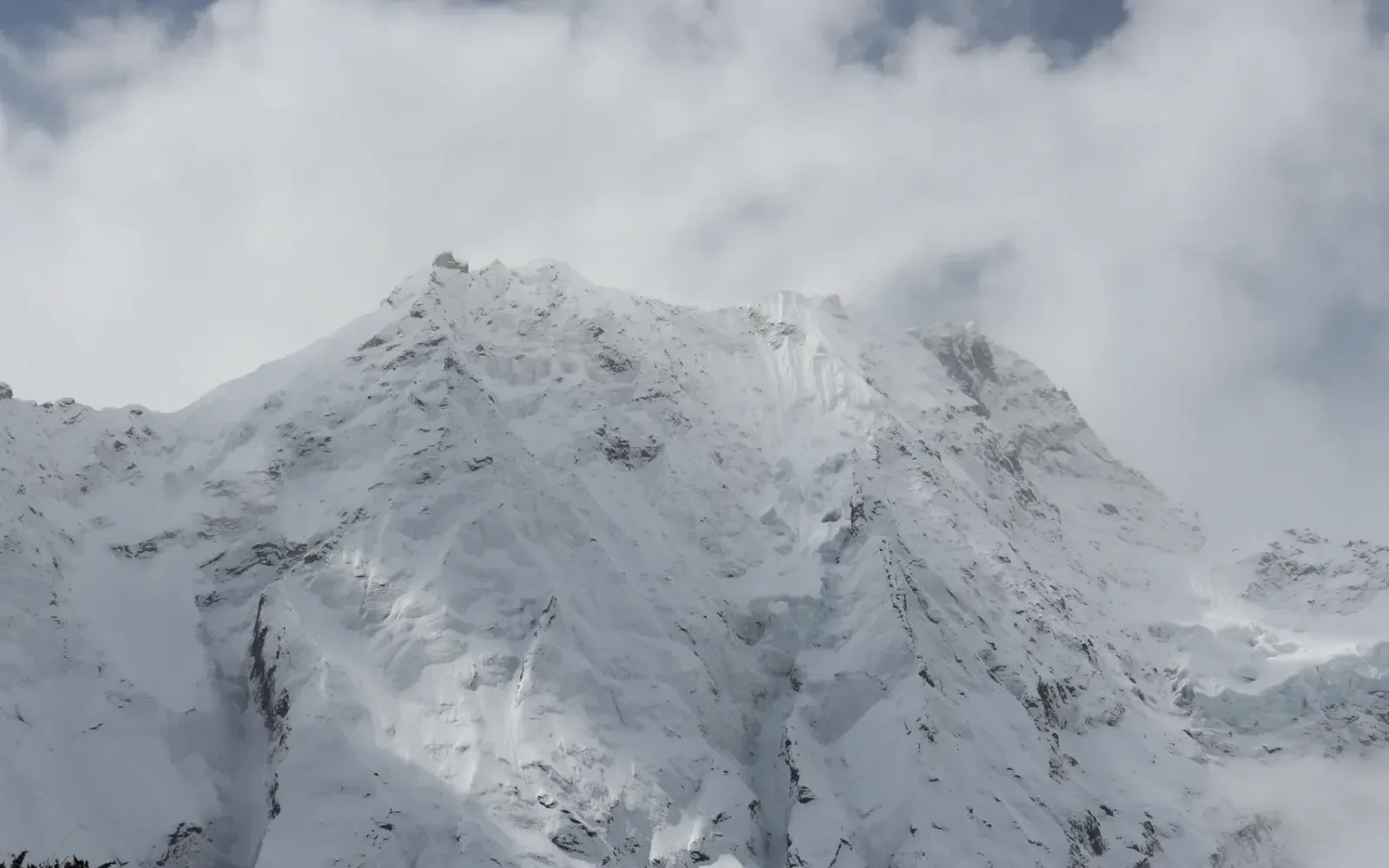
If you want solitude, culture, and a less developed Himalayan trek, the Manaslu Circuit vs Everest Base Camp comparison is worth considering. It does not mean that EBC and the Annapurna Circuit are not worth doing.
As established, EBC is one of the most popular treks in Nepal, while the Annapurna Circuit has great views and is better developed than Manaslu. Manaslu Circuit simply offers a different kind of experience.
Meanwhile, the Manaslu Circuit goes around the 8,163 m high Manaslu mountain from the lower Budhi Gandaki Valley and reaches the high Nubri region, crossing the 5,106 m high Larkya Pass. The altitude increases significantly from Machha Khola (900 m), Jagat (1,340 m), Deng (1,860 m), Namrung (~2,660 m), Lho (3,180 m), Samagaon (~3,500 m), Samdo (3,875 m), Dharamsala (~4,450 m), and Larkya Pass (5,106 m) to Bimthang (~3,590 m).
| Feature | Manaslu Circuit | Everest Base Camp | Annapurna Circuit |
|---|---|---|
| Highest point | Larke Pass (5,106 m) | Kala Patthar (5,545 m) | Thorong Pass (5,416 m) |
| Main mountain | Manaslu (8,163 m) | Everest (8,849 m) | Annapurna massif |
| Starting region | Gorkha | Khumbu | Manang/Lamjung side |
| Cultural interest | Tibetan/Nubri | Sherpa/Buddhist Gurung | Thakali, Manang and Tibetan influences |
| Infrastructure | More basic | Well developed | Well developed |
| Solitude | Generally higher | Lower on peak-season routes | Variable |
| Restricted area | Yes, upper Manaslu | No | Some restricted sections |
| Guide requirement | Restricted-area rules apply | Regulations differ | Regulations differ |
| Main attraction | Wilderness + culture + Larkya Pass | Everest and Khumbu | Landscape diversity |
Note: Kala Patthar is a viewpoint, not a pass or village.
Now, Let’s see the major distinct features of Manaslu Circuit :
The main reason to choose Manaslu Circuit Trek over EBC is not that it has “better mountains.” It has a different feel because the trail is less developed and more remote than the highly commercialized EBC trek.
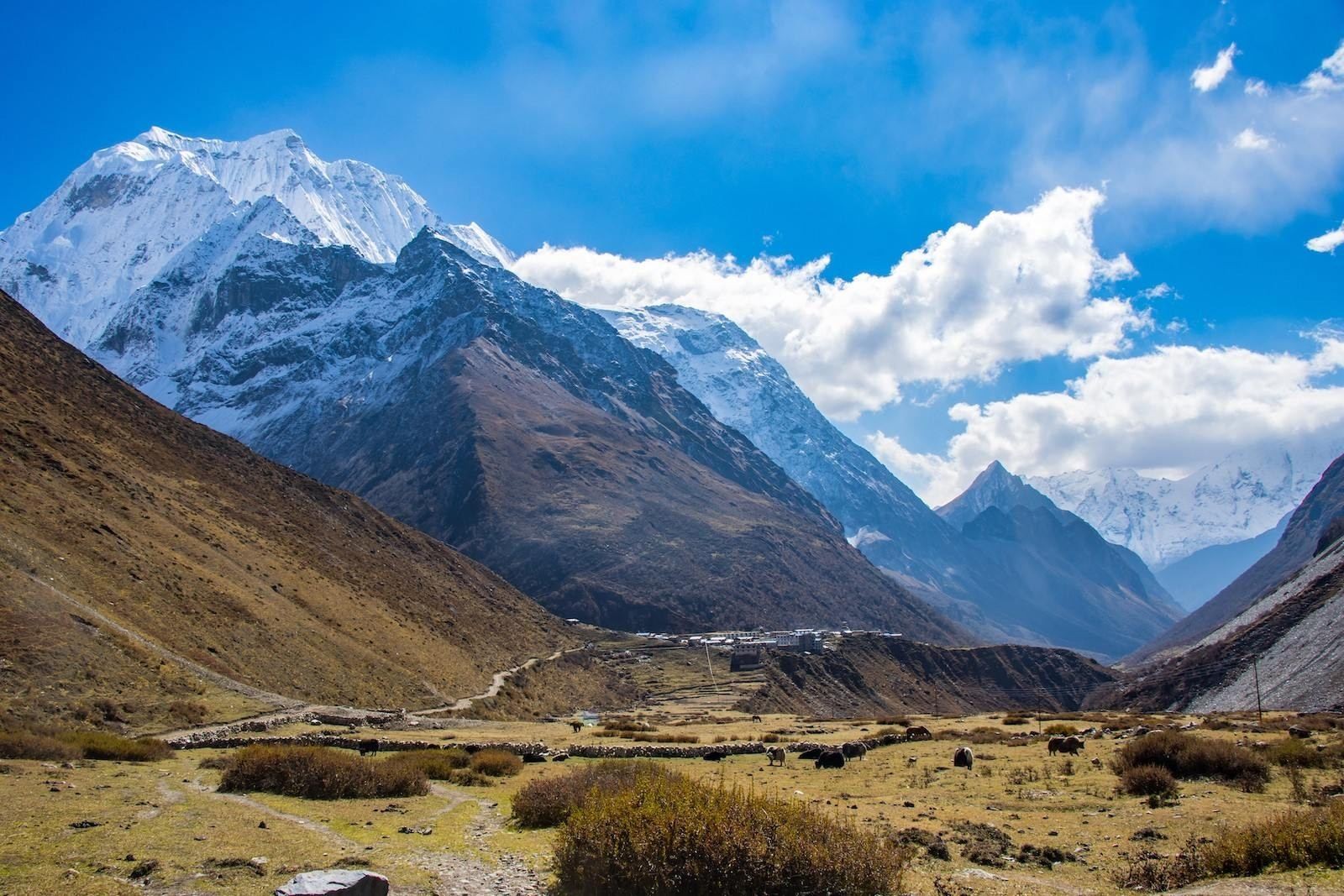
Likewise, the Manaslu Circuit route still has teahouses, lodges, WiFi, electricity, guides, and porters, but they become sparser as you get closer to Samagaon, Samdo, and Dharamsala.
Similarly, that difference is reflected in the trail itself. Instead of a continuous experience of a highly developed trail with many teahouse clusters, you get a mix of river valleys, forests, bridges, trails, villages, and higher mountains.
When comparing Manaslu vs Annapurna Circuit, another significant difference is culture. Annapurna Circuit goes through several different regions and landscapes, but Manaslu Circuit has a more distinct cultural feel in the upper valley.
At around 3,180 m in Lho, 3,500 m in Samagaon, and 3,875 m in Samdo, you will see monasteries, mani walls, prayer wheels, chortens, traditional houses, and other Tibetan/Nubri Buddhist cultural heritage.
It is not a “show village” put on for tourists; it is a real region and culture where people live their lives, practice their religion, and welcome you to their homes.
Here, several sources suggest that Manaslu Circuit is an alternative to EBC that is less busy, but it is important not to confuse fewer tourists with easier.
Meanwhile, Larkya Pass on the Manaslu Circuit trek is at 5,106 m, while the Everest Base Camp trek typically goes up to around 5,364 m, and the Kala Patthar viewpoint reaches 5,545 m.
In fact, Manaslu Circuit is a high-altitude trek that is more remote and less developed than EBC. It has more challenging passes, and the trail is generally more difficult. Experienced trekkers should be aware that the most difficult part of the Manaslu Circuit trek is:
Samagaon → Samdo → Dharamsala → Larkya Pass → Bimthang
Importantly, you need to plan accordingly and consider acclimatization, weather, and other factors.
The Manaslu Circuit trek goes through a restricted area in Nepal. The Nepal Tourism Board notes that special trekking permits are required for restricted areas, and the Department of Immigration confirms that foreign trekkers must apply for the appropriate permit through an authorized trekking agency.
The current restricted area permit (RAP) fee for Manaslu Circuit is :
| Period | Fee |
|---|---|
| September–November | USD 100 / person / week |
| December–August | USD 75 / person / week |
| Additional days | Additional daily fee (USD 15 per day) |
Please note that the restricted area permit for Manaslu Circuit is not cheap, and you should not expect to have the “untouched wilderness” experience on a budget.
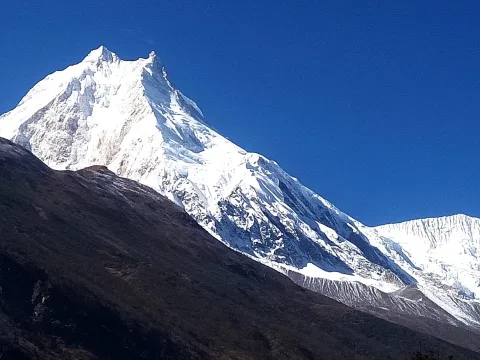
It is easy to say that Manaslu Circuit has fewer tourists than EBC or Annapurna Circuit. However, it is not entirely accurate, and it is important not to exaggerate the difference. Specific numbers for Manaslu Circuit are not available, but here is the current situation:
According to the Nepal Immigration Department, the number of Manaslu Circuit permits/trekkers for 2019 was :
In fact, that is a significant number, which means that Manaslu Circuit is not an undiscovered gem. It does have a more remote feel than EBC, but it is not empty.
A better way to phrase it would be :
Manaslu Circuit generally offers a less crowded trekking experience than Nepal’s most popular classic routes, although peak-season sections and specific villages can get busy.
Here, that is a more accurate and trustworthy way to position Manaslu Circuit without overstating the numbers.
As an experienced trekker, you know that fewer tourists means fewer amenities.
| Pros of Manaslu Circuit | Cons of Manaslu Circuit |
|---|---|
| Quieter trail | More basic accommodations |
| Wilderness feel | Fewer food options at higher altitudes |
| Unique cultural experience | Less developed trail |
| Fewer teahouse clusters | More difficult road access |
| Larke Pass crossing | More reliance on local guides |
| More authentic Himalayan trek | Fewer medical and safety facilities |
So, Manaslu Circuit is not the best option for everyone. It is a more authentic Himalayan experience, but it comes at the price of a more challenging trek.
Manaslu Circuit is a great option if:
However, Manaslu Circuit vs Everest Base Camp is not really a competition. It is more useful to compare Manaslu Circuit with Annapurna Circuit and consider the differences in trail development, cultural experiences, and peak-season crowding.
In fact, Manaslu Circuit has a strong appeal for experienced trekkers who want a more remote and authentic Himalayan adventure. It offers unique cultural encounters and challenging high passes, but it also has fewer amenities and requires a restricted-area permit.
Manaslu less crowded experience is one of its most attractive features, but the reason is more complex than it might seem at first glance.
However, the Manaslu Circuit trek is becoming increasingly popular, especially in October and November, but compared to Nepal’s most popular trekking routes, it still has a more remote feel. Part of the reason is the restricted area permit, but there are other contributing factors as well.
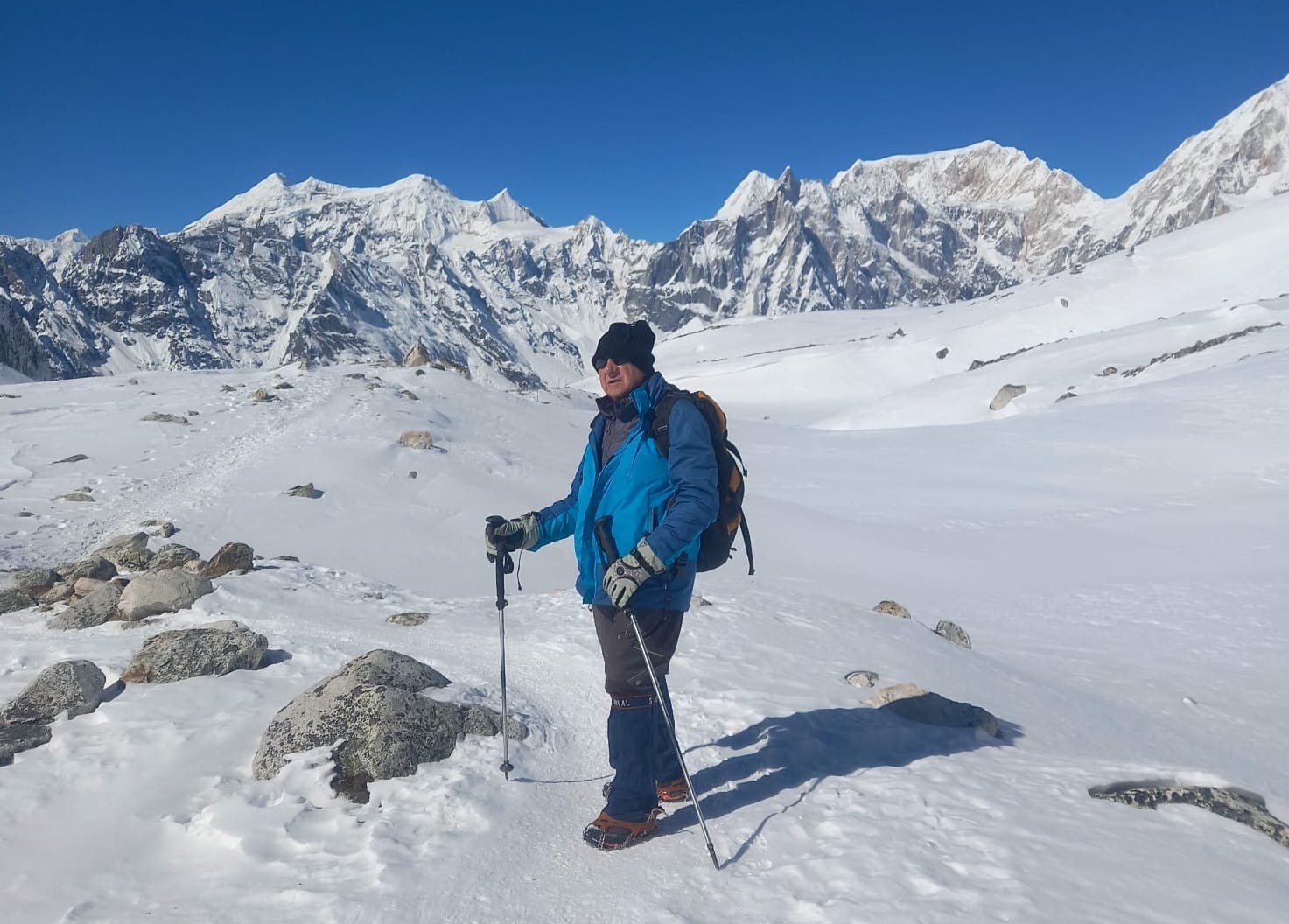
But the Manaslu Circuit trek is extremely diverse in terms of altitude. You will start your Manaslu Circuit trek at around 900 m in Machha Khola, then proceed to Jagat (1,340 m), Deng (1,860 m), Namrung (2,660 m), Lho (3,180 m), Samagaon (3,500 m), Samdo (3,875 m), Dharamsala (4,450 m), Larke Pass (5,106 m) and the highest point – Bimthang – 3,590 m.
Manaslu Circuit trek altitude :
There are several reasons why Manaslu Circuit has a more remote feel than other popular treks in Nepal.
Manaslu Circuit goes through a restricted area, which means that you will need a special permit to trek there. The Nepal Tourism Board notes that special trekking permits are required for restricted areas, while the Department of Immigration confirms that foreign trekkers must apply for the appropriate permit through an authorized trekking agency.
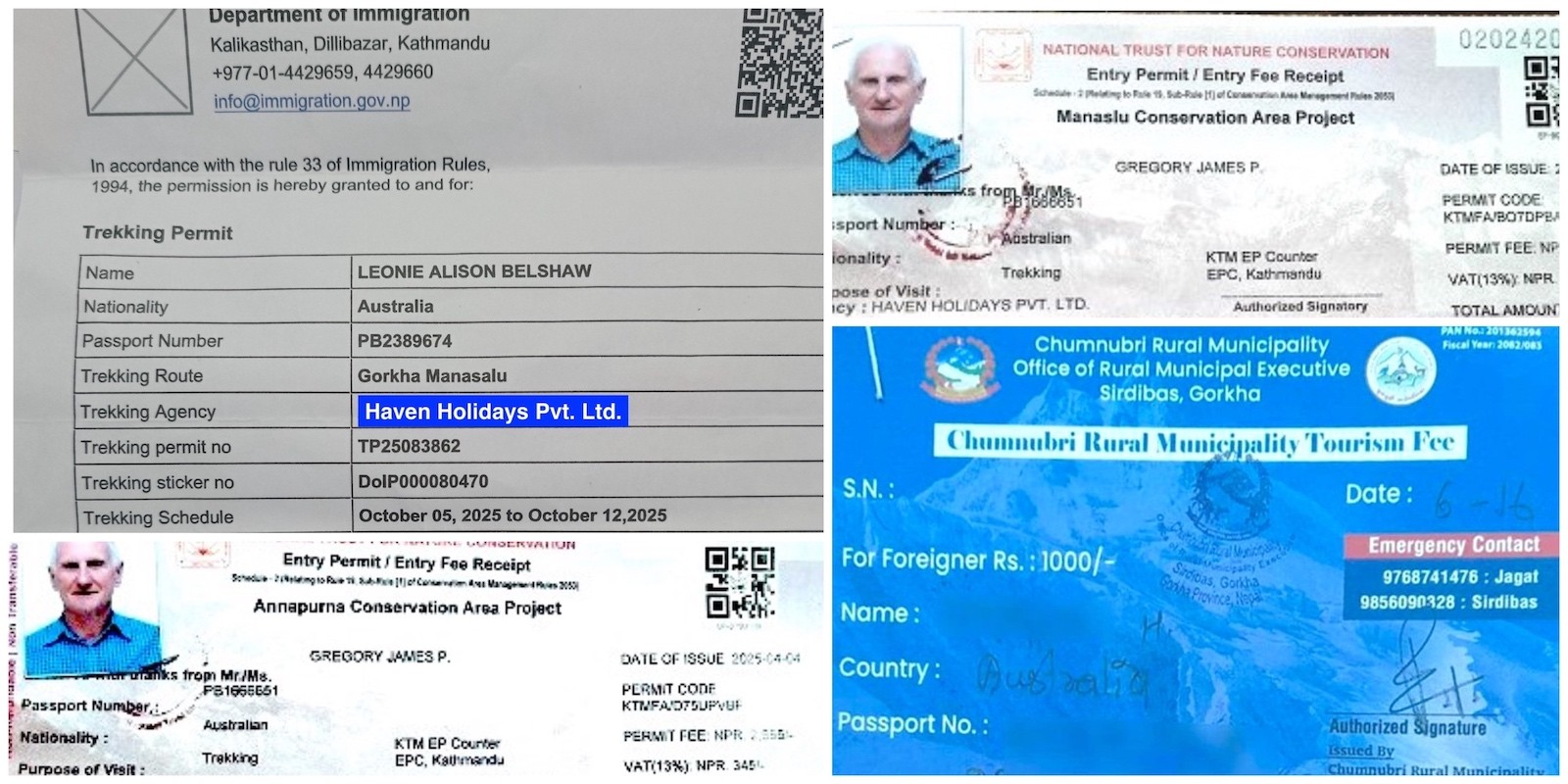
Even it was the rule like, it needed minimum 2 people needed for obtaining restricted area permits, but now it has been changed and even solo trekker can apply and obtain restricted area permits in Nepal.
In other words, trekking in a restricted area is different from trekking in an open area. The restricted area permit for Manaslu Circuit is not cheap, and you should not expect to have the “untouched wilderness” experience on a budget.
The number of Manaslu Circuit permits/trekkers for 2019, according to the Nepal Immigration Department, was:
Importantly, a better way to phrase it would be to say that Manaslu Circuit generally offers a less crowded trekking experience than Nepal’s most popular classic routes, although peak-season sections and specific villages can get busy.
It is easy to get caught up in the numbers, but the real difference between Manaslu Circuit and other popular treks in Nepal is the trail experience.
On the Manaslu Circuit trek, you will have the opportunity to enjoy the wilderness solitude, but it is important to understand what that really means. You will see fewer tourists than on the EBC trek, but the trail is not empty. You will see other trekkers, especially in the lower parts of the trail, and the teahouse accommodations are more basic than what you are used to seeing on the EBC trek.
| Feature | Manaslu Circuit | Everest Base Camp |
|---|---|---|
| Trail atmosphere | Generally less crowded | Very busy on peak season |
| Remote sections | More numerous | Fewer on popular route |
| High season congestion | Possible | Common around major hubs |
| Accommodation density | Lower | Higher in main settlements |
| Infrastructure | More basic | Strong |
| Restricted-area permit | Yes | No |
| Sense of wilderness | Strong | Variable |
| Crowded vs empty trail | Relatively quiet | Not empty |
That is why the phrase quiet Himalayan trail can be misleading when applied to the Manaslu Circuit trek. It is not that there are no other trekkers, but rather that the trail feels less developed and more remote than the highly commercialized EBC trek.
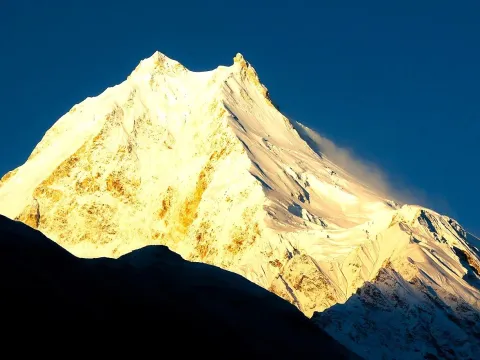
The trail around Machha Khola at 900 m can get busy with local traffic, and road construction has impacted the traditional trekking experience.
As you go up the trail, the atmosphere changes, and you will start to feel the solitude of the Himalayan wilderness.
At around 2,660 m in Namrung and 3,180 m in Lho, you will see the Tibetan/Nubri Buddhist cultural heritage. Then, at around 3,500 m in Samagaon, the valley opens up before you, revealing stunning views of the surrounding mountains.
At 3,875 m in Samdo, the landscape becomes more rugged and desolate, and at 4,450 m in Dharamsala, the facilities are more basic. Finally, you will cross the 5,106 m Larkya Pass, which will give you a unique high-altitude experience.
An experienced trekker knows that fewer crowds means fewer amenities.
Here are some practical tips for enjoying a less crowded Manaslu Circuit trek:
The real advantage of the restricted area trek is that it offers a more authentic Himalayan experience. Fewer tourists means that the trail is less developed and more challenging than the EBC trek.
Similarly, it also means that you will have a more authentic cultural experience, as the local villages are not as accustomed to dealing with a steady stream of foreign visitors.
That is the real advantage of the restricted area trek, and it is not something that can be found in the open areas. The combination of fewer tourists, more challenging trail conditions, and authentic cultural experiences makes the restricted area trek a unique and rewarding adventure.
The primary reasons experienced trekkers opt for the Manaslu Circuit over Everest Base Camp and Annapurna Circuit are connected to culture.
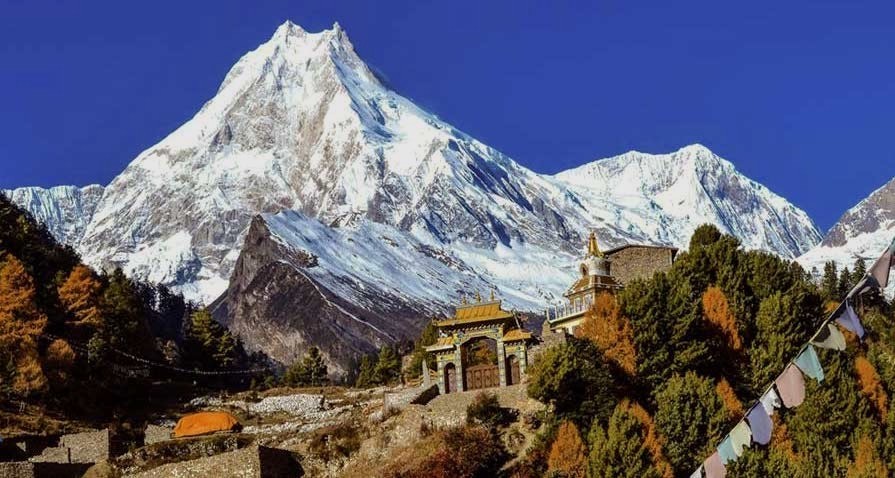
Meanwhile, Upper Manaslu, including the villages of Lho, Samagaon, and Samdo, is home to fascinating Tibetan Buddhist-influenced culture, agriculture, and mountainous isolation.
However, “untouched” is probably too strong a word since the region sees its share of tourists and local inhabitants who are accustomed to the presence of hikers and have adapted their services to meet the needs of visitors.
Here, it is probably more accurate to say that Manaslu offers a less commercialized experience centered around local culture.
The Manaslu Circuit trek begins in the lower Budhi Gandaki Valley, which is a crossroads for various Himalayan cultures. As the trek progresses, the cultural landscape begins to transform.
| Village / Location | Approx. Elevation (m) | Cultural /Natural Highlight |
|---|---|---|
| Machha Khola | 900 | Lower Himalayan river valley |
| Jagat | 1,340 | Traditional mountain village |
| Deng | 1,860 | Transition to upper valley |
| Namrung | 2,660 | Increasingly Tibetan-influenced |
| Lho | 3,180 | Buddhist-influenced culture |
| Samagaon | 3,500 | Center of Nubri Valley culture |
| Samdo | 3,875 | High-altitude Tibetan-influenced settlement |
| Dharamsala | 4,450 | High-altitude trekking village |
| Larke Pass | 5,106 | Highest point on the trek |
From Namrung (~2,660 m), the trail offers more intriguing cultural glimpses. Stone buildings, Buddhist iconography, prayer flags, mani walls, and chortens begin to dot the landscape.
Likewise, Lho (3,180 m) is the next leg of the journey, which is famous for the Ribung Gompa monastery and its cultural landscape. This village is most notable for its breathtaking views of Manaslu (8,163 m).
Moreover, Lho offers an excellent opportunity to experience the Tibetan Buddhist-influenced culture of the region. The village is home to a monastery, local hospitality, and an authentic Himalayan experience. However, it is also a gateway to higher altitudes and more spectacular views of Manaslu.
Furthermore, the village of Samagaon (~3,500 m) is one of the most important stops on the Manaslu Circuit trek. Samagaon is a great place to acclimatize and prepare for the next leg of the journey to Samdo (3,875 m) and Dharamsala (~4,450 m). Its cultural significance should also be noted, as the village is located in the heart of the Nubri Valley.
In addition to, Samagaon offers cultural immersion and acclimatization, making it a valuable experience for trekkers.
Beyond Samagaon, the trail becomes progressively more severe and exposed. The village of Samdo (3,875 m) is a high-altitude settlement located near the Tibetan border. The village’s cultural landscape, Buddhism, livestock, and unique settlement patterns are characteristic of the region’s high-altitude Himalayan life.
Importantly, Samdo has some trail amenities, but it is considerably smaller and less commercialized than similar Himalayan villages in the Khumbu region. This characteristic is part of the reason why many trekkers seek the Manaslu Circuit.
Here, in my personal view, it would be unfair to argue that the Everest region and Annapurna Circuit do not offer authentic cultural experiences. The Khumbu region has a rich Sherpa Buddhist culture, and the Annapurna Circuit is home to numerous Himalayan ethnic groups, including the Gurung, Thakali, Manang, Tibetan-influenced, and other communities.
However, the cultural authenticity of Manaslu is different in that it is less commercialized, especially beyond Namrung.
| Feature | Manaslu Circuit | Everest Base Camp | Annapurna Circuit |
|---|---|---|
| Upper-region culture | Strong Nubri/Tibetan influence | Strong Sherpa culture | Highly diverse |
| Major Buddhist traditions | Prominent | Prominent | Prominent in upper regions |
| Tourism intensity | Lower | Higher | Higher on popular sections |
| Traditional village character | Strong in upper valley | Mixed with trekking hubs | Highly variable |
| Commercial infrastructure | More limited | Extensive | Extensive in many areas |
Therefore, the argument for Manaslu’s cultural authenticity is not necessarily rooted in the absence of authenticity elsewhere. Rather, it is a matter of degree: the Manaslu Circuit offers a less commercialized cultural experience, especially beyond Namrung.
Authenticity should not be confused with entitlement. In other words, just because a region has traditional houses, Buddhist monasteries, and unique cultural practices does not mean that local people will allow you to photograph their homes or enter their temples.
Therefore, the most authentic cultural experiences are those that are earned through respect for local customs and traditions.
| Respectful behavior | Examples of authenticity |
|---|---|
| Ask permission to photograph people | Traditional houses, monasteries, and villages |
| Follow local customs | Buddhist practices, festivals, and rituals |
| Support local businesses | Buying local goods and services |
| Learn basic local customs | When applicable, learn local greetings |
| Listen to your guide | When in doubt, follow the advice of your guide |
Meanwhile, these respectful behaviors will undoubtedly lead to more authentic cultural encounters than taking photos of houses and temples from a distance.
The appeal of the Manaslu Circuit to experienced trekkers is multifaceted, but it is firmly rooted in the opportunity to experience high-altitude Himalayan trekking and wilderness with authentic cultural encounters. You can start your journey at around 900 m in Machha Khola, pass through various high-altitude villages, and enjoy the cultural landscape of Lho (3,180 m) and Samagaon (3,500 m).
Then, you can also continue your journey to Samdo (3,875 m) and the challenging Larkya Pass (5,106 m). In other words, the Manaslu Circuit offers a wilderness trekking experience with cultural and altitude diversity.
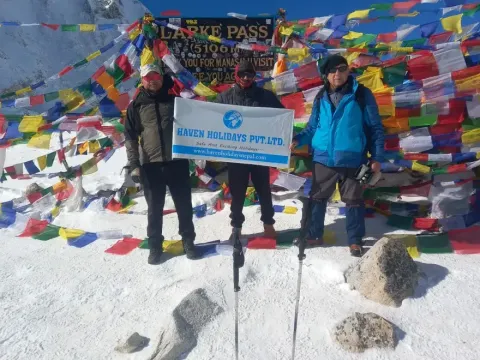
The Manaslu road-free trail argument is complicated by the fact that the trail is not entirely road-free. In fact, the lower portions of the Manaslu Circuit trek have seen a proliferation of road construction, fundamentally changing the trekking experience.
Compared to the Annapurna Circuit, the Manaslu Circuit offers more road-free trail sections, but it is not an entirely roadless trek.
This distinction is vital for trekkers who are seeking a roadless wilderness experience in Nepal.
The lower Manaslu Circuit trek has seen an explosion of road construction in recent years. Depending on the time of year, trekkers can expect to see roads and jeeps on lower parts of the trail.
Here, the trail begins at Machha Khola (900 m), which is also the lowest point on the trek. Therefore, it is entirely reasonable to argue that the Manaslu Circuit trek is not road-free.
However, the Manaslu Circuit trek is not entirely road-free either, which is the more nuanced argument. In other words, while road construction has impacted the lower parts of the Manaslu Circuit trek, it has not overtaken the upper parts in terms of trail experience. This is the primary distinction between the Manaslu Circuit and Annapurna Circuit.
As the Manaslu Circuit trek progresses beyond the lower and often road-affected Budhi Gandaki Valley, the trail begins to offer more authentic wilderness trekking opportunities.
Likewise, the trail begins to ascend to higher altitudes, passing through the villages of Deng (1,860 m), Namrung (2,660 m), and Lho (3,180 m). This part of the trekking route also begins to transform from a valley landscape to a more alpine one.
Beyond Lho (3,180 m), the trail continues to offer increasingly authentic wilderness trekking opportunities. The villages of Samagaon (3,500 m) and Samdo (3,875 m) are also found in this higher and more exposed part of the trek.
Unlike the lower parts of the Manaslu Circuit, which are impacted by roads, these higher villages are not traversed by road corridors in the same way as their counterparts in the Annapurna region.
In other words, the Manaslu Circuit trek offers more road-free trail sections at higher altitudes.
| Feature | Manaslu Circuit | Annapurna Circuit |
|---|---|---|
| Entire route road-free? | No | No |
| Lower-road sections | Yes | Yes |
| Long foot-trail sections | Strong | Strong |
| Vehicle encounters | Possible | More noticeable on roads |
| Upper high-altitude trail | Strong wilderness character | Strong wilderness character |
| Maximum major elevation | Larke Pass, 5,106 m | Thorong Pass, 5,416 m |
| Highest major villages | Samdo, 3,875 m | Manang, 3,540 m; other high settlements |
| Overall wilderness feel | Strong | Variable |
The trail beyond Samagaon (~3,500 m) begins to feel different. It is a high-altitude trek through a Himalayan alpine environment. The trail leads to Samdo (3,875 m), Dharamsala (4,450 m), and the formidable Larkya Pass (5,106 m).
Actually, this part of the Manaslu Circuit trek is largely defined by wilderness and high-altitude trekking. It is also different from the lower parts of the trek, which are impacted by road construction.
Likewise, the higher parts of the Manaslu Circuit trek offer a wilderness experience that is not found elsewhere on the trail. Beyond Samagaon (~3,500 m), the trail begins to feel more exposed. Vegetation begins to give way to expansive vistas over the Budhi Gandaki Valley.
Similarly, this part of the trek is also devoid of the road infrastructure that is increasingly apparent in the lower parts of the Manaslu Circuit trek.
In fact, this part of the trek is more similar to the Annapurna Circuit in terms of high-altitude trekking and wilderness landscape.
However, the road infrastructure that has overtaken parts of the Annapurna Circuit trek is not found in the higher parts of the Manaslu Circuit trek.
The road-free trail argument is not about authenticity per se. It is about the wilderness experience, which is significantly impacted by the presence of roads.
In other words, road infrastructure transforms the trekking experience from a wilderness adventure into a road-based one. This is an important distinction for trekkers who are seeking an authentic Himalayan wilderness experience.
Likewise, you can also hear the sounds of nature, including the Budhi Gandaki River, wind, animals, and the occasional prayer flags. This slower pace is essential for a wilderness trekking experience, which is ultimately the reason why many trekkers opt for the Manaslu Circuit over other popular Himalayan trails in Nepal.
However, Road Construction Is Impacting Manaslu in recent days.
In this case, the Manaslu Circuit trek is not an entirely road-free experience because road infrastructure is transforming the local environment. For trekkers who are seeking an authentic wilderness experience, this is an important consideration.
In addition to, local roads and trails are also impacted by monsoon-related weather conditions, landslides, and other natural disasters.
In addition, local infrastructure development, including road construction and trekking-related amenities, can also impact trail conditions.
Therefore, it is essential for trekkers to do their homework and be aware of the latest trail conditions before embarking on the Manaslu Circuit trek.
The Real Difference Between Manaslu Circuit and Annapurna Circuit.
The real difference between the Manaslu Circuit and Annapurna Circuit is that the former has more road-free trail sections at higher altitudes.
In other words, you can enjoy the wilderness trekking experience beyond Samagaon (3,500 m), including Samdo (3,875 m), Dharamsala (4,450 m), and the formidable Larke Pass (5,106 m).
From there, the trail begins its descent toward Bimthang (3,590 m).
In fact, it is this wilderness trekking experience that ultimately differentiates the Manaslu Circuit from other popular Himalayan treks in Nepal.
One of the strongest arguments for the Manaslu Circuit is the mountain scenery. The Manaslu Circuit does not lead simply to a goal at the end – it leads to a mountain that becomes more and more impressive as the trek progresses into the upper Budhi Gandaki Valley.
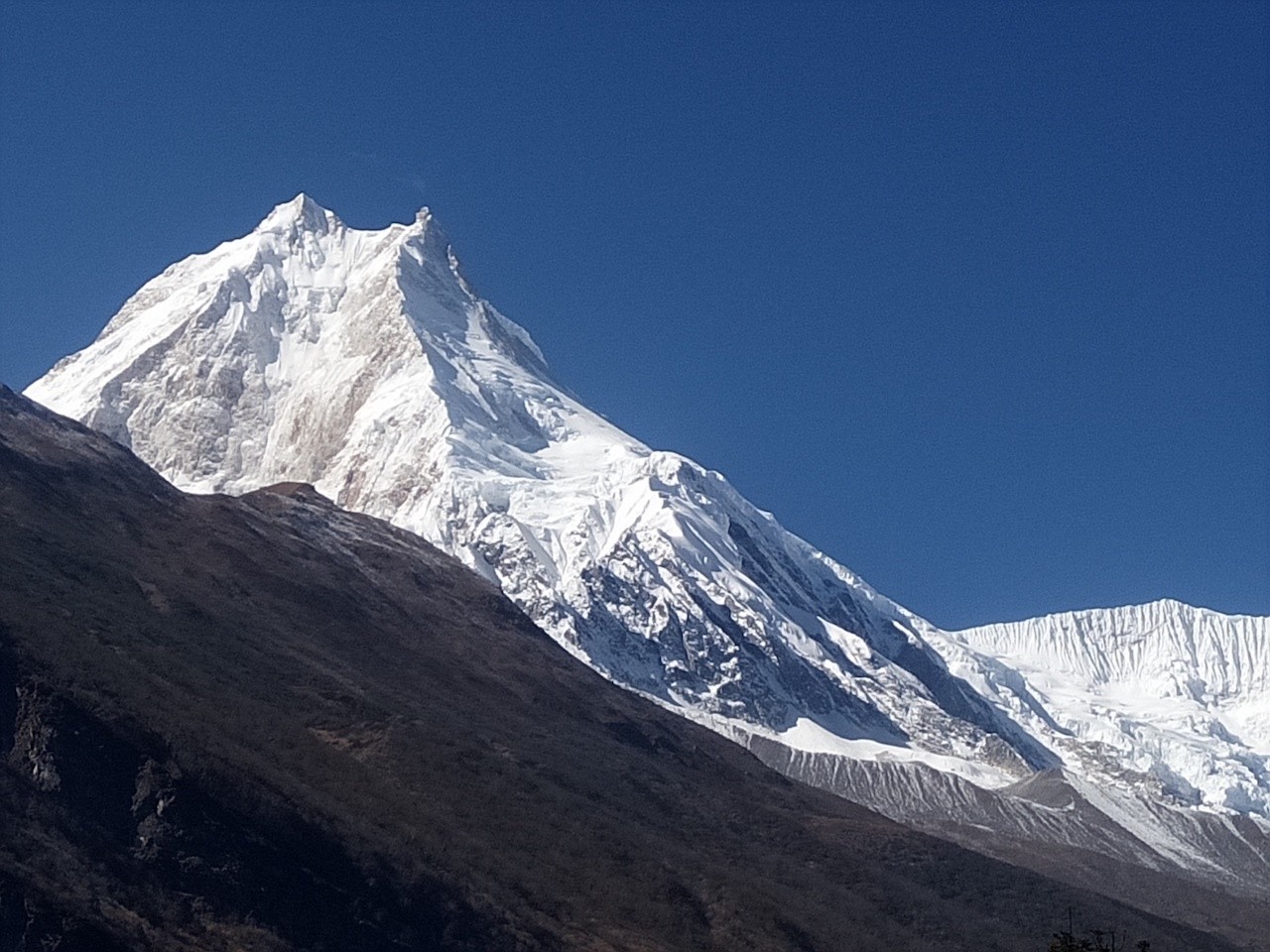
From Lho at 3,180 m and especially from Samagaon at 3,500 m, the mountain scenery becomes truly dramatic. It is important to make a fair comparison, however.
Here, the Everest region has the most famous peak in the world, 8,849 m high, and the views of Everest, Lhotse, Nuptse, Ama Dablam, and other great Himalayan mountains are truly spectacular.
In fact, Manaslu’s claim to fame is that it is an integral part of the trek – it is right there with you throughout the journey, and especially from the upper villages and valleys, it takes on a truly awe-inspiring presence.
In this section, we will discuss the mountain scenery of the Manaslu Circuit in detail.
Location Approx. elevation Mountain-view character :
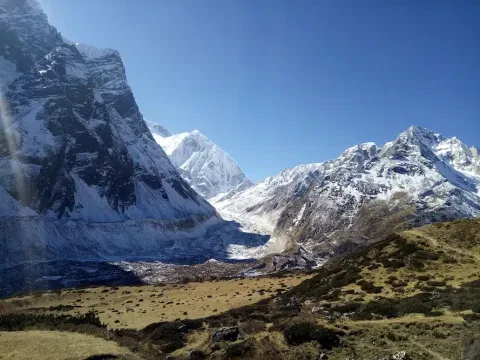
The change is most dramatic around Namrung, where the scenery opens up to reveal a panorama of high mountains. From Lho at 3,180 m, the view of Manaslu is powerful and close – this is one of the most impressive aspects of the trek.
Lho is one of the best places to see the relationship between Himalayan culture and nature. The village is surrounded by huge mountains, while traditional houses, terraced fields, prayer flags, and Buddhist shrines give the scene a most distinctive flavor. From Lho, Manaslu and the surrounding peaks can be seen in an especially close and impressive manner.
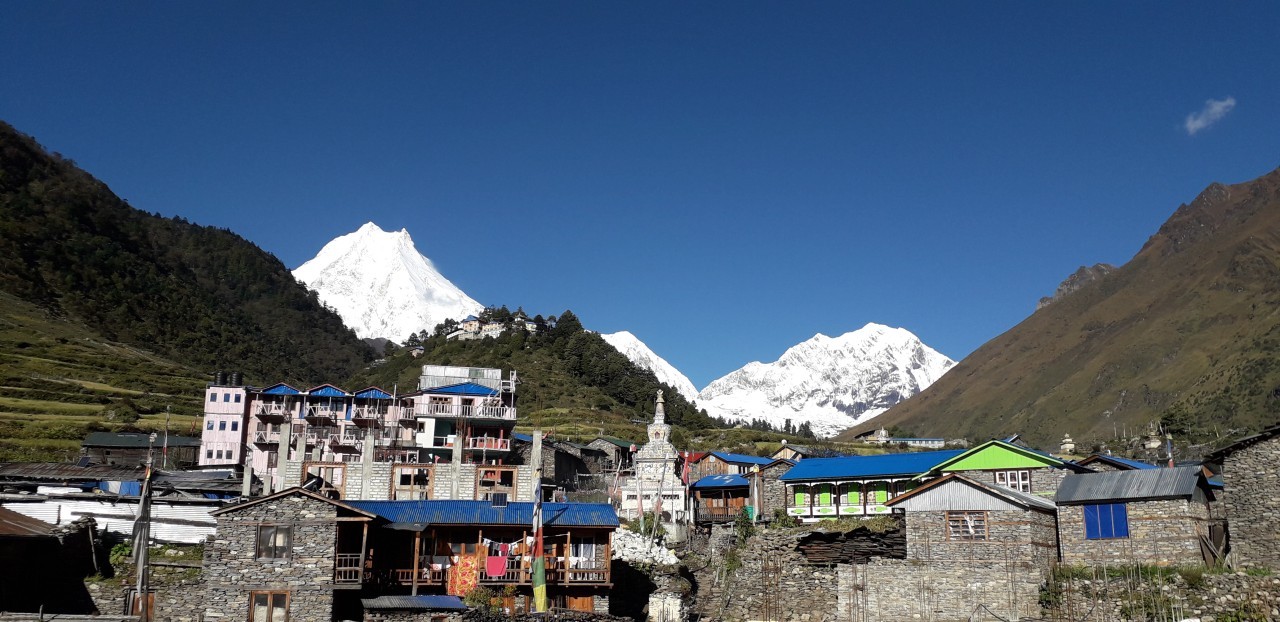
For a trekker, this means that a short walk away from the village reveals awesome mountain scenery. It is important to note, however, that mountain views are often dependent on the weather, and while dawn often provides the best opportunity for seeing the mountains, this is by no means a guarantee.
Samagaon at 3,500 m is arguably the most important point on the Manaslu Circuit in terms of scenery. The village is located in a large high valley surrounded by great Himalayan peaks, including Manaslu at an impressive 8,163 m. The panorama includes not only the huge summit of Manaslu but also other peaks, glaciers, and rocky ridges – in other words, a most spectacular view.
Meanwhile, many trekkers choose to spend an acclimatization day in Samagaon, which is a good idea given the altitude. It also provides an opportunity to get to know the area better – while not all treks will have the time or energy to explore the village and its surroundings, it is a most rewarding experience.
Especially popular is a detour to the Manaslu Base Camp area and/or Pungyen Gompa, depending on the chosen itinerary, the weather, and the acclimatization opportunities.
When comparing the trekking scenery of the Everest and Manaslu regions, it is important to understand that while Manaslu has its own charm, Everest is objectively more impressive – it is not only higher but more famous as well. The views of Everest, Lhotse, Nuptse, Ama Dablam, and other great peaks are simply unforgettable.
At the same time, Manaslu Circuit offers a different kind of experience that some may find more attractive. It is not just a trek to a famous peak – it is a journey into the heart of the Himalayas that reveals the region’s unique cultural and natural heritage.
Similarly, the Manaslu Circuit is all about the mountain – it is right there with you throughout the journey. The view of Manaslu becomes an integral part of the trek, while the Everest region offers a more varied experience with multiple Himalayan peaks to see.
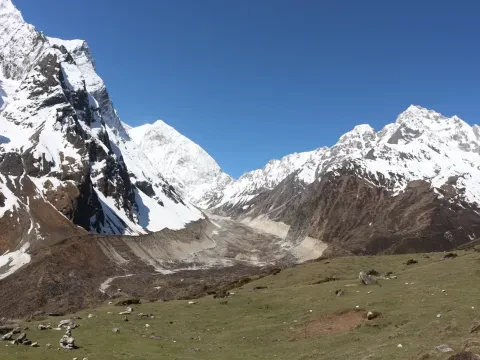
The scenery changes again beyond Samagaon, which at 3,500 m is already a high-altitude village. The landscape becomes progressively more barren and alpine beyond Samagaon as the trek heads towards the Larkya Pass.
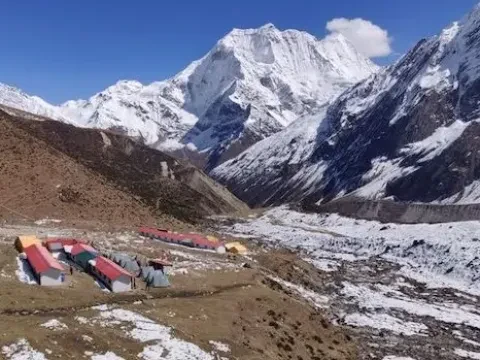
At Samdo at 3,875 m, there are few signs of vegetation, while the mountains dominate the scenery. Further ahead, Dharamsala at 4,450 m is the highest point along the entire trek before the Larke Pass. It is also the last overnight stop before crossing the pass – the conditions are extremely challenging, and the focus is on preparing for the long day ahead.
In fact, this is one of the reasons why the Manaslu Circuit is so rewarding for experienced trekkers – it offers a wide variety of scenery, from lowland river valleys to high-mountain landscapes. It is not just a trek to a famous peak, but a journey through different biomes and altitudes.
The most important attractions of the Manaslu Circuit scenery are:
Furthermore, you will see the mountain from different points of view at different altitudes. This is the main reason why the scenery of the Manaslu Circuit is so varied and rewarding for trekkers. The change in terrain and vegetation is also considerable, and the views of the great Himalayan peaks are among the most spectacular in the region.
It is important to note that no trekking operator can guarantee clear views of the mountains at any point. The mountain-view opportunities on the Manaslu Circuit are truly dependent on the weather, which can be unpredictable at any time.
Meanwhile, clouds, haze, snowfall, rain, wind, and other factors can obscure the view of Manaslu at any point. The best time to see the mountain is typically in the autumn, which tends to be the clearest season in the region. At the same time, spring is also a nice season for trekking, with blooming rhododendrons adding to the scenery.
Therefore, it is best to avoid promises of guaranteed mountain views on any trekking itinerary. A more honest approach is to note that the Manaslu Circuit offers multiple opportunities to see the great Himalayan peaks if the weather permits.
When comparing the trekking scenery of the Everest Base Camp and Manaslu Circuit, it is important to keep in mind that both have their advantages and disadvantages.
For some trekkers, the views of Everest will be a once-in-a-lifetime experience that cannot be matched by anything else. For others, the cultural and natural heritage of the Manaslu region will be much more attractive. The decision ultimately depends on the individual priorities and circumstances of the trekker.
If seeing the Everest massif is a personal goal, then EBC is the only viable option. At the same time, those who are interested in a more varied and authentic Himalayan experience will find the Manaslu Circuit much more rewarding.
Crossing the Larke Pass at approximately 5,106 m is the main challenge of the Manaslu Circuit. It is a true high-altitude Himalayan experience, as opposed to a short detour to a peak from a lower-valley village. The Larke Pass crossing begins after Dharamsala at 4,450 m, and it is common to start very early in the morning because the crossing can be long and the weather often changes throughout the day.
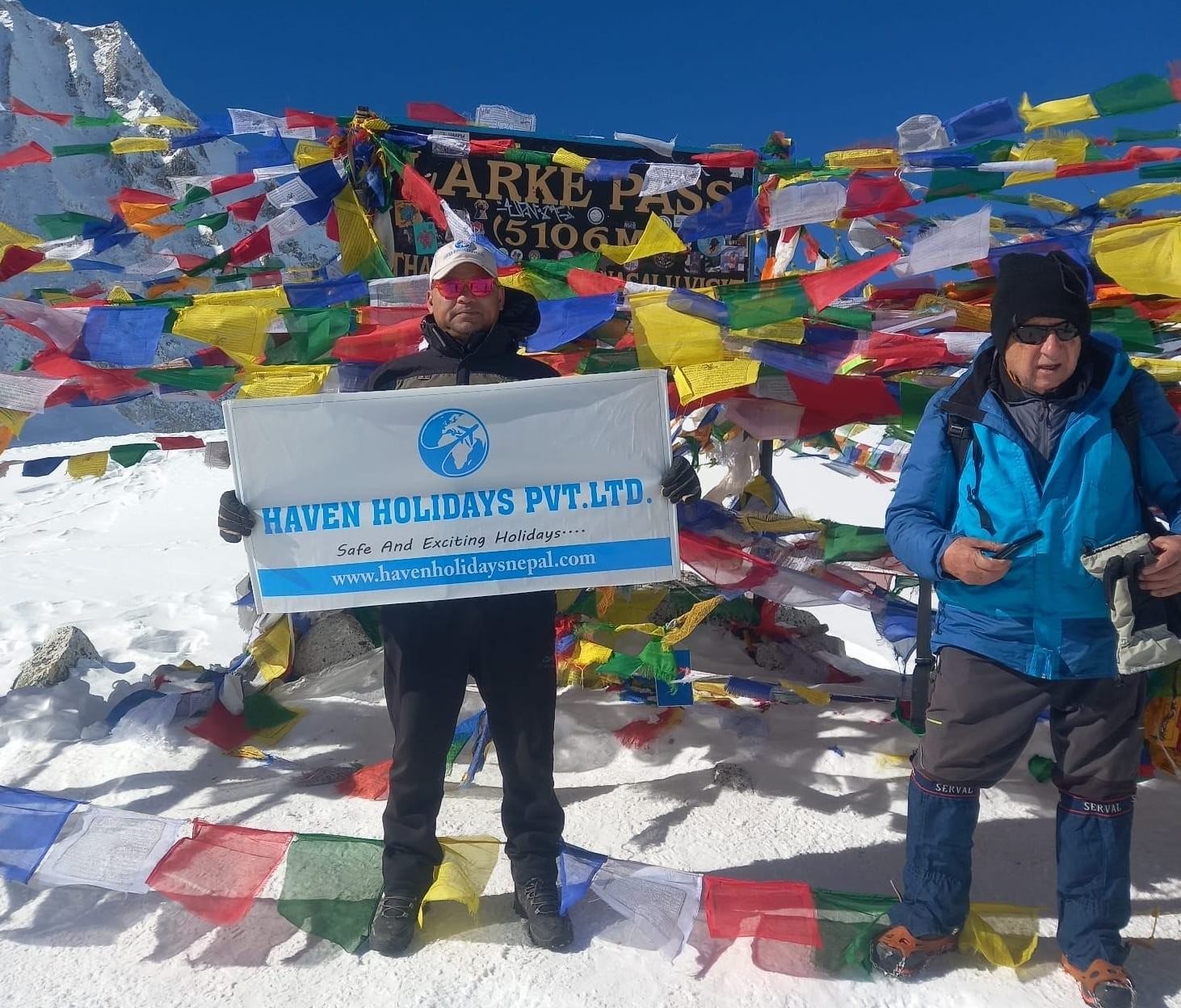
Here, it is important to note that 5,106 m is the generally accepted height of the Larke Pass. Some sources state 5,160 m, which is why it is important to double-check your reference before writing this article. I have used 5,106 m throughout this website.
The approach to the Larke Pass is completely different from anything seen on the lower part of the Manaslu trek.
The Larkya Pass trek follows this pattern:
From Dharamsala, the trail begins to enter the high alpine terrain. Vegetation becomes sparse, temperatures can drop well below freezing, and the trail can be affected by snow.
What Makes Larke Pass So Difficult ?
| Challenge | Explanation |
|---|---|
| Elevation | The Larke Pass at 5,106 m is substantially higher than most other trekking peaks in Nepal |
| Long crossing day | The day of the crossing can be very long |
| Starting early | It is common to start the Larkya Pass crossing before sunrise |
| Cold | Weather can be very cold at higher altitudes |
| Snow/ice | Depending on the season, the trail can be affected by snow |
| Weather | At higher altitudes, the weather can change rapidly |
| Descent | The long descent can be very hard on the knees |
Likewise, the Larke Pass itself is not especially challenging if the weather is clear and there is no snow on the trail. It is a high-altitude crossing, which makes it more difficult than most other trekking peaks in Nepal. However, it is not a technical climb, and most trekkers should have no problem with it on a clear day.
Important, the most important factor is the altitude, which can be especially challenging at the beginning of the crossing when you are climbing. It is important to pace yourself on the day of the crossing in order to avoid altitude sickness. Another common challenge is the long day, which can be especially difficult in the evenings when the temperature drops.
One of the most common comparisons is between the Larke Pass and the Thorong Pass on the Annapurna Circuit. The Thorong Pass at 5,416 m is substantially higher than the Larke Pass at 5,106 m, and it is generally more challenging.
Both passes are high-altitude crossings, which makes them substantially more difficult than most other trekking peaks in Nepal.
However, the Thorong Pass has become much more popular in recent years, partly because of the road construction project underway in the Annapurna region. The Larke Pass crossing is much more authentic and offers a more remote Himalayan experience, but it is also much more challenging in its own way.
| Feature | Larke Pass | Thorong Pass |
|---|---|---|
| Elevation | 5,106 m | 5,416 m |
| Trek | Manaslu Circuit | Annapurna Circuit |
| Approach | Dharamsala (4,450 m) | High Manang region |
| Main challenge | Altitude + long crossing | Altitude + long crossing |
| Wilderness character | Strong | Moderate |
| Road influence | Present on lower route | Significant |
The comparison with Everest is also interesting. The Everest Base Camp (EBC) trek is substantially longer than the Manaslu Circuit, but it is also much more popular.
Meanwhile, part of the reason for this is the view of Everest from Kala Patthar, which is one of the most iconic Himalayan experiences. Kala Patthar itself is 5,545 m, while EBC is at 5,364 m.
In other words, Kala Patthar is higher than both the Larke and Thorong passes, but it is not a true high-altitude crossing.
Importantly, the Larke Pass crossing is substantially more challenging than most other passes in Nepal. The Larke Pass crossing is similar to the EBC trek in terms of length, but it is much more difficult because of the higher altitude and the long day.
| Featrue | Larke Pass | EBC |
|---|---|---|
| Elevation | 5,106 m | 5,364 m |
| Type | High-altitude crossing | High-altitude Trekking |
| Length | Medium | Medium |
| Difficulty | Moderate to challenging | Moderate to difficult |
| Scenery | Remote Himalayan wilderness | More popular trekking region |
| View of the mountain | Panoramic view of Manaslu | Spectacular view of Everest |
The day of the crossing typically begins very early in the morning from Dharamsala. The trail begins climbing steadily through barren alpine vegetation. The higher you go, the more difficult it becomes, especially if there is snow on the trail.
Now, you will also experience cold weather and very low temperatures at the summit. The final climb to the summit can be especially challenging.
Likewise, it is important to pace yourself, because each step at higher altitudes is substantially more difficult than at lower elevations. You will feel it the moment you arrive at the summit – the pace slows down considerably. The most important thing on the day of the crossing is to avoid altitude sickness, which can be very dangerous at elevations above 5,000 m.
When you reach the summit of the Larke Pass, you will be rewarded with spectacular views of the Himalayas. The trail then begins its long descent into the Bimthang region on the other side of the pass.
Moreover, the long day is far from over, however, and you will need to pace yourself on the way down as well. The higher altitudes can be especially taxing on the knees, and it is a good idea to bring trekking poles for the Larke Pass crossing.
The panorama from the summit of the Larke Pass is spectacular when the weather permits. There are many snow-capped peaks and glaciers to see, but the LarkePass crossing is more about the long day and the challenge of getting to the summit.
Another challenge of the Larke Pass crossing is the descent on the other side of the pass, which can also be very difficult on the knees.
Similarly, it is important to keep in mind that the Larke Pass crossing is a true Himalayan adventure, and there are no guarantees when it comes to the weather.
In summary, this is especially true at higher altitudes, where the weather can change rapidly and without warning. This is why it is a good idea to double-check the weather forecast before attempting the Larke Pass crossing.
Many trekkers underestimate the difficulty of the Larke Pass crossing because they think that all the hard work is over when they reach the summit. Nothing can be further from the truth, as the long and challenging descent is also a major challenge. The Larke Pass crossing is much more difficult than most other passes in Nepal, and it is important to pace yourself on the way down as well.
Additionally, the long and challenging descent is also an excellent opportunity to enjoy the spectacular Himalayan scenery. The barren highlands give way to a much more vegetated and green landscape at lower elevations. The change in scenery is as remarkable as the view of the Himalayas itself.
The Larke Pass crossing is much more than a challenge – it is a Himalayan adventure in its own right.
The Larke Pass crossing offers a unique combination of :
In summary, the combination of these factors is what makes the Larke Pass crossing so special and so rewarding for experienced trekkers. It is not just a side attraction on the Manaslu Circuit – it is an adventure in its own right that is sure to stay with you long after you have finished the trek.
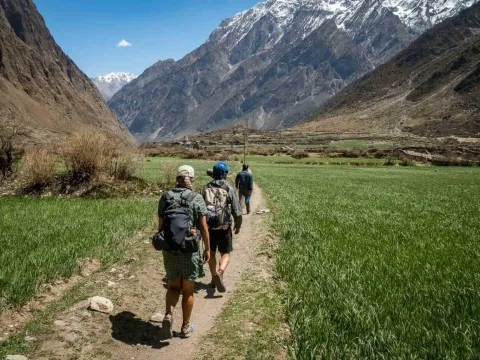
One of the practical advantages of the Manaslu acclimatization profile is that the trek starts relatively low and climbs gradually into the higher reaches of the Himalaya.
However, it is not necessarily easier or safer for acclimatization than Everest Base Camp. It all depends on the details of the itinerary, the altitude of the overnight stays, the amount of time spent at higher elevations, individual tolerance, the pace of ascent, fluid intake, weather, and general fitness.
Actually, the Manaslu Circuit starts in Machha Khola, which is already at 900 meters. From there, the trail climbs higher through Jagat (1,340 m), Deng (1,860 m), Namrung (~2,660 m), Lho (3,180 m), and Samagaon (~3,500 m).
| Location | Approx. elevation | Acclimatization significance |
|---|---|---|
| Machha Khola | 900 m | Low starting elevation |
| Jagt | 1,340 m | Initial gain |
| Deng | 1,860 m | Increasing altitude |
| Namrung | 2,660 m | Noticeable change |
| Lho | 3,180 m | High-altitude environment begins |
| Samagaon | 3,500 m | Important acclimatization area |
| Samdo | 3,875 m | Significant altitude exposure |
| Dharamsala | 4,450 m | High-altitude overnight |
| Larke Pass | 5,106 m | Highest point |
| Bimthang | 3,590 m | Major descent after pass |
Thus, this is a useful acclimatization profile because it allows the body to adjust to higher altitudes gradually before the final push to the Larke Pass.
The altitude profile of the Manaslu Circuit compared to Everest Base Camp is not as simple as high vs. low.
Here, the standard Everest Base Camp trek usually starts in Lukla at ~2,860 m and gains altitude to Namche Bazaar (3,440 m), Tengboche (3,860 m), Dingboche (4,410 m), Lobuche (4,910 m), and Everest Base Camp at ~5,364 m. Kala Patthar is even higher at ~5,545 m.
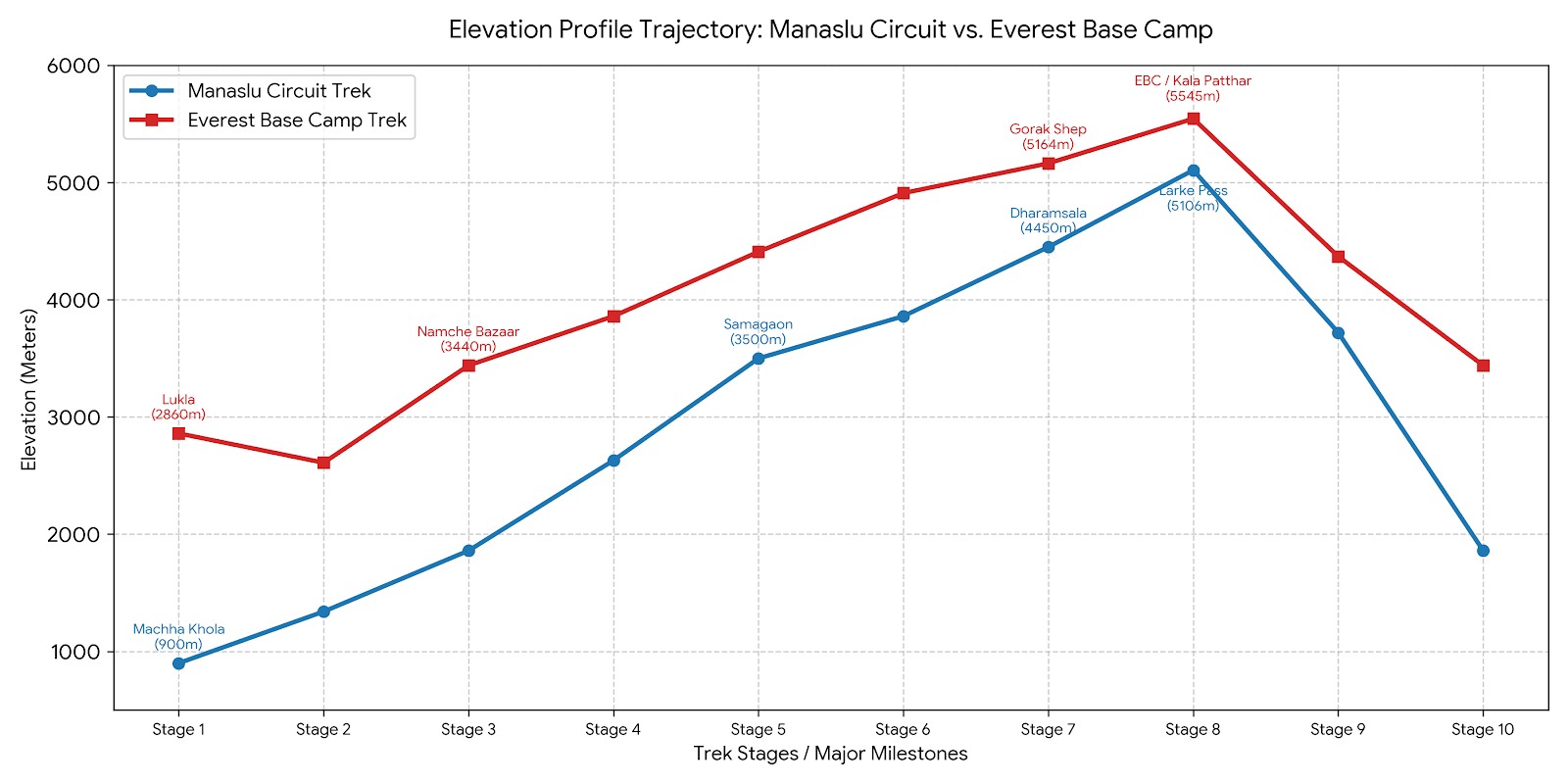
So, overall, the Everest Base Camp trek has a higher starting point and summit than the Manaslu Circuit.
| Feature | Manaslu Circuit | Everest Base Camp |
|---|---|---|
| Starting point | Machha Khola 900 m | Lukla 2,860 m |
| Major acclimatization village | Samagaon 3,500 m | Namche ~3,440 m |
| High overnight | Dharamsala 4,450 m | Gorak Shep ~5,164 m |
| Highest major point | Larke Pass 5,106 m | Kala Patthar ~5,545 m |
| Initial elevation exposure | Lower | Higher |
Therefore, in terms of altitude, the Manaslu Circuit has an advantage. You have more time to adjust to the higher elevations. However, it depends on the details of the itinerary.
Samagaon at ~3,500 m is one of the most crucial points in the Manaslu Circuit in terms of acclimatization. Most trekking itineraries suggest spending an extra day there. You do not have to stay put and waste an entire day, however. It is a good idea to do a day hike from Samagaon while still having the village as your overnight camp.
Here, it is possible to go towards Manaslu Base Camp or Pungyen Gompa, depending on the weather, trail conditions, your fitness, and your guide’s advice. The idea is to get higher during the day and back down to the same altitude at night.
This is where good trekking advice is particularly important. Just because the Manaslu Circuit has a lower starting point and a gentler acclimatization profile does not mean that you cannot get altitude sickness. You can still get it once you get to Samagaon at ~3,500 m, Samdo at 3,875 m, and Dharamsala at ~4,450 m.
In other words, altitude sickness can occur at any elevation, depending on the individual.
So, here are some general guidelines :
This is particularly relevant if you are asking this question about the 5-day Manaslu Circuit.
Here, the 5-day itinerary at higher altitude does not allow for the same acclimatization profile as a standard Manaslu Circuit. Trying to rush from lower elevations to Samagaon at ~3,500 m and then to Dharamsala at ~4,450 m and the 5,106 m Larke Pass is much more strenuous.
Therefore, a 5-day Manaslu trek at higher altitude from Lho Gaon to Larya Pass and Bimtang is more challenging in terms of acclimatization.
So, it all depends on the details of your itinerary.
As an avid trekker, I can say that the gradual transition from the lower valleys to the higher altitudes is one of the most enjoyable aspects of the Manaslu Circuit. You start your trekking adventure in the relatively warm lower valleys around Machha Khola at ~900 m. You slowly transition to the forested lower Himalaya around Jagat (1,340 m) and Deng (1,860 m).
Further up, you enter the Tibetan landscape in Namrung at ~2,660 m and Lho at 3,180 m. You stay overnight in Samagaon at ~3,500 m and gradually acclimatize before reaching the higher altitudes of Samdo at 3,875 m, Dharamsala at ~4,450 m, and the Larke Pass at 5,106 m.
Here, this gradual acclimatization is much easier on the body, hence why the Manaslu Circuit is so popular with hikers. However, it does not mean that you should dismiss caution when it comes to altitude. Manaslu has a great acclimatization profile, but it still requires common sense and responsible trekking.
The unique Buddhist culture of Manaslu is another significant advantage over other Himalayan trekking regions. The cultural experience begins as the trek enters the upper Budhi Gandaki and Nubri valleys.
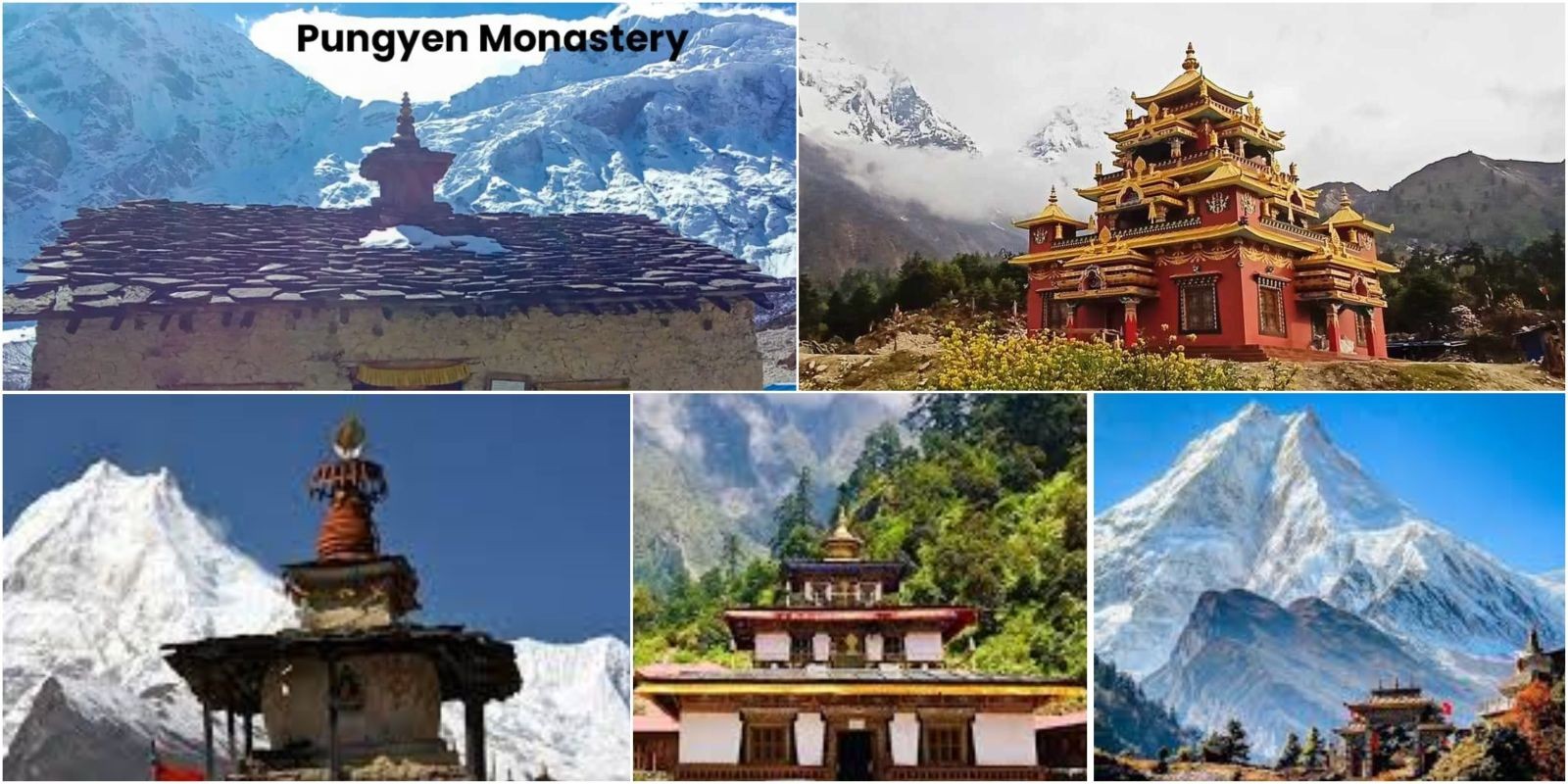
Here, it becomes more noticeable once you reach the villages of Namrung at ~2,660 m, Lho at 3,180 m, Samagaon at ~3,500 m, and Samdo at 3,875 m. What makes these cultural encounters so remarkable is that they are an organic part of the local landscape and not staged for the benefit of hikers.
The lower part of the Manaslu trek is much more diverse in terms of cultural heritage. As you gain altitude, the cultural landscape changes. The following table shows some of the most notable cultural observations at different elevations.
In fact, this is one of the most fascinating aspects of the Manaslu Circuit. You gradually transition from one cultural region to another as you trek higher into the mountains.
There are several monasteries and gompas along the trail and in the upper valleys.
Here are some of the most notable ones :
Likewise, the exact historical and cultural details of lesser-known monasteries may vary, so it is best to do your research or ask your guide.
Lho is one of the most remarkable cultural hotspots on the Manaslu Circuit. The village, its unique architecture, the monastery, the surrounding fields, and the towering Manaslu at 8,163 m create a sense of a world apart.
However, trekkers should remember that the monastery is a sacred place. Always ask for permission before taking photos or entering the monastery’s grounds.
Samagaon is the most important cultural village on the upper part of the Manaslu Circuit. Surrounded by high mountains, this settlement serves as the crossroads for many trekking trails and is the gateway to the high Himalaya. It is also an essential acclimatization point before the final push to Samdo at 3,875 m, Dharamsala at ~4,450 m, and the Larke Pass at 5,106 m.
Throughout the upper Manaslu region, you will see mani walls, prayer wheels, chortens, and prayer flags.
Here are some general guidelines when it comes to cultural and religious customs in the region:
The cultural landscape of the upper Manaslu region is not as commercialized as other trekking regions in Nepal. There are teahouses, trekking agencies, guides, and porters in the upper villages. There is also internet access in some places.
Therefore, it is not accurate to say that the Manaslu region is untouched by modern civilization. However, it does retain a unique cultural heritage that is not as commodified as in other regions.
Thus, the unique cultural aspect of the Manaslu Circuit is best experienced in the higher villages. Everything revolves around the mountains, subsistence farming, and religion. This is particularly evident in the settlement of Samdo at 3,875 m.
The term spiritual trekking in Nepal should be used with caution. Just because there are prayer flags does not mean that the entire region is steeped in spirituality. Different people can have different spiritual experiences. Some may find the local culture and religious practices to be deeply meaningful. Others may be more captivated by the beauty of the Himalaya or the adventure of trekking. Neither is wrong, of course. There is no single right or wrong way to experience the Manaslu Circuit.
Having said that, a good rule of thumb is to let the mountains inspire you rather than the other way around.
Here are some common cultural and religious guidelines for trekking in Nepal and for Manaslu Circuit Trek:
Importantly, a good local guide can make a world of a difference when it comes to cultural and religious practices. They can help you navigate potentially delicate situations and explain the significance of various customs.
The cultural richness of the Manaslu region is not defined by the number of monasteries. It is more about the unique experience of gradually transitioning from one cultural and geographical region to another.
Meanwhile, you start your trek in the lower valleys of Machha Khola at ~900 m and slowly make your way up the valley. You pass villages, forests, and rivers before encountering the unique Tibetan cultural heritage in the upper Budhi Gandaki and Nubri valleys. You stay overnight in the high Himalayan village of Samagaon at ~3,500 m and further acclimatize in Samdo at 3,875 m and Dharamsala at ~4,450 m before finally reaching the Larke Pass at 5,106 m.
The Manaslu Circuit is generally more expensive than the Annapurna Circuit due to its restricted status and additional permits. Compared to the Everest Base Camp, the costs can be similar, but they depend on the length of the route, guides and porters, transport, season, and group size.
If you are wondering about Manaslu Circuit cost vs EBC, the permit system and the level of development are significant factors.
Importantly, the biggest difference is the restricted area permit. According to the Nepal Department of Immigration, for the Gorkha Manaslu region, the fee is USD 100 for the first week in September-November and USD 15 for each additional day. From December-August, the first-week cost is USD 75, and each additional day is USD 10.
Current Manaslu Cost Factors :
Important: The permit costs change, so your trekking agency must confirm the exact fee when you book the tour. The Department of Immigration lists the Manaslu restricted area permit and the region covered by it as the Gorkha Manaslu area, Chumnubri rural municipality wards 1-4.
The restricted area system is one of the significant differences in Manaslu vs Annapurna Circuit price.
You are not only paying for the accommodation and meals; your package can also include
Here, the guide is a significant point because, for Manaslu Circuit, you cannot simply opt for a cheaper independent tour. A restricted-area permit requires an organized group with a licensed guide.
There is not a final answer because the Everest Base Camp packages vary significantly. Compared to EBC, Manaslu has a more challenging route, but it can also depend on the season, type of accommodation, and included services.
While Everest has more developed infrastructure, the price of flights to Lukla, higher-altitude meals, and longer routes can add up. Manaslu Circuit has a permit system and requires a guide, while Annapurna Circuit offers more flexibility.
| Cost consideration | Manaslu Circuit | Everest Base Camp | Annapurna Circuit |
|---|---|---|
| Restricted-area permit | Yes | None | None |
| Guide | Mandatory | Depends on the route | More flexible |
| Accommodation Options | Teahouse-based, varies with altitude | More developed, varies with altitude | More developed on many routes |
| Transport | Road transfers | Road transfers/Flight | Road access |
| Infrastructure | More limited | More developed | More developed on many sections |
| Overall budget | Moderate to high | Moderate to high | Usually lower |
Therefore, Manaslu is not the cheapest option, but it offers a more authentic experience.
This is where the discussion about the Manaslu Circuit cost vs Annapurna Circuit becomes subjective. You are paying extra for the restricted area access and a less-developed trail.
However, the Manaslu Circuit offers a unique experience that includes visiting local villages and remote mountain landscapes. You can hike through Namrung (around 2,660 m), Lho (3,180 m), Samagaon (around 3,500 m), and Samdo (3,875 m) on your way to Dharamsala (around 4,450 m) and the Larke Pass (5,106 m).
Here, this is not a luxury hotels/ resort trek, but the value is in the wilderness and cultural experience.
Manaslu Circuit is a great value for an experienced trekker who wants to avoid the crowds and has specific goals. If you are seeking solitude and a high-altitude Himalayan trekking experience, Manaslu offers a more authentic adventure. The Manaslu Conservation Area covers 1,663 square kilometers and spans elevations from around 600 m to Mount Manaslu’s 8,163 m.
Meanwhile, the range includes diverse ecosystems and dramatic landscapes that cannot be found on other treks. This is the appeal of the Manaslu Circuit; it is an excellent value for those who seek a wilderness experience.
The Manaslu Circuit is not for everyone. If you want luxury accommodations, Wi-Fi, diverse food options, and hot showers at every lodge, Manaslu may not be the best choice. The circuit has more limited infrastructure and a permit system that makes it less flexible than the Annapurna Circuit.
For those who want comfort and convenience, the Everest region and Annapurna Circuit can be a better choice.
The Manaslu Circuit cost is reasonable if you want a wilderness adventure. You start your trek at around 900 m in Machha Khola, and you will have the opportunity to see the local culture.
As you get closer to Samagaon (around 3,500 m), Samdo (3,875 m), and Dharamsala (around 4,450 m), the scenery becomes more spectacular. You will pass through Larke Pass (5,106 m) on your way to Bimthang (around 3,590 m).
Compared to a well-developed but commercialized trail, the Manaslu Circuit offers a unique experience. Is Manaslu worth it? It depends on what you are looking for in your trek.
If you want a challenging and remote Himalayan circuit, it can be an excellent value. However, if you are a budget-conscious traveler who wants luxury accommodations and diverse food options, Annapurna Circuit may be a better choice.
The Manaslu teahouse experience is significantly more basic than what is available in the Everest Base Camp region. It is also more limited than in many parts of the Annapurna Circuit.
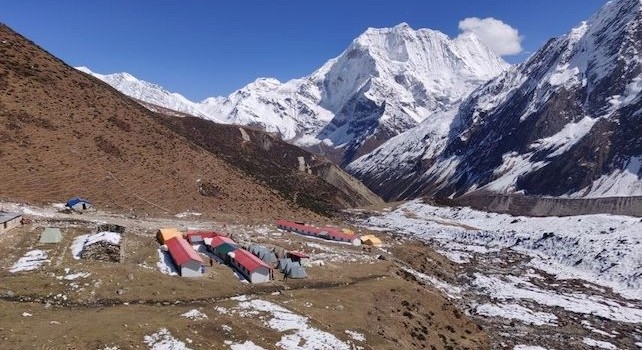
However, this does not mean that the Manaslu Circuit accommodations are primitive; the level of development depends on the altitude. The higher you go, the more limited the amenities become.
For an experienced trekker, the Manaslu vs EBC facilities are not a comparison between good and bad. It is a difference between a developing region and a long-established tourism area.
Most of the Manaslu Circuit accommodations are locally owned and operated teahouses or guesthouses.
A typical teahouse offers :
However, it is important to remember that not all teahouses offer the same amenities. A guesthouse with hot showers in one village will not have them in another.
| Area | Approx. elevation | Typical infrastructure |
|---|---|---|
| Machha Khola | 900 m | More developed local guesthouses |
| Jagat | 1,340 m | Basic but established teahouses |
| Deng | 1,860 m | Simple trekking accommodation |
| Namrung | 2,660 m | More established teahouses |
| Lho | 3,180 m | Basic–moderate guesthouses |
| Samagaon | 3,500 m | Several trekking lodges |
| Samdo | 3,875 m | More basic high-altitude lodging |
| Dharamsala | 4,450 m | Very basic high-altitude accommodation |
| Bimthang | 3,590 m | Better facilities after the pass |
Importantly, the difference becomes apparent after Samagaon.
At around 3,500 m, Samagaon is one of the more developed areas on the upper Manaslu Circuit. You will find more options for food, lodging, and communication.
However, do not expect the same level of comfort as in Kathmandu or the Everest region. The primary goal of the accommodations is to provide a warm place to sleep and meals that will give you enough energy for the next day of hiking.
At 3,875 m, Samdo is significantly more challenging than Samagaon. The same goes for Dharamsala (around 4,450 m), which is the highest village on the Manaslu Circuit. Spending the night in these remote and high-altitude settlements is necessary to acclimatize to the elevation.
However, the amenities are much more limited than in the lower parts of the trail. At these elevations, comfort should not be the priority; warmth, food, and water are more important.
The Everest region has a well-established tourism industry that has been growing for several decades. Popular areas such as Namche Bazaar offer a wide range of accommodations, dining options, bakeries, cafes, shops, and communication services. The Manaslu Circuit has fewer facilities, and the experience is more rustic.
| Facility | Manaslu Circuit | Everest Base Camp |
|---|---|---|
| Lodge choice | More limited | Generally wider |
| Luxury options | Limited | More available |
| Hot shower | Selectively available | More widely available |
| Wi-Fi | Selectively available | More widespread |
| Charging | Usually available for a fee | More widely available |
| Food variety | Basic–moderate | Generally broader |
| High-altitude comfort | Basic | Better developed |
| Remote atmosphere | Strong | Lower on busy sections |
Thus, this is one of the reasons why the Manaslu Circuit is more adventurous than other popular treks in Nepal.
Most teahouses offer similar foods, but the variety depends on the altitude.
Many guesthouses provide the following meals:
As you go higher, the options become more limited. At Dharamsala (around 4,450 m), you will not find the same variety of foods as in Kathmandu, Namche Bazaar, or Pokhara.
Electricity is available in most teahouses, but it depends on the region and the specific lodge. You may have to pay extra for charging your electronic devices. The availability of electricity also depends on the season and the local infrastructure. It is a good idea to bring a power bank, extra batteries for your camera, charging cables, and a universal adapter. Offline maps and important documents can also be helpful because the Internet and electricity may be unavailable.
Hot water is usually available in most teahouses, but it depends on the season and the region. At higher altitudes, you may have to rely on cold water. Many guesthouses have basic but functional bathrooms. As you go higher, you will notice that the facilities become more limited. It is not uncommon to see people using the same bathrooms for days or even weeks at a time.
For many experienced trekkers, the rustic accommodations are part of the adventure. A warm room, a good meal, and a view of the mountains are all you need for a satisfying trek.
However, it is important to remember that basic facilities often mean fewer conveniences and comforts. You may have to share a room, use cold water, and deal with limited electricity. Hot showers, private bathrooms, and luxury amenities are usually unavailable at higher altitudes.
It is necessary to set realistic expectations about the Manaslu Circuit accommodations. At lower elevations, most teahouses offer more comfort than you would expect.
As you get higher, the amenities become more limited. At Samagaon (around 3,500 m), you will notice that the options are more modest than in Kathmandu or the Everest region or in Annapurna Circuit.
However, you will still be able to find a warm and comfortable place to sleep and a good meal that will give you energy for the next day of hiking.
At Samdo (3,875 m) and Dharamsala (around 4,450 m), simplicity becomes the norm.
After crossing the Larke Pass (5,106 m), you will descend to Bimthang (around 3,590 m), where you will notice that the facilities become more comfortable again. This change in infrastructure is part of the adventure on the Manaslu Circuit.
If you want luxury accommodations and a wide range of amenities, the Manaslu Circuit may not be the best option.
Nevertheless, if you are an experienced trekker who wants to challenge yourself and enjoy the wilderness, the rustic teahouses are a small price to pay for an unforgettable Himalayan adventure.
It depends on what you mean by challenging. If you are asking about difficulty in terms of altitude, then Everest Base Camp trek has higher summits than Manaslu Circuit and Annapurna Circuit.
However, the Manaslu Circuit trek is generally considered more challenging due to its longer hiking days, isolated and more primitive trails, fewer services, and crossing the high altitude LarkevPass (5,106 m). Annapurna Circuit falls in between in terms of overall difficulty. It is well-developed in terms of infrastructure, but it also requires crossing another high mountain pass (Thorong Pass at 5,416 m).
| Feature | Manaslu Circuit | Everest Base Camp | Annapurna Circuit |
|---|---|---|
| Overall difficulty | Challenging | Moderate–challenging | Moderate–challenging |
| Highest point | Larke Pass – 5,106 m | Kala Patthar – 5,545 m | Thorong Pass – 5,416 m |
| Longest walking days | Often 7–9 hrs | Usually 5–7 hrs | 5–8 hrs |
| Remoteness | High | Moderate | Moderate |
| Infrastructure | Basic | Good | Good |
| Technical climbing | None | None | None |
| Best for beginners | No | Yes | Yes |
Manaslu Circuit vs Annapurna difficulty is mostly about accumulated vertical gain and not about overall altitude.
Compared to Annapurna trekking, Manaslu has several days of steady uphill walking, including passing through several high villages. You also have to descend a long way from Larke Pass (5106m) to Bimthang (3,590 m). Another factor is that Manaslu Circuit trek has fewer evacuation options and lacks the well-established infrastructure of the Everest region.
Here, Everest Base Camp has higher altitudes like Everest Base Camp (5,364 m) and Kala Patthar (5,545 m), but the Khumbu region has much better infrastructure, including lodges, hospitals, and even helicopter services. That said, climbing high altitude Everest trek is also associated with numerous health risks.
However, Annapurna Circuit trek is famous for the combination of amazing landscapes and the high Thorong Pass (5,416 m). Thanks to the road construction, Annapurna Circuit trek now involves relatively short walks and good infrastructure.
Physical difficulty is defined by a number of hours of walking, the steepness of the trails, the amount of elevation gained or lost, and other similar factors. Altitude challenge, on the other hand, is determined by how well your body reacts to lower air pressure and a decrease in the amount of oxygen.
Meanwhile, a physically strong person can still get altitude sickness and a slow walker can feel perfectly fine at high altitudes. This is why it is important not to compare yourself to others and pay close attention to your body.
Moreover, altitude sickness is often caused by overexertion, so it is important to keep an appropriate pace and climb high every other day in order to give your body a chance to adapt to the new environment.
| Trek | Physical | Altitude | Infrastructure |
|---|---|---|
| Manaslu Circuit | ⭐⭐⭐⭐⭐ | ⭐⭐⭐⭐☆ | ⭐⭐☆☆☆ |
| Everest Base Camp | ⭐⭐⭐⭐☆ | ⭐⭐⭐⭐⭐ | ⭐⭐⭐⭐☆ |
| Annapurna Circuit | ⭐⭐⭐⭐☆ | ⭐⭐⭐⭐☆ | ⭐⭐⭐⭐☆ |
If your primary goal was to choose the most challenging trekking holiday out of three, Manaslu Circuit is generally considered the most difficult due to long hiking days, remoteness, lack of infrastructure, and crossing Larke Pass (5,106 m).
However, Everest Base Camp trek is more difficult in terms of altitude and offers better infrastructure support. Annapurna Circuit has the best combination of spectacular scenery, good infrastructure, and the challenging Thorong Pass crossing.
Manaslu Circuit trek is suitable for hikers seeking authentic adventure in remote mountainous wilderness rather than the popular trail. If you have a couple of multi-day trekking adventures under your belt or like to hike at high altitudes, Manaslu is an excellent choice to fulfill your Himalayan dreams.
Also, it can be said with a high degree of confidence that Manaslu is not the best option for everyone, which is another reason why it can be considered the best. Only people with specific goals and motivations have a good chance of truly enjoying this trek.
In fact, Manaslu Circuit trek is recommended for people seeking...
Also, Choose Manaslu Circuit if you...
Here, the gradual uphill hike from Machha Khola (900 m) to Samagaon (3,500 m) and further to Larke Pass (5,106 m) rewards committed trekkers.
EBC is recommended for those who want the ultimate Everest experience and prefer well-developed trails and more infrastructure. It is often easier to get around the Everest region as there are more options for accommodations and means of transport.
Likewise, Everest is all about the iconic mountain scenery and cultural heritage with excellent supporting infrastructure.
Annapurna Circuit is a great choice if you want a wide variety of landscapes, convenient transportation, more options for accommodations and flexibility while trekking at high altitude.
Here, Annapurna Circuit is generally the most versatile option for first-time high-altitude trekkers.
| Your personal priorities | Best option |
|---|---|
| Everest bucket list experience | Everest Base Camp |
| Best infrastructure and flexibility | Annapurna Circuit |
| Solitude and wilderness | Manaslu Circuit |
| Rich cultural heritage | Manaslu Circuit |
| First high-altitude trek | Annapurna or EBC |
| Experienced Himalayan trekker | Manaslu Circuit |
If you...
Why Many Experienced Trekkers Choose Manaslu Circuit ?
After returning from Everest Base Camp or Annapurna Circuit trek, many hikers find themselves yearning for authentic solitude and wilderness. Manaslu Circuit is significantly more remote and offers incredible opportunities to discover unique Himalayan flora and fauna.
Importantly, you will pass from lush river valleys to the Tibetan-style villages of Lho (3,180 m) and Samagaon (3,500 m), then to the remote Samdo village (3,875 m), and finally to cross Larke Pass (5,106 m) before descending into the alpine meadows of Bimthang (3,590 m).
In conclusion, Manaslu Circuit is best for an experienced trekker who wants authenticity, long days walking at high altitudes, and a genuine Himalayan adventure rather than the popular multi-day trekking route.
For these reasons, the Manaslu Circuit trek is one of Nepal’s most unique, remote, and authentic trekking experiences that offers unparalleled insight into the traditional way of life.
While the Manaslu Circuit presents options for those seeking solitude, authenticity, and wilderness, it is by no means a universal choice. It ultimately depends on your experience, expectations, time constraints, comfort level, and goals. In some cases, Everest Base Camp or the Annapurna Circuit may make more sense.
If you are seeking the iconic Everest experience, the choice is clear – go to Everest Base Camp.
Actually, the standard EBC trek begins at Lukla (2860 m) and passes through several famed Khumbu villages, including Namche Bazaar (3440 m), Tengboche (3860 m), Dingboche (4410 m) and Lobuche (4910 m), before reaching Everest Base Camp (5364 m) and Kala Patthar (5545 m).
Similarly, the Khumbu also boasts an exceptionally well-developed trekking infrastructure that offers hikers a wide variety of accommodations and meals at various price points.
| Factorb | Everest Base Camp |
|---|---|
| Main attraction | Mount Everest |
| Maximum elevation | 5545 m (Kala Patthar) |
| Infrastructure | Highly developed |
| Lodge availability | Wide variety |
| Food variety | Wide variety |
| Communication | Accessible |
| Trek popularity | Extremely high |
| Best suited for | First-time high-altitude trekkers with preparation |
If this is your first Himalayan trek, this well-developed infrastructure can provide crucial reassurance.
By contrast, the Annapurna Circuit offers a far more flexible trekking option that provides incredible variety while also delivering on traditional Himalayan adventure.
Here, the high-altitude pass of Thorong (5416 m) towers over a strikingly diverse range of landscapes from subtropical valleys to the Himalayan peaks, while roads also offer greater transport flexibility than Manaslu.
However, this comes at the cost of reduced solitude, since some of the trail has been replaced by tarmac in recent years.
| Factor | Annapurna Circuit |
|---|---|
| Major high point | Thorong Pass (5,416 m) |
| Landscape diversity | Exceptional |
| Road access | Availability |
| Accommodation | Generally good |
| Flexibility | High |
| Cultural diversity | Very high |
| Best suited for | First-time and experienced trekkers |
For many, the Annapurna Circuit’s combination of Himalayan grandeur, accessibility, and variety is tremendously appealing.
The EBC trek is ideally suited for those who:
However, keep in mind that this does not eliminate altitude. Kala Patthar, for instance, rises to a breathtaking 5545 meters.
Annapurna Circuit is ideal for those who:
Here, the Annapurna Circuit can also accommodate a wide range of itineraries depending on road conditions and time constraints.
Manaslu tends to become much more appealing as soon as you acknowledge that its charm derives from its wilderness and cultural appeal.
| Your priority | Consider |
|---|---|
| Seeing Everest | EBC |
| Better infrastructure | EBC |
| Landscape diversity | Annapurna Circuit |
| Transport flexibility | Annapurna Circuit |
| Solitude/Wilderness/Less Crowds | Manaslu |
| Tibetan cultural flavor | Manaslu |
| Remote trekking | Manaslu |
| High-pass challenge | Manaslu/Annapurna |
| First Himalayan trek | EBC/Annapurna |
| Experienced trekker seeking less busy route | Manaslu |
Most importantly, the key point is that Manaslu does not diminish the appeal of Everest or Annapurna. It merely offers a different type of Himalayan trekking experience.
Another reason why returning trekkers favor the Manaslu Circuit is that it offers an authentic Himalayan experience. It is, in many ways, the last bastion of what Nepal’s classic trekking routes were like before roads, tourism, and infrastructure turned them into fully-fledged resorts.
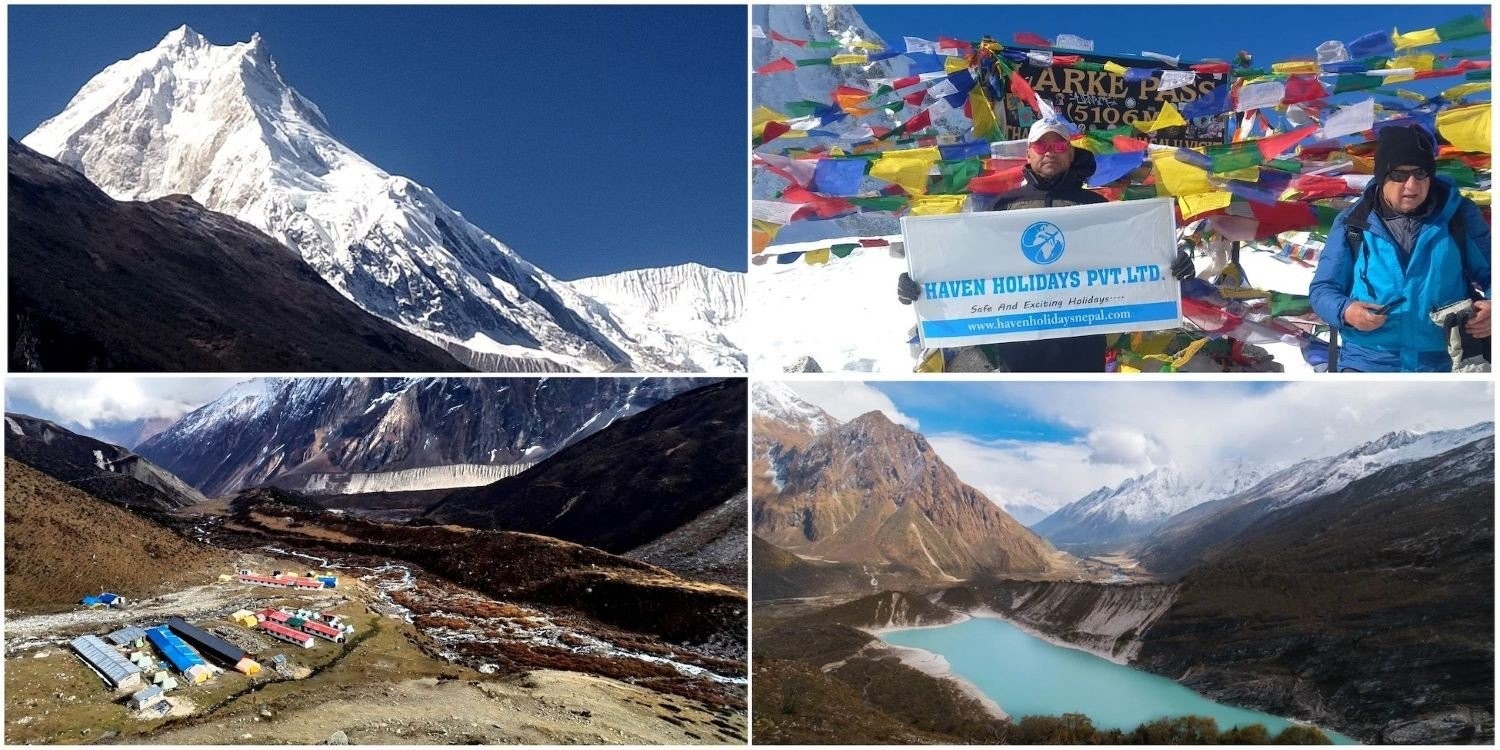
However, this is not entirely true. Manaslu is not as authentic as it used to be.
Likewise, roads now wind through the circuit, teahouses cater to international clients, and connectivity has improved considerably. It would be misleading to suggest that Manaslu offers a ‘pure’ Himalayan experience anymore.
Thus, the more accurate assertion would be to say that Manaslu still feels less commercialized and less touristy than the Everest and Annapurna regions.
It is also important to note that ‘authentic’ does not necessarily mean ‘untouched’.
Actually, an authentic experience refers to a trekking route where the local culture has not been entirely subsumed by tourism.
In other words, the villages along the trail still serve their traditional functions and have not been turned into showpieces for the benefit of hikers.
For instance, consider the villages of Lho (3180 m), Samagaon (3500 m) and Samdo (3875 m) that dot the Manaslu Circuit trail.
one of them still reflects centuries-old traditions, such as:
In essence, this is a living cultural heritage rather than a carefully curated museum exhibit.
Some older trekkers may also notice parallels between the Manaslu Circuit and the old Annapurna Circuit, which was also a trail before it became a road.
Meanwhile, it is easy to forget that road infrastructure has fundamentally changed the Annapurna trekking experience. What used to be a grueling multi-day walk has been replaced by a drive.
Of course, this has greatly benefited the local economy by bringing in tourists. It has also brought in greater connectivity, healthcare, and other services.
However, it has also diminished the trekking experience considerably for those seeking a less commercialized Himalayan adventure.
Here, this is the primary reason why the Manaslu Circuit has gained such a strong following among experienced trekkers.
In essence, the Manaslu Circuit might not be completely authentic, but it is arguably the closest thing to a trailblazing Himalayan trek that one can find these days.
It is also instructive to compare Manaslu’s authenticity to that of the Everest region. The Namche Bazaar (3440 m), for instance, has turned into a full-fledged resort complex with hotels, restaurants, cafes, bakeries, shops, internet cafes, and other tourism-related services.
Authenticity, however, is not a binary concept. Yes, Namche has indeed changed compared to a few decades ago. However, it still offers a unique cultural experience that you would not find anywhere else in the Himalayas.
Moreover, it would be a disservice to dismiss the value of modern infrastructure.
Meanwhile, the sheer accessibility and convenience of the Everest region cannot be denied. It has arguably helped promote Nepal as a trekking destination more than any other region.
Yet, it is also easy to understand why trekkers who crave a less commercialized experience would prefer Manaslu.
The shift towards a more commercialized experience becomes especially apparent at Namrung (2660 m), where the trail begins its steady climb up the valley.
As you continue hiking towards Lho (3180 m), you will begin noticing that the cultural landscape is gradually shifting towards a primarily Tibetan one.
Then, it reaches its culmination at Samagaon (3500 m), before the trail turns towards the isolated valley of Samdo (3875 m). It is then that you realize how incredibly far you are from civilization, with the journey continuing through Dharamsala (4450 m). The final challenge comes in the form of the Larke Pass (5106 m).
Let’s acknowledge the fact that Manaslu really is becoming more popular with every year that passes. You cannot deny that there are other trekkers on the trail, especially during the peak season.
Likewise, tea houses are more accustomed to international visitors these days, and the entire trail is much more accessible than it used to be.
With that in mind, let’s refrain from using hyperbolic phrases such as ‘untouched’, ‘no tourists’, ‘undiscovered Nepal’, etc. The more realistic phrase would be to note that Manaslu offers a less commercialized trekking experience.
A first-time trekker in Nepal is likely to be blown away by the scenery. An experienced trekker, on the other hand, will subconsciously realize that the experience depends a lot on how the local tourism infrastructure interacts with the environment.
Here, they will notice whether a village has been transformed into a resort complex or not. They will also be aware of the number of vehicles on the road and the degree to which the trail has been commercialized.
As an experienced trekker, you may prefer Manaslu because of its:
In short, the Manaslu Circuit encapsulates all of the above because the trail from Machha Khola (900 m) to Larke Pass (5106 m) follows this progression.
If you are a first-time trekker, you should not dismiss Manaslu based on its authenticity. It is a fantastic trekking route with unparalleled cultural and wilderness appeal.
However, it is also easy to understand why returning trekkers might choose Manaslu over the other Himalayan circuits. If you have grown accustomed to the commercialized nature of the Everest and Annapurna trekking trails, Manaslu is arguably the best alternative out there.
Likewise, it is not about authenticity or romanticism, but about realizing the value of a less commercialized trekking route that still possesses sufficient infrastructure to support an international trekking community.
Moreover, Manaslu may not be what it used to be many decades ago, but that does not detract from its current appeal. This is the main reason why it continues to be so popular among solo and independent trekkers who want to discover the real Nepal.
Manaslu Circuit does not need to compete with Everest Base Camp and Annapurna Circuit. Everest has the world’s favorite peak, while Annapurna offers diverse landscapes and the most developed trekking infrastructure.
Still, for serious hikers, Manaslu Circuit can be rewarding because of its remoteness, cultural diversity, wilderness, steep passes, and spectacular high-altitude scenery. This trek offers a great sense of isolation and is much less crowded than other famous trails in Nepal.
Actually, the trail from Machha Khola village (900 m) goes up to Jagat (1,340 m), Deng (1,860 m), Namrung (~2,660 m), Lho (3,180 m), Samagaon (~3,500 m), and Samdo (3,875 m). Along the trail, the scenery changes from river valleys and forests to high-altitude Himalayan landscapes. There is also a striking contrast between the lower valley with its rivers and wilderness and the upper reaches with a more Tibetan appearance.
| Feature | Benefits |
|---|---|
| Fewer crowds | More space for walking |
| Remote mountainous landscape | More opportunities to find wilderness than on other popular trekking routes in Nepal |
| Live cultural heritage | Local Buddhist traditions |
| High Mountain pass | Crossing the Larke Pass (5,106 m) |
| Mountainous scenery | Close views of Manaslu peak (8,163 m) |
| Teahouse trekking | More interaction with local communities |
| Physical activity | Long day hikes and high altitude gain |
| Less commercialization | Fewer teahouses, restaurants, and adventure tourism operators |
More importantly, Larke Pass crossing (5,106 m) is another reason why Manaslu Circuit can be more rewarding than treks to Everest Base Camp or Annapurna Circuit. It is a high-altitude pass, so you should plan to spend more time getting ready to cross it and gain enough endurance for the hike.
Coming from Dharamsala (4,450 m), you will see how the landscape becomes more desolate and barren ahead of the pass. On the way down, you will have breathtaking views of Bimthang Valley (3,590 m).
Manaslu Circuit’s main advantage over other highland treks in Nepal is probably the fact that there is no any specific goal to see or visit the Mountain peak.
It is true for Manaslu Circuit, Annapurna Circuit, and Everest Base Camp trek. They are all about visiting particular Himalayan peaks and nearby villages.
However, unlike the Everest and Annapurna treks, Manaslu Circuit trek provides a great variety of landscapes to enjoy. You start your hike at a relatively low altitude (around 900 m) in a Budhi Gandaki River valley.
Then, you go up to higher villages perched on rocky outcrops, explore beautiful monasteries, cross a couple of suspension bridges, and enjoy forested landscapes, mountain waterfalls, and high-mountain scenery.
Eventually, you reach Samagaon village at around 3,500 m and Samdo village at 3,875 m. You get an intense feeling of being in the mountains as the Samagaon and Manaslu ranges dominate the horizon.
Further along the trail, you will see Dharamsala (~4,450 m) and the Larke Pass (5,106 m), from which you have a great view of Bimthang Valley (3,590 m).
The answer to this question depends on your definition of the best alternative.
Manaslu Circuit can be a good option for those who want:
Meanwhile, those who prefer the Everest Base Camp trek may do so because of
In summary, Annapurna Circuit is a great alternative to both Manaslu and Everest treks because it offers a larger variety of landscapes, more transportation options, and a greater number of accommodations.
Why Manaslu Wins for Many Experienced Trekking Tourists ?
In this paragraph, we will discuss the most important benefit of the Manaslu Circuit trek. It is not necessarily better in terms of adventure, solitude, scenery, and other popular criteria. Rather, it is a combination of the following elements that make Manaslu rewarding for serious hikers:
These benefits are appealing to experienced trekkers who have explored most of the trails in Nepal and have grown tired of the aggressive commercialization, traffic jams, and lack of privacy on well-established routes.
Here, it is worth noting that Manaslu Circuit does not offer all the amenities of other trekking routes in Nepal. It lacks extensive teahouse accommodations and long-distance mountain biking and hiking trails.
Also, the Manaslu area is isolated, so you will need to invest more effort and money into organizing this trek than, say, a trek to Everest Base Camp.
As mentioned earlier, Manaslu Circuit trek is not for everyone. Some of the key disadvantages include:
In short, Manaslu Circuit trek is an extreme highland adventure in one of the most remote areas in Nepal. It lacks the comforts and convenience of other highland trekking routes and requires more dedication, experience, and effort to complete.
Manaslu Circuit is an exceptional trekking route that offers rewarding wilderness, cultural heritage, and high-altitude Himalayan landscapes.
Compared to other highland treks in Nepal, it is less commercialized and congested. It is a good alternative to Everest Base Camp for those who want to enjoy greater solitude and stunning vistas.
Likewise, Manaslu Circuit has many advantages for serious trekkers, but it also has its share of compromises in terms of infrastructure, crowdedness, and accessibility.
If you are unsure which trek to choose, consult a professional travel agency. Your agent can help compare the options based on your preferences, including length and difficulty of the trek, your expectations, and the time and money you are willing to invest in the adventure.
Here, if you need any help regarding trekking in Nepal including Manaslu, Annapurna and Everest, please contact us and can book your trek.
Making you easier to make the decision over Everest or Annapurna or Manaslu: Read these articles as well before making the final plan.
1. Why is the Manaslu Circuit Trek better than Everest Base Camp?
The Manaslu Circuit Trek provides a more remote wilderness than the Everest Base Camp Trek. The Manaslu Circuit has authentic Tibetan Buddhist culture, gorgeous villages, and a challenging mountain pass. Those who want a less crowded, more isolated Himalayan trek than the famous Everest Base Camp Trek may find the Manaslu Circuit Trek to be a fantastic alternative.
2. Is Manaslu Circuit better than Annapurna Circuit?
The Manaslu Circuit Trek is an excellent alternative for those who want to experience a more isolated trek than the popular Annapurna Circuit Trek. Manaslu Circuit is more unspoiled, has traditional villages, and includes a high-altitude mountain crossing. Additionally, the Manaslu Circuit trekking region boasts spectacular wilderness and is home to the 5,106-meter Larke La Pass. These characteristics make the Manaslu Circuit Trek a fantastic option for experienced trekkers looking for a remote Himalayan trekking adventure.
3. Why choose Manaslu Circuit instead of Everest Base Camp?
Choose the Manaslu Circuit Trek if you want a more isolated trek than the well-known Everest Base Camp Trek. The Manaslu Circuit has authentic villages, diverse landscapes, and breathtaking views of Mount Manaslu. Furthermore, the Manaslu Circuit Trek is less crowded than the Everest Base Camp Trek. Thus, those who want to embark on a Himalayan adventure with fewer crowds and a more authentic experience should select the Manaslu Circuit Trek over the Everest Base Camp Trek.
4. Which trek is less crowded: Manaslu, Everest Base Camp, or Annapurna Circuit?
Compared to the Everest Base Camp and Annapurna Circuit trekking routes, the Manaslu Circuit Trekking trail is less crowded. This Himalayan circuit trek is more isolated, less developed, and less frequented by tourists than other Nepalese treks. Thus, the Manaslu Circuit Trek is a fantastic option for those who want a less crowded trek than the Everest Base Camp Trek or Annapurna Circuit Trek.
5. Is Manaslu Circuit more authentic than Everest Base Camp?
The Manaslu Circuit Trek is more authentic than the Everest Base Camp Trek. The Manaslu Circuit Trek routes pass through traditional villages and offer a close look at Tibetan Buddhist traditions. Compared to the Everest Base Camp Trek, fewer people choose the Manaslu Circuit Trek. Therefore, the Manaslu Circuit Trek is more authentic for those looking for traditional Himalayan culture and an isolated wilderness trek.
6. What makes Manaslu Circuit more adventurous than Annapurna Circuit?
The Manaslu Circuit Trek has a more adventurous experience than the Annapurna Circuit Trek because it passes through isolated wilderness, diverse landscapes, and traditional Himalayan hamlets. Additionally, the Manaslu Circuit Trek is challenging due to the 5,106-meter Larke La Pass crossing. Those looking for an adventurous trekking holiday in Nepal should select the Manaslu Circuit Trek over the Annapurna Circuit Trek.
7. Does Manaslu Circuit have better mountain views than Everest Base Camp?
The Manaslu Circuit Trek offers spectacular mountain vistas, including views of the 8,163-meter Manaslu peak. The Manaslu Circuit Trek also takes hikers past glaciers, valleys, forests, and rocky outcroppings. The Everest Base Camp Trek provides unparalleled views of Mount Everest. However, the Manaslu Circuit Trek offers more diverse mountain scenery than the Everest Base Camp Trek. Furthermore, the Manaslu Circuit Trek has a more isolated and authentic feel than the Everest Base Camp Trek.
8. Why is Manaslu Circuit one of the best alternatives to Everest Base Camp?
The Manaslu Circuit Trek is one of the best alternatives to the Everest Base Camp Trek because it is isolated, spectacular, and provides a close look at traditional Himalayan cultures. Furthermore, the Manaslu Circuit Trek features a challenging crossing of the Larke La Pass. Thus, the Manaslu Circuit Trek is a fantastic option for those looking for an alternative to the Everest Base Camp Trek.
9. Is Manaslu Circuit suitable for experienced trekkers?
The Manaslu Circuit Trek is appropriate for experienced trekkers who enjoy challenging hiking. The Manaslu Circuit Trek passes through isolated regions and requires hikers to have a good level of fitness and stamina. Although the Manaslu Circuit Trek is not as difficult as some of the world’s toughest trekking routes, hikers must be well-prepared for long days of walking and several high-altitude crossings. Thus, the Manaslu Circuit Trek is appropriate for experienced trekkers who enjoy isolated wilderness hiking.
10. Which trek offers better cultural experiences: Manaslu or Everest Base Camp?
The Manaslu Circuit Trek offers better cultural experiences than the Everest Base Camp Trek. The Manaslu Circuit Trek is a fantastic opportunity to witness traditional Gurung and Tibetan Buddhist customs. Traditional villages, monasteries, and farms dot the trail of the Manaslu Circuit Trek. Compared to the Everest Base Camp Trek, the Manaslu Circuit Trek provides a more authentic cultural experience.
11. Why is Larke La Pass a major advantage of the Manaslu Circuit?
The highlight of the Manaslu Circuit Trek is the crossing of the Larke Pass. Larke Pass is a challenging 5,106-meter high-altitude crossing. The crossing of Larke Pass offers spectacular views of the surrounding Himalayan landscape. Compared to the Everest Base Camp Trek, the Manaslu Circuit Trek provides a more authentic wilderness trekking experience that includes crossing a Himalayan pass.
12. Is Manaslu Circuit less commercialized than Everest Base Camp?
Compared to the Everest Base Camp Trek, the Manaslu Circuit Trek is less commercialized. The Manaslu Circuit Trek passes through isolated areas and offers a more authentic cultural experience. The Everest Base Camp Trek is a well-established and popular trekking route with numerous teahouses and hotels available along the trail. Thus, compared to the Everest Base Camp Trek, the Manaslu Circuit Trek is less commercialized and offers a more genuine Himalayan trekking experience.
13. Why does Manaslu Circuit offer a better wilderness experience?
Manaslu Circuit offers a better wilderness experience because it winds through remote forested valleys, alpine ridges, and traditional villages. Compared to other popular treks in Nepal such as Everest Base Camp Trek and Annapurna Circuit Trek, the Manaslu Circuit Trek passes through more isolated wilderness areas. Thus, those who want a remote trekking experience in the Himalayas should choose the Manaslu Circuit Trek.
14. Is Manaslu Circuit harder than Everest Base Camp?
The Manaslu Circuit Trek is more difficult than the Everest Base Camp Trek. The Manaslu Circuit Trek is longer and includes a 5,106-meter crossing of the Larke Pass. Furthermore, the Manaslu Circuit Trek is more isolated and has more challenging terrain than the Everest Base Camp Trek. Thus, while both treks are demanding, the Manaslu Circuit Trek is generally more difficult than the Everest Base Camp Trek.
15. Which trek is best for avoiding crowds in Nepal?
Those who want to avoid crowds in Nepal should choose the Manaslu Circuit Trek. The Manaslu Circuit route is relatively isolated and less traversed than other trekking trails in Nepal. Thus, the Manaslu Circuit Trek is an excellent option for those who want a less crowded trekking experience in Nepal.
16. Does Manaslu Circuit provide better value than Everest Base Camp?
Manaslu Circuit provides better value than Everest Base Camp. Compared to the Everest Base Camp Trek, the Manaslu Circuit Trek offers a more diverse range of landscapes, including glaciers, valleys, mountains, and forests. The Manaslu Circuit Trek also provides an authentic cultural experience with opportunities to explore traditional villages and monasteries. The Manaslu Circuit Trek might entail a more significant financial investment than the Everest Base Camp Trek, but it has plenty of value for those seeking a Himalayan adventure.
17. Why is Manaslu Circuit ideal for travelers seeking an off-the-beaten-path trek?
Manaslu Circuit is ideal for those seeking an off-the-beaten-path trek because it winds through remote Himalayan terrain and traditional Nepalese villages. Compared to other Nepalese treks, the Manaslu Circuit Trek passes through less-traveled and isolated areas. Thus, the Manaslu Circuit Trek is an excellent option for those seeking a Himalayan trekking adventure that is far removed from the beaten path.
18. Can Manaslu Circuit be a better choice for repeat Nepal trekkers?
Those who have hiked popular trekking routes in Nepal such as Annapurna Circuit Trek or Everest Base Camp Trek may consider the Manaslu Circuit Trek as a repeat trekking option. The Manaslu Circuit Trek is appropriate for experienced trekkers who want a more isolated wilderness trek than the one provided by the Annapurna Circuit Trek. The Manaslu Circuit Trek is an excellent repeat trekking option for those who are looking for a Himalayan trekking challenge that is different from other popular Nepalese treks.
19. Should I choose Manaslu Circuit, Everest Base Camp, or Annapurna Circuit?
Those who like challenging trekking adventures should choose the Manaslu Circuit Trek, while those who want a more popular trekking experience should choose the Everest Base Camp Trek or Annapurna Circuit Trek. Compared to the Everest Base Camp and Annapurna Circuit trekking routes, the Manaslu Circuit Trek is remote, diverse, and challenging. The Manaslu Circuit Trek provides a spectacular wilderness trekking experience with a close look at the traditional Himalayan culture. The Everest Base Camp Trek is an iconic Himalayan trekking adventure with breathtaking views of Mount Everest. The Annapurna Circuit Trek is a fantastic trekking option that is easily accessible to first-time trekkers. Thus, depending on the particular needs and preferences of the trekker, any of these three trekking routes might be an excellent choice.
20. Why does Manaslu Circuit beat Everest Base Camp and Annapurna Circuit?
Manaslu Circuit beats Everest Base Camp because it is more isolated, diverse, and challenging. Furthermore, the Manaslu Circuit Trek provides a more authentic cultural experience and includes crossing the challenging Larke Pass. Compared to the Annapurna Circuit Trek, the Manaslu Circuit Trek is more remote and challenging. Thus, compared to both the Everest Base Camp Trek and Annapurna Circuit Trek, the Manaslu Circuit Trek offers a spectacular wilderness trekking adventure.
Our travel experts are ready to assist you with any questions.
Send us a message.Have a question before you book? Send your enquiry below and our travel experts will get back with the required information.