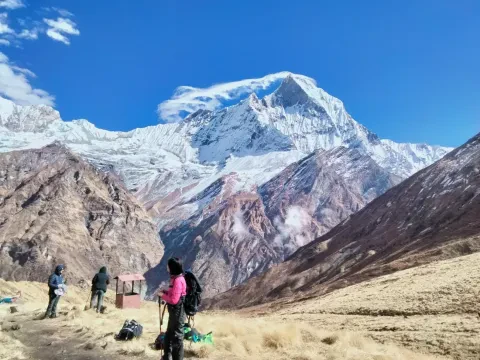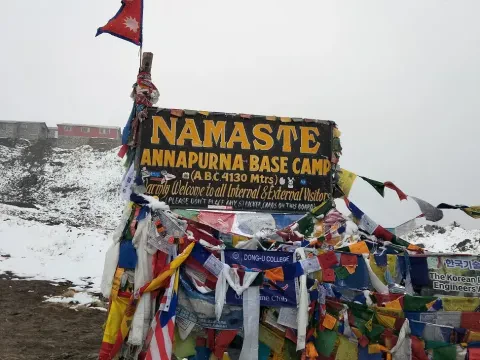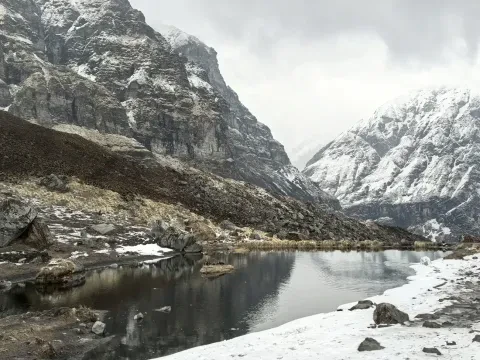
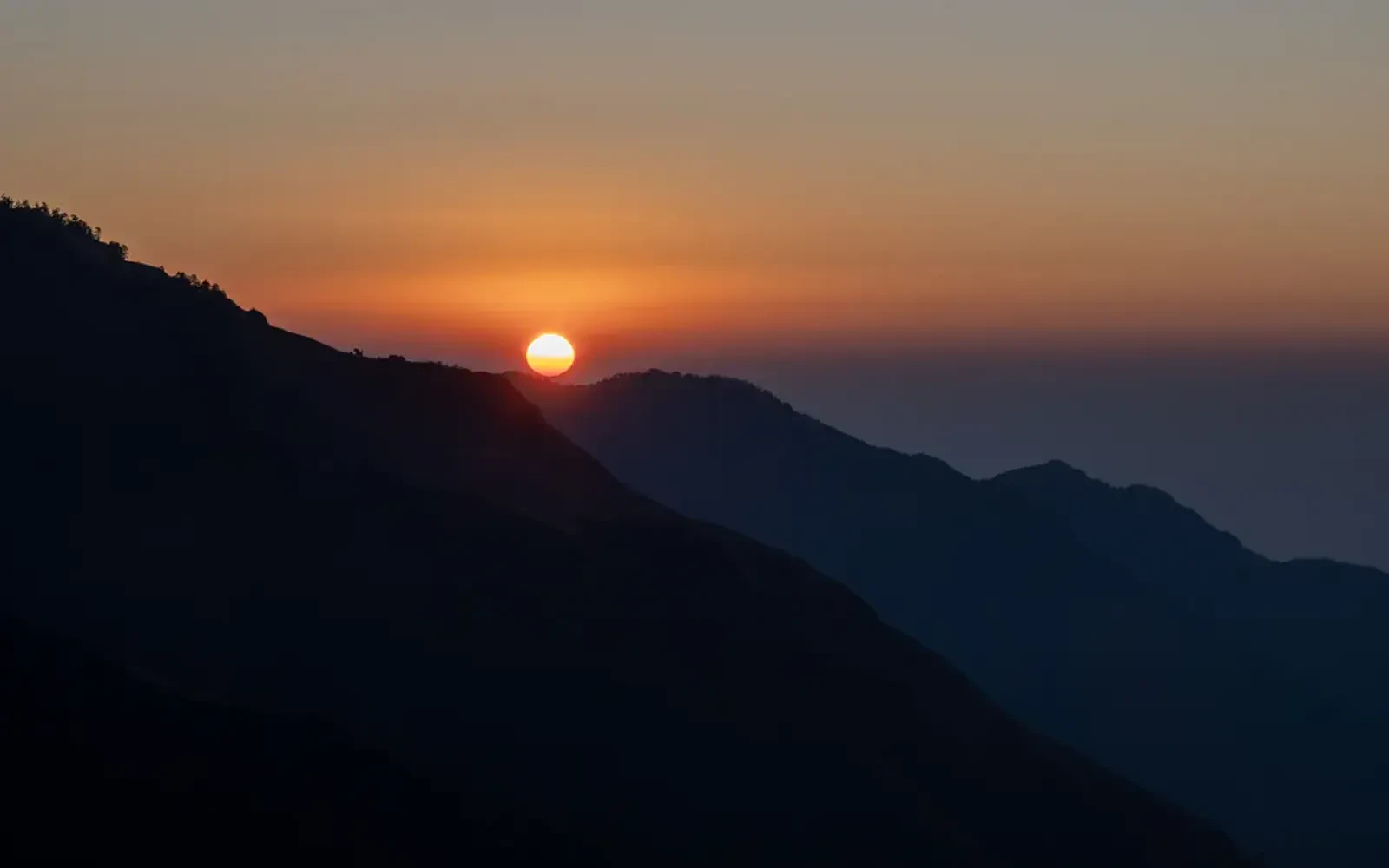
The Annapurna Base Camp Trek route via Poon Hill is one of the most popular and unique hiking trails in Nepal. The main reason to choose the Poon Hill route is the view of golden sunlight falling on the snow-capped Himalayas from the top of the Poon Hill (3210 meters). Annapurna I (8091 meters), Dhaulagiri I (8167 meters), Machhapuchhre/Fishtail (6993 meters), Hiunchuli (6441 meters), Annapurna South (7219 meters), and Nilgiri (7061 meters) are just a few of the awe-inspiring peaks. Besides, when hiking to the Annapurna Sanctuary via Poon Hill, you get up close to even more Himalayan giants and spend hours marveling at their beauty.
However, unlike the short hike from Jhinu Danda, the Annapurna Base Camp trek via Poon Hill is a more involved experience. Your first reward for effort will be a breathtaking view of the sunrise over the Annapurna range. The trail will take you through rhododendron forests, local villages, terraced fields, bamboo forests, alpine valleys, and glaciers. Hence, this trek is the perfect getaway for nature lovers and those who want to experience the culture of the Himalayas.
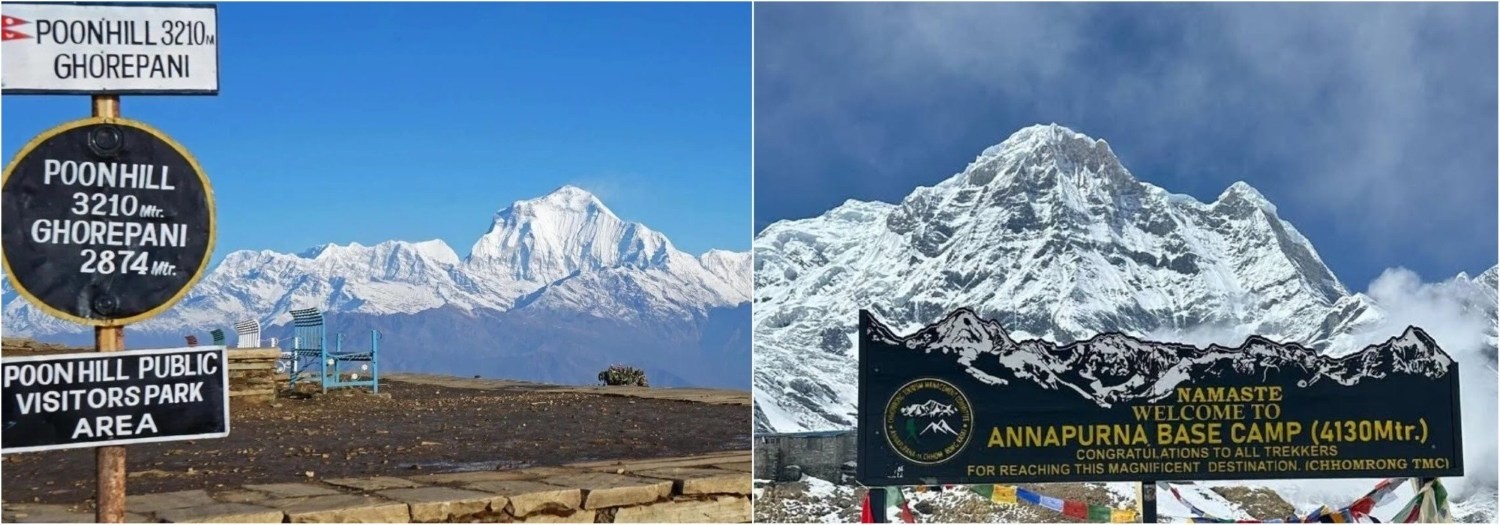
Moreover, Annapurna Base Camp trek usually starts from the city of Pokhara (822 meters). It may start from Birethanti (1025 meters) or Ulleri (2050 meters) after a short drive from Pokhara. Less common variations start from Nayapul (1070 meters) or Banthanti (2210 meters) due to the long distance. Then the trail leads to Ghorepani (2874 meters), Poon Hill (3210 meters), Tadapani (2630 meters), Chhomrong (2170 meters), Bamboo (2310 meters), Deurali (3230 meters), Machhapuchhre Base Camp (3700 meters), and Annapurna Base Camp (4130 meters). The Annapurna trek via Poon Hill is a great value option for many reasons.
First, it is a fantastic acclimatization opportunity because the trail rises gently. Second, you may find it easier to enjoy local hospitality and Nepali cuisine at comfortable teahouses along the route. Third, the route gives you stunning views of beautiful Himalayan peaks.
In addition to, the Annapurna Base Camp trek via Poon Hill is suitable for someone who wants to experience the most popular trekking route in Nepal. Whether you are an avid trekker looking to challenge yourself or a first-time visitor wanting to see the best views of the Himalayas, this trail is for you.
Moreover, this itinerary is suitable for people with average fitness levels. Hence, it is perfect for families with kids and grandparents. Furthermore, photography enthusiasts will enjoy the incredible views of the high mountains and unique local culture. Overall, in the following guide, you will find the detailed day-to-day itinerary, elevation profile, and other essential details about the Annapurna Base Camp trek route via Poon Hill.
The Annapurna Base Camp trek route via Poon Hill is one of the most popular and unique ways to experience the Annapurna Himalaya. Compared to the classic Annapurna Base Camp trek, this variation involves an additional climb up to the top of Poon Hill (3210 meters) to enjoy the most scenic sunrise over the Annapurna range. This Himalayan trek also passes through traditional villages, forests, and various landscapes on the way to Annapurna Base Camp (4130 meters). Furthermore, the gradual ascent allows you to acclimatize well during the climb.
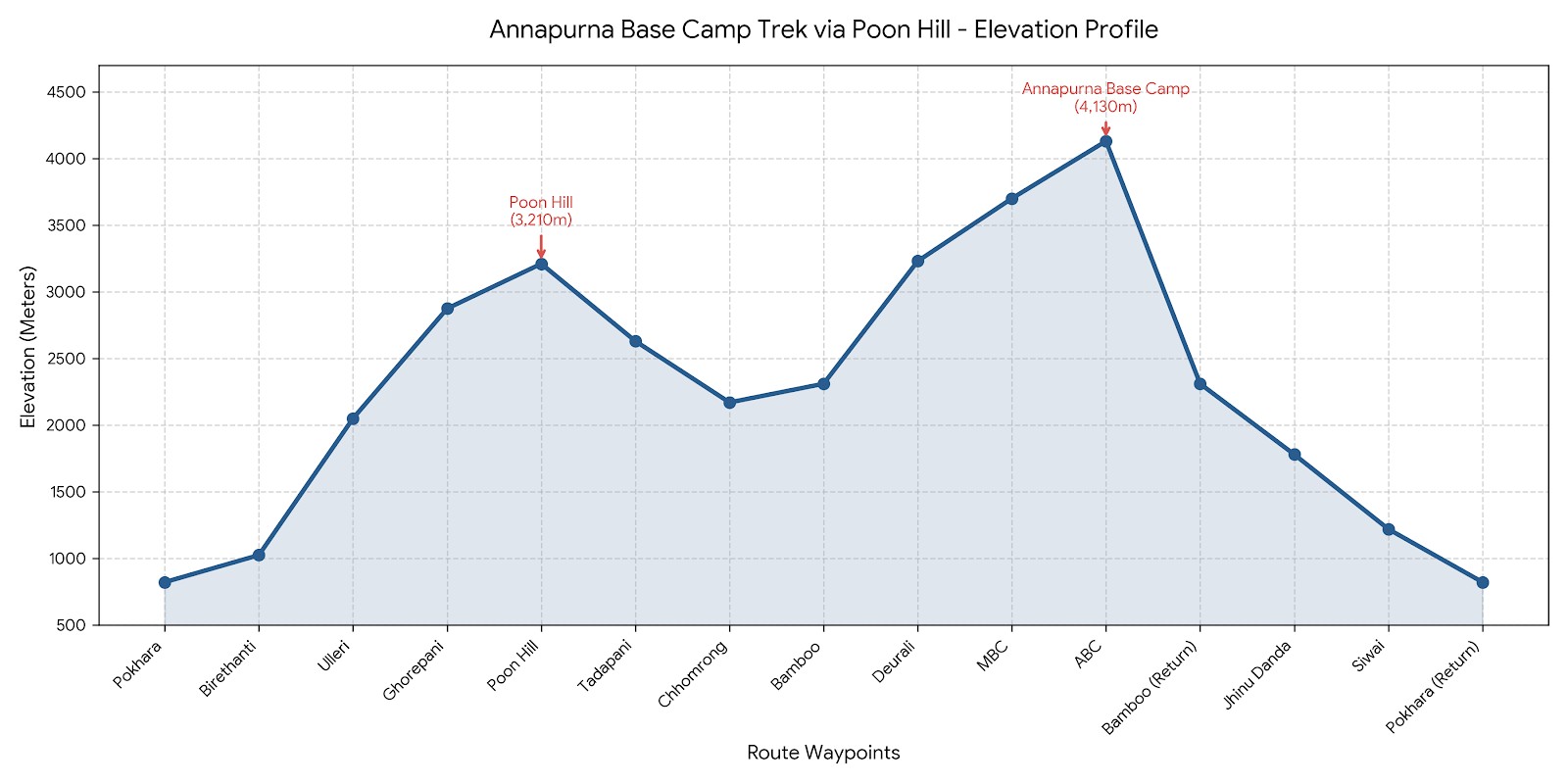
Below is an overview of the trek route, elevations, and other details:
| Day / Destination | Elevation |
|---|---|
| Pokhara – Starting Point | 822 m |
| Birethanti – Trek Beginning | 1,025 m |
| Ulleri – Overnight Stay | 2,050 m |
| Ghorepani – Overnight Stay | 2,874 m |
| Poon Hill – Sunrise Viewpoint | 3,210 m |
| Tadapani – Overnight Stay | 2,630 m |
| Chhomrong – Overnight Stay | 2,170 m |
| Bamboo – Overnight Stay | 2,310 m |
| Deurali – Overnight Stay | 3,230 m |
| Machhapuchhre Base Camp (MBC) | Rest Stop 3,700 m |
| Annapurna Base Camp (ABC) | Summit 4,130 m |
| Bamboo – Return Overnight Stay | 2,310 m |
| Jhinu Danda – Hot Springs | 1,780 m |
| Siwai – End of Trek | 1,220 m |
| Pokhara – Return Destination | 822 m |
Elevation :
Why Choose the Annapurna Base Camp Trek Via Poon Hill?
Fourth, you will see various natural landscapes, ranging from farmlands to glaciers. Additionally, this trek involves crossing bamboo forests, waterfalls, alpine valleys, and rhododendron forests.
| Mountain Peak | Height |
|---|---|
| Annapurna I | 8 ,091 m |
| Dhaulagiri I | 8,167 m |
| Machhapuchhre (Fishtail) | 6,993 m |
| Annapurna South | 7,219 m |
| Hiunchuli | 6,441 m |
| Gangapurna | 7,455 m |
| Nilgiri | 7,061 m |
In general, the Annapurna Base Camp trek via Poon Hill is the most rewarding variation of the ABC trek. It offers you the most spectacular views of the Annapurna Himalayas and unique cultural experiences. As a result, you will have an extraordinary high-altitude adventure with local hospitality.
Consequently, the Annapurna Base Camp trek via Poon Hill is an ultimate Himalayan experience for any traveler who wants to explore the beauty of the Annapurna region in Nepal.
Choosing the best time to go trekking Annapurna base camp is an essential step and makes the most difference in your adventure. This trek is a year-round activity. It is best to visit in the months of March to May and September to November. This trek has a fantastic scenery, amazing views of the Himalayas, and diverse landscapes. During the winters, we do have clear trails and monsoon adds beauty to the mountains. As the Annapurna base camp route covers the famous Poon Hill (3,210 m) and Annapurna base camp (4,130 m) sunrise view, good and clear visibility is a must to witness the snow-capped peaks of the Himalayas.
Poon Hill is one of the best viewpoints of the Annapurna region and the Poon Hill sunrise view is one of the most awaited experiences of this trek.
The Poon Hill sunrise view offers a clear view of the surrounding mountains like:
This season is famous for rhododendron blooms, pleasant weather, and clear mountain views throughout the trek. The Annapurna region comes alive with blooming rhododendrons and flowers. Warm days and cool nights allow you to explore all trekking routes in Nepal.
The sunrise view from Poon Hill (3,210 m) includes a clear view of the surrounding mountains and is a once-in-a-lifetime experience. The temperatures on the ABC trek are comparatively higher during day and night.
| Place | Day | Night |
|---|---|
| Pokhara (822 m) | 20-28 | C 10-16 C |
| Ghorepani (2874 m) | 10-18 | C 2-8 C |
| Annapurna base camp(4130 m) | 5-12 C | -5 C to 0 C |
Advantages of Trekking in Spring :
It is the peak season to trek in Nepal. The post-monsoon season is the best time of the year for trekking as we have clear visibility of the mountains and great mountain views. The monsoon adds beauty to the trekking trails and waterfalls. The Annapurna base camp trek is famous for Poon Hill (3,210 m) sunrise view which is a must experience for all trekkers. The morning fog clears to reveal the mountain ranges of Annapurna and Dhaulagiri from Poon Hill.
| Place | Day | Night |
|---|---|
| Pokhara | 18-26 C | 10-15 C |
| Ghorepani | 8-16 C | 0-6 C |
| Annapurna base camp | 3-10 C -8 C to -2 C |
Advantages of Trekking in Autumn :
Booking accommodation in advance is highly recommended for this season.
Monsoon (June to August):
The monsoon season is highly recommended for those who want to witness lush green forests, waterfalls, and rice fields. But the trail can be slippery in some parts, and the leech infestation is severe in lower parts. Afternoon showers are common throughout the Annapurna region, especially below 2,500 meters.
Advantages of Trekking in Monsoon
Winter (December to February):
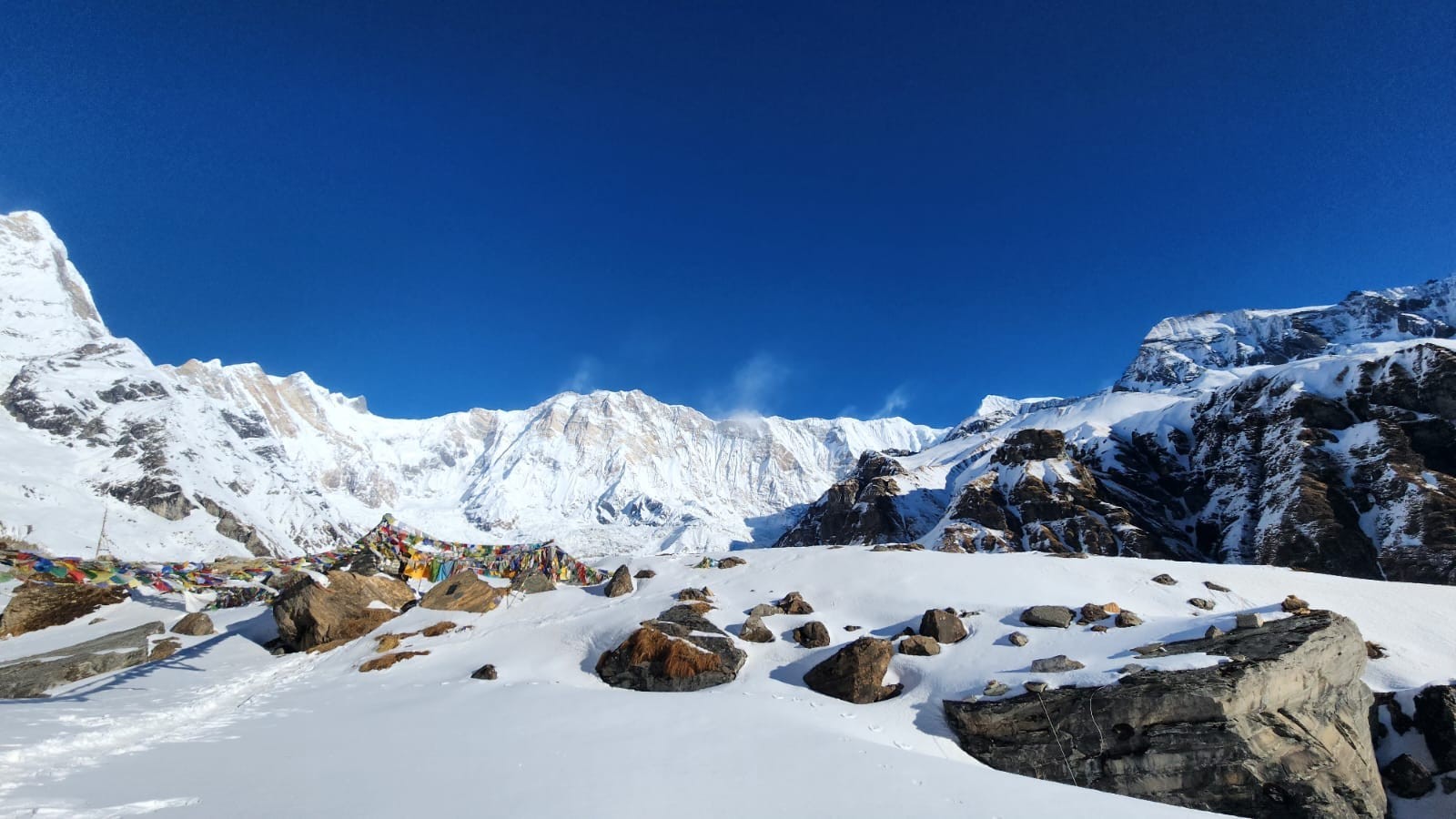
Winter offers clear visibility of the mountains and great views of the snow-capped peaks. The trails are less crowded and teahouses are calmer. The temperatures are quite cold and it becomes freezing at the Annapurna base camp (4,130 m). The Annapurna base camp trek offers a unique experience of trekking in snowy trails during winter. Early mornings are freezing, but the temperatures rise during the day.
Advantages of Trekking in Winter :
| Season | Weather | Visibility | Temperature | Crowds | Recommendation |
|---|---|---|
| Spring | Warm and stable | Excellent | Mild | Moderate | ★★★★★ |
| Autumn | Dry and clear | Outstanding | Comfortable | High | ★★★★★ |
| Monsoon | Wet | Limited | Warm | Low | ★★☆☆☆ |
| Winter | Cold and dry | Excellent | Cold | Low | ★★★★☆ |
Best Months To Witness Clear View of Mountains From Poon Hill,
The most common months to witness excellent sunrise views from Poon Hill are:
Expert Tips by Haven Holidays Nepal For Choosing the Right Time for Annapurna Trek.
For most trekkers, the period March to May and September to November offer comfortable weather, extraordinary mountain views, and great landscapes for this Himalayan adventure. For a quieter and less demanding version of this trek, early December and late February are also good.
In conclusion, the Annapurna base camp trek via Poon Hill is a fantastic Himalayan trekking adventure for first-time trekkers.
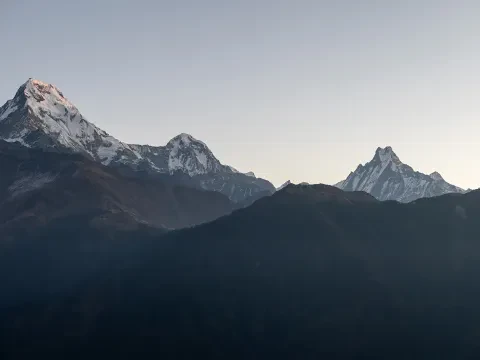
The Annapurna base camp trek difficulty is a moderate Himalaya trek. Trekking to Annapurna base camp via Poon Hill does not require advanced mountaineering skills. However, it does need a good level of fitness, endurance and determination. The trail includes steep inclines, rocky staircases, uneven mountain trails, and long hours of walking per day. The trek also reaches high altitudes, including Annapurna base camp (4,130 m) and Mardi Himal (4,089 m).
Despite the challenges, anyone can easily complete this trekking circuit with the right preparation.
| Difficulty | Factor Level |
|---|---|
| Technical Difficulty | Easy |
| Physical Difficulty | Moderate |
| Altitude Difficulty | Moderate |
| Trekking Experience | Not essential |
| Fitness level | Moderate to good |
Most days involve 5-6 hours of walking or more. It is better to take breaks to reduce the effects of high altitude on the body.
| Days | Walking Hour |
|---|---|
| Easy Days | 4-5 Hours |
| Average Days | 5-6 Hours |
| Longest Days | 6-8 Hours |
Difficult Sections During Annapurna Trek :
Other difficult but exciting parts of the trek include:
Altitude on Annapurna Trek.
The highest altitude reached during the Annapurna base camp trek is the Annapurna base camp (4,130 m). The air pressure at this altitude is lower, making it difficult to adjust. Most people experience altitude sickness at night when the air pressure is at its lowest.
Altitude sickness symptoms include:
Serious cases of altitude sickness are rare as long as you listen to your guide and follow the acclimatization process.
Suitability for Different Types of Travelers
Anyone can trek to Annapurna base camp as long as they have sufficient fitness levels. Annapurna base camp trekking is ideal for first-time trekkers, families with children, couples, solo travelers, hikers, photographers, and nature lovers.
Recommended Fitness Level for Annapurna Trek
You do not need to be an athletic adventurer to trek to Annapurna base camp. However, you should have enough energy to:
Building enough stamina before the trek is critical.
How To Prepare for Annapurna Trek,
A simple 6 to 8-week training plan should be enough.
Make sure to focus on the following:
A weekend hiking session with a backpack is a good way to prepare.
Practical Fitness Test for Annapurna Trek,
Ask yourself the following questions before trekking:
If you answer most of these questions with a ‘Yes’, you are ready for the Annapurna trek.
Tips to Make the Annapurna Trek Easier,
Some vital tips for Annapurna trekking are:
| Challenges | Solutions |
|---|---|
| Long hikes | Walk at a steady pace |
| Staircase | Use trekking poles |
| High altitude | Climb slowly |
| Muscle cramps | Take short breaks |
| Cold weather | Wear warm clothes |
Expert Trekking Advice From Haven Holidays Nepal on Difficulty of Annapurna Trek.
The Annapurna base camp trek difficulty is suitable for most people with average fitness levels. You do not need much trekking experience, but you should build enough stamina for continuous day hiking. You can easily tackle the Annapurna trek with a little preparation.
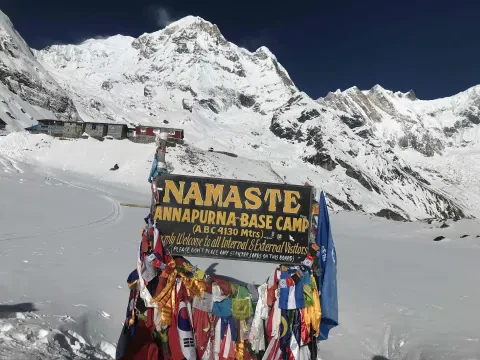
Before starting the Annapurna Base Camp Trek via Poon Hill, every trekker must have the needed permits. The permits assure that Annapurna Conservation Area, trails, and the fragile Himalayan ecosystem are protected and preserved. Additionally, the permits guarantee the security of the trekkers and climbers. Fortunately, obtaining the necessary documents is relatively easy, especially when trekking with a reliable local company.
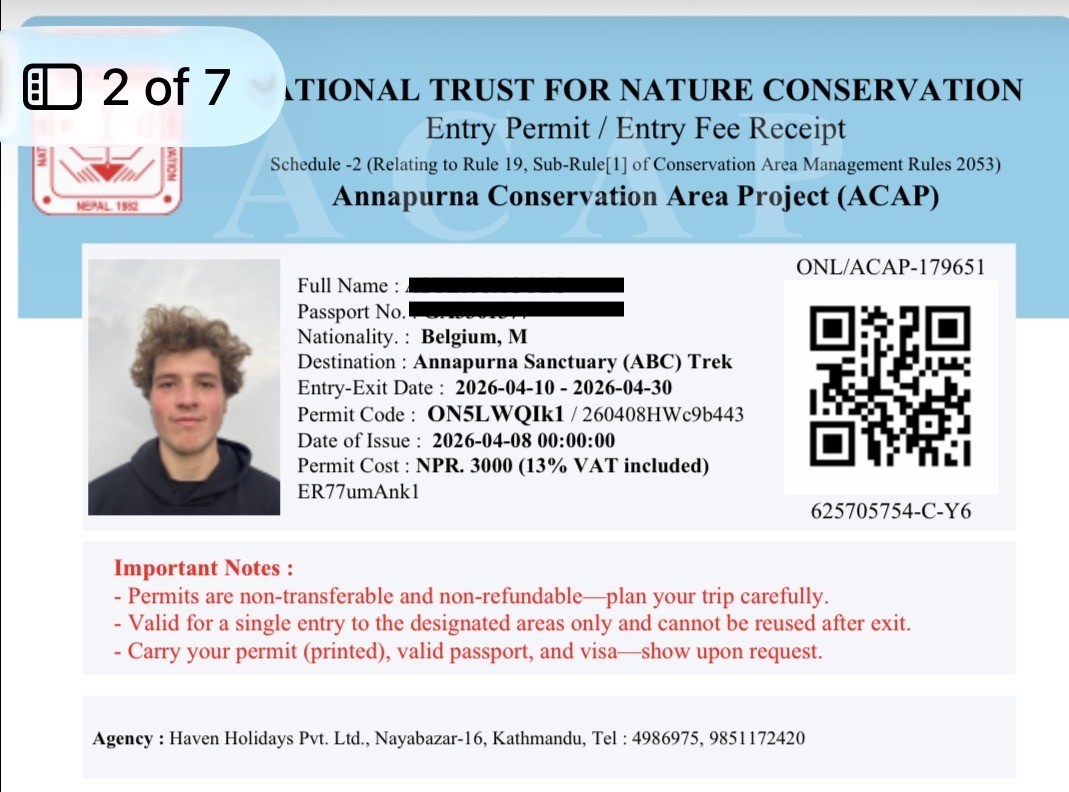
Meanwhile, the Annapurna Conservation Area Permit and the TIMS Card are the permits that every trekker should know about. However, the requirement of TIMS Card may change from time to time depending on the government policies, so it is essential to learn the most recent information before applying.
Required Permits
There are two primary forms of permits needed to trek in the Annapurna Conservation Area. The following section lists those permits and their details.
1. Annapurna Conservation Area Permit (ACAP),
Annapurna Conservation Area Permit (ACAP) is required for all trekkers and climbers who want to enter the Annapurna Conservation Area.
The permit fees directly contribute to wildlife conservation, trail maintenance, waste management, community development, and other crucial services. Every trekker needs to present the ACAP during the entire trek.
2. TIMS Card,
TIMS Card was introduced to ensure the safety of trekkers and climbers in Nepal. The card helps the authorities keep track of all trekkers and their itineraries. The requirement for TIMS Card depends on the current government policies.
In some cases, organized trekkers do not need an additional TIMS Card. Moreover, permit requirements are subject to change, and it is always advisable to double-check with the local authorities or trekking agencies.
Approximate Cost of Permits (2026) :
| Permit Category | Foreign Nationals | SAARC Nationals |
|---|---|---|
| Annapurna Conservation Area Permit (ACAP) | NPR 3,000 | NPR 1,000 |
| TIMS Card | Subject to current regulations | Subject to current regulations |
The TIMS requirements can change frequently, so it is recommended to confirm the most recent information before planning the trek.
Where to Apply for Permits,
There are two significant cities in Nepal where permits can be acquired. The following section lists those places and other crucial documents that should be presented when applying for permits.
Kathmandu :
Pokhara :
Most trekkers usually arrive in Pokhara and complete all permit requirements because the trek generally begins in Pokhara.
Documents Required :
Visa :
Permit Checkpoints,
The permits should be presented at permit checkpoints located along the trail, including Birethanti, Ghorepani, Chhromong, Bamboo, and Annapurna Base Camp route check posts.
Why Permits Are Important,
The permit system ultimately benefits the trail, community, and trekking experience. The funds acquired from the permits help maintain the trails and assist various organizations in providing crucial services, including search and rescue operations.
Changes in Trekking Rules,
It is always advisable to contact local authorities and trekking agencies to ensure that the most updated information regarding trekking rules and permit categories is followed. There have been recent changes in trekking rules, particularly in relation to licensed guides in Nepal.
Quick Reference Table For Required Permits :
Expert Tips by Haven Holidays Nepal,
With Haven Holidays Nepal, permits are taken care of well before the trek begins. The expert team of Haven Holidays Nepal handles every detail of the trek to ensure that the travelers have a pleasant experience. It will allow them to fully enjoy the spectacular views of the Himalayas without having to worry about the permits. It is always advisable to rely on licensed local operators to ensure that the trek will run smoothly and without any unexpected challenges. The team at Haven Holidays Nepal knows the latest permit information and is confident that the client will have the most remarkable experience on the Annapurna Base Camp Trek via Poon Hill.

Since the Annapurna Base Camp Trek Via Poon Hill trek begins in Pokhara (elevation: 822 m), this section will focus on the best ways to get to Pokhara from Kathmandu.
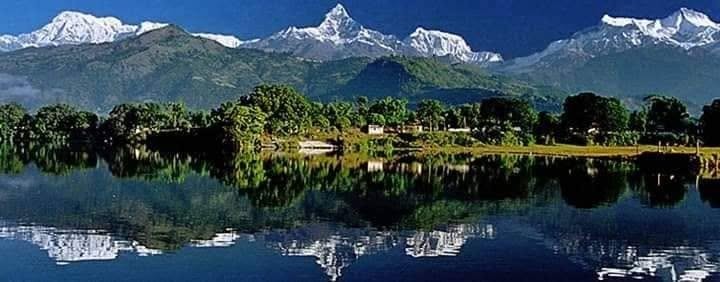
Pokhara is the largest lakeside city in Nepal and an excellent place to begin the Annapurna trek. Reaching Pokhara from Kathmandu is relatively easy, and most people choose to travel by tourist bus. Others prefer a deluxe tourist bus, private car, or even a domestic flight. Most trekkers like to spend an overnight stay in Pokhara, where they can unwind before beginning their adventure into the mountains.
From Pokhara, the trail extends towards the village of Birethanti (elevation: 1,025 m) or Nayapul (elevation: 1,070 m). Alternatively, some travelers choose to stop at the village of Ulleri (elevation: 2,050 m) at the beginning of their journey.
Option 1: Tourist Bus,
Most travelers prefer the tourist bus as the best option for reaching Pokhara from Kathmandu.
| Route | Kathmandu – Pokhara |
|---|---|
| Distance | Approximately 200 km |
| Time | 7-9 hours (usually departing at around 7:00 am) |
| Cost | USD 12 – USD 20 |
Most tour buses have comfortable seating, air-conditioning, and offer a short lunch break. The prices vary depending on the comfort level of the bus.
This option is best for budget-conscious travelers.
Option 2: Deluxe or VIP Tourist Bus,
Features:
Most families and senior citizens find this option better and more comfortable.
Option 3: Domestic Flight
Many travelers find this to be the best option as it is fast and efficient.
| Route | Kathmandu – Pokhara |
|---|---|
| Flight Time | 25 – 30 min |
| Departure Airport | Tribhuvan International Airport |
| Arrival Airport | Pokhara International Airport |
| Estimated Cost | USD 110 – USD 160 |
Domestic flights are best for time-constrained travelers as they significantly shorten the travel time between the two cities.
Another advantage of domestic flights is that they provide spectacular views of the Himalayas on clear days. However, flights may sometimes be delayed due to weather conditions, especially during monsoon season.
Option 4: Private Car or Jeep,
| Vehicle | Approximate Cost |
|---|---|
| Private Car | USD 120 – USD 170 |
| Private Jeep | USD 180 – USD 250 |
Unlike other transport options listed above, a private car or jeep offers extra flexibility. It can also be hired for a longer period.
Another excellent reason to consider this option is that it generally allows for a hotel pickup, ensuring that the traveler has a stress-free and comfortable journey to Pokhara.
Overnight Stay In Pokhara,
Many trekkers like to spend the night in Pokhara before beginning their adventure in the mountains.
The following are reasons why an overnight stay in Pokhara is a great idea:
From Pokhara to the Trek Starting Point,
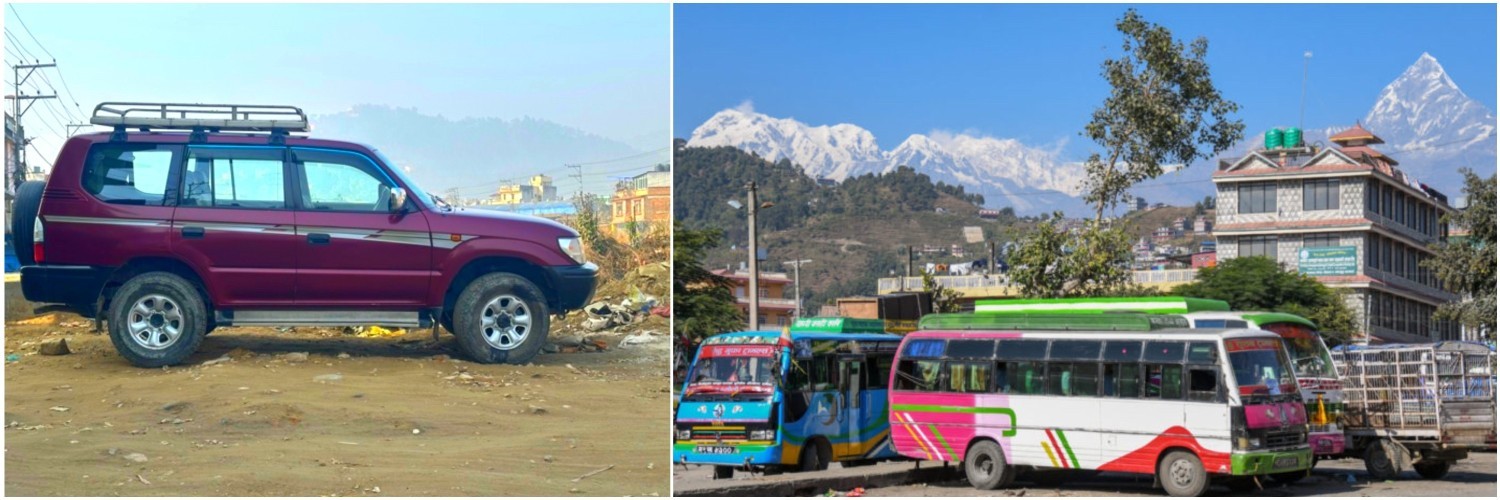
Once in Pokhara, the next step is to drive towards Birethanti, Nayapul, or Ulleri, the trailheads for most of the Annapurna treks.
| Trailhead | Elevation | Driving Time |
|---|---|---|
| Birethanti | 1,025 m | 1.5 – 2 hours |
| Nayapul | 1,070 m | 1.5 – 2 hours |
| Ulleri | 2,050 m | 3 – 4 hours by jeep |
Most hikers have recently opted to fly or drive directly to Ulleri, which shortens the trekking day on the first day of the hike.
Differences Between Transportation Options,
| Option | Time | Cost | Best For |
|---|---|
| Tourist Bus | 7-9 hrs | USD 12-20 | Budget travelers |
| Deluxe Bus | 7-8 hrs | USD 20-35 | Families and comfort |
| Domestic Flight | 25-30 mins | USD 110-160 | Time-constrained |
| Private Car/J Jeep | 6-8 hrs | USD 120-250 | Groups and flexibility |
Expert Tips by Haven Holidays Nepal,
Most travelers find that it is best to spend at least one night in Pokhara before beginning the trek the very next day. Budget-conscious hikers usually opt for the tourist bus or deluxe bus, whereas time-constrained travelers prefer to fly via domestic flights. Families and private groups will find that a private car/jeep is the best option for flexibility and comfort. In all cases, it is essential to begin the Annapurna Base Camp Trek Via Poon Hill trek from Pokhara rested and relaxed.
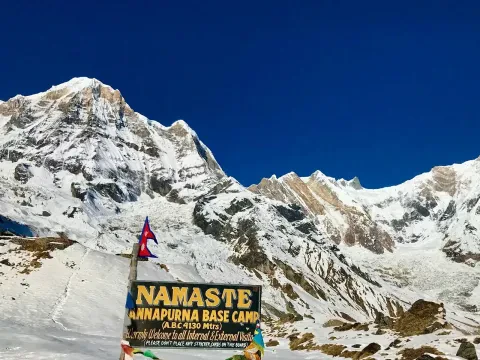
Annapurna base camp from Pokhara itinerary is one of the popular trekking itineraries in Nepal. The trail promises to offer an unforgettable mountainous experience with a spectacular Poon Hill sunrise followed by Annapurna peak sightseeing and crossing through valleys, rhododendron forests, Gurung and Magar villages to Annapurna base camp. The trail also provides an opportunity to enjoy the snow-capped mountain ranges of Annapurna I (8091m), Machhapuchhre (6993m), Dhaulagiri I (8167m), Hiunchuli (6441m), and Annapurna South (7219m).
A 9-day Annapurna base camp trek from Pokhara through Poon Hill is the ideal trekking package for moderate-altitude gain, teahouse stays, and exceptional acclimatization.
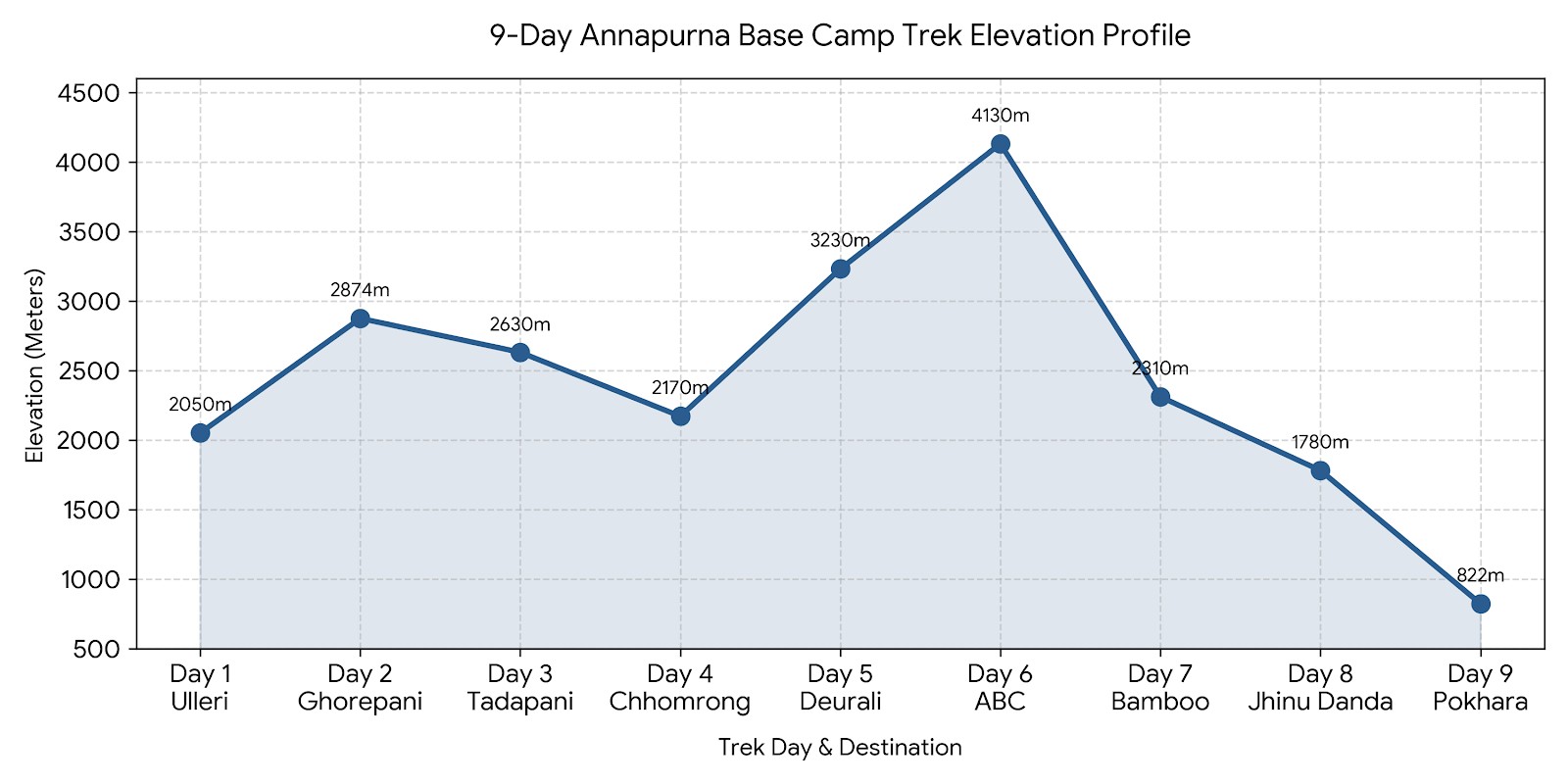
| Day Details | Elevation | Time | Overnight |
|---|---|---|
| 1 Pokhara to Bhirethanti to Ulleri | 2,050 m | 4-5 hrs | Ullery |
| 2 Ulleri to Ghorepani | 2,874 m | 5-6 hrs | Ghorepani |
| 3 Poon Hill sunrise to Tadapani | 2,630 m | 6-7 hrs | Tadapani |
| 4 Tadapani to Chhomrong | 2,170 m | 5-6 hrs | Chhomrong |
| 5 Chhomrong to Bamboo to Deurali | 3,230 m | 6-7 hrs | Deurali |
| 6 Deurali to Machhapuchhre base camp to Annapurna Base Camp | 4,130 m | 5-6 hrs | Annapurna base camp |
| 7 Annapurna base camp to Bamboo | 2,310 m | 6-7 hrs | Bamboo |
| 8 Bamboo to Jhinu danda | 1,780 m | 5-6 hrs | Jhinu danda |
| 9 Jhinu danda to Siwai to Pokhara | 822 m | 02-03 hrs walk, 5 hrs drive | Pokhara |
Day 1: Pokhara (822 m) to Birethanti to Ulleri (2,050 m)
After having breakfast, you will start your trek to Annapurna base camp from Pokhara. You will first be driven towards Birethanti before starting the hill climb. Register to get your trekking permits ready and then continue your journey. You will pass through beautiful villages and terraced fields, cross bridges over the Bhurungdi Khola, and finally reach the steep stairs to Ulleri. Enjoy the marvelous view above the village as you complete the day’s walking trail.
Must-see: Traditional villages, rice fields, suspension bridges, and mountain views
Day 2: Ulleri to Ghorepani (2,874 m)
Your trail will take you through beautiful rhododendron and oak forests. During spring, these forests are exceptionally scenic and bursting with biodiversity. Marvel at the beauty of the forest while crossing one waterfall after another.
Must-see: Rhododendron, waterfalls, mountain views, and comfortable teahouses.
Day 3: Ghorepani to Poon Hill (3,210 m) to Tadapani (2,630 m)
Here, you will wake up early in the morning and explore the famous Poon Hill view point. It takes about an hour to reach Poon Hill from Ghorepani. Capture the magnificent sunrise view over the mountain ranges of Annapurna, including the 8,091m Annapurna I, 8,167m Dhaulagiri I, 6,993m Machhapuchhre, 7,061m Nilgiri, and other peaks. After taking pictures and enjoying the view, you will descend back to Ghorepani for breakfast. You will then head to Tadapani through forests.
Must-see: Poon Hill sunrise, mountain panorama, and rhododendron forests.
Day 4: Tadapani to Chhomrong (2,170 m)
Here, you will explore beautiful forests as you descend down to the Modi Khola. You will then cross various rivers before climbing to Chhomrong village. You will also enjoy the marvelous views of Machhapuchhre and Annapurna South throughout the trail.
Must-see: Beautiful traditional Gurung villages, stairways, terraced farmland, and tea plantations.
Day 5: Chhomrong to Bamboo (2,310 m) to Deurali (3,230 m)
Meanwhile, you will start the day crossing Chhomrong Khola before climbing up through Bamboo forests to Himalaya and Deurali. The trail becomes progressively alpine and exceptionally scenic.
Must-see: Bamboo forests, river gorge, waterfalls, and Annapurna Sanctuary.
Day 6: Deurali to Machhapuchhre base camp to Annapurna base camp (4,130 m)
On day six of the Annapurna base camp trek, you will gradually climb up through alpine meadows before reaching M.B.C. You will then follow a trail through the amazing Annapurna Sanctuary toward the Annapurna base camp.
Must-see: Annapurna Sanctuary, glaciers, Annapurna I, and a 360-degree mountain view.
Day 7: Annapurna base camp to Bamboo (2,310 m)
Wake up early to enjoy the fantastic sunrise view from Annapurna sanctuary before heading to M.B.C. through Deurali, Himalaya, Dobhan, and arriving in Bamboo.
Must-see: Sunrise view from ABC, glaciers, and descending through forests.
Day 8: Bamboo to Jhinu danda (1,780 m)
You will retrace your steps through Chhomrong as you head down toward Jhinu danda. Jhinu village is situated along the Modi Khola and has a hot spring that you can enjoy.
Must-see: Hot springs, traditional Gurung villages, and river valley views.
Day 9: Jhinu danda to Siwai to Pokhara (822 m)
You will have a short walk to Siwai before driving back to Pokhara, marking the end of your amazing trekking trail.
Below is a summary of the entire trek:
Annapurna Base Camp Trek from Kathmandu offers an incredible mountain experience with a fantastic view of the Himalayas. Unlike the standard Annapurna base camp trek from Pokhara which takes seven (7) days, the Annapurna base camp from Kathmandu is an eleven (11) day adventurous trail designed for international travelers.
Most of the Annapurna base camp from Kathmandu trekkers opt to fly from Kathmandu to Pokhara as it is the nearest airport to the trekking trail. Some opt for a bus ride or a private vehicle while a few prefer to take the long but scenic adventure drive. However, if you have limited time to start the trek directly from Pokhara, then you can consider flying back from Pokhara to Kathmandu to end your trail.
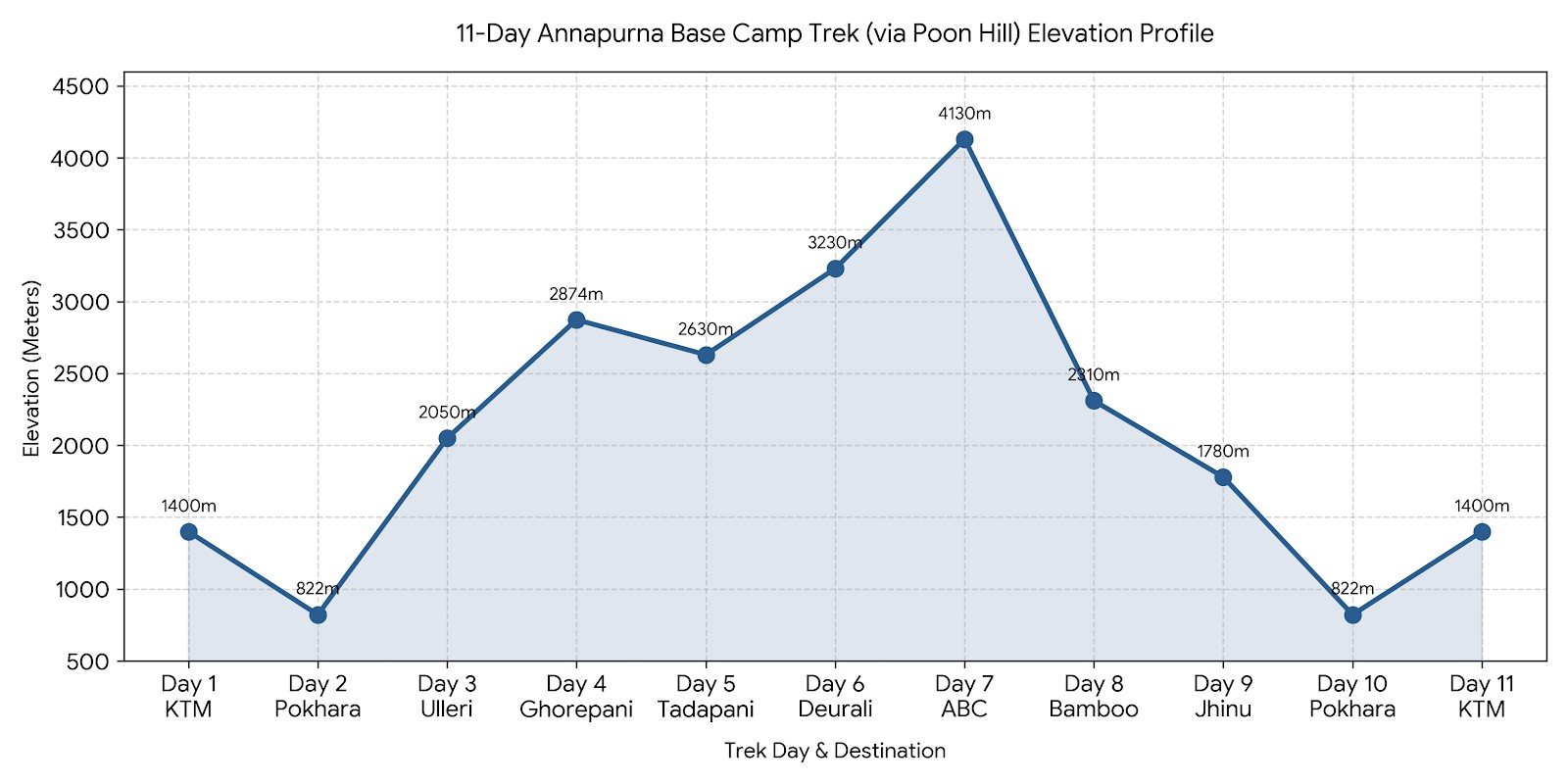
| Day Details | Altitude | Activity |
|---|---|---|
| 1: Arrival in Kathmandu | 1,400 m | Arrival |
| 2: Kathmandu to Pokhara | 822 m | Bus or Flight |
| 3: Pokhara to Birethanti to Ulleri | 2,050 m | Trek |
| 4: Ulleri to Ghorepani | 2,874 m | Trek |
| 5: Poon Hill sunrise to Tadapani | 3,210 m / 2,630 m | Trek |
| 6: Tadapani to Sinuwa | 2360 m | Trek |
| 7: Sinuwa to Deurali | 3,230 m | Trek |
| 8: Deurali to Annapurna base camp | 4,130 m | Trek |
| 9: Annapurna base camp to Bamboo | 2,310 m | Trek |
| 10: Bamboo to Jhinu to Pokhara | 1780 m / 822 m | Trek |
| 11: Jhino to Pokhara and Pokhara to Kathmandu | 1,400 m | Bus or Flight |
Detail Travel Days and Itinerary,
Day 1: Arrival in Kathmandu (1,400m),
After arriving in Kathmandu, you will be picked up upon arrival and be escorted to the hotel while your trekking gear is being checked for the Annapurna base camp trek. You can also explore the city on arrival.
Day 2: Kathmandu to Pokhara (822m),
| Mode of transport | Time | Cost |
|---|---|
| Tourist Bus | 7-9 hrs | USD 12-20 |
| Deluxe Bus | 7-8 hrs | USD 20-35 |
| Domestic Flight | 25-30 mins | USD 80-120 |
Stay overnight in Pokhara before you start the Annapurna base camp trek from Pokhara.
Trek Days (Days 3-11)
From Day 3 to Day 11, you will follow the same itinerary of the Annapurna Trek from Pokhara as listed below.
Pokhara to Annapurna Base Camp Trek Days Highlights:
You can return from Pokhara to Kathmandu by tourist bus, deluxe bus, domestic flight, or a private vehicle. Most trekkers usually prefer to spend an extra night in Kathmandu before departing for their onward destination or international flight.
Below is a comparison of choosing whether to begin your trek from Kathmandu or Pokhara.
Comparison Highlights :
Meanwhile, Annapurna base camp trek from Kathmandu offers the best of both worlds including exploring the capital city of Nepal while enjoying a world-class mountainous trekking trail. If you are already in Pokhara, consider the 9-day Annapurna trek from Pokhara while if you are arriving internationally, the 11-day Annapurna trek from Kathmandu through Pokhara is recommended.
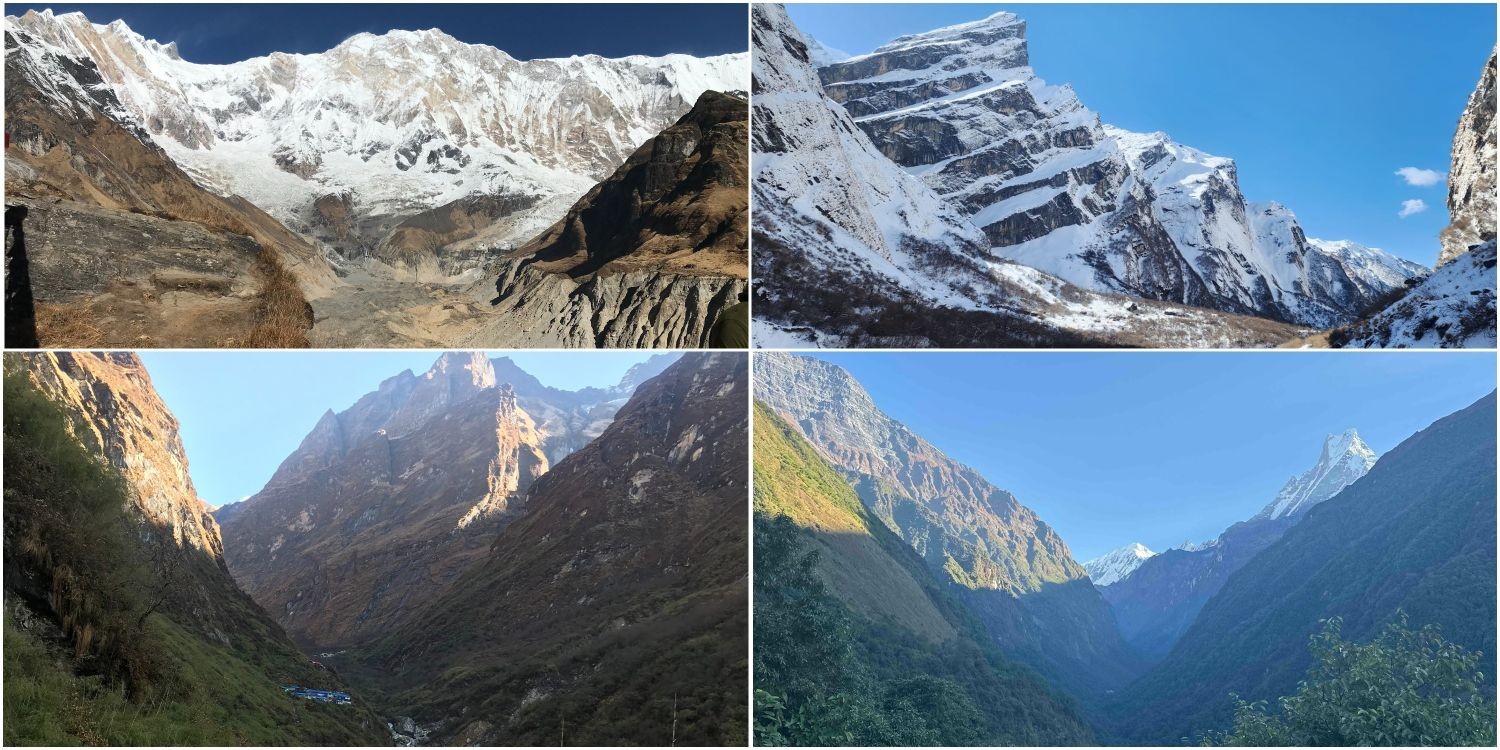
Annapurna Base Camp Trek via Poon Hill presents many opportunities to photograph outstanding views over the Annapurna range. This trek offers fantastic scenery, diverse flora and fauna, unique cultural heritage, and challenging mountainous landscapes. Here are the main experiences and highlights from day to day.
Actually, this 9-day trek takes you through a wide range of landscapes on your way to the Annapurna Sanctuary. Starting on the outskirts of Pokhara, you’ll pass by farmland, rivers, and traditional villages before reaching the first Himalayan peaks.
Here, the Annapurna Base Camp Trek Via Poon Hill has many exciting opportunities for travelers who seek to capture the best pictures of the mountains. You can witness awe-inspiring sunrise views from Poon Hill over the Annapurna range and also enjoy the sight of the magnificent glacier amphitheater at Annapurna Base Camp (4,130m).
Day 1: First Impression of Annapurna from Ulleri (2,050m)
It’s amazing to see how the landscape changes while on the trail. You start by walking along farmland, rivers, and beautiful villages. As you climb up the famous Ulleri stone steps, you can see some snow-capped peaks in the distance.
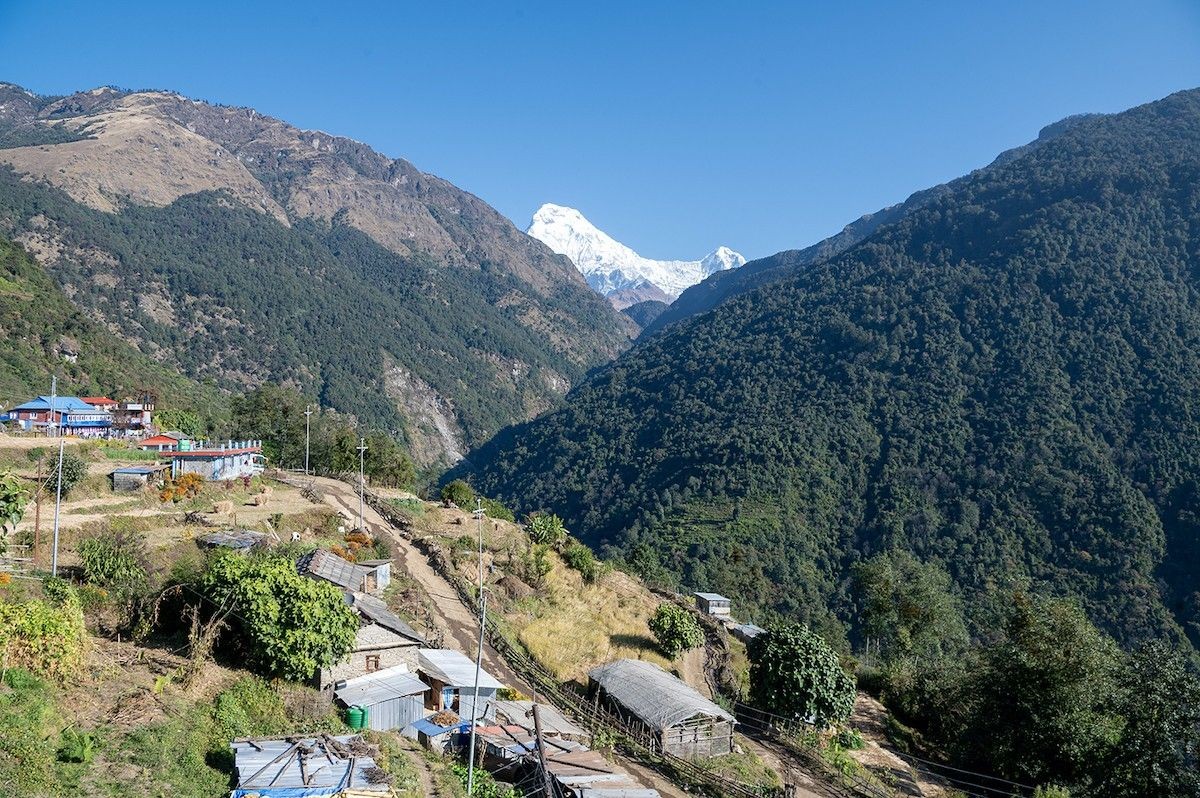
These first glimpses of the Annapurna range are spectacular and will surely inspire more exciting photos from your trip.
Photography Highlights :
Day 2: Explore Rhododendron Forests on the Way to Ghorepani (2,874m),
As you walk towards Ghorepani, you’ll be amazed by the view of the Himalayas. Especially during spring, the forest is full of blooming rhododendrons of different shapes and sizes.
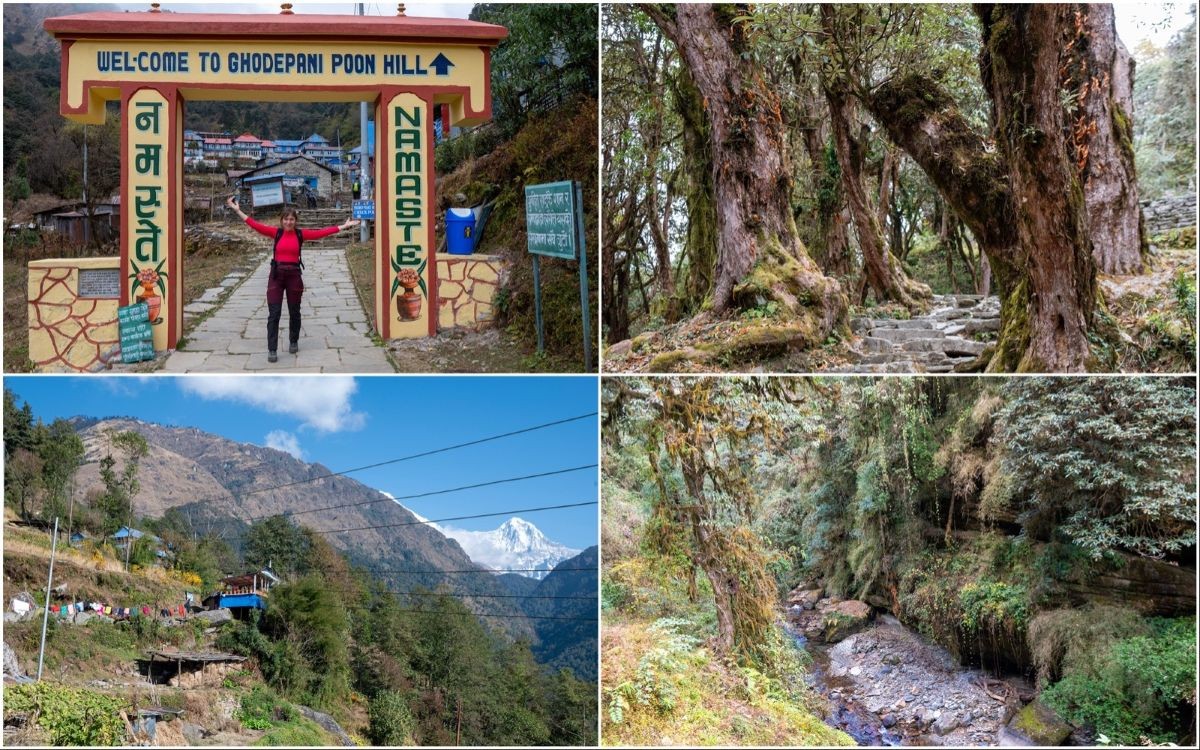
On the trail, you will have a fantastic opportunity to capture amazing pictures of the snow-capped peaks and take some spectacular shots of the local wildlife.
Photography Highlights :
Day 3: Poon Hill Sunrise Viewpoint (3,210m)
This day’s highlight is the famous sunrise view from Poon Hill. You will need to leave early from Ghorepani village (approximately 1 hour from Poon Hill) to witness this magical experience. As the first rays of the sun appear on the horizon, beautiful lights begin to shine from the tallest mountains in the world.
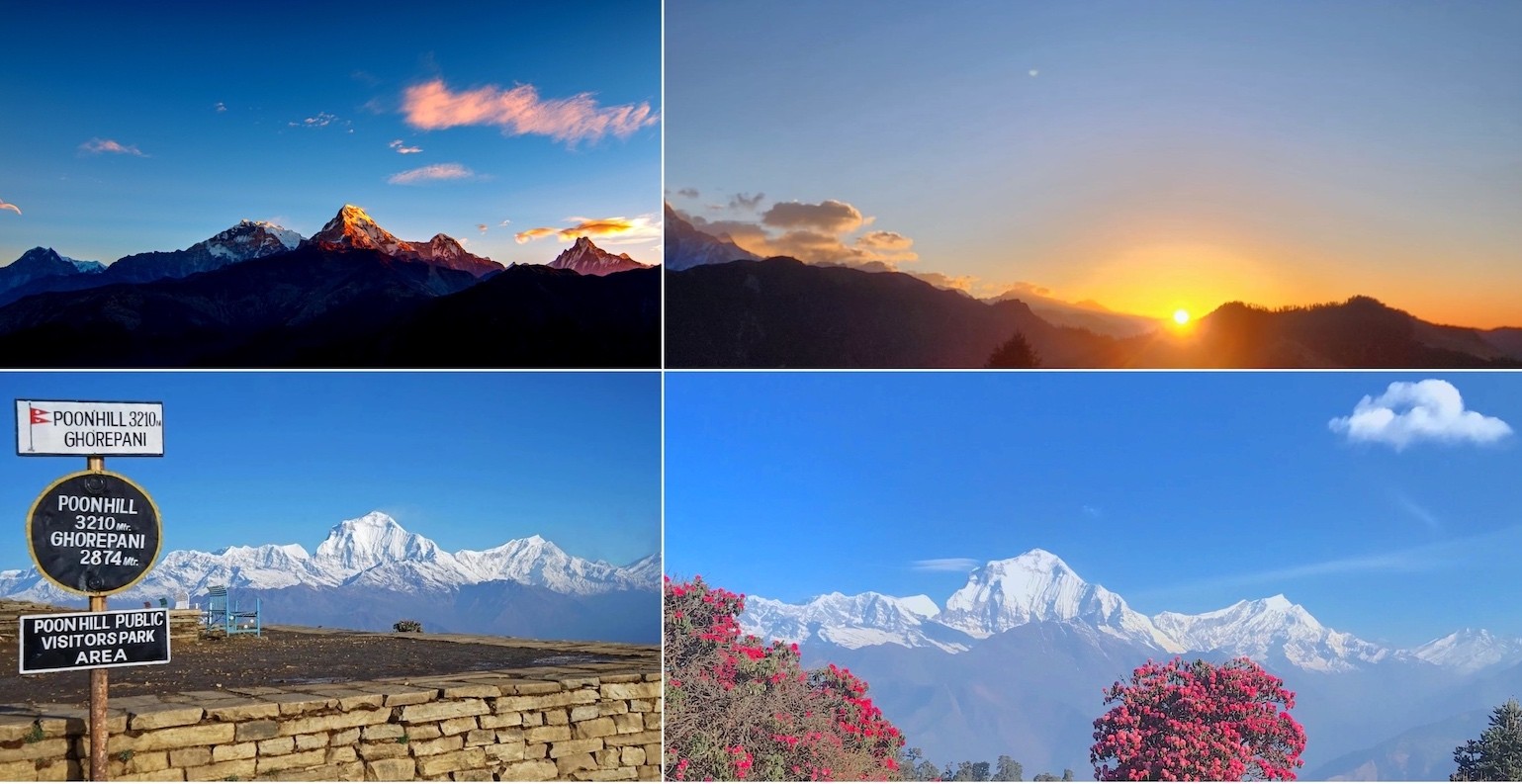
From Poon Hill viewpoint, you can see:
This fantastic view ranks among the best photography opportunities in Nepal, as it offers a unique insight into the beauty of the Annapurna region.
As the sun rises higher, you will continue your hike from Poon Hill to Tadapani and enjoy the beauty of the forest and Himalayan scenery.
Photography Highlights :
Day 4: Fantastic Views Over Annapurna South,
From Tadapani, you have constant wonderful views of the Himalayan range. The trail leads through dense forests and eventually opens up to spectacular views of Annapurna South.
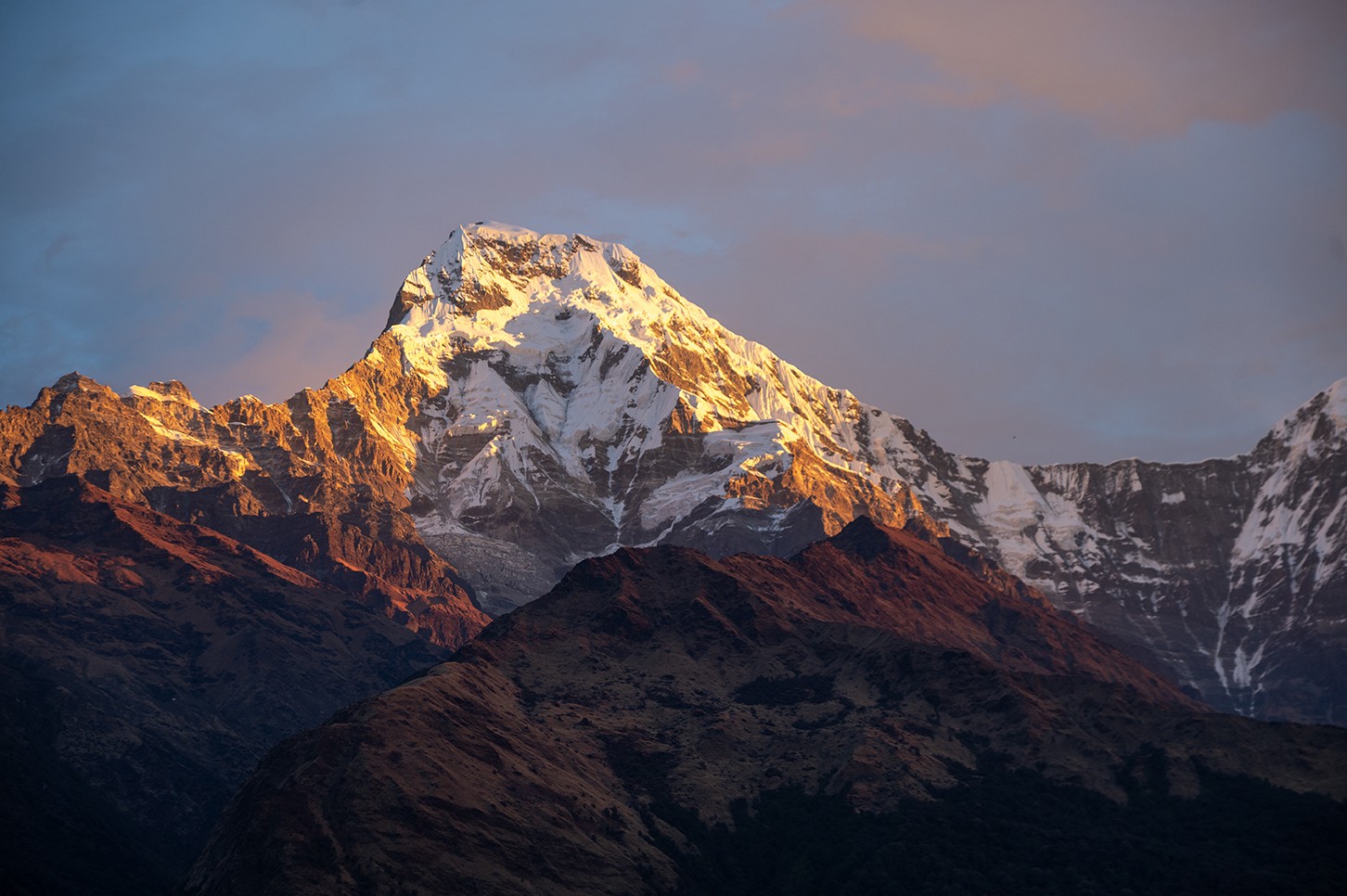
As you approach Chhomrong village, you can see Machhapuchhre peak coming closer on your right, while you enjoy the amazing view of the Modi Khola valley.
During your trek through the forest, you will also see traditional Gurung villages and several suspension bridges.
Photography Highlights :
Day 5: Entering the Annapurna Sanctuary,
From Chhomrong, you enter a fantastic Himalayan world of ancient forests, thundering waterfalls, and deep gorges carved by the Modi Khola River. As you walk further, you are rewarded with stunning views of the Annapurna sanctuary. The narrow valleys and towering rock formations are simply breathtaking.
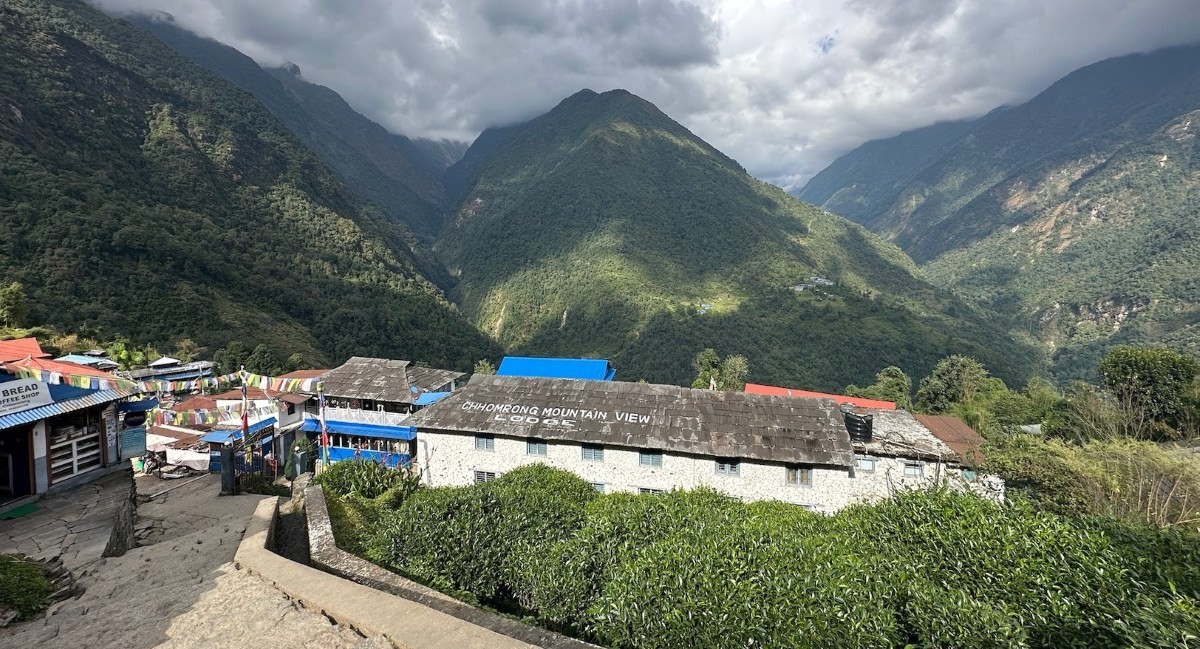
As you get closer to Deurali, you can see snow-capped mountains surrounding the valley.
Photography Highlights :
Day 6: Spectacular Views from Machhapuchhre Base Camp (3,700m),
As you walk from Deurali to Machhapuchhre Base Camp, you will enjoy incredible landscape views. You may consider this place to be among the most beautiful viewpoints in the Annapurna region.
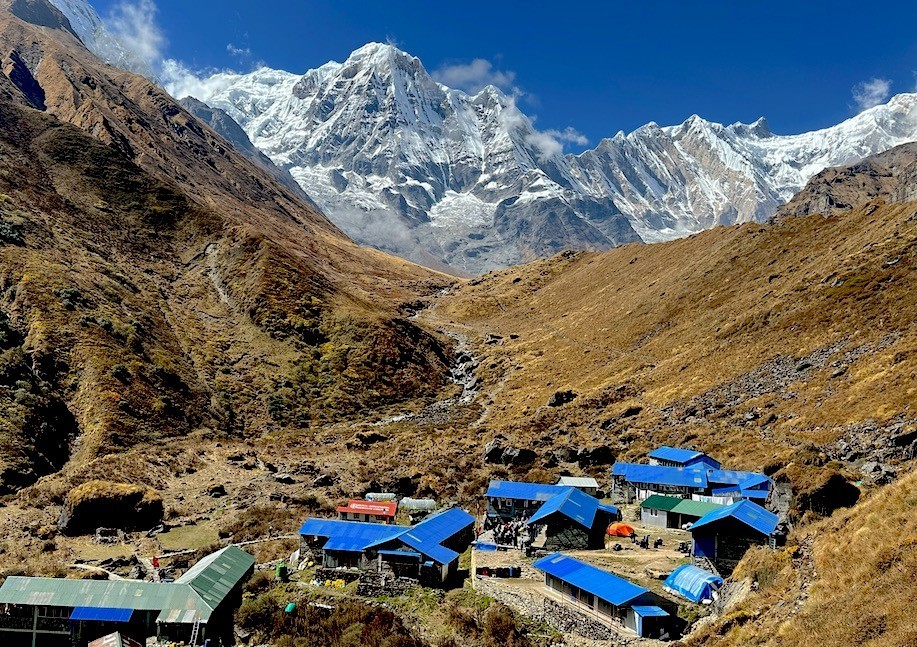
At Machhapuchhre Base Camp, you can capture phenomenal pictures of the Machhapuchhre peak in the center of the valley. The mountains that appear on your horizon are:
The wide glacial basin that opens up before your eyes marks the entrance to the Annapurna Sanctuary.
Photography Highlights :
Day 6 Afternoon: Annapurna Base Camp (4,130m),
A short walk from Machhapuchhre Base Camp leads you to the unbelievable Annapurna Base Camp (ABC). This area is surrounded by towering Himalayan peaks, providing fantastic photo opportunities for nature lovers. Remarkable views are available for those willing to make the effort to witness this spectacular sight.
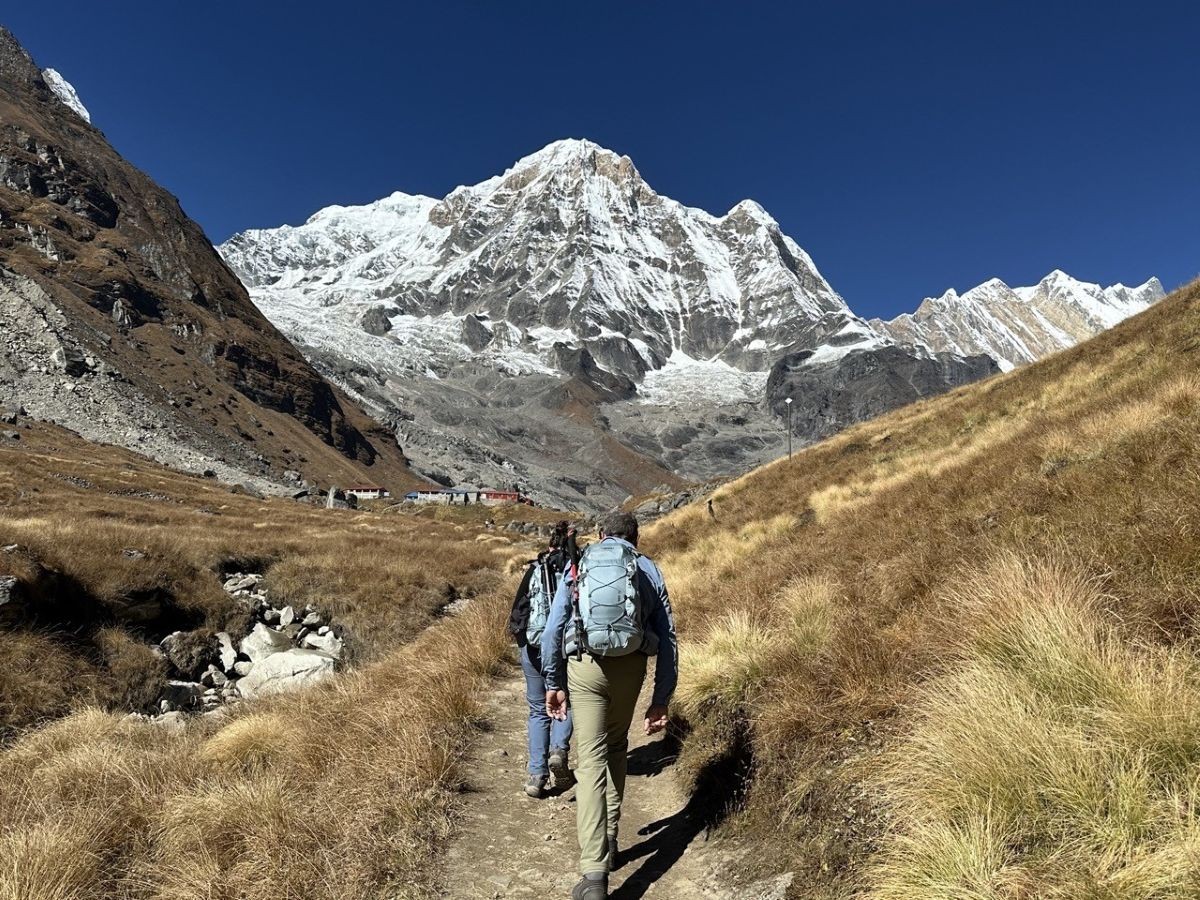
From the Annapurna Base Camp viewpoint, you can capture incredible pictures of the following peaks:
Being in the middle of this massive glacial amphitheater makes you feel as if you were on the world’s roof.
Photography Highlights :
Day 7: Witness Another Spectacular Sunrise from the Annapurna Sanctuary
You should wake up early and prepare your camera gear to witness another fantastic sunrise. You will see the first light piercing through the dark horizon and bringing out the most amazing colors on the snow-covered mountains.
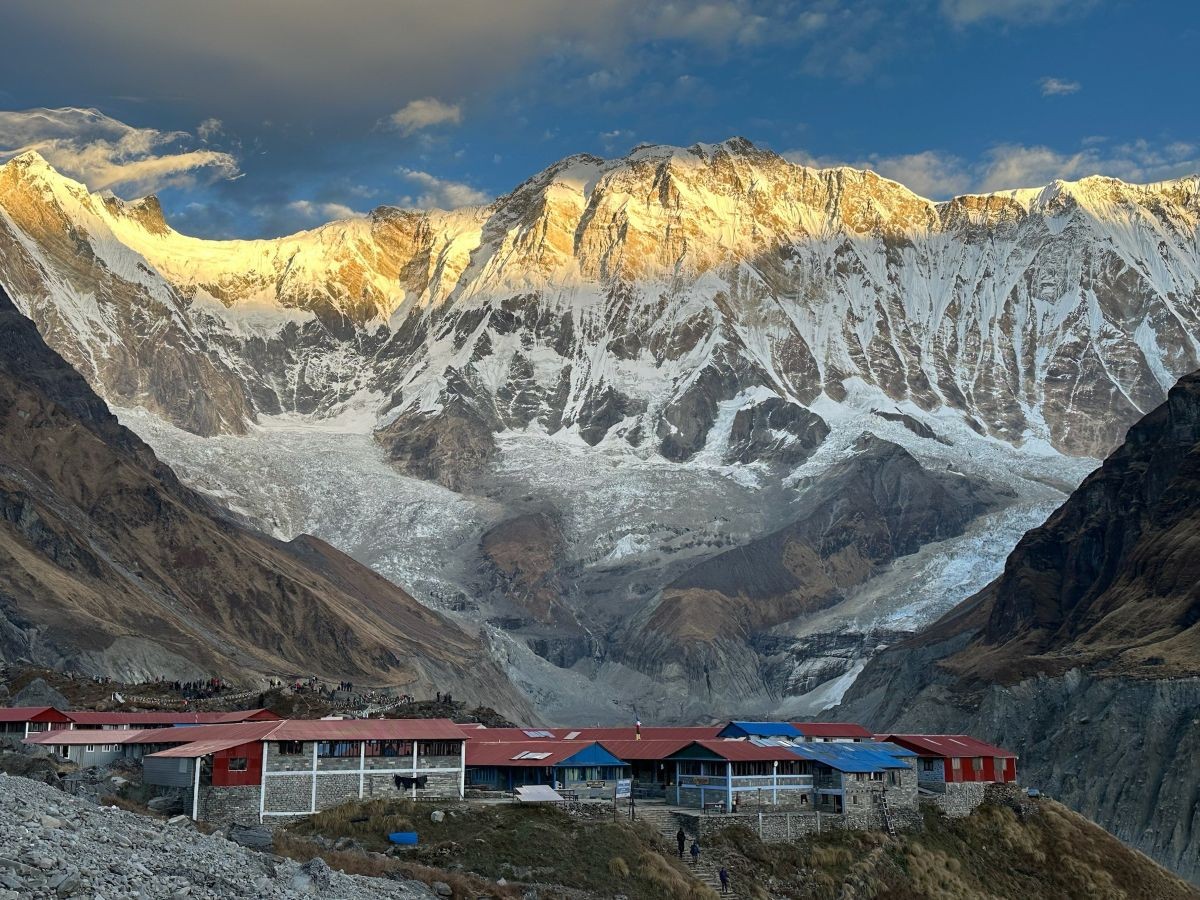
I personally think that sunrise views from the Annapurna Sanctuary are more breathtaking than the ones from Poon Hill.
Day 8: Enjoy Hot Springs at Jhinu Danda (1,780m),
After several days of walking through the mountain trails, it is time to relax. The hot mineral water springs at Jhinu Danda are the perfect place to let your muscles rest while enjoying incredible views of the Modi Khola valley.
With a comfortable teahouse accommodation along the ABC Trail, great food, and unforgettable Himalayan scenery, a Poon Hill trekking tour is a fantastic experience for any traveler.
| Viewpoint | Elevation | Highlights |
|---|---|---|
| Poon Hill Viewpoint | 3,210m | Sunrise view of the Annapurna and Dhaulagiri ranges |
| Tadapani Ridge | 2,630m | View of the Annapurna South and Machhapuchhre peaks |
| Chhomrong | 2,170m | Panoramic view of the Machhapuchhre valley |
| Machhapuchhre Base Camp | 3,700m | Beautiful mountain views |
| Annapurna Base Camp | 4,130m | 360-degree view of the Annapurna Sanctuary. |
Expert Advice from Haven Holidays Nepal,
The Annapurna Base Camp Trek via Poon Hill is one of the best options for capturing the most scenic mountain views in Nepal. With two of the most popular viewpoints of the Annapurna range and one of the most beautiful sunrise views in the Himalayas, this trek is one of the most scenic trekking adventures in the world. The trail takes you through dense forests, deep river gorges, and mountain ridges covered in snow. This trail is a fantastic opportunity to capture some of the most scenic pictures of the Himalayas.
One of the best things about the Annapurna Base Camp Trek Via Poon Hill is the wonderful teahouse accommodations with great food. Unlike challenging camping treks, this trail gives you a chance to explore one of the best teahouse trekking experiences in Nepal. As you walk through the mountain trails, you will stay at local family-run guesthouses that provide all kinds of comfort at reasonable prices. You will enjoy warm and friendly hospitality and wake up every morning to breathtaking mountain views.
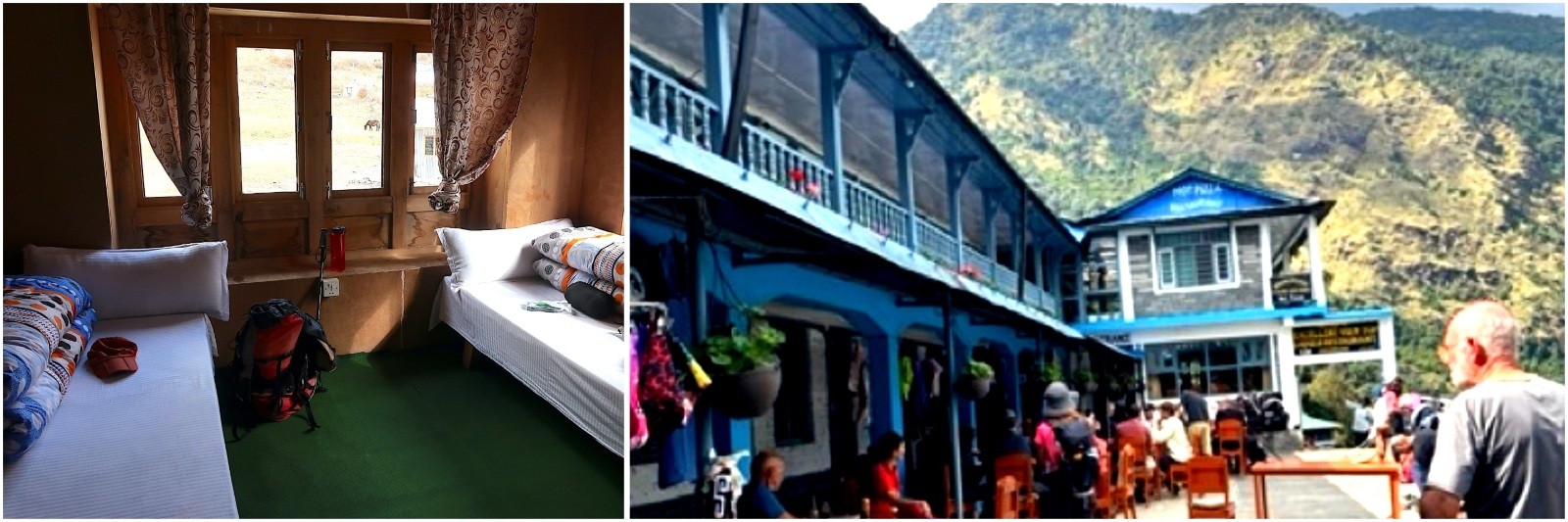
Here, accommodation becomes progressively better as you gain altitude. But the friendly vibe and delicious food remain the same throughout the trail.
Tea House Accommodation,
The family-run tea houses offer you comfortable twin beds, foam mattress, pillows, blankets, and a small table. Hot drinks, meals, and warm tea will help you survive the cold mountain nights.
In most cases, you will have access to shared bathrooms in the tea houses. Private rooms can be found in the lower mountain villages like Ulleri, Ghorepani, and Tadapani. The availability decreases as you go higher than Deurali village.
Dining Room
Every tea house has a communal dining room with nice furniture. You can expect to find a heating system (gas or wood-burning depending on the season) and comfortable seating inside the dining hall. Most tea houses provide electric outlets for your convenience.
Evenings are the best time to enjoy the warm tea house atmosphere while sharing great stories and meals with fellow travelers.
Food on the Poon Hill Trail and ABC Trek,
When it comes to food on the Annapurna Base Camp Trek, you have plenty of options. Local dishes are reasonably priced and taste amazing after a day of hiking through the mountains. You can find traditional Nepali cuisine like Dal Bhat, fried rice, and vegetable curry in most of the tea houses.

Below are some of the most popular local dishes served for breakfast, lunch, and dinner for the Poon Hill trail and Annapurna Base Camp trek:
Traditional Nepali Dishes
Dishes Description
Dal Bhat- Local dish of Nepal made of steamed white rice, lentils soup, and seasonal vegetables
In fact, Dal Bhat is the most popular dish among trekkers because most tea houses offer complimentary refills. It is also filling enough to keep you energized during the day of hiking.
Breakfast Food,
Foods Description:
Hot teas and coffee are also available to enjoy with your meals.
Lunch & Dinner Food,
Food Description :
Due to the high altitude, the menu options become limited as you ascend to higher altitudes.
Vegetarian and Vegan Food,
In most tea houses, you can order vegetarian food like:
Vegan food can also be prepared upon request, so you can ask for vegetarian dishes that do not include dairy products and eggs. The meals are healthy, delicious, and will fill you up for another day of trekking in the Himalayas.
Drinking Water,
Drinking water can be obtained by :
It is advisable to avoid buying bottled water to reduce plastic waste.
Hot Showers,
Hot showers are available in most of the villages for NPR 300 – 700, depending on the altitude. The price varies according to the distance and difficulty of transporting fuel to higher mountain villages.
Charging Electronic Devices,
Charging electronic devices like mobile phones and cameras is possible in most of the tea houses. This facility usually costs around NPR 200 – 500 per device. It is always a good idea to carry a power bank with you, especially when you are above Chhomrong village.
Wi-Fi and Internet Connection,
Most tea houses provide free Wi-Fi with an extra cost. The connection speed may vary depending on altitude and weather conditions. You can also buy Nepal Telecom (NTC) and Ncell SIM cards with local data bundles at an affordable price. However, the internet coverage is unstable at higher altitudes due to poor network reception.
| Meals | Estimated Price in NPR |
|---|---|
| Breakfast | 500 – 900 |
| Lunch | 700 – 1,000 |
| Dinner | 700 – 1,200 |
| Tea/Coffee | 150 – 400 |
| Snacks | 200 – 600 |
Price varies with the altitude because of the transportation fee.
Important Reminders :
The packing list for Annapurna Base Camp Trek must be convenient yet safe and comfortable. As Annapurna Base Camp and Poon Hill’s elevation ranges from 3,210 to 4,130 meters, it is crucial to bring suitable clothing. While the lower valleys are warm, overnight temperatures can drop below freezing, especially in spring, autumn, and winter.

This is a teahouse trek, which means that you will not have to carry camping gear. You can also buy most of the hiking equipment from the many shops in Pokhara.
Clothing,
While trekking through the Himalayas, layering is the best way to prepare for rapidly changing weather conditions. The following clothing can be categorized as base layers, mid-layers, and outer layers.
Base Layers :
Mid Layers :
Outer Layers :
Footwear,
Well-fitted and high-quality shoes and socks are among the most essential pieces of gear for any trek to Poon Hill.
Essentials :
Hats & Gloves,
Weather conditions change dramatically in a matter of hours in the Annapurna region. Here are some popular headwear and gloves:
Sleeping Bags
Teahouses provide blankets, but it is recommended to bring a sleeping bag to ensure a good night’s rest.
Must-Haves :
Trekking Equipment,
Some essential gear can make your journey through the Himalayas much more pleasant.
Must-Haves :
Nice-to-Haves :
Electronics,
Most teahouses offer electric charging outlets, but it usually comes at an additional cost.
Remember to bring the following:
Toiletries,
It is vital to bring travel-size cosmetics and personal hygiene products.
Some necessary products are:
Personal Medicines,
It is essential to bring personal medicines and a basic first aid kit.
Staples to pack:
Trekking Documents,
Always keep them in a waterproof bag:
Snacks :
| Must-Haves | Nice-to-Haves |
|---|---|
| Waterproof trekking boots | Inflatable pillow |
| Down jacket | Camp sandals |
| Rain jacket | Gaiters |
| Trekking poles | Sit pad |
| Sleeping bag | Camera tri pod |
| Water purification and filter | Kindle or book |
| Headlamp | Trekking umbrella |
Rental Services in Pokhara,
| Equipment | Approx. price per day |
|---|---|
| Down Jacket | NPR 150-300 |
| Sleeping Bag | NPR 150-300 |
| Trekking Poles | NPR 100-200 |
| Backpack | NPR 150-300 |
| Gaiters NPR | 100-150 |
It is recommended to use the locally available resources as much as possible. Most of the equipment mentioned in the article can be rented in Pokhara.
Packing Tips
Dos :
Don’ts :
Expert Advice from Haven Holidays Nepal
A correctly made packing list for Annapurna Base Camp trek will ensure your safety, comfort, and satisfaction. It is always better to pack smart and light rather than overload your bag with unnecessary gadgets and clothes. Annapurna Base Camp via Poon Hill is a fully supported trek, meaning that you will find teahouses offering lodging and meals. Haven Holidays Nepal also arranges high-end equipment rentals in Pokhara, which is a great way to reduce the weight of the luggage and the overall costs of the trek.

Knowing how much Annapurna Base Camp trek costs is crucial for any visitor who wishes to have a clear understanding of the general idea of the expenses involved before even setting foot on the trail. The price of the Annapurna Base Camp trek depends on your preferred starting point (Kathmandu or Pokhara), guide and porter services, accommodation preferences, and the amount of cash you are willing to spend during the climb. Annapurna Base Camp via Poon Hill is one of the most affordable highland treks in Nepal, which means that you will get tremendous value for your money.
Independent Trek vs Guided Trek Budget,
Independent Trek :
Guided Group Trek :
Permit Fees :
| Type of Transportation | Approx. Cost |
|---|---|
| Tourist Bus (one way) | USD 10-15 |
| Deluxe Bus | USD 20-30 |
| Flight to Pokhara | USD 90-140 |
| Private Jeep | USD 180-250 |
| Type of Transportation | Approx. Cost |
|---|---|
| Shared Jeep to trailhead | USD 15-25 |
| Private Jeep | USD 80-120 |
| Locations | Approx. Cost per Night |
|---|---|
| Lodging in Lower Villages | USD 5-10 |
| Lodging in Mid-range Villages | USD 8-12 |
| Lodging in ABC & MBC | USD 10-15 |
Most tea houses offer significant discounts for those who purchase a meal right there.
| Meals | Approx. Cost |
|---|---|
| Breakfast | USD 5-8 |
| Lunch USD | USD 6-10 |
| Dinner USD | USD 7-12 |
| Drinks & Snacks | USD 5-10 |
On average, you will need to spend USD 25 – 40 per day on food.
Guide, Porter, and Their Assistance
| Services | Approx. Cost per Day |
|---|---|
| Licensed Guide | USD 30-40 |
| Porter | USD 20-30 |
| Guide/Porter | USD 25-35 |
It is customary to give tips to your guide and porter at the end of the trek.
Extra Expenses,
| Service | Approx. Cost |
|---|---|
| Hot Shower | USD 3-7 |
| Wi-Fi | USD 3-6 |
| Charging devices | USD 2-5 |
| Bottled Water | USD 2-5 |
| Boiled Water | USD 1-3 |
| Laundry | USD 3-6 |
| Category | Kathmandu | Pokhara |
|---|---|---|
| Transportation | Higher | Lower |
| Trek Duration | 8-11 Days | 6-8 Days |
| Total Budget | USD 450-1,500 | USD 350-900 |
| Travel Time | Longer | Shorter |
| Independent Trek | Guided Trek |
|---|---|
| Lower Costs | Higher Costs |
| More Freedom | Better Organization |
| Self-planning | Experienced Locals Assist |
| Suitable for Everyone | Additional Services Available |
Budget Planning Tips
Undoubtedly, the Annapurna Base Camp trek cost is worth it. Annapurna Base Camp via Poon Hill offers tremendous value for the money spent considering the breathtaking views of the high-altitude landscape, comfortable tea-house accommodations, and unique cultures and customs. Compared to many other Himalayan destinations around the world, the Annapurna region is one of the most affordable places to engage in trekking activities. Annapurna Base Camp via Poon Hill is also one of the most popular trails around the globe, so it is fair to assume that there is not a single penny wasted on this trek.
Expert Advice from Haven Holidays Nepal
In most cases, it is a better idea and a safer option to opt for a guided trek. Haven Holidays Nepal can show you the best views of the Annapurna Massifs while making sure that your journey goes smoothly. We guarantee high-quality trekking experiences and affordable rates for Annapurna Base Camp via Poon Hill tours starting from both Kathmandu and Pokhara.
The Annapurna Base Camp Trek through Poon Hill is an amazing Himalayan adventure for those ready to embrace the challenge. While this trail is marked as one of the easiest in Nepal due to teahouse comforts, hikers still need to acclimatize while gaining around 3000 meters in altitude from Pokhara to Poon Hill (3,210 m) and Annapurna Base Camp (4,130 m). This blog aims to provide altitude sickness ABC, safety tips, and responsible trekking advice on the Annapurna Base Camp trek from Poon Hill guide and plan your Himalayan hiking accordingly.

Here, good preparation, a steady pace, and sustainable tourism let you enjoy the beauty of the Annapurna Sanctuary while preserving this mountainous region for years to come.
Understanding Altitude Sickness (AMS)
Altitude sickness (AMS) is common for everyone, young or old.
It usually occurs above an altitude of 2500 m, but most hikers report feeling mild symptoms at Deurali (3,230 m), Machhapuchhre Base Camp (3,700), Annapurna Base Camp (4,130). The good news is that most people acclimatize well to higher altitudes as they ascend gradually from Pokhara, Ghorepani, Tadapani, Chhomrong, Sinuwa, Bamboo, Himalaya, and Deurali.
Symptoms of Altitude sickness,
Symptoms of AMS include:
Most of these symptoms disappear when AMS becomes severe.
Seek medical attention if you have any of these symptoms:
This means you have serious altitude sickness and you need to descend immediately.
How to prevent altitude sickness,
The most effective way to prevent AMS is proper acclimatization. Other useful measures include:
Staying Hydrated,
| Altitude | Required amount of water per day |
|---|---|
| 2500 m | 2-3 liters |
| 2500 m | 3-4 liters |
Drink water from a metal bottle instead of a plastic bottle.
Weather Safety,
Weather in the Annapurna Himalayas is unpredictable. It is advisable to carry warm clothing even in spring and autumn. You should also carry:
Check the weather forecast before trekking each day.
Staying Safe on the Trails,
The trails are generally well-marked. You need to be extra careful on:
You should also use trekking poles on steep inclines and declines.
Stomach Safety,
The most common causes of stomach discomfort in this region are poor food hygiene and water-borne diseases. You should:
It is critical that you carry a detailed list of emergency contacts. You should carry:
You can always contact helicopter services if your condition permits.
Sustainable Trekking in Annapurna,
The Leave No Trace motto should always be on your mind when trekking in the Annapurna region. This includes:
The Annapurna region is the home of the Gurung and Magar ethnic groups. As a responsible and sustainable trekker, you need to:
Your presence in the Annapurna region should have a positive impact on the locals. You can achieve this by:
| Safety Item | Recommended |
|---|---|
| Travel insurance | ✓ |
| Licensed guide | ✓ |
| First aid kit | ✓ |
| Water purification | ✓ |
| Trekking poles | ✓ |
| Headlamp | ✓ |
| Warm clothes | ✓ |
| Emergency Contacts | ✓ |
Your highest priority during Annapurna Base Camp trek through Poon Hill is safety. You need to trek responsibly while being conscious of the local environment. You must always remember to acclimatize properly and drink plenty of fluids. Moreover, it is essential to respect local customs and traditions. Haven Holidays Nepal expert guides will always keep you updated on weather and trail conditions as they monitor things around the clock. With their help, you will enjoy a fantastic Himalayan trekking experience while having peace of mind.
The Annapurna Base Camp trek through Poon Hill is a relatively easy to moderate climb. This trail involves moderate hiking, so it is suitable for most reasonably fit adventurers. That said, many first-time visitors to Nepal often overlook several crucial details regarding Annapurna and Poon Hill. This guide on Poon Hill trek mistakes and how to avoid them aims to help you prepare for this Himalayan trekking adventure.
Meanwhile, most inexperienced trekkers underestimate the challenge of the Annapurna trek. While it is always essential to set realistic expectations, it is also worth noting that this region boasts some of the most spectacular hiking trails in the world.
Likewise, many first-time Annapurna hikers focus too much on reaching Annapurna Base Camp. The truth is that careful preparation in advance of the trek is as important as the climb itself.
1. Underestimating the Difficulty of Annapurna Trek :
Most of us wrongly assume that the Annapurna trek is easy since many teahouses are available for convenience. Even so, you must not forget to prepare since you have to hike steep inclined and hundreds of stairs while acclimatizing at elevations of over 3000 meters above sea level. You should also expect to hike for 5-7 hours per day.
Quick Tip,
2. Walking Too Fast :
Quick Tip,
3. Bringing Too Much Gear
Too many hikers bring unnecessary items that could weigh them down during the trek.
Quick Tip
Only what you bring is what you need to carry on your back. A daypack should weigh between 4-6 kg while a porter's bag should weigh between 10-12 kg. You can buy or rent gear you need in Pokhara.
4. Wearing the Wrong Clothes
Quick Tip
5. Bringing Too Little Money
You cannot rely on ATMs to withdraw money once you reach Pokhara. Note that most teahouses are willing to charge you extra for hot showers, Wi-Fi, and battery charging. You also need extra cash to buy souvenirs or even snacks.
Quick Tip
Remember to bring enough Nepalese Rupees with you since you cannot use your credit card to pay for most things beyond Pokhara.
6. Not Drinking Enough Water
Quick Tip
7. Hiking at the Wrong Time of Year
Winters are cold while monsoons keep the trails muddy and slippery in Nepal. That said, Annapurna trek is best enjoyed during spring (March to May) and autumn (September to November).
| Season | Weather |
|---|---|
| Spring | Excellent |
| Autumn | Excellent |
| Winter | Cold |
| Monsoon | Warm and Wet |
Pick the Annapurna season that suits your fitness level and personal preference.
8. Skipping Travel Insurance
Quick Tip
9. Not Hiring a Guide
Here are some reasons to hire a guide:
10. Failing to Enjoy the Adventure
Some Annapurna hikers set their hearts on reaching Annapurna Base Camp. Others forget to enjoy the spectacular sunrise views at Poon Hill. However, the most beautiful sights and experiences are often found along the trail.
Make sure to appreciate the following:
Remember: The journey is as important as the destination.
| Mistakes | Solution |
|---|---|
| Underestimating Trek Difficulty | Get into good shape and do regular hikes before the climb |
| Walking Too Fast | Always remember to slow down |
| Bringing too much gear | Only bring what you need |
| Wearing the wrong clothes | Dress in layers and bring a waterproof jacket |
| Bringing too little money | Carry lots of Nepalese Rupees |
| Not drinking enough water | Always drink 3-4 liters plus electrolytes |
| Hiking at the wrong season | Pick spring or autumn and do your research |
| Skipping travel insurance | Never skip travel insurance, especially hiking gear |
| Not hiring a guide | Always ask for a licensed and experienced guide |
| Failing to enjoy the adventure | Remember that the journey is as important as the destination |
Avoiding these common Poon Hill trek mistakes and ABC trek issues will enable you to have a fantastic high-altitude trekking adventure in the Nepal Himalayas. Always prepare properly and follow the safety guidelines to ensure a fantastic trekking experience. With the help of Haven Holidays Nepal local experts, you will undoubtedly enjoy a once-in-a-lifetime Himalayan trekking holiday.
The Annapurna Base Camp Trek via Poon Hill is a unique adventure that will take you from sunrise over Poon Hill (3,210 m) to the majestic natural amphitheater of Annapurna Base Camp (4,130 m), offering days of unforgettable memories in the heart of the Himalayas. This tour is a must for those looking for a comprehensive Poon Hill ABC experience, providing spectacular mountain views, authentic mountain village culture, forest walks, waterfalls, hot springs, and a close encounter with the awesome Annapurna range. The good news is, no matter whether you arrive in Pokhara or Kathmandu, you can embark on this once-in-a-lifetime adventure. So, are you ready to take on the challenge?
Why trek from Pokhara or Kathmandu?
| Basis | Start from Kathmandu | Start from Pokhara |
|---|---|---|
| Total trip duration | 9-11 Days | 6-8 Days |
| Best for | International guests | Arriving in Pokhara |
| Time-saving | Transportation to the trail Tourist bus, flight, or private transfer | Same-day drive |
| Trekking days | Similar | Similar |
| Budget | Slightly higher | More economical |
| Flexibility | More sightseeing opportunities | Shorter, more convenient |
However, both routes include the magnificent sunrise over Poon Hill and breathtaking 360-degree views of the Annapurna Sanctuary, but your timing and preferences will undoubtedly determine which one is the best for you. Now, let's proceed to the reasons why you should consider trekking to Annapurna Base Camp through Poon Hill. The reasons why you must experience the ABC trek from Pokhara or Kathmandu include:
Why you should add this trek to your bucket list ?
The Annapurna Base Camp Trek to Poon Hill promises to give you an experience of a lifetime!
The reasons for this include: Unbelievable mountain panorama
There are a few sights better than an amazing mountain panorama. This trek offers fantastic views of:
These fantastic views create one of the most remarkable sights in the world.
Fabulous variety of landscapes,
The trail will take you through various landscapes, including:
Every day, you will be amazed by the variety of landscapes.
Cultural heritage,
You will have an opportunity to discover the unique culture of the local people and learn about their lifestyle, including:
Likewise, there are many opportunities to interact with local people in mountainous regions. The cultural experience offered by this trek is invaluable and unforgettable!
Tea house trekking
Unlike challenging and strenuous camping treks, this adventure allows you to enjoy all the comforts of home. Most tea houses provide private rooms, delicious Nepali meals, warm and cozy lounges, and hot showers (for an additional fee). Moreover, electricity is available for charging your electronics, and free wi-fi is also offered in many places. All of this makes this trek suitable for all travelers who want to experience the Himalayas without sacrificing comfort.
Adventure for all,
This trek is a great choice for:
Whatever your travel goals are, this trek can be customized according to your needs. Furthermore, different itineraries offered allow you to choose how long you want to spend in the Annapurna region.
Prior to kickstarting your Poon Hill ABC journey, note the following helpful hints:
With these essential tips in mind, we hope you are now excited about your upcoming adventure. Remember, proper preparation is the key to a fantastic trekking experience.
Why trek with Haven Holidays Nepal?
We understand that choosing a reliable local company is vital in ensuring that you have a wonderful Himalayan trekking experience.
With Haven Holidays Nepal, you will receive:
In conclusion, their local expertise ensures that you have peace of mind while enjoying the stunning mountainscapes of the Annapurna region. So, what are you waiting for? Contact them and let us help you design your own unforgettable Himalayan trekking adventure!
1. What is the Annapurna Base Camp Trek itinerary via Poon Hill?
The Annapurna Base Camp Trek itinerary via Poon Hill is a combination of the Poon Hill Trek and Annapurna Base Camp Trek that usually takes 9 to 11 days to complete from Pokhara. The trail involves moderate to challenging hikes through several villages including Ghorepani and Poon Hill (3,210 m) with spectacular views of the Himalayas.
The route passes through Tadapani, Chhomrong, Deurali, Machhapuchhre Base Camp (3,700 m), and Annapurna Base Camp (4,130 m).
2. How many days does the Annapurna Base Camp Trek via Poon Hill take?
The Annapurna Base Camp Trek via Poon Hill is generally undertaken for 10 or 11 days. Faster trekkers might finish it in 9 days whereas leisurely ones could complete it in 12 days. The itinerary allows for enough time to prepare oneself for the challenges of high altitude while enjoying the mountainous landscape of the region.
3. Why should I choose the Annapurna Base Camp Trek via Poon Hill?
The Annapurna Base Camp Trek via Poon Hill is the most popular option among trekkers for a simple, scenic, and cultural Himalayan adventure. This trek offers more mountain views than the usual Annapurna Base Camp Trek. You will witness an amazing sunrise from the top of Poon Hill (3,210 m) on your way to Annapurna Base Camp.
Moreover, you will also discover rhododendron forests, Gurung villages, terraced farms, and have close views of the stunning Himalayas, making it one of the most unique trekking adventures in Nepal.
4. What is the best itinerary for the Annapurna Base Camp Trek via Poon Hill?
The best itinerary for the Annapurna Base Camp Trek via Poon Hill starts from Pokhara. It goes through the Poon Hill trail to Ghorepani, followed by a trek to Annapurna Base Camp. The return journey usually follows the Jhinu Danda route to enjoy the hot springs in Pokhara.
5. What is the highest elevation on the Annapurna Base Camp Trek via Poon Hill?
The highest altitude you will encounter on the Annapurna Base Camp Trek via Poon Hill is the Annapurna Base Camp at 4,130 meters. You will climb higher to reach Annapurna Base Camp from Machhapuchhre Base Camp (3,700 m). On the other hand, the first overnight camp at Poon Hill is at 3,210 meters, offering a spectacular sunrise view over the Annapurna range: Annapurna I (8,091 m), Dhaulagiri (8,167 m), and Machhapuchhre (6,993 m).
6. Is the Annapurna Base Camp Trek via Poon Hill suitable for beginners?
Yes, the Annapurna Base Camp Trek via Poon Hill is suitable for beginners and those not accustomed to high-altitude trekking, as it does not involve extreme physical exertion. Most days involve light hiking for about five to seven hours. Furthermore, the trail steadily gains elevation to help trekkers acclimatize to the altitude.
However, it is critical to consider hiring a licensed guide and porter to ensure the safety of both you and your trekking companions in the Annapurna Conservation Area.
7. When is the best season for the Annapurna Base Camp Trek via Poon Hill?
The most suitable months to embark on the Annapurna Base Camp Trek via Poon Hill are spring (March to May) and autumn (September to November). During these seasons, the trails are clear, and the views of the mountains are breathtaking.
Additionally, pleasant temperatures and blooming rhododendrons make the Annapurna Base Camp Trek via Poon Hill a delightful experience for most trekkers who wish to complete it.
8. How difficult is the Annapurna Base Camp Trek via Poon Hill?
The Annapurna Base Camp Trek via Poon Hill involves several steep staircases and inclines that could be challenging. This trek is moderately difficult due to the high altitude at which it is conducted. Nevertheless, the trail is well maintained and suitable for most fit and determined adventurers.
9. What permits are required for the Annapurna Base Camp Trek via Poon Hill?
The Annapurna Conservation Area Permit is mandatory for the Annapurna Base Camp Trek via Poon Hill. Moreover, the Trekker’s Information Management System (TIMS) registration is usually not necessary for independent trekkers as it is managed by the trekking agencies.
10. What mountains can I see on the Annapurna Base Camp Trek via Poon Hill?
The Annapurna Base Camp Trek via Poon Hill provides spectacular views of several mountains. They include Annapurna I (8,091 m), Annapurna South (7,219 m), Machhapuchhre (6,993 m), Hiunchuli (6,441 m), Gangapurna (7,455 m), Nilgiri (7,061 m), and Dhaulagiri (8,167 m).
Furthermore, the sunrise view from Poon Hill is among the most unmissable attractions of this trek.
11. How long is the Annapurna Base Camp Trek via Poon Hill?
The Annapurna Base Camp Trek via Poon Hill is one of the longest treks in Nepal. It is between 110 and 125 kilometers long depending on the specific itinerary that you choose. In general, trekkers walk for 10 to 18 kilometers daily. These distances vary depending on the number of hours you walk and overnight stays.
12. Is altitude sickness possible on the Annapurna Base Camp Trek via Poon Hill?
Altitude sickness is common at elevations higher than 3,000 meters. Although the Annapurna Base Camp Trek via Poon Hill is not particularly difficult, it can lead to altitude sickness if not properly acclimatized.
To avoid it, you must drink plenty of fluids, walk slowly, eat healthy foods, and avoid drinking alcohol. Moreover, you should descend immediately if you suspect altitude sickness during the Annapurna Base Camp Trek via Poon Hill.
13. Are teahouses available in the Annapurna Base Camp Trek via Poon Hill?
There is an abundance of teahouses throughout the Annapurna Base Camp Trek via Poon Hill. All of them provide warm welcomes and excellent views of the mountains. Most teahouses offer twin-sharing rooms and meals. Some also provide Wi-Fi, electricity, and hot water showers at an additional charge. Accommodation becomes progressively expensive at higher altitudes, although it is always comfortable and cozy.
14. What food is available on the Annapurna Base Camp Trek via Poon Hill?
Dining options are endless as you trek towards the Annapurna Base Camp via Poon Hill. However, it is critical to carry some snacks with you. You will find an array of vegetarian dishes, including Dal Bhat, noodles, fried rice, pasta, pancakes, soup, and eggs. Additionally, you will also find tea, coffee, vegetables, and fruits, including pancakes and eggs.
15. Can I do the Annapurna Base Camp Trek via Poon Hill without a guide?
Most of the time, trekking companies require international climbers to employ a local licensed guide for the Annapurna Base Camp Trek via Poon Hill. This regulation exists because a guide ensures a safe and enjoyable journey while informing you about the local customs and traditions.
16. How much does the Annapurna Base Camp Trek via Poon Hill cost?
The cost of the Annapurna Base Camp Trek via Poon Hill varies between USD 700 and USD 1,200. It depends on the selected length of the itinerary, type of teahouse, transportation, guides, porters, permits, and other expenses. Additionally, private tours are more expensive than group tours.
17. What should I pack for the Annapurna Base Camp Trek via Poon Hill?
It is essential to pack appropriately for the Annapurna Base Camp Trek via Poon Hill. Therefore, you should carry layered clothing, waterproof gear, hiking boots, trekking poles, and other warm clothing such as gloves, scarves, and beanie. Similarly, you should bring sunglasses, sunscreen, reusable bottles, and power banks.
These items will enhance your trekking experience on the Annapurna Base Camp Trek via Poon Hill. As such, you can explore the region comfortably despite the unpredictable weather.
18. Is the Annapurna Base Camp Trek via Poon Hill safe?
The Annapurna Base Camp Trek via Poon Hill is considered one of the safest trekking routes in Nepal. This trek boasts of well-maintained trails, good teahouse accommodations, and competent local guides. Additionally, a stable rescue system supports the trekkers in case of any difficulties.
19. Can I combine Poon Hill with the Annapurna Base Camp Trek?
Yes, you can combine the Poon Hill and Annapurna Base Camp Trek. In fact, it is the most common way to enjoy both Poon Hill and Annapurna Base Camp. Similarly, it offers a wonderful view of the sunrise and explores the local culture and rhododendron forests.
20. Why is the Annapurna Base Camp Trek via Poon Hill one of the best in Nepal?
The Annapurna Base Camp Trek via Poon Hill involves a combination of Himalayan views, cultural experiences, mountain walks, forest exploration, and short days of hiking. As such, it is an extraordinary trekking experience for those who want to embrace the best of Nepal.
In summary, this trek offers unforgettable memories for people who love Himalayan scenery and want to see the sunrise from Poon Hill (3,210 m) and the Annapurna Base Camp (4,130 m).
Our travel experts are ready to assist you with any questions.
Send us a message.Have a question before you book? Send your enquiry below and our travel experts will get back with the required information.