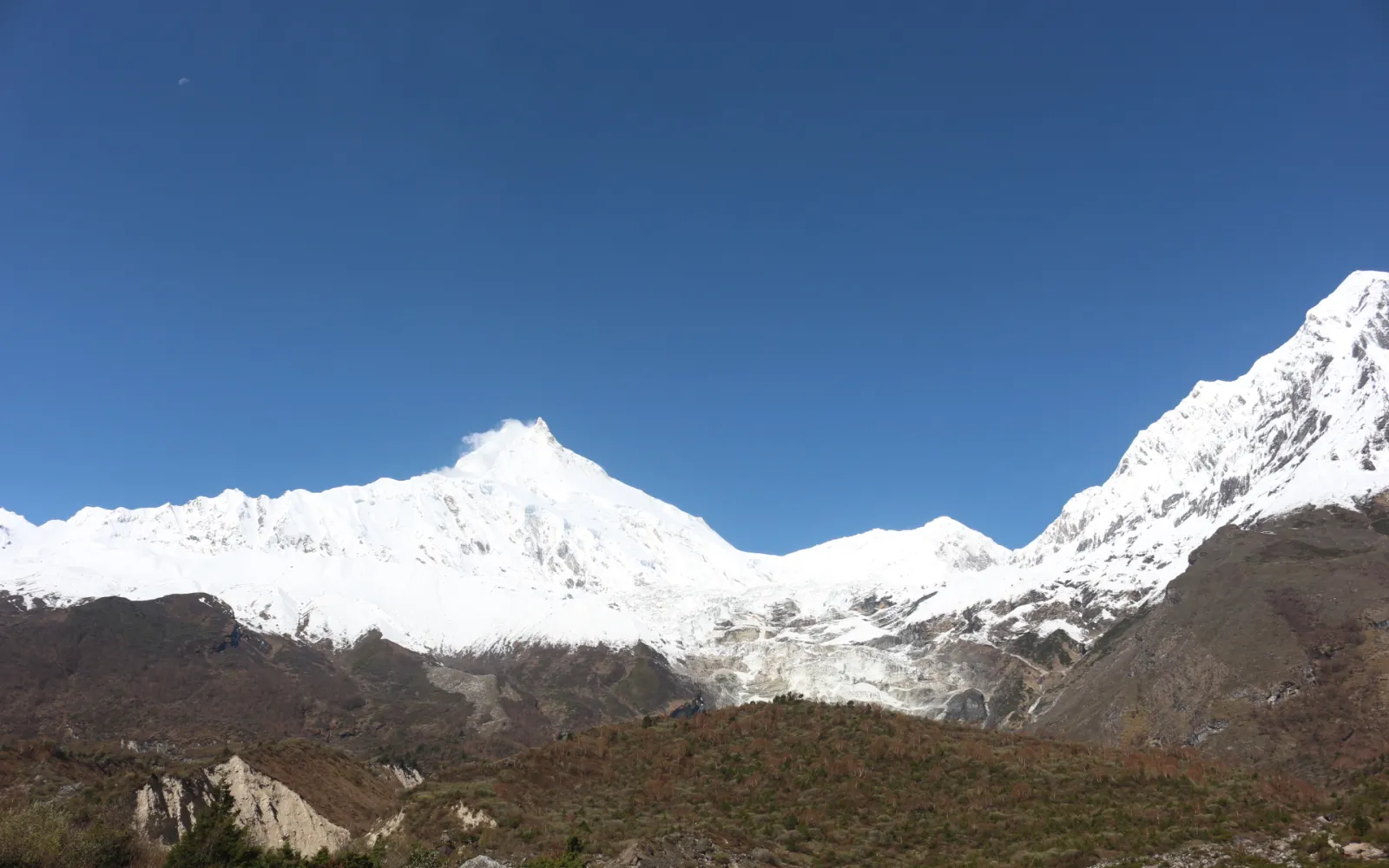
Manaslu Circuit Trek is a remote and restricted area trekking in Nepal. It takes you to far distant area of remote Gorkha district bordering to Tibet.
Moreover, Manaslu Trek in Nepal offers you an opportunity to conquer Larkya Pass(5106m). This ascent lets the trekkers feel the real adventure in their life.
Meanwhile, the view of Mt. Manaslu is dominant all over the trail from Machhakhola to Dharapani.
Here, let’s discuss about Manaslu Circuit Trek Itinerary, Cost, Route, Permits, Transportation and accommodation for 2027.
The Manaslu Circuit Trek 2027 takes hikers around the eighth-highest mountain on Earth at 8,163 m! Here, the Manaslu trail includes dramatic mountain scenery, remote villages, Tibetan culture, Budhi Gandaki Valley, and the challenging Larkya La Pass.
To begin with, the Manaslu Circuit Trek 2027 involves hiking along the Budhi Gandaki River and its fascinating gorges and valleys with traditional villages.
Likewise, trekkers will see a variety of mountainous terrain and ecosystems from lower elevations around Samagaun, Samdo, and Larkya Phedi to higher altitudes.
In the same way, the trail provides unique cultural experiences that set Manaslu Trek Nepal apart from other Himalayan treks. The upper elevations have Tibetan Buddhist influence in the villages, monasteries, and customs.
Furthermore, the mountain views become more spectacular as the trail leads to Namrung, Lho, and Samagaun. On a clear day, hikers will enjoy panoramic views of the Himalayas, including the eighth-highest mountain peak, Mount Manaslu.
Besides, the Larkya La Pass trail is one of the high-altitude challenges hikers can expect on the Manaslu Circuit Trek 2027.
After Larkya La, they will descend to Bimthang and head back towards the Marsyangdi Valley.
However, access to the lower valley has improved dramatically in recent years. In 2026, the road access was available to Machha Khola, and recent road maintenance also repaired the road for trekking in Namrung.
For these reasons, Manaslu Circuit Trek 2027 will likely be less strenuous than the itineraries of previous years.
To sum up, improved access to these areas, including teahouse accommodations and communication infrastructure, will make the planning easier, although the mountainous landscape and high altitude should still be considered a true Himalayan trek.
Main Reasons to Choose the Manaslu Circuit Trek
| Highlight | What You Experience |
| Mount Manaslu | An 8,163 m high Himalayan peak |
| Budhi Gandaki Valley | Gorges, rivers, waterfalls, and valleys |
| Traditional villages | Gurung people and Tibetan culture |
| Monasteries | Tibetan Buddhist cultural influence |
| Larkya La | A high mountain pass at 5,106m |
| Bimthang | An acclimatization village with beautiful sceneries |
| Improved access | Road access and communication in lower valleys and villages |
Why Is Manaslu Trekking Different in 2027?
Remote Himalayan villages
Strong Tibetan cultural influence
Views of Mount Manaslu
Budhi Gandaki River landscapes
Larkya La Pass crossing
Teahouse accommodation along the route
Improved lower valley road access
Better communication in some villages
Combination of nature, culture, and adventure
Generally, Manaslu Trekking 2027 will continue to be a diverse Himalayan trekking experience rather than a high-altitude expedition.
In 2027, the trail will also improve accessibility to Manaslu Circuit while preserving the unique mountain landscape, traditional villages, and high mountain pass.
The Manaslu Circuit Trek follows the Budhi Gandaki River through valleys and villages, past forests and mountains. There is a variety of cultures and landscapes as the trail rises from lower elevations to higher altitudes with Tibetan cultural influence.
Firstly, the trail starts in the traditional village of Jagat and passes through Deng to Namrung.
Similarly, there is a transition from lower elevation views and cultural experiences to higher altitude sceneries and Tibetan Buddhist influence.
Secondly, the trek continues to Lho and Samagaun, the cultural centers and acclimatization points of the Manaslu Circuit Trek.
With breathtaking views of Mount Manaslu, the highlight of this area is Birendra Lake.
From Samagaun, hikers can also go to Manaslu BC.
In the same way, hiking the circuit includes the high-mountain village of Samdo near the Tibetan border.
From there, the trail goes to Larkya Phedi before the hikers tackle the high mountain pass of Larkya La.
In fact, Larkya La Pass at 5,106 m is one of the highest points on the Manaslu circuit, and after crossing it, hikers descend to Bimthang.
Here, they encounter a different landscape with forests, glaciers, and mountains.
Moreover, there are several monasteries, prayer flags, mani walls, and traditional houses as the trail passes through villages with strong Tibetan Buddhist cultural influence.
Major Places and Experiences
| Place | Main Experience |
| Budhi Gandaki River | River valleys, bridges, gorges, and waterfalls |
| Jagat | Traditional village and trekking trailhead |
| Deng | Cultural and landscape transition |
| Namrung | Mountain views and Tibetan culture |
| Lho | Manaslu views and monastery experience |
| Samagaun | Acclimatization, lake, and mountain views |
| Samdo | Himalayan village near the Tibetan border |
| Larkya Phedi | Preparaion for crossing the high pass |
| Larkya La | Highest point on the Manaslu Circuit at 5,106m |
| Bimthang | Vegetation, glaciers, and mountain views |
What You Can Experience
Walk along the Budhi Gandaki River
Visit traditional villages
Experience Tibetan Buddhist culture
Tour monasteries and prayer sites
View Mount Manaslu
Visit Birendra Lake in Samagaun
Observe village life in the Himalayas
Explore the high mountain landscape
Cross the Larkya La Pass
Witness forest, mountain, and glacial views
Lastly, the Manaslu Circuit Trek covers a variety of natural and cultural experiences connected in a single trail. Nepal Tourism Board describes the Manaslu Conservation Area as a hiking destination offering the beauty of mountain peaks, valleys, and rivers, as well as cultural experiences, village tours, and teahouse or camping accommodations.
Hence, the Manaslu Circuit Trek is an outstanding choice for those seeking more than just views of the mountain.
In a single Manaslu trail, trekkers will explore the valleys and rivers, villages and monasteries, and high mountain passes and views that change as the elevation rises.
Manaslu Circuit Trek is a difficult high altitude trek due to long walking days, steep mountainous landscapes, and the crossing of Larkya La (51016m).
However, the trek is challenging due to both physical and altitude difficulties, and the necessary preparations can significantly improve the experience.
Firstly, the lower parts of the circuit include relatively gentle climbs, forested areas, and crosses several suspension bridges, and rocky gullies alongside Budhi Gandaki Valley.
Furthermore, the trail only becomes steeper as trekkers reach Namrung, Lho, and Samagaun.
Likewise, certain days of the Manaslu Circuit Trek involve several hours of continuous walking with frequent ascents and descents.
Therefore, trekkers should consider the likelihood of uneven ground instead of imagining a flat and easy route.
Most importantly, altitude difficulties begin to impact trekkers above Samagaun and Samdo towards Larkya Phedi. The Nepal Tourism Board recommends a gradual ascent for good reason, as altitude illness can be severe above 2,500 m.
In fact, the 5,106 m Larkya Pass is the highest point of the Manaslu Circuit Trek, and the climb to the pass is the single most demanding part of the circuit for most people.
In addition, cold temperatures, wind, snow, or low visibility can create particularly severe conditions on the day of the crossing.
At the same time, weather conditions in the mountains can change rapidly, even during the recommended trekking seasons.
Therefore, a flexible itinerary and an experienced guide are essential assets if the Larkya La crossing is impacted by adverse weather.
Physical Difficulty Vs Altitude Difficulty
Type of Difficulty | Description
Physical | Long walking days
Trail | Rocky paths, stairs, and bridges
Descents | Long downhill after high points
Altitude | Lower oxygen levels and slow movements
Larkya La | Long climb to 5,106 m
Weather | Cold, wind, snow, or cloud
Remoteness | Fewer facilities in upper areas
Can Beginners Do the Manaslu Circuit Trek?
An inexperienced trekker should not attempt the Manaslu Circuit as a gentle introduction to hiking.
At the same time, a properly prepared first-time trekker can consider the Manaslu Circuit with a balanced combination of fitness, acclimatization, equipment, and guide support.
What Preparation Helps?
Uphill walking
Long weekend hikes
Stair and legs training
Strength exercises
Walking on rough ground
Practice with a daypack
Proper trekking boots
Acclimatization days
Flexible itinerary for Larkya La
Finally, Manaslu Circuit Trek difficulty is dependent on trekkers’ fitness levels, altitude experience, weather, pace of walking, and itinerary.
Therefore, the emphasis should be placed on completing high points in comfort instead of trying to finish the trek on the shortest schedule.
The Manaslu Circuit Trek length depends on the point of departure, means of transport, acclimatization schedule, and the choice of Tsum Valley.
For most trekkers, a well-balanced itinerary will include sufficient time for acclimatization before reaching Larkya La.
Here, a 12–14 day Manaslu Circuit itinerary is possible for those with considerable trekking experience and road travel experience to reduce walking days in lower altitudes.
However, the schedule can become extremely compressed with bad weather, road closures, altitude sickness, or other issues.
Next, a 16–18 day itinerary is a better option for most trekkers, as it provides a more relaxed schedule with additional days for acclimatization and flexibility around Larkya La.
Moreover, multi-day itineraries provide greater opportunities for exploring the region around Samagaun, Samdo, and Tsum Valley.
Manaslu Circuit Trek Duration Options
Itinerary | Duration | Suitable For | Main Advantage
Short | 12–14 days | Experienced trekkers | More compact days
Standard | 16–18 days | Most trekkers | Pacing and flexibility
Extended | 19+ days | Explorers | Additional days for acclimatization or Tsum Valley
Why Should You Not Rush
The highest point of the Manaslu Circuit follows after several days of climbing. As a result, rushing between Samagaun, Samdo, Larkya Phedi, and Larkya La can increase the likelihood of altitude illness and reduce the safety margin for unpredictable mountain conditions.
Importantly, the Nepal Tourism Board specifically advises a gradual ascent above 2,500 m and several days of acclimatization.
Therefore, the Manaslu Circuit Trek itinerary should be based on individual altitude needs instead of daily distances.
A Practical Manaslu Circuit Route Sequence
Kathmandu → Machha Khola Machha Khola → Jagat Jagat → Deng Deng → Namrung Namrung → Lho → Samagaun Acclimatization around Samagaun Samagaun → Samdo Samdo → Larkya Phedi Larkya Phedi → Larkya La → Bimthang Bimthang → Dharapani Drive toward Kathmandu or Pokhara
Finally, the Manaslu Circuit Trek 2027 should be planned around actual trekking conditions and not focus only on the shortest possible duration.
Moreover, the current Nepal Tourism Board guidance highlights March–May and September–November as the best seasons for trekking, while current route conditions updates also warn about unpredictable mountain weather.
The Manaslu Circuit Trek 2027 can be planned as a 14-day walk from Kathmandu to Machha Khola and back via Dharapani. This version also leaves some leeway to explore Samagaun’s acclimatization potential before the high mountain passage begins.
Itinerary Highlights & General Flow:
• Road transfer from Kathmandu to Machha Khola (900 m)
• Trek through Budhi Gandaki Valley: Jagat, Deng, Namrung, Lho, Samagaun
• Samdo, Larkya Phedi (Dharamsala) and Larkya La (5,106 m) high pass
• Descent to Bimthang and road transfer through Dharapani to Kathmandu.
Manaslu Circuit Trek Route Description
Day Route | Overnight
1 Kathmandu → Machha Khola | Machha Khola
2 Machha Khola → Jagat | Jagat
3 Jagat → Deng | Deng
4 Deng → Namrung | Namrung
5 Namrung → Lho | Lho
6 Lho → Samagaun | Samagaun
7 Acclimatization at Samagaun | Samagaun
8 Samagaun → Samdo | Samdo
9 Samdo → Larkya Phedi | Larkya Phedi
10 Larkya Phedi → Larkya La → Bimthang | Bimthang
11 Bimthang → Dharapani | Dharapani
12 Dharapani → Besisahar | Besisahar
13 Besisahar → Kathmandu | Kathmandu
14 Buffer or departure day | Kathmandu
Manaslu Circuit Trek Overview – Route Map
Kathmandu → Machha Khola → Jagat → Deng → Namrung → Lho → Samagaun → Samdo → Larkya Phedi → Larkya La → Bimthang → Dharapani → Kathmandu
The following Manaslu Circuit Trek Itinerary 2027 will be based on a Machha Khola roadhead and acclimatization period at Samagaun as well.
Importantly, note that most of the distances, walking duration, and elevation gains/losses are approximate figures – trail difficulty, road conditions, and seasonal variations can impact any given year.
Day 1: Kathmandu → Machha Khola
The road transfer from Kathmandu to Machha Khola begins the Manaslu Circuit Trek 2027. The drive takes between 8-10 hours as the road conditions progressively worsen toward the Budhi Gandaki Valley.
• Distance: ~160 km by road
• Walking: None
• Trail/Road: Paved and rough mountain roads
• Overnight: Machha Khola
• Highlights: Budhi Gandaki Valley and hill landscapes
Day 2: Machha Khola → Jagat
The trek from Machha Khola heads toward the confluence of the Budhi Gandaki River and the village of Jagat (~1,340 m). The trail is lined with suspension bridges, forested stretches, waterfalls, rocky outcrops, and local settlements.
• Distance: ~16-22 km
• Walking: 6-8 hrs
• Elevation: 900 m – 1,340 m
• Ascent/Descent: Mostly gradual climb with multiple short ascents
• Overnight: Jagat
• Highlights: River valley, Tatopani, and villages
Day 3: Jagat → Deng
The trail from Jagat to Deng continues following the Budhi Gandaki River through a series of forested, narrow valley sections. Expect to see rock formations, suspension bridges, and more local Nepali villages dotting the mountainside.
• Distance: ~18-20 km
• Walking: 6-8 hrs
• Elevation: 1,340 m – 1,800 m
• Ascent/Descent: Overall gradual ascent with some descents
• Overnight: Deng
• Highlights: Dense pine forests, valley village culture, and riverside settlements
Day 4: Deng → Namrung
From Deng, the trail to Namrung begins with gradual ascents through forested and rocky terrain before opening up to a larger valley with Ghap settlements.
• Distance: ~17-19 km
• Walking: 6-8 hrs
• Elevation: 1,800 m – 2,630 m
• Ascent/Descent: Steady uphill climb
• Overnight: Namrung
• Highlights: Ghap village, mountainous terrain, and valley culture
Day 5: Namrung → Lho
The next stage of the Manaslu Circuit trek passes through Shyala on the way to Lho (~3,180 m). Stone cottages, mani walls, and monasteries begin to appear as the path gradually turns toward Manaslu.
• Distance: ~10-12 km
• Walking: 4-6 hrs
• Elevation: 2,630 m – 3,180 m
• Ascent/Descent: Moderate upward trek
• Overnight: Lho
• Highlights: Manaslu views, monasteries, and Nubri culture
Day 6: Lho → Samagaun
The trail from Lho to Samagaun leads along a series of ridgelines through Shyala Valley and the first significant alpine section of the Manaslu Circuit trek.
• Distance: ~8-12 km
• Walking: 4-6 hrs
• Elevation: 3,180 m – 3,530 m
• Ascent/Descent: Moderate upward climb
• Overnight: Samagaun
• Highlights: Manaslu, Himalchuli, Shyala Valley, monasteries, and alpine beauty
Day 7: Acclimatization at Samagaun
The acclimatization day at Samagaun gives a short respite before the high mountain crossing. If conditions permit, hikers might want to consider a side trip toward Birendra Lake or Pungyen Gompa.
• Distance: Variable
• Walking: 2-6 hrs (if hiking)
• Elevation: ~3,530 m
• Ascent/Descent: Varies with side trips
• Overnight: Samagaun
• Highlights: Birendra Lake, Manaslu views, monasteries, and village life
Day 8: Samagaun → Samdo
The next leg begins with a gradual climb out of Shyala Valley toward the higher altitude of Samdo (~3,860 m).
• Distance: ~7-8 km
• Walking: 3-4 hrs
• Elevation: 3,530 m – 3,860 m
• Ascent/Descent: Mostly gradual uphill
• Overnight: Samdo
• Highlights: Alpine valley, Manaslu views, and Tibetan village culture
Day 9: Samdo → Larkya Phedi
The trail from Samdo to Larkya Phedi (Dharamsala) involves gradually reaching higher past Larke Gompa at ~4,460 m, but it’s a short day to allow recovery ahead of the Larkya La crossing.
• Distance: ~6-7 km
• Walking: 3-5 hrs
• Elevation: 3,860 m – 4,460 m
• Ascent/Descent: Generally uphill
• Overnight: Larkya Phedi
• Highlights: High-mountain valley and Larkya La views
Day 10: Larkya Phedi → Larkya La → Bimthang
Early morning departure from Larkya Phedi is needed to cross the high Larkya La pass (5,106 m) – the highest point on the Manaslu Circuit route.
After descending the other side, the trail drops steadily toward the settlement of Bimthang (~3,600-3,700 m.
• Distance: ~16-20 km
• Walking: 8-10 hrs
• Elevation: 4,460 m – 5,106 m – 3,600-3,700 m
• Ascent/Descent: ~650 m gain; >1,300 m loss
• Trail Conditions: Rough, rocky, and moraine-strewn
• Overnight: Bimthang
• Highlights: Himlung Himal, Cheo Himal, Kang Guru, Annapurna II, and Larkya La views
Day 11: Bimthang → Dharapani
The next stage from Bimthang to Dharapani involves steady descents through forests and meadows toward the lower altitude of Dharapani (~1,860 m).
• Distance: ~20-24 km
• Walking: 6-8 hrs
• Elevation: 3,600-3,700 m – 1,860 m
• Ascent/Descent: Long downward trek with a few short ups
• Overnight: Dharapani
• Highlights: Bimthang Valley, biodiversity, and rhododendron forests
Day 12: Dharapani → Besisahar
The road transfer from Dharapani to Besisahar begins the return leg on the eastern side of the circuit.
• Distance: Road travel
• Walking: None
• Elevation: 1,860 m – Lower Marsyangdi Valley
• Road Conditions: Mountain roads with rough stretches
• Overnight: Besisahar
• Highlights: Lower Marsyangdi Valley and hill scenery
Day 13: Besisahar → Kathmandu
As the final day of road travel from Besisahar to Kathmandu begins, the route traverses the Marsyangdi Valley toward the capital city.
• Distance: ~170-200 km by road
• Driving: 6-9 hrs (varies with conditions)
• Overnight: Kathmandu
• Highlights: Middle hills and mountain vistas
Day 14: Buffer or Departure Day
The final day serves as a buffer for weather, altitude, or other issues. Alternatively, it can be used as a departure day from Kathmandu. Or can do Kathmandu City Tour or Nagarkot Sunrise Tour.
• Activity: Departure or free day
• Overnight: Kathmandu (if needed)
Manaslu Circuit Trek Route Summary
Section | Approx. Elevation | Approx. Walking | Main Character
Machha Khola → Jagat | 900 → 1,340 m |6-8 hrs |River valley and forest
Jagat → Deng | 1,340 → 1,800 m| 6-8 hrs | Gorge and bridges
Deng → Namrung | 1,800 → 2,630 m | 6-8 hrs| Forest and rising mountains
Namrung → Lho | 2,630 → 3,180 m| 4-6 hrs |Manaslu views and culture
Lho → Samagaun | 3,180 → 3,530 m | 4-6 hrs| Alpine valley
Samagaun acclimatization| ~3,530 m | 2-6 hrs| (optional) Birendra Lake and viewpoints/Manaslu Base Camp (6-7 hrs.)
Samagaun → Samdo | 3,530 → 3,860 m | 3-4 hrs| High valley
Samdo → Larkya Phedi (Dharmasala)| 3,860 → 4,460 m | 3-5 hrs| High-altitude terrain
Larkya Phedi → Larkya La → Bimthang | 4,460 → 5,106 → 3,600 m | 8-10 hrs | Highest and hardest stage
Bimthang → Dharapani| 3,600 → 1,860 m |6-8 hrs |Long descent and forest
Dharapani → Kathmandu | 1,860 m | Lower Marsyangdi Valley| Road Marsyangdi Valley
All in all, the Manaslu Circuit trek 2027 appears to follow a consistent progression from Machha Khola, through the lower Budhi Gandaki Valley and up toward the high Himalayan ridgelines.
The Manaslu Circuit Trek begins at a relatively low altitude and gradually climbs through the Budhi Gandaki Valley towards the high Himalayas. The highest point is Larkya La Pass at approximately 5,106 m (16,752 ft).
First, the trek begins at Machha Khola at around 900 m (2,953 ft) where the trekking trail begins after the road journey from Kathmandu. The trail continues to Jagat at around 1,340 m (4,396 ft) through Deng at around 1,800 m (5,906 ft) to Namrung at 2,630 m (8,629 ft) and Lho at 3,180 m (10,433 ft).
Next, the trail climbs gradually to Samagaun at around 3,530 m (11,581 ft), which is the main acclimatization point, continuing to Samdo at around 3,860 m (12,664 ft) and Larkya Phedi at around 4,460 m (14,632 ft).
Moroever. Larkya Phedi is the final overnight stop before the high-pass crossing. However, it is not the highest point of the entire trek as the trail climbs higher the morning of the pass crossing. See the table below for a summary of these points.
Major Manaslu Circuit Elevations
| Location | Elevation (Meters) | Elevation (Feet) | Importance |
| Machha Khola | ~900 m | ~2,953 ft | Trek starting point |
| Jagat | ~1,340 m | ~4,396 ft | Lower trekking village |
| Deng | ~1,800 m | ~5,906 ft | Valley settlement |
| Namrung | ~2,630 m | ~8,629 ft | Upper valley begins |
| Lho | ~3,180 m | ~10,433 ft | Mountain views |
| Samagaun | ~3,530 m | ~11,581 ft | Main acclimatization point |
| Samdo | ~3,860 m | ~12,664 ft | High Himalayan village |
| Larkya Phedi | ~4,460 m | ~14,633 ft | Highest overnight area |
| Larkya La Pass | ~5,106 m | ~16,752 ft | Highest point crossed |
| Bimthang | ~3,600-3,700 m | ~11,811-12,139 ft | Post-pass settlement |
| Dharapani | ~1,860 m | ~6,102 ft | Trek ending area |
Highest Overnight vs Highest Point
The highest overnight altitude for this itinerary is approximately Larkya Phedi (Dharmasala) at 4,460 m (14,633 ft) whereas the highest point crossed on this trek is at Larkya La at around 5,106 m (16,752 ft).
Therefore, it is important to note that trekkers should not judge the altitude of the Manaslu Circuit Trek based on the sleeping altitude of their route, but also based on the temporary altitude gain required to complete the high-pass crossing.
Why Does Altitude Matter?
Above 2,500 m altitude-related sickness is a major concern and the Nepal Tourism Board recommends gradual altitude gain, appropriate acclimatization, and awareness of the symptoms, which can include headaches, nausea, dizziness, and unexplained fatigue.
It is, therefore, critical that the Manaslu Circuit Trek altitude is managed carefully and gradually with additional acclimatization as required. The acclimatization day at Samagaun also helps in preparing trekkers for the route through Samdo, Larkya Phedi, and the Larkya La Pass.
The Larkya La Pass crossing is the highest and most demanding experience on the Manaslu Circuit Trek and requires an early start, sufficient acclimatization, appropriate equipment, and a steady pace.
First, trekkers will typically depart Larkya Phedi at around 4,460 m (14,633 ft) in early morning to allow for sufficient light and time to complete the long climb, pass crossing, and descent to Bimthang.
Next, the trail gradually rises through a cold, rocky, and high-altitude environment. Depending on the season and recent weather patterns, snow or ice may also be present at various points along the route.
Furthermore, the air becomes visibly thinner as the pass approaches, and a slow and steady pace is important rather than rushing to the summit.
Larkya La Pass Crossing at a Glance
| Section | Approx. Elevation | Typical Condition |
| Larkya Phedi | ~4,460 m / 14,633 ft | Cold high-altitude settlement |
| Pass approach | ~4,500-5,000 m | Rocky, steep, possible snow |
| Larkya La | ~5,106 m / 16,752 ft | High, exposed, cold |
| Descent | Below 5,000 m | Rocky and steep initially |
| Bimthang | ~3,600-3,700 m | Lower alpine environment |
In conclusion, mountain weather conditions can change rapidly around the Larkya La Pass, and strong winds, snow, cloud, freezing temperatures, or reduced visibility can all add to the challenge of the high-pass crossing.
What Is the Trail Like?
- Rocky and uneven
- Steep in several sections
- Possible snow or ice
- Exposed to wind
- Limited shelter
- Long descent after the pass
- Physically demanding at high altitude
After arriving at Larkya La, the trail begins its long descent towards Bimthang. While the reduction in altitude will reduce the physiological strain, the descent is steep, and rocky and can be highly stressful to the knees and legs.
What Equipment Do You Need?
Appropriate clothing is extremely important as the temperatures can still be very cold around sunrise and the pass itself.
Meanwhile, clothing such as warm layers, a waterproof jacket, gloves, a warm hat, good trekking boots, sunglasses, trekking poles, and a headlamp are all highly recommended.
Why Is Acclimatization Important?
The human body requires time to adjust to higher altitudes, and the Nepal Tourism Board recommends gradual ascent and adequate rest following significant altitude gains while worsening symptoms require immediate descent.
It is, therefore, essential that the acclimatization day at Samagaun and the reduced stage lengths through Samdo and Larkya Pedi are factored into a sensible itinerary.
Also, a licensed guide can monitor the group, assess local conditions, and make decisions in case of adverse weather or difficulties with altitude.
Finally, the Larkya Pass crossing is not simply about climbing the highest point, but involves an early start, high-altitude climb, varying mountain weather, and a long descent into Bimthang.
9. What Permits Are Required for the Manaslu Circuit Trek in 2027?
The Manaslu Circuit Trek 2027 requires 4 types of permits as the route passes through both a restricted area and Manaslu Conservation Area.
Further, current regulations require trekkers to travel with a licensed guide and to obtain an agency-issued TIMS card.
First, the Manaslu Restricted Area Permit is needed for the section within Chumnubri Rural Municipality wards 1, 2, 3 and 4.
Here, the current official fee is USD 100 per person per week from September to November and USD 75 per person per week from December to August.
Next, trekkers require a Manaslu Conservation Area Permit (MCAP) to enter the protected area.
For this, the latest NTB protected-area fee table indicates NPR 3,000 for foreign visitors, NPR 1,000 for SAARC nationals and NPR 100 for Nepali citizens.
Similarly, the TIMS Card is currently required for the Manaslu Circuit Trek, with the Nepal Tourism Board indicating Manaslu as a route which requires a licensed guide and an agency-issued TIMS card. Here, the current charge as NPR 2,000 for non-SAARC trekkers and NPR 1,000 for SAARC trekkers.
Manaslu Circuit Trek Permit Requirements
| Requirement | Current Requirement | Main Purpose |
| Restricted area permit | Required | Entry into restricted area |
| MCAP | Required | Entry into conservation area |
| TIMS card | Required | Trekker registration |
|Tsum Nubri Local Area Entry Permit| Required| to enter into Local Area from Jagat
| Licensed guide | Required | Guided trekking |
| Registered agency | Required | Permit and TIMS |
Further, a registered trekking agency is responsible for the restricted area permit and the agency-issued TIMS process, and normally the trekker provides passport details while the agency arranges the required documentation before trek start.
What does Haven Holidays Nepal Arrange?
Manaslu restricted area permit
Manaslu conservation area permit
Agency-issued TIMS card
Licensed trekking guide and porters
Permit documentation
Trekking itinerary
Transportation
Accommodation
Therefore, trekkers should not consider the Manaslu Circuit as an independent free-trekking route under the current regulations. Before traveling in 2027, Haven Holidays must reconfirm the permit rates as government charges and trekking regulations can fluctuate.
10. How Much Does the Manaslu Circuit Trek Cost in 2027?
The Manaslu Circuit Trek cost 2027 is approximately USD 795 - 1,060 per person for a 14-day Kathmandu-to-Kathmandu package through Haven Holidays. The final price mainly depends on group size, transportation, accommodation, guide and porter, and the services included.
First, transportation is an important cost element of the trek as it normally begins with a long journey from Kathmandu towards Machha Khola, and after completing the circuit at Dharapani, continues with road transportation through the Marsyangdi Valley prior to returning towards Kathmandu.
Next, permit costs include the restricted area permit, MCAP and TIMS. Current official fees should be used for calculation of the 2027 package, although government charges may be revised ahead of the trekking season.
Further, guide and porter costs form an important part of the package, as a licensed guide is required under the current Manaslu trekking regulations and porter services depend on the selected Haven Holidays package.
Haven Holidays Manaslu Circuit Trek Cost 2027
| Group size | Indicative cost per person | Main pricing reason |
| 1 person | USD 1,060 | Higher guide and transport sharing costs |
| 2 - 4 people | USD 950 USD 1,000 | Small group arrangement |
| 5 - 8 people | USD 875 USD 925 | Improved group cost sharing |
| 9 - 12 people | USD 825 USD 875 | Reducing shared operating costs |
| 13 - 16 people | USD 795 USD 825 | Larger group cost sharing |
What does the Manaslu Trek Cost Include?
| Cost component | What it covers |
| Transportation | Kathmandu - Machha Khola and Dharapani - Kathmandu |
| Restricted permit | Manaslu restricted area entry |
| MCAP | Manaslu conservation area entry |
| TIMS | Trekker registration |
| Guide | Licensed trekking guide |
| Porter | As per selected package |
| Accommodation | Teahouse or lodge stays |
| Meals | As per package |
| Kathmandu hotel | As per package |
| Government taxes | Applicable taxes and charges |
| Staff costs | Guide and porter costs if included |
Meanwhile, several personal costs normally remain outside the package, for example international flights, Nepal visa, travel insurance, emergency evacuation, personal equipment, drinks, snacks, wi-fi, hot showers, charging, laundry and tips.
Main expenses you should budget for
Transportation
Restricted area permit
MCAP
TIMS
Tsum Nubri Local Area Entry Fee
Licensed guide
Porter
Teahouse accommodation
Trekking meals
Kathmandu accommodation
Personal equipment
Travel insurance
Emergency expenses
Personal Expenses
Tips and optional services
Notably, travel insurance should cover high altitude trekking and emergency evacuation as normal travel insurance may have altitude limitations.
Similarly, personal equipment costs depend on individual ownership and rental/purchase decisions in Kathmandu.
Therefore, the Manaslu Circuit Trek price 2027 should be compared based on total services rather than the advertised starting price, as a lower quotation may not include permits, meals, transportation, guide services, porter, or Kathmandu accommodation and thus it is essential to check the complete inclusion list.
Finally, Haven Holidays can provide the Manaslu Circuit as a 14-day Kathmandu-to-Kathmandu package from approximately USD 795 - 1,060 depending on group size and selected services.
11. What Is Included and Excluded in the Manaslu Circuit Trek Package?
A transparent Manaslu Circuit Trek package should clearly state what you pay for before finalizing your booking. The basic Haven Holidays Nepal trekking services will be given according to the selected itinerary, group size, confirmed quotation.
Here, a licensed trekking guide will lead the group throughout the trekking section. Porter service is given according to the confirmed Haven package while porter arrangement can vary with group requirements.
Meanwhile, the Manaslu Restricted Area Permit, Manaslu Conservation Area Permit, and TIMS Card given where such services are listed in the confirmed package. Transportation between Kathmandu, trekking roadhead and trek ending point is given according to the itinerary agreement.
Similarly, accommodation is given in selected teahouses or lodges during trekking. Meals are given where meals are stated in the package, while Kathmandu hotel accommodation will depend on the confirmed package option.
What Is Included?
Included | Service Details
Licensed guide | Professional trekking guide throughout the trek
Porter | According to confirmed package
Restricted permit | Manaslu Restricted Area Permit
MCAP | Manaslu Conservation Area Permit
TIMS | Agency-issued TIMS Card
Tsum Nubri Entry Permit | Local Area Entry Permit
Transportation | Agreed transport between Kathmandu and trailhead
Accommodation | Teahouse or lodge during trekking
Meals | According to confirmation package
Staff wages | Guide and porter wages where included
Staff insurance | Applicable guide and porter insurance
Medical allowance | Staff medical support according to company policy
First-aid support | Basic trekking first-aid support
Government taxes | Applicable company and government taxes
Meanwhile, some services are not included as they depend on personal requirements and unexpected circumstances. International flights, Nepal visa fees, personal insurance, personal equipment, and emergency evacuation are normally the responsibility of the traveler unless otherwise stated.
What Is Excluded?
International airfare
Nepal visa fee
Personal travel insurance
Emergency helicopter evacuation
Personal medical expenses
Personal trekking equipment
Drinks and alcoholic beverages
Snacks and bottled drinks
Hot showers where separately charged
Wi-Fi where separately charged
Battery charging where separately charged
Laundry
Personal purchases
Tips for guide and porter
Extra accommodation caused by delays
Costs from itinerary changes requested by the traveler
Importantly, emergency evacuation should not be assumed to be included due to basic first-aid support being available. Suitable travel insurance, which covers high altitude trekking and emergency evacuation, is recommended for trekkers.
Therefore, the final Haven Holidays quotation should be carefully considered before payment. The inclusion list can change according to group size, accommodation choice, transportation arrangement, meal plan, porter requirement, and other services selected for the 2027 trek.
12. When Is the Best Time for the Manaslu Circuit Trek in 2027?
The best time for the Manaslu Circuit Trek in 2027 is normally in spring and autumn, which provide more favorable conditions for the high altitude trek. The current Nepal Tourism Board identifies season for trekking in Manaslu as the month of March to May and October to November.
Spring – March to May
Spring brings gradually increasing temperatures and improved conditions in higher sections of the Manaslu route. Moreover, rhododendrons bloom in lower and middle elevations and mountain views can improve as the season progresses.
March can still have cold conditions around high pass and upper villages. However, April and May provide generally comfortable conditions before the arrival of the summer monsoon.
Autumn – October to November
Autumn is another popular season for Manaslu trekking following the end of the main monsoon period. Generally suitable weather and clearer mountain views can make the route attractive during this period.
Meanwhile, October is usually a popular month as trails are generally dry and visibility can be good. However, accommodation and guide availability can increase during the busiest weeks.
Winter – December to February
Winter brings much colder temperatures, particularly around Samdo, Larkya Phedi, and Larkya La. Snow can occur in the high pass while freezing conditions can make the crossing more demanding.
Actually, lower sections stay accessible while the high altitude section requires suitable equipment and planning for winter conditions. Therefore, winter trekkers should assess recent snow and weather situations before attempting Larkya La.
Monsoon – June to August
Monsoon brings frequent rainfall in lower Budhi Gandaki Valley and can impact roads and trekking trails. Landslides, muddy paths, swollen streams, cloud, and transportation delays can interfere with the approach.
The upper Manaslu region can receive less rainfall than lower areas due to its Himalayan position. Nevertheless, lower road sections are exposed to monsoon issues so local travel conditions should be assessed.
Manaslu Trek Seasons at a Glance
Season | Months | Main Conditions | Main Consideration
Spring | March to May | Warmer and improving | Snow may remain at high elevations
Autumn | September to November | Generally stable and clearer | Higher trekking demand
Winter | December to February | Very cold | Snow and difficult Larkya La conditions
Monsoon | June to August | Rain and cloud |Landslides and road problems
Which Months Are Most Practical?
For many trekkers, April, October, and November represent a practical combination of temperatures and trail conditions. March and May can also be suitable while September can depend on how quickly the monsoon weather clears.
Finally, the Manaslu Circuit Trek 2027 should be planned around mountain conditions and not just a specific date. Even during the main seasons, weather can change quickly around Larkya La so a flexible itinerary and local weather assessment remains important.
13. What Are the Accommodation and Food Like on the Manaslu Circuit?
The Manaslu Circuit Trek accommodation option is largely provided in family-run tea houses and mountain lodges. The Nepal Tourism Board also notes lodges as an accommodation option in the Manaslu Conservation Area.
Here, tea house rooms at lower elevations will be simple but comfortable, with beds, mattresses, blankets, and basic furnishings. Twin-sharing rooms and shared bathroom facilities between several rooms are common.
Above Samagaun, Samdog, and Larkya Pedi, lodges become increasingly basic due to the remote location and colder temperatures. Attached bathrooms may be available, but shared bathrooms become the norm at higher altitudes.
Likewise, a dining room is normally located in the lodge where trekkers eat, relax, and charge devices if available. The room is especially valuable at night when temperatures can drop dramatically at higher altitudes.
Dining options normally include simple, hearty foods that fuel long days of trekking. Dals, bhat, noodles, rice, pasta, potatoes, soup, Tibetan-style bread, momos, and seasonal vegetable are all commonly available.
Dal bhat is a favorite due to its combination of rice, lentils, vegetable, and curry in a single dish. Noodles and soups are also good options for quicker, warming meals after hours of trekking.
Similarly, menu options reduce as you gain altitude, which reflects the need to transport food supplies farther into the mountains. Therefore, options around Samdog and Larkya Pedi will be more limited than in lower-altitude villages.
Tea, coffee, hot lemon, ginger tea, and other hot drinks would be readily available at the mountain lodges. Warm drinks and consistent water intake become even more important as you gain altitude.
Accommodation and Food by Altitude
Area | Accommodation| Food and Facilities
Machha Khola–Jagat | Lower teahouses and lodges | Dal bhat, noodles, rice, soup, tea
Deng–Namrung | Mid-level comfortable lodges | Wider food choices and dining rooms
Lho–Samagaun | Upper teahouses and lodges | Dal bhat, noodles, Tibetan foods, hot drinks
Samdo | High mountain lodges | Fewer menu choices and simple meals
Larkya Pedi | Very high lodge accommodation| Simple meals, soup, noodles, tea and hot drinks.
Bimthang–Dharapani | Lower teahouses and lodges | More food choices as you descend
What Should You Expect?
Twin rooms are normally not available.
Shared bathrooms are the norm, especially above Samagaun.
Attached bathrooms can be found in lower, larger lodges.
Dining rooms provide a place to eat and relax.
Dal bhat remains a staple trekking food.
Noodles, soup, potatoes, rice, pasta, and momos are available.
Tibetan-style foods become more prevalent in the upper valley.
Hot tea and other warm drinks are widely available in the lodges.
Facilities become progressively more basic above Samagaun.
Charging, Wi-Fi, hot showers, and other services may come at an additional cost.
Therefore, trekkers should not expect hotel-style accommodations and food throughout the circuit.
Instead, the Manaslu Circuit Trek has simple teahouse accommodations that become progressively more basic as the trail progresses to higher altitudes.
14. What Transportation Is Used for the Manaslu Circuit Trek?
The Manaslu Circuit Trek transportation option is primarily road-based due to the lack of a domestic airport on the trekking route. The Nepal Tourism Board specifically notes road access as the primary access to the Manaslu Conservation Area.
Kathmandu to the Trek Starting Point
Most itineraries currently use Machha Khola as the realistic trekking starting point. The road normally follows Kathmandu → Dhading Besi → Arughat → Soti Khola → Machha Khola, with the last segments becoming progressively more rugged and winding.
Meanwhile, the drive from Kathmandu to Machha Khola is normally 8–10 hours with variations due to weather, road conditions, and the type of vehicle used. Local buses, shared jeeps, and private 4WD jeeps are all available depending on the itinerary and group size.
Local Bus, Shared Jeep, or Private Jeep
A local bus will be the lowest-cost option but also the slowest and least comfortable due to the rough mountain road conditions. A shared jeep is a good middle option, and a private jeep provides the most flexibility for small groups.
Mainly, a private 4WD jeep is recommended if you are bringing significant luggage or want greater comfort on the drive through rough mountain roads. The required type of vehicle will depend on the current road conditions and the point at which your car can turn off the main road.
Road Conditions
The road from Kathmandu grows progressively more rugged as you move beyond major road junctions. The Arughat–Soti Khola–Machha Khola segment can involve gravel, dirt, rocks, narrow mountain passes, dust, and mud.
Dry road conditions can allow vehicles to travel farther beyond Machha Khola toward Jagat and other mountain villages. However, this access can fluctuate greatly due to rain, landslides, road construction, and seasonal conditions.
Dharapani-Side Transportation
After crossing Larkya La Pass at approximately 5,106 m, the trail drops to Bimthang and then to Dharapani, a road junction where trekkers take a shared or private jeep toward Besisahar.
From Besisahar, you can travel toward Kathmandu or Pokhara by bus or jeep, depending on your post-trek travel plans. Therefore, the transportation is normally broken into three segments: the drive to the trailhead, the trekking segment, and the road travel after Dharapani.
Typical Transportation Arrangement
Kathmandu → Machha Khola: Local bus, shared jeep, or private 4WD jeep. Machha Khola → Dharapani: Trekking on foot through the Manaslu Circuit. Dharapani → Besisahar: Shared or private jeep. Besisahar → Kathmandu: Bus or jeep. Besisahar → Pokhara: Bus or jeep.
Finally, road construction and weather conditions can change rapidly in the mountainous region of Manaslu. Therefore, for your 2027 Manaslu Circuit Trek, Haven Holidays will help you identify the actual driving point and road conditions shortly before departure rather than a theoretical roadhead months in advance.
15. Is the Manaslu Circuit Trek Safe in 2027?
Manaslu Circuit Trek may be a challenging experience for many, but with the right preparation, support, and consideration of weather conditions, it can be made safer.
Firstly, it is important to travel with a licensed trekking guide and acquire the required permits and agency-issued TIMS card. As mentioned by the Nepal Tourism Board, Manaslu Circuit Trek currently requires that a licensed trekking guide and agency-issued TIMS card must be with you at all times.
A gradual acclimatization is also needed as Larkya La, the highest point of the trek, is at about 5,106 m. A gradual trekking itinerary with an acclimatization day around Samagaun will help your body to get used to the altitude before heading to Samdo, Larkya Phedi, and the highest pass.
Likewise, altitude sickness should also be taken seriously as trekking above 2,500 m increases the risk of altitude sickness. According to Nepal Tourism Board, the prevention methods include gradually acclimating to the altitude and being aware of the symptoms like headache, nausea, dizziness, and uncharacteristic tiredness.
Additionally, if the symptoms persist or become severe, it is important to descend immediately.
Next, weather conditions should also be monitored as bad weather can affect the trek. Always consult with your guide before crossing Larkya La as snow, wind, rain, fog, landslides, or reduced visibility can occur on the route.
Asking about travel insurance is also highly recommended as a good travel insurance covers altitude-related illnesses, treatment, and helicopter rescue if needed. Moreover, if your travel insurance covers helicopter rescue, it should be considered as an emergency helicopter rescue can be costly.
In addition, emergency helicopter rescue might be required after an altitude illness, injury, or any other medical emergency.
As suggested by Nepal Tourism Board, trekkers should contact their local agency in case of emergency helicopter rescue.
Hence, your guide and trekking agency should know your emergency contact information.
Furthermore, it is always safer to trek with a partner or in a group rather than trekking alone in remote areas. As suggested by Nepal Tourism Board, trekkers should always trek in a group and stick to the designated trekking routes with the guide.
Finally, it is worth monitoring the heavy rainfall on September 11, 2026, that the damaged structures in the trekking route around Namrung in Chumnubri Rural Municipality-4 had been repaired to make the trekking route safe for trekkers.
Actually, the advisory to restrict trekking in the area was, thus, lifted with effect from September 11, 2026, however, trekkers were advised to stay updated with the prevailing conditions and take the necessary precautions.
Be watchful that similar case may happen during Manaslu Trek 2027 too.
Practical Safety Measures for 2027
• Trek with a licensed guide and registered trekking agency.
• Acquire the required restricted area permits and TIMS.
• Acclimatize gradually.
• Be aware of the altitude sickness symptoms.
• Always monitor weather conditions.
• Prepare warm clothes to keep you warm at night.
• Trek in a group.
• Get travel insurance that covers high-altitude trekking and emergency helicopter rescue.
• Keep emergency contacts and passport details handy.
• Stay updated about the conditions of the route, trail, and roads.
• Always follow the guide's instructions if the weather conditions are not favorable.
Therefore, Manaslu Circuit should be treated as a high-altitude trek rather than a simple hiking trip. With the acclimatization, preparation of warm and waterproof clothing, travel with a licensed guide, travel insurance, and knowledge of the current condition of the route, trekkers can plan their 2027 Manaslu Circuit Trek responsibly.
16. What Should You Pack for the Manaslu Circuit Trek?
The Manaslu Circuit Trek requires you to pack according to the local temperature, cold climate at altitude, and varying weather conditions. Thus, it is important to pack wisely according to necessity without overburdening yourself with unnecessary items that may increase the load on your trekking backpack on a multi-day trek.
Trekking Gear
Your trekking boots should be comfortable and well broken in before the start of the trek as the route has rocky, uneven, and slippery parts. Good ankle support and a strong grip are needed on the steep sections and steps.
Likewise, trekking poles will give you the much-needed support on rocky trails, steep slopes, and when crossing uneven paths around higher altitudes.
Warm and Waterproof Clothing
Layering is the key to warmth on the Manaslu Circuit Trek as the lower valley temperatures are relatively warm compared to the cold evenings and mornings at altitude. Having a set of warm base layers, fleece, and a thick down jacket will give you an option to vary the layers while walking.
Moreover, a warm down jacket is needed, in particular, around Samagaun, Samdo, Larkya Phedi, and Bimthang. In addition, a waterproof jacket and trousers will keep you dry in case of rain, snow, or high winds at altitude.
Similarly, trekking pants should be comfortable and have a good range of motion as you will be walking on steep trails most of the time. While trekking in lower altitudes and warmer days, light trekking pants can be used. However, warmer and windproof pants are needed at altitude.
Protection From Cold and Sun
Warm gloves are needed as it can get very cold before the Larkya La crossing. A warm hat or a beanie will keep your head warm during cold mornings and evenings at altitude.
Moreover, sunglasses with a good UV rating are essential at altitude, in particular, on snowy days to protect your eyes from the sun's harmful UV rays. Sunscreen and lip balm are also needed to protect your skin from the harsh mountain sun that can cause sunburn even on cold days.
Sleeping and Hydration
Even though teahouses provide blankets, it is always a good idea to bring a warm sleeping bag for extra warmth and comfort during chilly nights at altitude.
A water bottle and a water purification method of your choice are essential to stay hydrated during the long walking days and while trekking at altitude. Staying hydrated is also needed to deal with the effects of altitude.
Hence, water purification tablets or drops, or a portable water filter, are also needed.
Lighting and Personal Health
A headlamp with extra batteries is needed as power cuts can happen in the mountain lodges.
Thus, it is always a good idea to have a backup light source in case of an emergency, in particular, before the Larkya La crossing.
Here, your personal medication should be packed in your daypack instead of the main duffel bag as medication is needed during the trek.
In addition, it is a good idea to carry personal medication and first aid in your daypack in case of an emergency. Some of the items in your personal first aid kit may include blister treatment, bandages, antiseptic cream or ointment, and any medication that you may need personally.
Documents and Important Items
Your passport, personal documents, emergency contacts, and insurance details should be kept in a safe and easily accessible place.
Here, having a copy of your travel insurance, passport, and any other important documents can be very helpful in an emergency.
Note that your trekking agency will make the necessary arrangements for trekking permits, however, having your passport with you is always a good idea as you may be asked to show your passport for permit and identification checks.
Manaslu Circuit Trek Packing Checklist
• Trekking boots
• Warm base layers
• Fleece or insulating layers
• Down jacket
• Waterproof jacket and trousers
• Comfortable trekking trousers
• Warm gloves
• Hat or beanie
• Sunglasses
• Sleeping bag
• Water bottle
• Water purification tablets, drops, or filter
• Headlamp and spare batteries
• Trekking poles
• Sunscreen and lip balm
• Personal medicines
• Basic first-aid items
• Passport
• Trekking permits and TIMS documents
• Travel insurance information
• Emergency contact details
Finally, having a waterproof jacket, gloves, water, sunscreen, medicines, headlamp, and documents within handy reach in your daypack is always a good idea.
Having these items in your daypack means that you will not have to rummage in your duffel bag to find a few items that you may need during the trek.
17. Do You Need a Guide and Porter for the Manaslu Circuit Trek?
Yes, you need a licensed guide and a TIMS card issued by a trekking agency for the Manaslu Circuit Trek, per the Nepal Tourism Board recommendation. The Manaslu Circuit, Manaslu-Tsum Valley and Tsum Valley Trek are examples NTB provides that require a licensed guide and TIMS card issued by a trekking agency.
Therefore, it is no longer possible to trek the Manaslu Circuit independently. It is further necessary to get the restricted permit (through a trekking agency) and the immigration department requires your passport, insurance documents, guide and porter insurance, and a detailed itinerary for the restricted area permit.
Actually, a licensed guide is necessary since the Manaslu Circuit goes through villages, high altitudes, and the 5,106 m Larkya La Pass. The guide can assist with navigation, accommodation, permit checks, weather, and altitude issues, and communication.
In addition to, a porter is not another condition to confuse the guide, but can make a noticeable difference in a trek. A porter carries the main bag while the trekker carries a smaller day-pack with water, clothes, foods, medicines and more.
Here, it is particularly helpful on the long trek from Samagaun to Samdo, Larkya Phedi and Larkya La. Carrying a small pack can ease the steep climb and the long descent towards Bimthang.
In conclusion, Haven Holidays Nepal can help design the Manaslu Circuit Package with the proper licensed guide, permits, TIMS, accommodations, transport, porter support as per the group size confirmation. The staff insurance and documents should be confirmed prior departure.
Guide and Porter Roles from Haven Holidays Nepal
| Service | Main Responsibility |
| Licensed guide | Route, safety, permits, accommodation, altitude |
| Porter | Main bag, less load for trekker |
| Trekker | Day pack with water, foods, medicines, valuables |
| Trekking agency | Permits, TIMS, staff, transport, logistics |
Why Trek With a Guide and Porter?
A licensed guide is required on Manaslu Circuit.
The agency arranges TIMS card.
The guide assists on the route and weather.
The guide monitors altitude-related issues.
The porter carries the main bag.
A smaller day pack eases the steep climb.
Assistance is particularly useful before Larkya La.
The agency can assist in emergencies if needed.
Therefore, the primary difference between a licensed guide and porter is that the former is currently required, but the latter can reduce the load for the trekker.
For the remote and high altitude Manaslu Circuit, a guide and porter can make the trekking easier if arranged through a trekking agency.
18. Can You Combine the Manaslu Circuit With Tsum Valley?
Yes, you can extend the Manaslu Circuit to Tsum Valley as an additional detour, although the latter is not included in the standard Manaslu Circuit.
Here, Nepal Tourism Board currently recommends the combined Manaslu-Tsum Valley Trek as a route that requires a licensed guide and TIMS card as issued by a trekking agency.
Actually, the difference from the Manaslu Circuit is that Tsum Valley detour passes through Lokpa, Chumling, Chhekampar, Nile and Chule on the way back to the wider Manaslu Circuit route.
Manaslu Circuit Only
The Manaslu Circuit only refers to the full circuit around Mount Manaslu and the Larkya La Pass at about 5,106 m elevation. It caters to those who want to enjoy the mountain vistas, villages and monasteries as well as a high-altitude pass.
A typical trip lasts about 2 weeks depending on the road-head, acclimatization, transport and buffer days.
Manaslu Circuit With Tsum Valley
The Tsum Valley option usually requires a few added days since it involves a detour in another valley before heading towards Samagaun, Samdo, Larkya Phedi and Larkya La.
Here, the number of extra days depends on the starting point, acclimatization plan, overnight stops, and use of transport.
Likewise, Tsum Valley also requires a separate restricted permit since it covers part of Chumnubri Rural Municipality . Here, the current fee schedule (Department of Immigration) is USD 40/person/week from September to November, and USD 30/person/week from December to August with additional daily fees beyond one week.
Likewise, the added permit and the extra days are reasons the combined trek is more expensive than the Manaslu Circuit only. Extra budget should also be reserved for additional accommodation, meals, guide and porter days, transport and other trekking costs.
What Does Tsum Valley Add?
Tsum Valley adds the Tibetan Buddhist experience, villages and monasteries to the Manaslu Circuit in a more secluded mountain valley. This is a good option if you have more time, want to see more villages and monasteries and be less focused on the Larkya La Pass.
Meanwhile, the physical demand also rises since the combined trek involves more days of walking.
Although Tsum Valley is not about extreme altitude, the extra itinerary requires enough fitness, acclimatization, and preparation for the later stages around Samagaun, Samdo, Larkya Phedi and the Larkya La Pass.
Manaslu Circuit vs Manaslu + Tsum Valley
| Feature | Manaslu Circuit | Manaslu + Tsum Valley |
| Main route | Manaslu Circuit | Tsum Valley + Manaslu Circuit |
| Typical duration | ~14-18 days | Usually longer |
| Larkya La | Included | Included |
| Tsum Valley | Not included | Included |
| Extra permits | Manaslu restricted permit + other required permits | Additional Tsum Valley restricted permit |
| Cultural experience | Villages, monasteries, Tibetan-influenced culture | More villages, monasteries and Tsum Valley culture |
| Physical demand | Challenging | More cumulative trekking days |
| Cost | Lower than combined option | Higher due to extra days and permits |
| Best suited to | Trekkers who want the circuit | Trekkers who want a longer cultural and trekking experience |
Who Should Choose the Combined Trek?
The combined trek is good for those who have the time and want more than the Manaslu Circuit. It is also suitable for those who prefer a slower itinerary with more villages and exploration rather than completing the circuit as soon as possible.
However, adding Tsum Valley should not remove any acclimatization days since the itinerary still needs enough time to prepare for the high altitude and the Larkya La Pass.
Finally, keep in mind that the permit rules and costs may change before the season for the 2027 Manaslu Circuit Trek. Haven Holidays Nepal will recheck the restricted permit rates, TIMS card, route status, and documents shortly before departure.
19. How Does the Manaslu Circuit Compare With the Annapurna Circuit?
The Manaslu Circuit Trek and the Annapurna Circuit Trek both provide high Himalayan scenery, mountain villages, dramatic landscapes, and a high pass crossing but with differences in road access, trekking atmosphere, accommodation, culture, altitude, and time spent in remote areas.
Landscape
The Manaslu Circuit follows the Budhi Gandaki Valley toward the Tibetan-influenced upper villages and the Larkya La crossing. It features river valleys, forests, waterfalls, alpine landscapes, glaciers, and views of Mount Manaslu at 8,163 m.
Likewise, the Annapurna Circuit passes along the Marsyangdi Valley before joining the dry high-altitude landscape of Manang and Mustang. The Annapurna Circuit region is described by Nepal Tourism Board as a combination of forest, high Himalaya, and trans-Himalayan desert with views of Annapurna, Dhaulagiri, Manaslu, and other peaks.
Crowds and Trekking Atmosphere
Manaslu Circuit tends to have a quieter trekking atmosphere, especially in the upper Budhi Gandaki Valley, while Annapurna Circuit can be more developed with a higher number of trekkers, settlements, and transport on certain sections.
The experience is, therefore, different, even though both routes pass traditional Himalayan villages. Manaslu Circuit emphasizes restricted-area trekking and upper villages while Annapurna Circuit represents a more developed trekking corridor.
Road Access
The access to the Manaslu Circuit and Annapurna Circuit has changed substantially with road access on both sides.
On the Manaslu side, the current road development means that vehicles can reach well into the lower Budhi Gandaki Valley with Machha Khola being a commonly used entry point, although this can vary with road conditions and seasonal weather.
Here, the Annapurna Circuit has extensive road access as well with vehicles running on the Marsyangdi and Kali Gandaki valleys. This means that trekkers can shorten certain parts of the journey depending on the days, road conditions, and personal preferences.
Culture
Manaslu Circuit features strong Tibetan Buddhist cultural influences in the villages of Lho, Sama Gaun, and Samdo. Monasteries, traditional mountain homes, prayer flags, mani walls, and the Himalayan setting provide a distinctive cultural experience.
On the contrary, Annapurna Circuit provides more varied cultural influences with Gurung, Magar, Thakali, Manang, and Tibetan communities. The upper Manang and Mustang areas become more prominent with Tibetan cultural influences.
Accommodation
Both routes include teahouses and lodges along the way, but the Annapurna Circuit has better-developed accommodation options while the Manaslu Circuit becomes simpler in the upper areas.
On the Manaslu Circuit, trekkers should be prepared for more basic conditions around Samdo and the Larkya Phedi area. Annapurna Circuit also has high-altitude lodges in certain areas, but the range of accommodation and services is broader on many sections.
Altitude
The highest point of the Manaslu Circuit is the Larkya La pass at approximately 5,106 m. The highest point of the Annapurna Circuit is the Thorong La pass at approximately 5,416 m, according to the Nepal Tourism Board.
Both passes require proper acclimatization and conditions, but the difference in altitude is not the sole factor affecting physical demands. Daily altitude changes, weather conditions, trail difficulties, and other factors also influence the experience.
Larkya La vs Thorong La
| Feature | Larkya La | Thorong La |
| Trek | Manaslu Circuit | Annapurna Circuit |
| Elevation | About 5,106 m | About 5,416 m |
| Surroundings | Manaslu and surrounding Himalayan peaks | Annapurna, Dhaulagiri and surrounding peaks |
| Approach | Larkya Phedi | Thorong Phedi or High Camp |
| High-altitude crossing | Early start commonly required | Early start commonly required |
| Descent | Toward Bimthang | Toward Muktinath |
| Main consideration | Remote route and changing weather | High pass and longer-established trekking corridor |
Trek Duration
A Manaslu Circuit route commonly takes trekkers on a journey of around 14–18 days depending on the roadhead, acclimatization, overnight stays, and transport. The Annapurna Circuit duration varies even more with road access being able to shorten the journey.
Here, the Nepal Tourism Board describes the classical Annapurna Circuit route as a longer journey around the Annapurna massif and current road access means that commercial itineraries can be substantially shorter than the historic full walking route.
Permit Requirements
The Manaslu Circuit passes through a restricted area, and trekkers therefore need the appropriate Manaslu Restricted Area Permit, conservation-area requirements, and TIMS under the current rules. The current fee listed by Nepal Tourism Board is USD 100 per person per week from September to November and USD 75 from December to August, subject to government changes.
However, the Annapurna Circuit requires the appropriate Annapurna Conservation Area permit and TIMS under the current system. The current NTB TIMS guidance also applies to the Annapurna Circuit as a route requiring a licensed guide and agency-issued TIMS.
Remote Sections
The Manaslu Circuit has longer stretches without villages, teahouses, or other services on certain parts of the route. This adds to the overall impression of the trail, but it impacts preparation, guide requirements, accommodation planning, and weather considerations.
Unlike that, the Annapurna Circuit has more developed villages and services on many sections. However, the higher parts of the route around Manang, Thorong Phedi, Thorong La, and Muktinath still require proper high-altitude acclimatization and preparation.
Quick Comparison
| Feature | Manaslu Circuit | Annapurna Circuit |
| Main river valley | Budhi Gandaki | Marsyangdi and Kali Gandaki |
| High pass | Larkya La, ~5,106 m | Thorong La, ~5,416 m |
| Main mountain focus | Manaslu | Annapurna and surrounding peaks |
| Cultural character | Strong Tibetan influence in upper villages | Gurung, Magar, Manang, Thakali and Tibetan influences |
| Road access | Increasing into lower sections | Extensive in many sections |
| Accommodation | Teahouses, more basic in remote areas | Broad range of teahouses and lodges |
| Remote character | More pronounced in upper sections | More developed overall |
| Restricted-area permit | Required | Not the same Manaslu-style restricted permit |
| Guide and TIMS | Currently required | Currently required |
| Typical itinerary | About 14–18 days | Highly variable |
| High-pass descent | Larkya La to Bimthang | Thorong La to Muktinath |
In conclusion, the Manaslu Circuit and Annapurna Circuit represent substantially different trekking options with no simple better-or-worse assessment. Your available time, preferred scenery, accommodation comfort, cultural interests, and other factors should guide the choice between the circuits.
Less crowded and remote area trekking? Manaslu Circuit Trek. More facilitated area trekking in Nepal? Annapurna Circuit, it’s simple.
20. Is the Manaslu Circuit Trek Right for You in 2027?
The Manaslu Circuit Trek 2027 might be suitable for trekkers looking for a Himalayan challenge through remote villages, mountain landscapes, and a high-pass crossing but individual circumstances impact the choice.
Meanwhile, it is important to consider previous trekking experience, fitness, available days, budget, and comfort with certain trail conditions.
Previous Trekking Experience
Previous experience on multi-day mountain treks can make the Manaslu Circuit a more accessible challenge, but it is not the only consideration.
However, experienced trekkers are not the sole candidates for the route as long as physical preparation, acclimatization, and guide support are in place.
Novice high-altitude trekkers should understand that the Manaslu Circuit includes long days, steep climbs and descents, remote areas, and the 5,106 m Larkya La crossing.
Fitness
You should be reasonably fit with the ability to walk for several hours on a day. Uphill walking, stair climbing, long hikes, and related exercises can build the necessary muscles for the trek.
Fitness is only one part of the preparation as altitude, acclimatization, and proper rest also impact high-altitude treks. Walk long distances on rough ground before the Manaslu Circuit start at lower altitudes to build stamina and endurance.
Available Days
Plan the itinerary according to your available days rather than the opposite. A realistic Manaslu Circuit covers around 14–18 days depending on transportation, acclimatization, road conditions, and personal preferences.
Add extra days for Tsum Valley, extra acclimatization, and buffer days if your schedule allows. The longer itinerary also includes more flexibility for weather changes and personal preferences.
Comfort With Basic Accommodation
The Manaslu Circuit uses teahouses and mountain lodges with the overall quality becoming more basic at higher altitudes. Prepare yourself for shared bathrooms, simple rooms, and limited services in the upper areas of the trek.
If you are looking for an authentic cultural village experience in the mountains, the Manaslu Circuit offers this with few luxuries. If you expect modern comforts on a daily basis, the upper areas require more consideration.
High-Altitude Tolerance
You need to be prepared for the cold, oxygen-thinning air, steep mountain passes, and changing weather on the Manaslu Circuit. The Nepal Tourism Board warns that acute mountain sickness can occur at high altitude and proper precautions should be taken.
Likewise, it is important to understand that you might need to adjust the plans if the body does not react positively to the altitude. A licensed guide can support you throughout the trek and ensure the correct actions are taken in case of altitude-related difficulties.
Interest in Remote Villages
The Manaslu Circuit is a great choice for trekkers interested in remote Himalayan villages and traditional cultures. The Nepal Tourism Board mentions the area's traditional culture, local hospitality, mountain views, and teahouses for visitors.
Moreover, village visits on the Manaslu Circuit include Namrung, Lho, Sama Gaun, and Samdo with the Tsum Valley extension providing more village days with fewer trekkers on the trail.
Budget
The budget should include funds for transportation, restricted-area permits, conservation fees, TIMS, teahouse or lodge fees, food, guide and porter services if used, insurance, and personal expenses. The Manaslu Circuit 2027 cost depends on the size of the group, transport, accommodation standard, itinerary length, and current government fees.
Likewise, a financial buffer should be made for extra nights, meals, and transportation on both sides of the trek. Travel insurance should cover high-altitude trekking and emergency situations if applicable.
Desire for a Quieter Himalayan Route
The Manaslu Circuit is ideal for trekkers looking for more remote mountain villages and fewer developed tourism services than some of Nepal's more accessible areas. Road development has changed the lower parts of the circuit with the upper areas still offering a trekking-focused experience.
Thus, the Manaslu Circuit can be considered for 2027 if you are prepared for a Himalayan high-altitude trek through remote villages. Check with your trekking agency regarding the current conditions and requirements for the Manaslu Circuit before departure.
Is Manaslu Right for Your Trekking Style?
You have prior trekking experience: The route may fit your experience level.
You are physically prepared: Long walking days and steep terrain should be manageable.
You have enough time: Allow approximately 14–18 days for a practical itinerary.
You accept basic lodges: Upper sections have fewer facilities.
You are prepared for altitude: Larkya La reaches about 5,106 m.
You enjoy remote villages: The route provides strong cultural and village experiences.
Your budget allows flexibility: Include permits, guides, transport, accommodation, meals, and contingency costs.
You prefer a quieter and remote Himalayan experience: The upper Manaslu route provides substantial remote trekking sections.
Finally, personal preparation is more important than a simple choice between treks. If your priorities are remote villages, Himalayan landscapes, Tibetan culture, a high mountain pass, and a multi-day challenge, the Manaslu Circuit can be relevant to your 2027 Nepal trek.
Frequently Asked Questions (FAQs)
1. How much does the Manaslu Circuit Trek cost in 2027?
The Manaslu Circuit Trek 2027 cost ranges between USD 795–1,060 per person, depending on group size, transportation, accommodation, guide and porter services, permits and other inclusions. Larger groups tend to see a lower per-person cost, while private transportation, upgraded accommodation and additional services can raise the final package cost.
2. How many days do you need for the Manaslu Circuit Trek?
A regular Manaslu Circuit Trek lasts roughly 12–16 days depending on the starting point, acclimatization days and transportation options. A well-planned itinerary gradually follows the Budhi Gandaki Valley from Jagat through Namrung to Samagaon and Samdo before crossing Larkya La Pass towards Dharapani.
3. Is the Manaslu Circuit Trek difficult?
The Manaslu Circuit Trek is demanding due to its extensive walking days, steep ascents, rocky trails and high altitude. With the highest point located at Larkya La Pass (approximately 5,106m / 16,752ft), a good level of fitness, proper acclimatization and a steady walking pace are important in order to tackle the trek properly.
4. Is a guide mandatory for the Manaslu Circuit Trek 2027?
Yes. The Nepal Tourism Board currently lists the Manaslu Circuit Trek among the routes where trekkers must be accompanied by a licensed trekking guide and must carry an agency-issued TIMS card. As Manaslu remains a restricted area as well, the trek must be arranged through the appropriate, registered trekking agency with the necessary permits.
5. What permits are required for the Manaslu Circuit Trek?
The Manaslu Circuit requires a Manaslu restricted-area trekking permit, Manaslu Conservation Area entry permit and TIMS card. The current restricted-area fee stands at USD 100 per person per week from September to November and USD 75 per person per week from December to August. Permits and associated costs should be reconfirmed closer to the departure date in 2027.
Also, the local Tsum Nubri Local Area Entry Permit is required and it is obtained at Jagat.
6. What is the highest altitude of the Manaslu Circuit Trek?
The highest altitude is reached at Larkya La Pass, which is approximately 5,106m / 16,752ft. Other notable elevations include Samagaon at roughly 3,530m and Samdo at approximately 3,875m. As the trail slowly gains altitude from the lower Budhi Gandaki Valley, an acclimatization day around Samagaon becomes crucial in preparation for the Larkya La crossing.
7. What is the best time for the Manaslu Circuit Trek 2027?
The main trekking seasons are generally considered to be March to May and September to November, according to Nepal Tourism Board. Autumn months offer generally favourable trekking conditions and clear views of the surrounding peaks, while spring sees blooming rhododendrons at lower altitudes. Wintertime can bring snow around Larkya La, while monsoon season can make lower trails more slippery.
8. What is the accommodation like on the Manaslu Circuit Trek?
Accommodation is mostly provided in local teahouses and mountain lodges in the form of simple twin-sharing rooms with shared bathrooms.
Further up the mountain at more isolated places such as Samdo and Dharamsala, accommodations become more rustic. Meals can be expected along the main trekking route; more limited food options are available as one approaches Larkya La Pass.
9. Can beginners do the Manaslu Circuit Trek?
The Manaslu Circuit Trek is generally not recommended for first-time, high-altitude trekkers, particularly due to the remoteness of the trail and the overall length and incline of the trek.
Having said that, a fit beginner with adequate preparation can complete the trek with a licensed guide, proper acclimatization and equipment. Previous multi-day trekking experience is recommended.
10. What is included in the Manaslu Circuit Trek 2027 cost?
Depending on the USD 795–1,060 package, the cost usually covers trekking permits, TIMS, a licensed English-speaking guide, teahouse accommodation, meals during the trek, porter service and transportation between Kathmandu and the trailhead. Travel insurance, personal expenses, drinks, tips or upgrades might not be included, so double-check the inclusions before finalizing the booking.
Our travel experts are ready to assist you with any questions.
Send us a message.Have a question before you book? Send your enquiry below and our travel experts will get back with the required information.