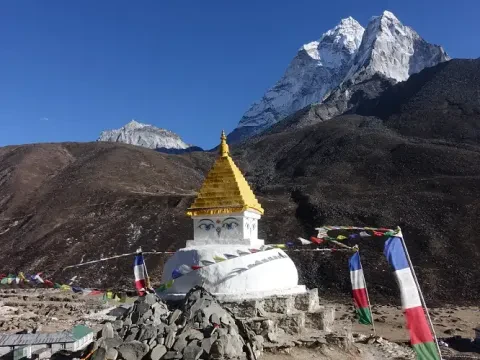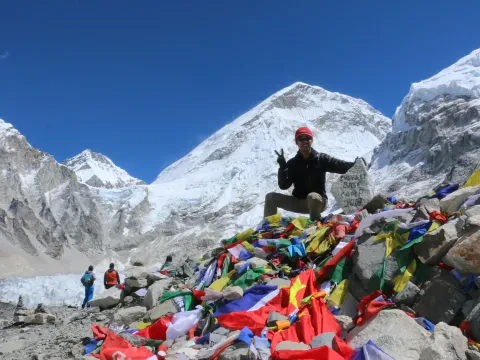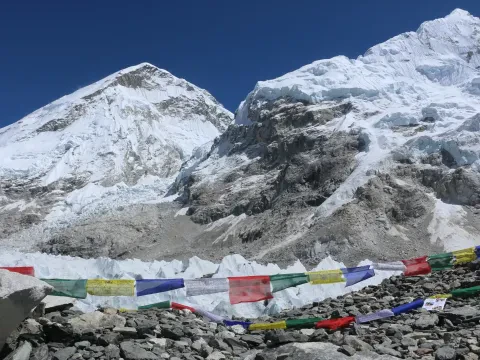
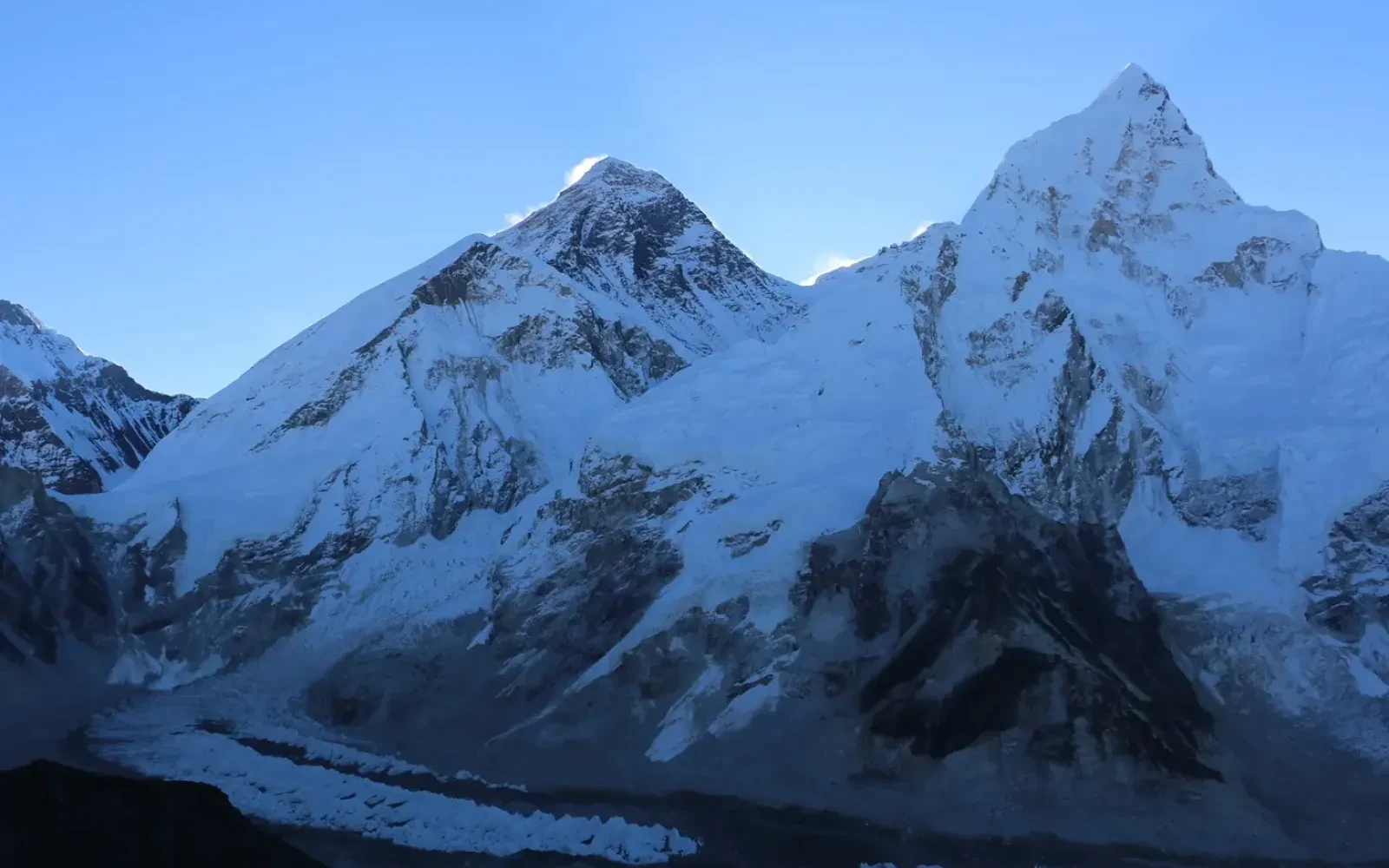
Everest trekking in Nepal covers the region around the world’s highest mountain, offering diverse itineraries that highlight the Himalayas’ iconic viewpoints, villages, valleys, monasteries, and high mountain destinations. It extends beyond the popular Everest Base Camp Trek, incorporating options like Everest View, Gokyo Lake, Three Passes Trek, Thame, and various shorter routes.
If you combine few days climbing, Everest Base Camp Trek with Island Peak Climbing and Everest Base Camp Trek with Lobuche Peak Climbing are also popular challenging options for adventure lovers in Everest region trekking.
| Everest Trek Route | Approx. Highest Point | Difficulty | Typical Duration |
|---|---|---|
| Everest View | 3,880 m / 12,730 ft | Easy–Moderate | 5–8 days |
| Everest Base Camp | 5,364 – 5,380 m | / 17,598–17,650 ft | Moderate-High | 12–16 days |
| Gokyo Lake | 5,357 m / 17,575 ft | Moderate – High | 12–15 days |
| Everest Three Passes | 5,535–5,700 m / 18,159–18,700 ft | Very High | 18–22 days |
| Jiri–Everest | Up to 5,545 m / 18,192 ft | High | 20–25+ days |
Note: Specific elevations and durations can vary depending on the itinerary and individual route variations.
Everest region trekking takes place primarily within the Sagarmatha National Park in the northeast of Nepal, which is a UNESCO World Heritage Site. This park spans around 1,148 sq. km with altitude ranging from roughly 2,300 m up to 8,848 m.
The major attractions of Everest trekking in Nepal include villages and valleys, monasteries and mountains, and high mountain passes. While many itineraries begin in Lukla (2,840–2,850 m / 9,318–9,350 ft), longer options start in lower altitude Solu regions, and the Jiri alternative provides a gradual climb, compared to the steep ascent from Lukla.
Everest Trekking Destinations :
Meanwhile, the Nepal Tourism Board recommends sufficient acclimatization, as the altitude rises significantly beyond Namche, especially on itineraries leading to Lobuche and Everest Base Camp.
Everest trekking encompasses various routes, from shorter and lower altitude options to longer and challenging ones, each with its unique features and highlights. The choice of an Everest trek should, therefore, be based on individual needs and experience.
Everest Trekking Route Comparison :
Is Everest Trekking Suitable for Everyone?
Everest trekking is accessible to a wide range of people; however, the selection of an appropriate route depends on one’s experience, level of fitness, and time availability.
Whereas the Everest View trek is a good option for less seasoned trekkers, those embarking on EBC or Three Passes need to be adequately prepared, as they involve much higher altitudes.
Everest Trek Nepal is not a singular experience but a variety of challenging and spectacular adventures, as each itinerary involves different altitudes, landscapes, and cultures.
With a selection of routes, duration options, and cultural insights, this region is a great choice for a memorable adventure.
2. Why Everest Region Trekking in Nepal Is Worthwhile?
The Everest region is a highlight of mountain trekking in Nepal, as it comprises not only the highest peak on Earth but also Lhotse, Cho Oyu, Ama Dablam, Nuptse, and many more. Sagarmatha National Park, a UNESCO World Heritage Site, is home to some of the most extraordinary Himalayan views and biodiversity.
| Highlight | Typical Elevation | Why It Matters |
|---|---|---|
| Lukla | 2,840–2,850 m / 9,318–9,350 ft | Main gateway for classic treks. |
| Namche Bazaar | 3,440–3,500 m / 11,286–11,483 ft | Acclimatization hub and Sherpa trading center. |
| Tengboche | 3,860 m / 12,664 ft | Famous monastery and breathtaking mountain views. |
| Dingboche | 4,410 m / 14,468 ft | Acclimatization stop before Everest Base Camp. |
| Everest Base Camp | 5,364–5,380 m / 17,598–17,650 ft5,364–5,380 m / 17,598–17,650 ft | Iconic destination and view on Everest. |
| Kala Patthar | 5,545 m / 18,192 ft | Highest viewpoint on Everest. |
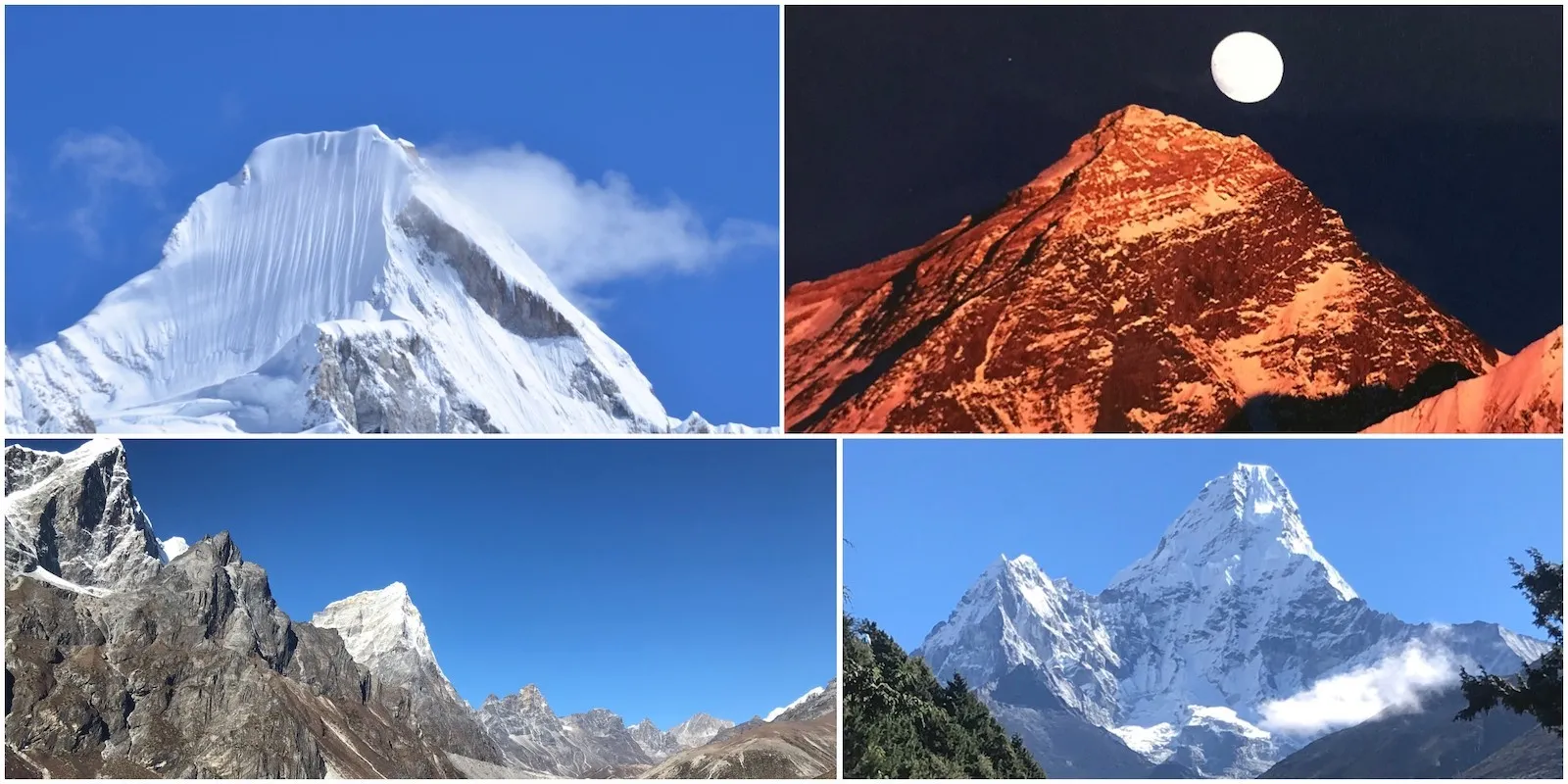
Among the main highlights of an Everest region trek are the view on the highest peak and other mountains, the unique landscapes, the local culture and religion, and the natural environment.
An Everest region trek is renowned for its spectacular views on the mountains, among which Everest, Lhotse, and Ama Dablam are the most prominent. The landscapes change with the altitude, starting from coniferous and hemlock forests, to fir, birch, and rhododendron, juniper, and alpine meadows.
The local population consists mainly of Sherpas, a mountain tribe known for their resilience and adaptability.
Moreover, many people in the region are followers of Tibetan Buddhism, and there are several monasteries and monks to see during an Everest trek.
Likewise, Tengboche Monastery is a significant spiritual site, and the villages around it are ideal for observing the local culture.
In addition to Tengboche, other monasteries worth visiting include Khumjung, Khunde, Taingpoche, and Thame Monasteries. These are ancient places of worship frequented by monks and local people, offering unique cultural and spiritual insights.
Namche Bazaar is a market town at approximately 3,440–3,500 m and serves as an important acclimatization point.
In addition, the area offers access to other villages, making it a valuable location for adjusting to the altitude before proceeding to higher altitudes.
Gokyo is a great alternative to the more demanding Everest Base Camp and Three Passes trek. It is a village located in a valley with glacial lakes and offers a fantastic view on Cho Oyu. Gokyo Ri is a high viewpoint at 5,357 m / 17,575 ft, providing an amazing vantage point over Everest, Lhotse, Makalu, and Cho Oyu.
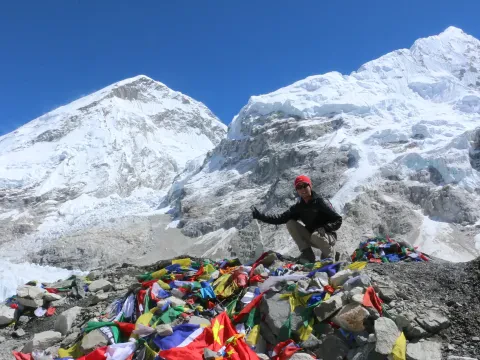
Everest trekking is indeed a challenging but rewarding experience, and the main obstacles include high altitudes, prolonged walking days, cold temperatures, and unpredictable mountain weather.
Therefore, trekkers should adequately prepare and pack warm clothes and sufficient amounts of water.
Moreover, an Everest trek should not be rushed, as this will complicate the acclimatization process.
The main reasons for choosing the Everest region for trekking in Nepal are its uniqueness and authenticity. An Everest trek is not only about reaching the mountain but also includes local culture, history, and nature.
Having said that, an adequate level of fitness and preparation is vital, as higher-altitude treks are particularly strenuous and demanding.
The best Everest trek route depends on your time availability, fitness level, experience, and objectives, because different routes have different difficulty levels and itineraries. The main Everest trekking routes in Nepal include Everest Base Camp, Everest View, Gokyo Valley, and the challenging Three Passes route.
| Route | Everest View | Everest Base Camp | Gokyo Valley/Lake | Everest Three Passes |
|---|---|---|
| Duration | 5–8 days | 12–16 days | 12–15 days | 18–22 days |
| Highest Point | 3,880 m / 12,730 ft | 5,545 m / 18,192 ft | 5,357 m / 17,575 ft | 5,535–5,700 m / 18,159–18,700 ft |
| Difficulty | Easy–Moderate | Moderate–Hard | Moderate–Hard | Hard |
| Best For | Short trips and beginning trekkers | First classic Everest trek | Lakes and quieter trails | Experienced trekkers |
Importantly, the EBC itself is around 5,364–5,380 m while Kala Patthar reaches about 5,545 m.
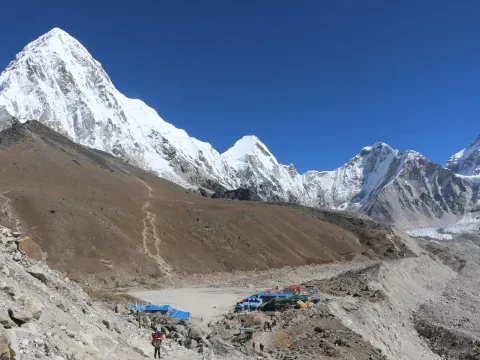
Everest Base Camp route goes through Lukla, Phakding, Namche, Tengboche, Dingboche, Lobuche, and finally Gorak Shep to reach Everest Base Camp (about 5,364–5,380 m / 17,598–17,650 ft), and usually includes Kala Patthar (around 5,545 m / 18,192 ft) for panoramic Everest views.
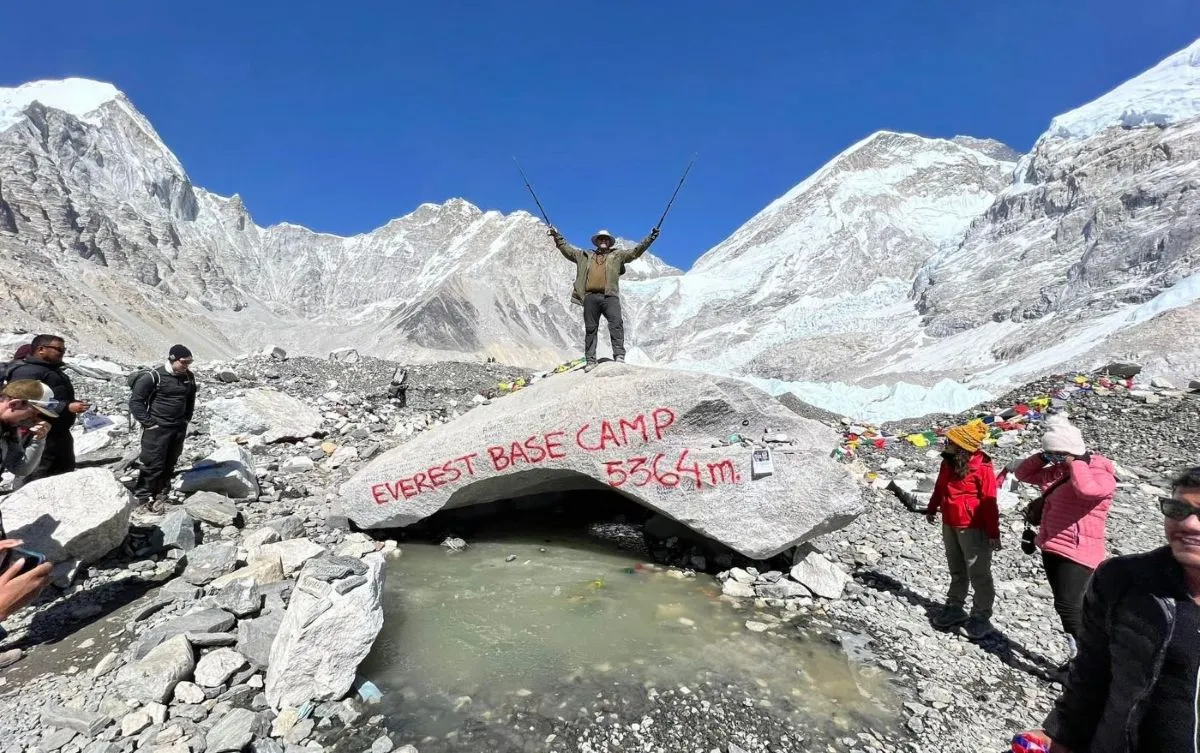
Alternatively, Kathmandu -Salleri-Surke and Phakding is also accessible by road during dry season for Everest Base Camp Trek by Land. This way, one can escape Lukla flight.
In fact, this route is suitable for those who want to experience the most iconic Everest trek, though you should be prepared for altitude and pace yourself carefully on the walk.
The Everest View Trek is a shorter option that generally reaches Everest View Hotel around 3,880 m / 12,730 ft before going back down the Khumbu valley, and offers views of Everest, Ama Dablam, Lhotse, and other peaks without requiring the extreme altitude of EBC.
Here, this is recommended for those with limited time, families, and beginning trekkers.
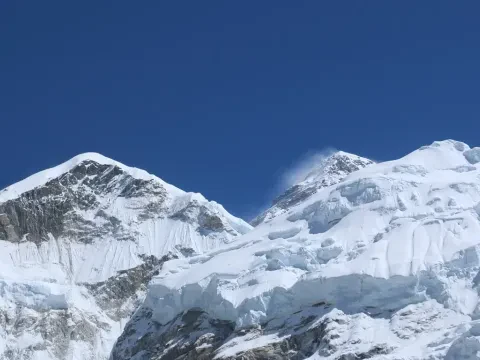
Gokyo Valley Trek explores a different side of Everest, featuring glacial lakes and valleys, and reaching Gokyo Ri (about 5,357 m / 17,575 ft). The route is also joined by the Everest Base Camp trail via the Cho La Pass.
Everest Three Passes Trek is the most challenging of the main routes, because it requires crossing high mountain passes (Renjo La, Cho La, Kongma La), and the passes on this route generally range from about 5,360 m to 5,700 m / 17,585–18,700 ft.
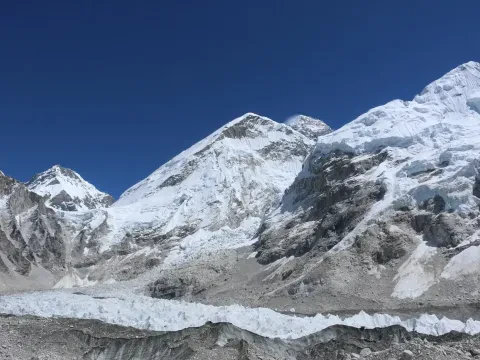
Which Everest Trek Route Should You Choose?
Therefore, there is no single best Everest trek, because the choice depends on your time availability, preparation level, and preferred difficulty. Be aware that altitude can be a problem on all routes above 3,000 m / 9,843 ft, so a gradual acclimatization is important.
For most first-time trekkers, Everest View Trek is a more manageable option since it reaches about 3,880 m / 12,730 ft without as much high-altitude walking as EBC, but beginning trekkers can also complete the Everest Base Camp Trek with a good preparation, suitable pacing, and enough time for altitude acclimatization.
| Feature | Everest View | Everest Base Camp | Gokyo Valley | Three Passes |
|---|---|---|
| Highest Point | 3,880 m / 12,730 ft | 5,364–5,545 m / 17,598–18,192 ft | 5,357 m / 17,575 ft | Up to 5,700 m / 18,700 ft |
| Duration | 5–8 days | 12–16 days | 12–15 days | 18–22 days |
| Beginner Suitability | very suitable | Suitable | Moderate preparation | not ideal |
Why Is Everest View Better for Beginners?
Everest View Trek provides a lower maximum altitude than Everest Base Camp while still giving an insight into the Himalayas, including the famous Namche Bazaar, and is a good choice for those who want an Everest trekking experience without spending that much time above 4,000 m / 13,123 ft.
Can Beginners Do Everest Base Camp?
Yes, beginners can do Everest Base Camp for beginners with a good preparation since climbing skills are not necessary on the standard route, but keep in mind that the EBC trek is physically demanding because you will have to walk to altitudes of 5,364–5,380 m at the EBC and 5,545 m at Kala Patthar.
Before your Everest trek, you should do:
The Everest trek is not technically difficult, but altitude, weather, and terrain can play a role in how challenging it is, and beginners should not assume that being fit at sea level will prevent altitude problems.
Everest View Trek is generally easier than Everest Base Camp, and other higher-altitude routes, so if you have limited trekking experience, it is a good idea to consider this option, and if you are well-prepared and in good physical condition, you can also choose Everest Base Camp for your first major trek.
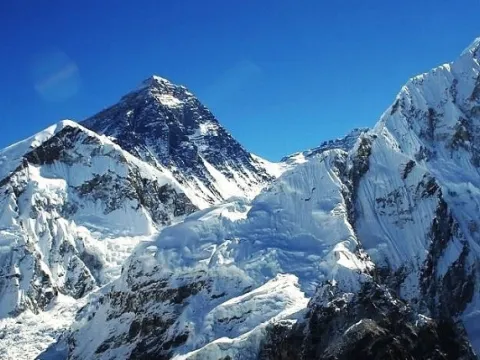
The Everest Base Camp Trek is the iconic high altitude trek from the Everest gateway into the heart of the Khumbu region. The classical route runs from Lukla through Phakding, Namche Bazaar, Tengboche, Dingboche, Lobuche, Gorak Shep and down to Everest Base Camp itself, usually including a side-trip up Kala Patthar.
| Place | Approx. Elevation | Role on the Trek |
|---|---|---|
| Kathmandu | 1,320 m / 4,331 ft | Arrival and preparation |
| Lukla | 2,840–2,850 m / 9,318–9,350 ft | Main trekking gateway |
| Phakding | 2,610 m / 8,563 ft | First overnight stop |
| Namche Bazaar | 3,440–3,500 m / 11,286–11,483 ft | Acclimatization center |
| Tengboche | 3,860 m / 12,664 ft | Monastery and mountain views |
| Dingboche | 4,410 m / 14,468 ft | Second acclimatization area |
| Lobuche | 4,910 m / 16,109 ft | High-altitude overnight stop |
| Gorak Shep | 5,164 m / 16,942 ft | Final settlement before EBCFinal settlement before EBC |
| Everest Base Camp | 5,364–5,380 m / 17,598–17,650 ft | Trek destination |
| Kala Patthar | 5,545 m / 18,192 ft | Major Everest viewpoint |
Many trekkers now begin their EBC journey in Kathmandu before flying into Lukla, though road approaches from Salleri or Surke reduce reliance on the mountain airport. The traditional trail then runs along the Dudh Koshi Valley to Phakding, Namche, Tengboche, Dingboche, Lobuche, and Gorak Shep.
Here, most classic Everest Base Camp Trek Nepal itineraries run between 12–16 days, due to the need for acclimatization days and the return journey. The Nepal Tourism Board describes the traditional EBC route as approximately a two-week trek beginning and ending at Lukla, with modern transport options shaping alternative itineraries.
Acclimatization days allow your body to adjust at altitude during the gradual trek from Lukla to above 4,000 m. Namche and Dingboche are common places for acclimatization stops, with optional short hikes built into the days to avoid extra altitude gain overnigh.
From Dingboche, the trail proceeds through Lobuche at about 4,910 m, and Gorak Shep at about 5,164 m, prior to arriving at Everest Base Camp, and then up Kala Patthar at about 5,545 m for the best viewpoint over Mount Everest.
EBC Trek at a Glance :
Here, the Everest Base Camp Trek Nepal is therefore a physically demanding trekking experience rather than a technical climbing one, as reaching the destination requires endurance, acclimatization, pacing, and preparation.
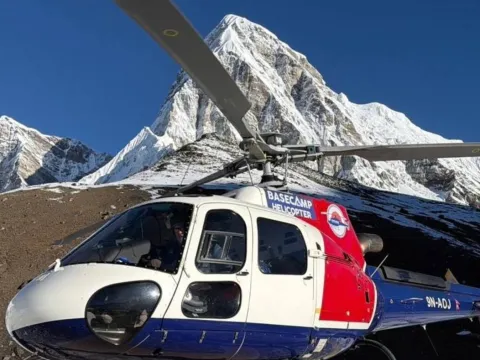
The Everest Trek cost in Nepal varies drastically due to route, duration, group size, transportation, accommodation, guide, comfort level, and other variables. A standard guided Everest Base Camp EBC trek in 2027 usually ranges between USD 1,375–2,355 depending on travel companions, with budget itineraries costing less and luxury treks ranging well above USD 4,000.
| Trek Style | Approx. 2027 Budget | Typical Services |
|---|---|---|
| Budget / Independent | USD 900–1,400+ | Basic lodges, shared costs, self-arranged services |
| Standard Guided | USD 1,375–2,355 | Guide, permits, lodges, meals, transport |
| Private Comfort | USD 2,000–3,500+ | Private services, better rooms, flexible transport |
| Premium / Luxury | USD 4,000+ | Higher-end lodges and additional services |
Importantly, these are indicative ranges rather than set prices, since flight fares, currency exchange rates, accommodation, and other expenses can vary before the 2027 season.
| Expense | Practical Planning Range |
|---|---|
| Sagarmatha National Park Permit | Around NPR 3,000 |
| Khumbu local permit | Around NPR 3,000 |
| Lukla flights (Two Way) | Approximately USD 500 – 580+ |
| Guide | About USD 25–35/day |
| Porter | About USD 20–30/day |
| Teahouse accommodation | About USD 5–30/night |
| Food | About USD 25–40/day |
| Insurance | Often USD 100–200+ |
| Personal expenses | About USD 80–160+ |
| Gear rental | About USD 50–150+ |
Moreover, current sources consistently identify the Sagarmatha National Park permit and Khumbu Pasang Lhamu Rural Municipality fee as the key permits for the standard Everest Base Camp trek, with TIMS generally not being required.
Likewise, current figures suggest the two main permits generally cost around NPR 6,000 combined for most foreign trekkers, though travelers should check the latest fees before departing.
The Lukla flight is one of the main variable expenses on a classic Everest Base Camp itinerary, since fares fluctuate according to the season, airline, and whether flights begin at Kathmandu or Ramechhap. Recent 2026–2027 planning sources place two way flights broadly between USD 500–580+, so this figure should be confirmed closer to departure.
Here, road-based itineraries using the Salleri or Surke alternative routes can reduce reliance on Lukla flights, though they require extra road travel and can add to the overall transportation time.
However, the cheapest option is not always the fastest or most comfortable, particularly with seasonal road conditions in mind.
A clear Everest trek package cost should identify whether the advertised price includes permits, guide, porter, accommodation, meals, domestic flights, ground transportation, insurance support, and taxes.
In fact, some packages only include the trekking services, while others bundle Kathmandu accommodation, airport transfers, and other expenses.
For a comfortable standard Everest Base Camp Trek cost 2027, planning around USD 1,375–2,355 per person is a realistic starting point for many guided itineraries.
But the budget trekkers may spend less with independent arrangements, while private transportation, better accommodation, helicopter services, or private and luxury lodges can increase the overall cost.
Also, the budget trekkers can use road based itinerary via Salleri and Surke from Kathmandu.
Important Everest Trek Expenses :
A realistic Everest Trek Nepal cost should therefore be estimated from the entire journey, and not simply from the advertised package headline, since variable flights, insurance, tips, personal expenses, and equipment can add several hundred dollars.
Most crucially, do not underestimate the budget by prioritizing cheaper options over proper acclimatization, insurance, equipment, or local support, since these directly impact safety at altitude like at EBC and Kalapatthar.
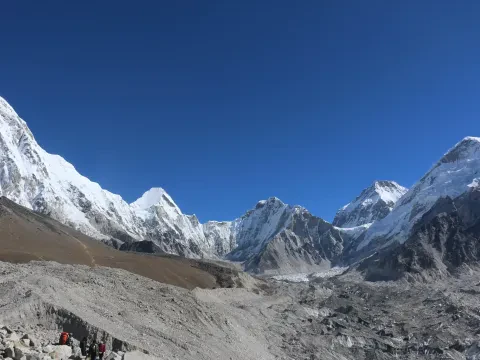
There is not one Everest trek duration, since each route reaches different altitudes and involves different levels of acclimatization. A shorter Everest View Trek might take less than a week while EBC, Gokyo and Three Passes each involve increasing lengths of time.
| Everest Trek | Trekking Days | Highest Point | Difficulty |
|---|---|---|
| Everest View | Trek 5–8 days | 3,880 m / 12,730 ft | Easy–Moderate |
| Everest Base Camp | 12–16 days | 5,545 m / 18,192 ft | Moderate–Hard |
| Gokyo Valley Trek | 12–15 days | 5,357 m / 17,575 ft | Moderate–Hard |
| Three Passes Trek | 18–22 days | 5,535–5,700 m / 18,159–18,700 ft | Hard |
The Everest Base Camp trek itinerary usually lasts around 12–16 days, since acclimatization and recovery time are important considerations.
Here, the Nepal Tourism Board describes the classic route as a roughly two-week-long trek starting and finishing at Lukla while individual itineraries may vary.
You see a significant increase in altitude following Namche, so rushing can place more strain on your body while reducing the available time to adjust.
Therefore, the Nepal Tourism Board recommends spending some time around Namche acclimatizing, since altitude adjustments cannot be hurried.
Most EBC itineraries include acclimatization around Namche Bazaar at roughly 3,440–3,500 m / 11,286 – 11,483 ft and Dingboche at around 4,410 m / 14,468 ft.
Moreover, you can add short day hikes at these points to keep active while sleeping at the same altitude.
Trekking days refer specifically to days spent walking on the mountain trail while the entire Kathmandu-to-Kathmandu trip includes extra days for travel, arrival, preparation and contingencies.
Here, this means that a 12-day EBC itinerary may include roughly 14–16 days inside Nepal to allow for international travel and delays.
Classic EBC itineraries start with a flight towards Lukla around 2,840–2,850 m while road approaches from Salleri or Surke add distance but reduce reliance on flights.
Practical Everest Trek Planning :
Meanwhile, 12–16 days is therefore a good target for the classic EBC while 14–16 days from Kathmandu provides better leeway for preparation and unexpected delays.
For 2027, you should pick an itinerary depending on acclimatization requirements rather than selecting the shortest possible Everest trek itinerary.
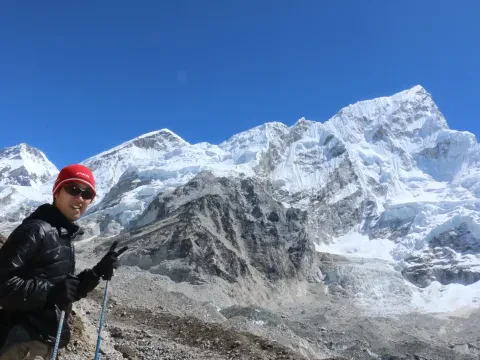
The best time for Everest trekking in Nepal depends on your priorities, but October–November and March–May are the main seasons while winter provides a viable alternative and monsoon has its challenges.
| Season | Months | Conditions | Suitability |
|---|---|---|
| Autumn | October–November | Clearer skies, cold nights, stable conditions | Excellent |
| Spring | March–May | Warmer days, good visibility, blooming rhododendrons | Excellent |
| Winter | December–February | Very cold, possible snow and icy trails | Possible with preparation |
| Monsoon | June–September | Rain, clouds, wet trails, transport disruption | Less suitable |
October and November are major months for Everest trekking since post-monsoon conditions usually provide clearer views of the mountains and reasonably stable weather. During this time, nights get colder at altitude, but the daylight hours are pleasant at most points during October and early November.
March through May comprises the primary spring trekking season, although conditions warm up gradually as May arrives. April is popular among trekkers seeking relatively comfortable temperatures while May sees more cloud cover as the monsoon approaches.
Likewise, Spring also involves blooming rhododendrons at lower and mid-altitudes while higher reaches remain characterized by alpine flora and snow.
In fact, the overall appearance is therefore different from autumn even though both seasons provide good trekking conditions.
Winter trekking is possible, although temperatures get very low at higher altitudes and snowfall becomes a factor.
Here, Nepal Tourism Board notes that December–February can see snow and 5°C temperatures in the Sagarmatha area while overall daytime temperatures hover around 5°C, so insulation becomes critical.
Lukla to Everest Base Camp trekking during June–September is the least predictable due to monsoon conditions, which bring rain, clouds, wet trails and disrupted transportation.
While the Khumbu region sees less precipitation than lower parts of the Himalayas during this period, flights and road travel can be delayed by poor weather.
Everest Weather by Trekking Priority :
Autumn and spring months draw more trekkers due to favorable conditions, so you may find busy periods at points such as Namche Bazaar (3,440–3,500 m), Tengboche (around 3,860 m) and Lobuche (around 4,910 m).
Here, you can avoid some of the crowds by arriving early or late in the shoulder season, although weather becomes increasingly unpredictable.
In conclusion, the best time for Everest Base Camp is therefore not the same for everyone since photographers value cloudless days while experienced trekkers may prefer fewer people at the expense of the cold.
Most importantly, October–November and March–May are still the most advisable months for most visitors while winter and monsoon treks require more consideration.
Everest trek difficulty varies according to the route, walking experience, level of fitness, altitude, weather conditions, and acclimatization schedule, whereas technical climbing is not necessarily a requirement.
Meanwhile, the difficulty level of hiking in the Everest region gradually rises from moderate on well-trodden tracks to severe above 3,000 m (9,843 ft), and thus the overall challenge can be reduced by preparing for both physical and altitude-specific endurance.
| Trek | Highest Point | Walking per day | Overall Difficulty | Suitable For |
|---|---|---|
| Everest View | 3,880 m / 12,730 ft | 4-7 hrs/day | Easy-Moderate | Beginners with basic fitness |
| EBC Trek | 5,545 m / 18,192 ft | 5-8 hrs/day | Moderate-Hard | Well-prepared first-timers |
| Gokyo Valley | 5,357 m / 17,575 ft | 5-8 hrs/day | Moderate-Hard | Fit trekkers |
| Three Passes | 5,700 m / 18,700 ft | 6-9 hrs/day | Hard | Experienced trekkers |
The gradual ascent and descent along uneven mountain paths, crossing suspension bridges, and navigating rocky scatters constitute a moderate to severe hiking experience with a daily walking duration of between 5 and 9 hours. Even though certain parts of the Everest trail are relatively flat, higher altitudes may become exhausting due to the reduced oxygen levels in the air.
The effects of high altitude become more prominent from Namche Bazaar (3,440 m / 11,286 ft) onward, and thus the recommended EBC itineraries include an acclimatization day in Dingboche (4,410 m / 14,468 ft) and/or Gorak Shep (5,164 m / 16,942 ft).
Moreover, the Nepal Tourism Board advises a slow walking pace, sufficient water intake, and altitude-specific training rather than focusing on the speed of progression.
Everest Trek Difficulty: Preparation :
Although the EBC trek difficulty level is relatively high, first-time trekkers with a sound fitness profile may complete it without prior Himalayan experience.
However, altitude sickness (acute mountain sickness) remains unpredictable, and thus it is hard to estimate the degree of individual hardship accurately.
In conclusion, the Everest trek difficulty is primarily determined by the selected route and the allocated time for acclimatization rather than the distance walked.
In other words, Everest View is a gentle introduction to mountain hiking, whereas EBC requires moderate physical endurance, Gokyo Valley is demanding at higher altitudes, and Three Passes is suitable for experienced and professional trekkers only.
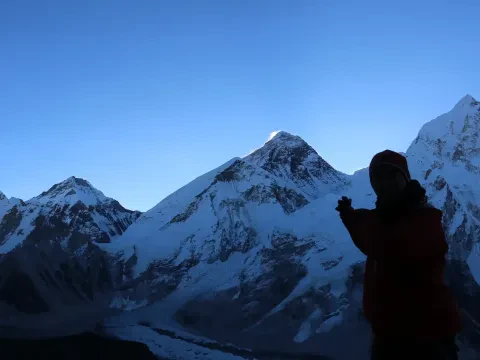
Everest trek altitude varies from the capital city of Kathmandu to the mountain passes of the Khumbu region, and thus the overall climbing experience is defined by the gradual increase in elevation.
In turn, the EBC route altitude starts at around 2,840 m (9,318 ft) in Lukla, reaches an altitude of 5,364-5,367 m (17,598-17,608 ft) in Everest Base Camp, and finishes at 5,545 m (18,192 ft) Kala Patthar.
| Location | Elevation Approx. |
|---|---|
| Kathmandu | 1,320 m 4,331 ft |
| Lukla | 2,840 m 9,318 ft |
| Phakding | 2,610 m 8,563 ft |
| Namche Bazaar | 3,440 m 11,286 ft |
| Tengboche | 3,860 m 12,664 ft |
| Dingboche | 4,410 m 14,468 ft |
| Lobuche | 4,910 m 16,109 ft |
| Gorak Shep | 5,164 m 16,942 ft |
| Everest Base Camp | 5,364-5,367 m 17,598-17,608 ft |
| Kala Patthar | 5,545 m 18,192 ft |
Note: The elevation varies depending on the source
The distance walked cannot be the sole indicator of trek difficulty because the oxygen-carrying capacity of the air decreases exponentially with altitude.
For instance, a 1-hour hike at 5,000 m (16,404 ft) might be more fatiguing compared to a 2-hour walk at a lower elevation.
Namche Bazaar (3,440 m / 11,286 ft) is the first crucial acclimatization point on the Everest trail, whereas Dingboche (4,410 m / 14,468 ft) is the second one.
Moreover, it is advisable to spend an extra day in these villages because short day hikes allow the body to adapt to the new environment.
Everest Base Camp altitude is between 5,364 and 5,367 meters above sea level, depending on the exact location of the campsite.
In fact, Kala Patthar at 5,545 m (18,192 ft) is higher than EBC, and thus individual acclimatization days should be planned in accordance with the chosen trek itinerary.
Kala Patthar is a popular destination on the EBC route because the view from this peak is an unparalleled sightseeing experience.
Moreover, many travelers prefer to climb Kala Patthar on the morning of the designated day because the sunrise view is exceptionally impressive.
Most importantly, the Everest Trek altitude ranges illustrate the gradual acclimatization process that determines the overall level of difficulty. In other words, a thorough preparation for high-altitude hiking is more important than the expected distance walked.
For this reason, it is essential to listen to one’s body and follow the acclimatization advice from a certified mountain guide.
Whether or not you need a guide to trek Everest is primarily dependent upon your route selection, level of experience, and the number of people involved.
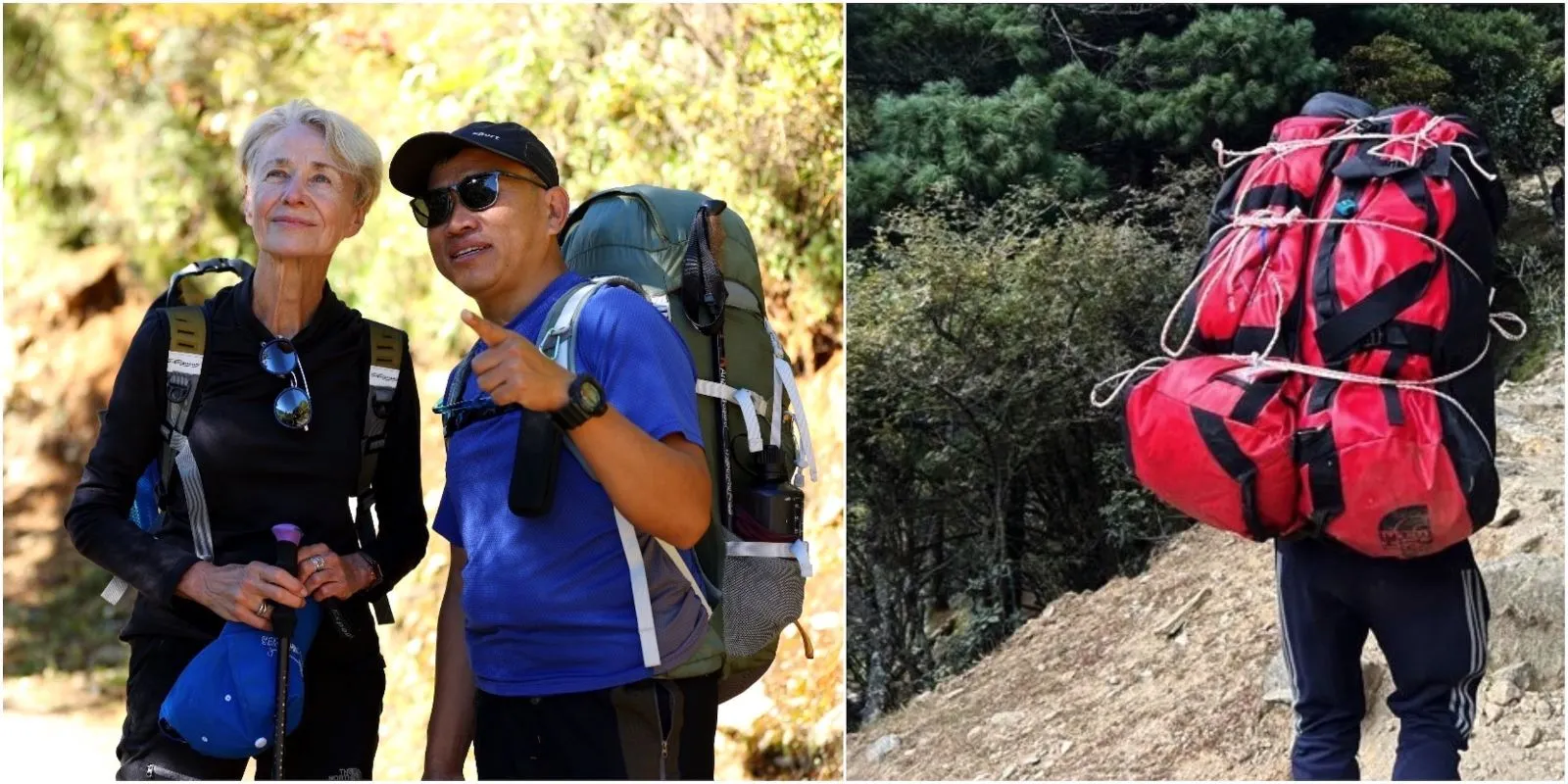
However, regulations on trekking can also play a role due to the fact that the requirements may be slightly different for the various protected areas and routes.
In fact, it is no mandatory to hire guide and porter for your Everest Trekking in Nepal.
Nevertheless, the guide on Everest Base Camp route provides practical support in terms of navigation, altitude, accommodation, communication, and emergency services.
| Option | Main Support | Best For |
|---|---|---|
| Independent | Self-managed logistics | Experienced trekkers |
| Guide Only | Navigation, safety, local coordination | Trekkers carrying their own bags |
| Porter Cum Guide | Guiding plus limited baggage support | Budget-conscious trekkers |
| Guide + Porter | Full trekking support | Most comfort-focused trekkers |
| Full Package | All-in transport, permits, meals, supporting lodging | Travelers wanting organized service |
A guide for Everest trekking manages things like day-to-day routes, walking pace, accommodation, meals, weather, and communication with local lodges.
In addition, the experienced guide on Everest Base Camp route can identify worrying symptoms related to the altitude and recommend resting or even descending if required.
Most importantly, the guide will also give insight into the local culture, including the Sherpa people, monasteries, mountain conditions, and trail variations.
However, a guide cannot prevent altitude sickness, and trekkers should always report concerns in good time.
Porter for your Everest Base Camp Trek will carry a reasonable amount of the group’s belongings, while the trekkers are recommended to carry personal belongings in a daypack.
Meanwhile, the most common and practical amount of weight carried by a guide and porter on Everest is around 20-25 kg, however the guide should consider the well-being of the porter and avoid overloading them.
Requirements for guides can change, and it is worth double-checking the requirements prior to departure, especially for restricted and protected routes. The Nepal Tourism Board currently has specific guidelines relating to licensed guides and TIMS, and local regulations may also affect individual routes.
But for Everest Trekking, it doesn’t require guide and porter so far ( Sep.12,2026) if you are sure that you will be confident and comfortable during the trek.
Practical Recommendation :
In short, the need for a guide and porter on Everest is not just about finding the way, but also about the overall management of the trek, including altitude, communication, and changing conditions on the mountain.
Importantly, the guide and porter should also look after the welfare of their workers and have appropriate insurance.
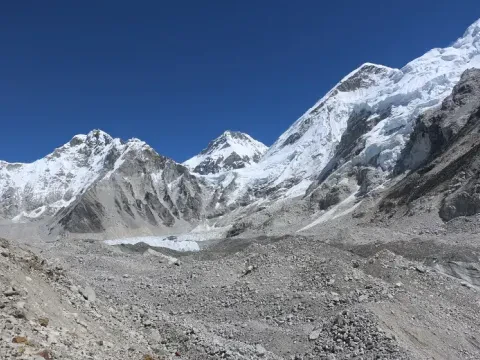
The main options for reaching the Everest region are to fly towards Lukla or to travel by road towards Salleri and Surke, since there is not a road directly to Everest Base Camp.
In fact, these choices affect the overall time, cost, convenience, and the ability to travel independently of mountain weather, and should be considered in combination with the overall trekking itinerary.
| Route | Approx. Travel Time | Main Advantage | Main Consideration |
|---|---|---|
| Kathmandu–Lukla flight | About 30–40 min flight | Fastest access | Weather delays possible |
| Ramechhap–Lukla flight | About 20–25 min flight | Common seasonal alternative | Requires road transfer |
| Kathmandu–Salleri by jeep/bus | About 7–10 hrs by road | Avoids Lukla flight | Long mountain drive |
| Salleri–Surke by jeep | 7-8 hours by jeep | Extends road approach to Surke | Rough sections possible |
| Surke–Khumbu trail | Trekking begins | Avoids flying into Lukla | Adds walking days |
Note: The approximate times stated here are based on the average speeds, although variations occur due to traffic, road conditions, weather, and variations in type of transport.
The classical flight from Kathmandu to Lukla is the quickest option, and the airport is located at approximately 2,840–2,850 m (9,318–9,350 ft).
Here, flights are affected by the weather, however, and schedules can change depending on the visibility, wind, cloud, and other factors affecting mountain aviation.
During busy times of the year ( Autumn and Spring), flights to Lukla may leave from Ramechhap Airport, which requires an overnight or early morning road transfer from Kathmandu.
For this, the drive to Ramechhap can take around 4–5 hours, although the departure point and transfer time can vary depending on the conditions and traffic.
In short, trekkers should confirm their flight departure point before leaving Kathmandu and leave room in the schedule, since a delayed flight can affect the overall Everest Base Camp itinerary, and a spare day is always a good idea.
The road option travels from Kathmandu towards Salleri, and then by local jeep towards places like Surke when the roads are open.
Meanwhile, this is significantly slower than flying, but it can avoid the need to fly into Lukla and may be a good option for budget travelers and those wishing to extend the approach route through the lower Solu-Khumbu region.
In fact, the roads from Kathmandu to Surke via Salleri can be rough and winding, and time estimates should be treated as approximate figures since variations in weather and road conditions change the overall travel time.
Here, improved roads have meant that vehicles can travel further towards the Khumbu, but the roadheads fluctuate with roadworks, erosion, and the seasons.
Classic flight itineraries usually begin walking at Lukla, while road itineraries can begin trekking further down the track depending on the vehicle.
From Lukla, the classic trail heads towards Phakding at around 2,610 m (8,563 ft), and then to Namche Bazaar at approximately 3,440 m (11,286 ft).
Kathmandu-to-Everest Planning Checklist :
For those asking about how to get to Everest Base Camp, it is clear that the best option is dependent on personal preferences, since flying saves both time and energy.
While the alternative road route via Salleri and Surke can avoid the need to fly into Lukla. It is cheaper and more dependable for your EBC Trek.
However, regardless of the choice, transportation planning should be flexible since delays and changes are common with mountain weather, road conditions, and flight operations.
When comparing transport options from Kathmandu to Lukla, it is important to highlight that flight time saved by avoiding the road, while road travel reduces the need for high mountain aviation.
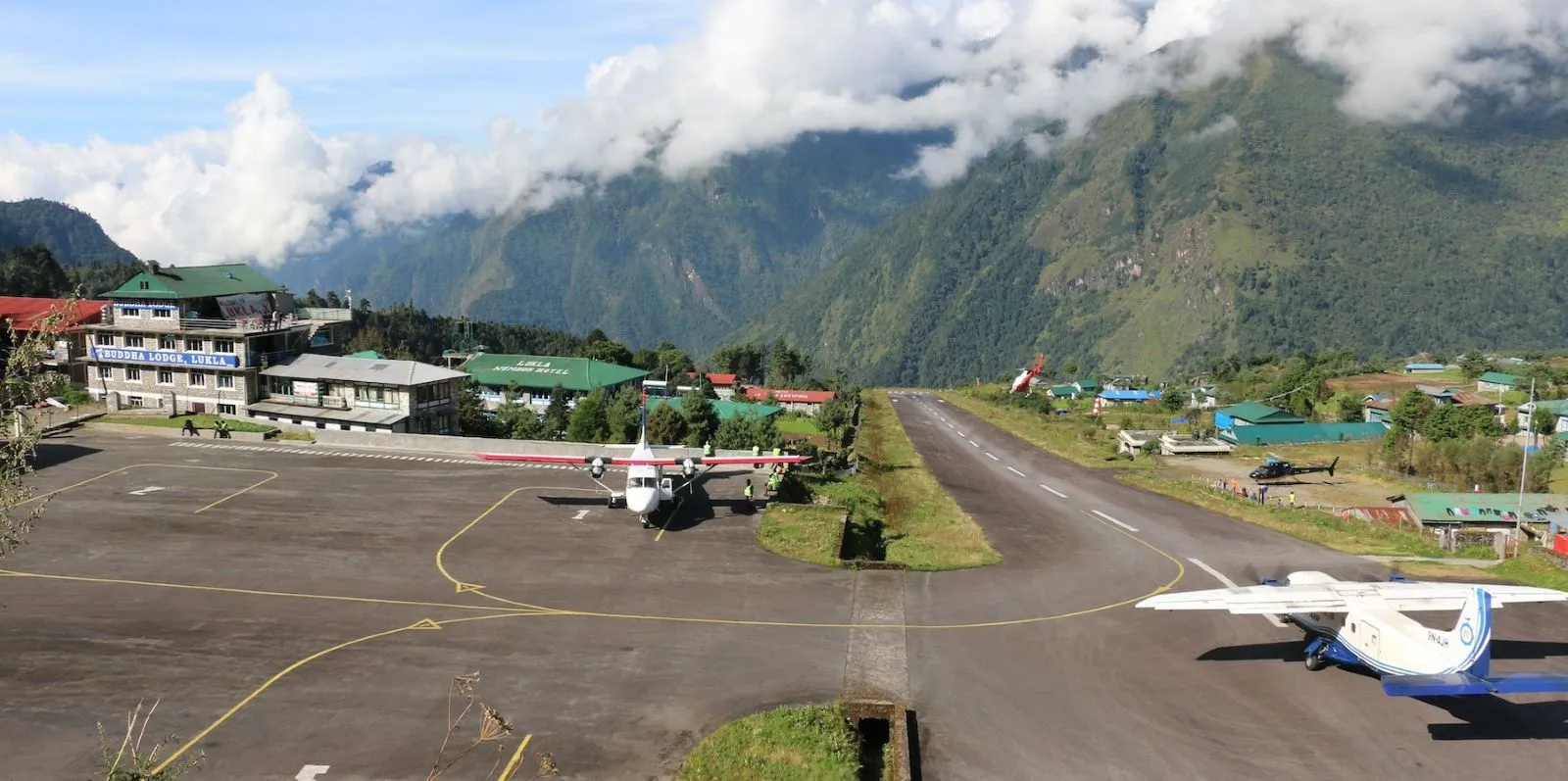
Actually, the Lukla to Everest versus the Salleri/Solukhumbu route will provide varied levels of expenditure, time investment, convenience and experience, depending on travel preferences.
Travelling to Everest route via Lukla vs travel via Salleri and Surke comparison includes :
The main Kathmandu to Lukla flight journey takes approximately 30-40 minutes under normal conditions, while Lukla airport is a small high altitude airport located at an approximate elevation of 2840-2850m (9318-9350ft).
According to Nepal Tourism Board the Lukla airport offers the main access to Everest Base Camp with regular flight services operating to other regional destinations as well.
During high season ( Spring and Autumn), it will be necessary to cross-check whether flights to Lukla will depart from Kathmandu or Ramechhap airports depending on the prevailing operational conditions.
In fact, there will be cases when trekkers may have to reach this regional airport via a certain road option and this will result in much more time spent on travel.
This Kathmandu – Salleri – EBC route would avoid the dependency on Lukla flights, with the alternative road journey being much longer compared to the direct flight from Kathmandu however with certain conditions applying.
However, it is worth noting that prolonged driving along rough terrain, traffic conditions and seasonal road closures will affect anyone choosing to drive to Salleri. Such travel conditions would be much more tiring than a short plane ride to Lukla airport.
In addition, this alternative provides a different trekking experience to the one that one would get following a Lukla-based itinerary: a longer trek from the road-head rather than from the airport.
For most trekkers a flight to Lukla would allow much faster progress towards the start of climbing or trekking activities. Avoiding Lukla-based flight itinerary reduces reliance on mountain aviation and can work out cheaper depending on the season.
However, in both options there will be time spent on transport which should be taken into account for an effective travel plan.
Meanwhile, the choice between the road to Salleri and a flight option to Lukla should be based upon general expectations and time limitations rather than focusing only on cost differences – with the cheaper transportation option involving multiple days of activity.
For instance, it would take an alternative road route from Kathmandu to Salleri which could potentially be longer than the alternative road journey from Kathmandu to Lukla.
At the same time trekkers can plan to arrive in Lukla on the same day as choosing to drive to Salleri which would make the overall trip itinerary significantly different (due to different road-head).
Either transport option will have their weather-related restrictions and special considerations in advance. Hence, a travel plan should allow for extra days with either transport option to accommodate any unforeseen delays and circumstances.
Similarly, the decision as between the Lukla flight and the alternative Salleri/Surke road journey will also depend on how many other days are allocated to a broader itinerary and what the overall purpose of travel is.
Importantly, there is always the potential for both flight itinerary and mountain road journeys to be cancelled or experience delays due to weather conditions.
The main permit requirements for the Everest region include the Sagarmatha National Park, Khumbu Pasang Lhamu permit, TIMS requirements, as described by current Nepal Tourism Board instructions.
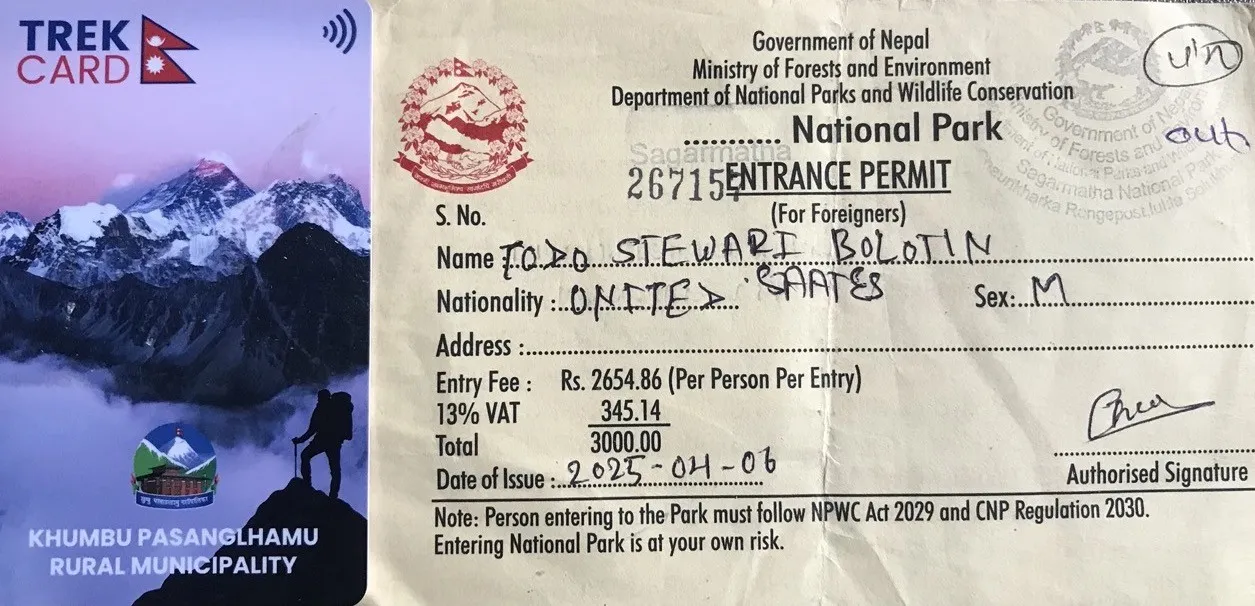
| Permit/Requirement | Current Guidance | Purpose |
|---|---|---|
| Sagarmatha National Park | NPR 3,000 foreign visitors | Protected Area Entry |
| Khumbu Pasang Lhamu permit | NPR 3000 | Local area permit |
| TIMS card | NPR 2,000 for foreign trekkers | Permit for trekker safety (Check new rules for TIMS) |
The Sagarmatha National Park permit shall have to be obtained as one will be entering the national park at Monjo / Jorsale area.
According to the current Nepal Tourism Board, permits are issued at the park entrance, namely the Jorsalle gate or in Kathmandu before heading to Khumbu region.
One can obtain Sagarmatha National Park Entry Permit at the end of Lukla while moving towards Phakding on the first day.
The Khumbu Pasang Lhamu Rural Municipality permit would apply in the local area and the current Nepal Tourism Board mentions that it covers the specified Ward 5 area at NPR 3000 per person per week rate.
According to the current rules, trekking and climbing around the Everest Base Camp requires licensed guides and a TIMS card. The current TIMS card rate mentioned by the Tourism Board is NPR 2,000 for most foreigners and NPR 1,000 for SAARC nationality.
However, unfortunately, it is not applicable currently. Chek the latest update by Nepal Tourism Board about TIMS. ( 12-09-2026)
Typically, on an organized trek, arranging permits and TIMS registration are included in the services offered by a trekking company while independently planning a trek, trekkers will need to find out about relevant procedures to complete.
As described by the current Nepal Tourism Board, the TIMS card is issued by a registered trekking company with the electronic version generated once the relevant fee has been paid.
Trekking to Gokyo and Three Passes normally follow the same set of rules and guidance regarding the permits applicable in the Sagarmatha National Park area.
Since there is no any restricted area trekking in Everest region, any other special permits and restrictions are not applicable.
Stating clearly, Khumbu Local Area Entry Permit and Sagarmatha National Park Entry Permit are the only applicable entries for Everest Trekking in Nepal.
Everest permit list :
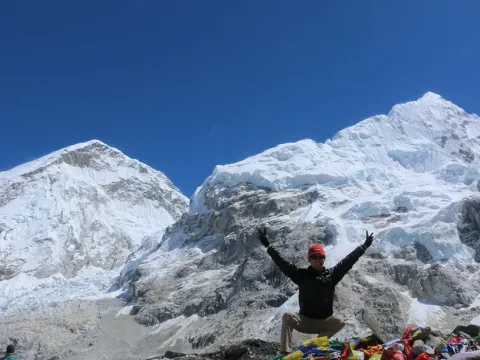
Accommodation in the Everest region is mostly provided by family-owned teahouses and mountain lodges offering basic twin-sharing rooms and shared bathrooms.
| Area | Typical Accommodation | Bathrooms | Facilities |
|---|---|---|
| Lukla | Comfortable teahouse/lodge | Private or shared | Hot shower, dining room, Wi-Fi in many lodges. |
| Phakding | Basic to comfortable lodge | Mostly shared | Dining room, electricity. |
| Namche | Good quality teahouse/lodge | Shared or some attached | Hot shower, Wi-Fi, charging. |
| Tengboche | Basic mountain lodge | Mostly shared | Dining room, limited heating. |
| Dingboche | Basic and modern teahouse/ hotels | Private and shared | Dining room, charging, limited hot water. |
| Lobuche | Basic mountain lodge | Shared | Dining room, limited facilities. |
| Gorak Shep | Basic teahouse | Shared | Very basic rooms and facilities. |
Importantly, note that the further you go up the mountain, the more basic your accommodation will be due to the greater challenges of transportation and construction.
Therefore, expect the conditions to be far simpler at higher altitudes compared to Lukla or Namche Bazaar.
However, at Lukla, Namche and Dingboche, there are more advanced and luxury lodges and hotels for luxury seekers.
Most tea houses along the Everest trek will provide :
Some hotels and lodges at Lukla, Namche and Dingbcohe provide private attached room with hot shower as well
Limited internet connectivity at higher elevations
While some lower altitude accommodation will provide attached bathrooms, expect these facilities to become far sparser as you reach higher altitudes. Hot showers and charging facilities may incur additional costs in some villages.
Everest food consists of a blend of typical Nepali, Tibetan, and international dishes, although the menu will be far more limited at greater altitudes.
Meanwhile, most tea houses will serve dal bhat, noodles, pasta, soup, rice, potatoes, eggs, bread, porridge, and momos.
| Meal | Common Everest Trek Food |
|---|---|
| Breakfast | Porridge, eggs, toast, pancakes, Tibetan bread, tea, coffee. |
| Lunch | Dal bhat, noodles, pasta, fried rice, soup, momos. |
| Dinner | Dal bhat, noodles, pasta, potatoes, rice, soup. |
| Snacks | Biscuits, chocolate, nuts, energy bars, pastries. |
| Drinks | Tea, coffee, hot lemon, hot chocolate, bottled drinks. |
Importantly, note that dal bhat is a highly recommended dish for longer days on the trail due to its filling nature as a combination of rice, lentils, vegetables, and curry.
Furthermore, simple food such as soup, potatoes, rice, noodles, and eggs may be easier to tolerate at greater altitudes.
While Everest trek water sources are available from taps, streams, lodges, and dedicated water stations, make sure that any untreated mountain water is purified before use with tablets, a portable filter, or a UV purifier.
Importantly, make sure you carry sufficient water supplies, especially if trekking independently or at greater altitudes.
We recommend the following Everest water equipment :
Importantly, note that water purification tablets may become unavailable at certain lodges, and you may find it challenging to access your preferred water equipment at higher altitudes.
Depending on the Everest Base Camp trek package, most organized treks will normally include accommodation and meals within the set program, while individual drinks and additional items on the menu will become extra.
Before finalizing your Everest trek booking, make sure to clarify if the breakfast, lunch, and dinner are covered by the tour, as well as the sleeping accommodation.
Most organized tours will normally include the following :
Note that a comfortable Everest tea house experience means making peace with relatively basic mountain accommodations, particularly above Namche Bazaar.
Therefore, sensible expectations, warm clothes, and a good sleeping bag will make a noticeable difference to your trek.
The Everest packing list should be based on sensible layers, warm clothing, good footwear, and any personal equipment that you may find necessary.
Since altitude changes can drastically influence the temperature, multiple layers of clothing will be a better option compared to a single warm but heavy jacket.
| Category | Recommended Items |
|---|---|
| Clothing | Base layers, trekking shirts, fleece, down jacket, waterproof jacket and trousers. |
| Trousers | Trekking trousers, thermal underwear, comfortable hiking pants. |
| Headwear | Warm hat, sun hat, buff or neck gaiter. |
| Gloves | Lightweight liner gloves and warm insulated gloves. |
| Footwear | Trekking boots, trekking socks, camp shoes or sandals. |
| Sleeping | Warm sleeping bag, sleeping bag liner if needed. |
| Daypack | Comfortable 20–30L daypack and rain cover. |
| Hydration | Two water bottles, hydration bladder, purification system. |
| Sun Protection | Sunglasses, sunscreen, lip balm, sun hat. |
| Electronics | Phone, charger, power bank, headlamp. |
| Medical | Personal medicines, blister treatment, basic first-aid items. |
| Documents | Passport, insurance details, permits, emergency contacts. |
| Personal | Toiletries, quick-dry towel, tissues, hand sanitizer. |
Layering is the most sensible approach since temperature differences between sunny afternoons, cold mornings, and high-altitude nights can be extremely vast.
AS per our past experience of operating Everest Trekking several times in different times of the year, we recommend bringing a few sets of light clothing, as well as a warm fleece or down jacket, and a waterproof jacket and trousers for rainy conditions.
Essential clothing items for an Everest Base Camp trek include :
A good pair of sturdy trekking shoes with a strong grip and flexible ankle joints will be essential for rocky sections, stone stairs, and unpredictable mountain conditions.
Moreover, make sure your boots are well broken in before the trek, and consider pack shoes or sandals for use inside teahouses.
A warm sleeping bag is an absolute necessity, especially at higher altitudes where night temperatures can become extremely low.
Note that some organized tours will provide sleeping bags and duffel bags, while others may offer the possibility to rent them in Kathmandu.
Make sure to bring any personal medication and basic first aid supplies, even if you have a guide and a group first aid kit.
Likewise, blister treatments, painkillers, personal medications, bandages, antiseptic wipes, and altitude medication prescribed by a medical professional are all useful items to bring.
Keep your passport, insurance, permits, and emergency contact information in a waterproof pouch for safety.
Additionally, a phone, charger, power bank, and headlamp will be essential, particularly at higher altitudes where electricity becomes a rare luxury.
Sunglasses, sunscreens, lip balms, and sun hats will become invaluable assets at high altitude, where the climate can become surprisingly dry and sunny.
Additionally, make sure to bring two reusable water bottles and a reliable purification system.
| Avoid | Why |
|---|---|
| Too much clothing | Layering is a better option, and warm clothes will be available at tea houses. |
| Multiple pairs of shoes | One sturdy pair of trekking boots and a lighter pair for teahouse use will suffice. |
| Large sized toiletries | Smaller size toiletries reduce weight and pack space. |
| Unnecessary electronics | Charging becomes more challenging at higher altitudes. |
| Duplicate equipment | Extra weight without significant benefits. |
| Heavy luggage | Extra weight for porters and personal use. |
Importantly, note that the Everest checklist should be based on warmth, safety, and comfort rather than being prepared for every possible scenario.
Therefore, make sure to research and clarify your Everest tour season, itinerary, accommodation, and equipment before finalizing your Everest packing list.
Altitude sickness is a natural danger on the Everest trek route due to the high altitude of the region. Despite thorough preparation, no special training, drugs, or Itineraries can provide 100% protection from altitude sickness.
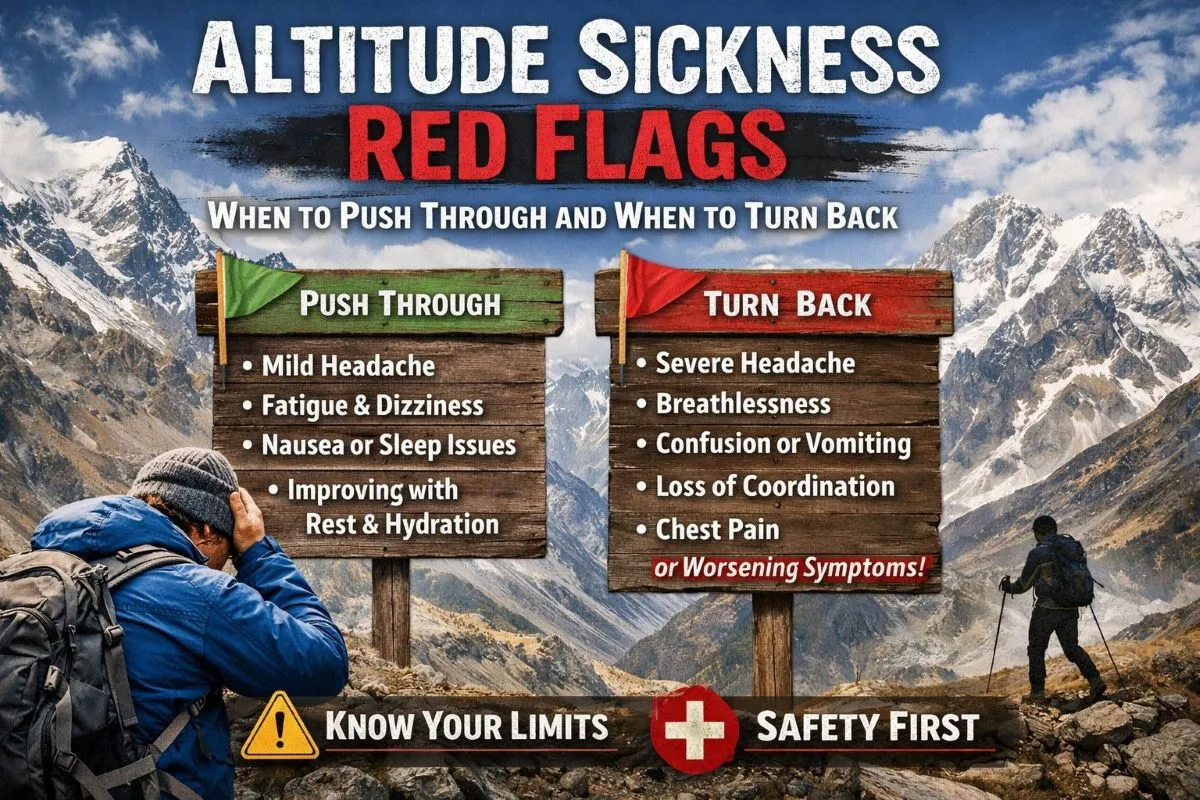
Preventing altitude sickness on Everest is all about careful planning and giving your body time to adjust to the reduced oxygen levels.
Following a sensible itinerary with planned acclimatization days is safer than attempting to reach the Everest base camp as soon as possible.
| Altitude safety practice | Why it matters |
|---|---|
| Ascend gradually | Time for your body to adapt to the reduced oxygen |
| Acclimatization days | Physiological adjustment to higher altitudes |
| Walk steadily | Avoid overexertion |
| Stay hydrated | Proper fluid balance supports bodily functions |
| Adequate rest | Let your body recover from physical exertion |
| Avoid overexertion | Do not push yourself more than you can handle |
| Monitor symptoms | Track your health and recognize altitude sickness |
| Descent if unwell | Lower altitudes are safer when sick |
Everest trek acclimatization usually involves having rest days at specific altitudes, primarily around Namche Bazaar and Dingboche.
Actually, these days are not necessarily complete rest since a short walk to higher viewpoints can aid acclimatization while still sleeping at a lower altitude.
A typical Everest base camp itinerary contains :
Altitude sickness mild forms usually involve headache, tiredness, dizziness, loss of appetite, nausea, and disturbed sleep. These symptoms should never be ignored since they may signal more serious altitude sickness developing.
Common altitude sickness symptoms include:
Meanwhile, severe altitude sickness symptoms may suggest life-threatening altitude illness and require immediate medical attention.
Importantly, never ignore severe confusion, walking difficulties, shortness of breath at rest, persistent vomiting, or worsening symptoms.
If altitude sickness symptoms become severe, or if they do not subside, the most important thing is to descend to a lower altitude as soon as possible.
Likewise, guides and medical professionals can provide emergency treatment if severe altitude sickness develops.
Moreover, trekkers should inform their guide of any symptoms so that they can monitor the situation and make necessary arrangements.
Physical fitness plays a small role in preventing altitude sickness on Everest. A fit body handles long walks and reduced oxygen levels better than an unfit one.
However, even young and fit trekkers may suffer from altitude sickness as everyone reacts differently to high altitude.
Various drugs can be used to treat and prevent altitude sickness while trekking in Everest region of Nepal.
However, not all of them are suitable for every trekker. Medication should be discussed with a medical professional to assess individual risk factors and potential side effects.
| Everest Altitude | Safety Checklist |
|---|---|
| Ascend gradually | Follow acclimatization Itinerary |
| Walk steadily and steadily | Maintain a steady pace throughout |
| Hydration and nutrition | Stay properly hydrated and nourished |
| Rest and sleep | Get sufficient rest and sleep |
| Avoid overexertion | Do not push yourself too hard |
| Report symptoms to guide | Inform the guide of any issues |
| Travel insurance | Get suitable travel insurance |
| Evacuation plan | Have an emergency plan in place |
| Descent if unwell | Lower altitude if altitude sickness develops |
Most importantly, the Everest trek is not a race like Everest Marathon and the safest Itinerary for acclimatization is not the shortest one.
Therefore, choose an itinerary that allows you to monitor your altitude sickness symptoms and descend if they worsen.
In many ways, yes – with proper preparation, a suitable itinerary, sufficient acclimatization, and responsible guides the Everest base camp trek is possible for beginners.
Actually, the main danger to inexperienced trekkers on Everest is not the climb itself but the combination of reduced oxygen levels, cold temperatures, and long walks.
The Everest base camp trek is not technically challenging, although it does require a good level of fitness to deal with the long days of walking.
Here, this allows inexperienced trekkers to complete the Everest trek with minimal risk if they prepare carefully and follow a sensible itinerary.
| Factor | Notes |
|---|---|
| Fitness | Preparing for long days of walking is essential |
| Altitude | Getting used to the reduced oxygen levels is vital |
| Weather | Getting used to the weather is vital |
| Terrain | Getting used to the steep slopes, stairs, and suspension bridges is vital |
| Guide support | Having a guide can support you throughout the journey |
| Insurance | Choose the right travel insurance for high altitude trekking |
| Itinerary | Choose the right itinerary for your fitness level |
| Emergency plan | Having an emergency plan is crucial for safety |
The Everest Base Camp Trek involves long days of walking at high altitude with varying weather conditions and a challenging terrain.
Here, standard itineraries normally reach around 5,364 – 5,367 m (17,598 – 17,608 ft) at the Everest base camp, with Kala Patthar around 5,545 m (18,192 ft).
A good level of fitness is always beneficial when trekking on Everest.
However, even the fittest and strongest people can suffer from altitude sickness.
Thus, altitude sickness is a major risk factor on the Everest base camp trek, regardless of fitness level.
An inexperienced and beginner trekker should choose an itinerary that gives them enough rest and time to get used to the reduced oxygen levels at altitude rather than trying to reach the Everest base camp as soon as possible.
Actually, acclimatization days should be planned around Namche Bazaar and Dingboche. A sensible itinerary can include gradual elevation gain and extra days for health or weather reasons.
Everest base camp: beginner’s itinerary hints
Having a guide is always useful when trekking on Everest. An experienced guide knows the area, can advise on the best route, and can monitor altitude sickness symptoms.
However, a guide is not an all-powerful solution to the dangers of the mountains and trekkers should also follow the safety advice of the guide.
What About Weather and Emergency Planning?
Weather on Everest trekking can change suddenly, and weather conditions can affect transportation links. Therefore, travelers should build extra days into their itinerary just in case and get travel insurance that includes high altitude trekking. An appropriate emergency plan is also essential.
Beginners should prepare for the reduced oxygen by training for long days of walking and getting used to rough terrain.
Likewise, suitable clothing, shoes, water purification tablets, personal medications, and other climbing gear are also needed for an Everest base camp trek.
Everest Trek Safety Checklist for Beginners :
In fact, Everest trekking can be a once-in-a-lifetime adventure for inexperienced trekkers, as long as they make health and safety their priority. Never consider a high altitude trek as a simple low-altitude walk.
There are variations in the Everest trek itinerary options based on time availability, fitness level, altitude preferences and overall expectations from the trip.
Meanwhile, shorter itineraries are lower altitude-focused, while the multi-day variations offer more time for acclimatization and include Gokyo or high passes.
| Everest Trek | What’s Included | Typical Duration | Highest Altitude | Difficulty Rating | Ideal For |
|---|---|---|
| Everest View Trek | Shorter trip, lower altitude | 5–8 days | 3,880m 12,730ft | Easy–Moderate | Limited time and lower altitude |
| Everest Base Camp Trek | Classic EBC itinerary | 12–16 days | 5,545m 18,192ft | Moderate–Hard | First-time Everest region trekkers |
| Gokyo Trek | Gokyo Lake and Valley | 12–15 days | 5,357m 17,575ft | Moderate–Hard | Alpine scenery and Gokyo views |
| Everest Three Passes | High passes and multi-day duration | 18–22 days | Around 5,700m 18,700ft | Hard Multi-day passes and high altitude |
The Everest View Trek itinerary is among the most popular short tours, since it avoids continuing towards the Everest Base Camp. It typically involves visiting Namche Bazaar and other viewpoints at around 3,880m 12,730ft altitude.
A general Everest View Trek itinerary outline would be:
A 12-day Everest Base Camp trek itinerary is possible with a well-planned daily schedule, but it leaves less room for health issues, weather disruptions or even luggage delays on the mountain.
Here, it’s important to understand that a shorter Everest trek itinerary will be more intense compared to 14- or 16-day EBC tours.
A basic 12-day EBC itinerary could include the following :
Kathmandu → Lukla → Phakding → Namche → Tengboche → Dingboche → Lobuche → Gorak Shep → Everest Base Camp → return to Lukla → Kathmandu
A 14-day itinerary for the Everest Base Camp trek is a relatively realistic option that leaves room for acclimatization, while also providing a good amount of time for the travel to and from Lukla airport.
Meanwhile, this type of 14-day EBC tour is usually recommended for first-time trekkers and those with a reasonable fitness level, while allowing for a certain amount of flexibility with the daily schedule.
Importantly, note that the overall duration of the Everest Base Camp trek itinerary will vary depending on the weather and flight availability.
A 16-day Everest Base Camp trek itinerary is recommended primarily due to the flexibility and reduced stress of a multi-day high altitude trek. Additional days can also be helpful with the acclimatization or weather-related issues.
A longer Everest Base Camp trek can be beneficial for :
The Gokyo Trek itinerary is also a popular choice that diverges from the classical EBC tour in favor of the Gokyo Valley and Lakes. The trail passes the view points of Everest and other high peaks of the region, with Gokyo Ri at around 5,357m 17,575ft altitude.
Likewise, Gokyo Lake Trek can be combined with the EBC tour via Cho La pass, which makes the Gokyo to EBC route longer and more demanding.
Overall, the Gokyo trek is a great alternative to the EBC trek for those interested in the alpine lake and a different mountain experience.
The Everest Three Passes Trek is a longer and more demanding variation that includes additional high mountain passes in the route. It generally requires around 18–22 days for the Everest three passes itinerary, and is ideally suited for more experienced trekkers.
The Everest three passes route can include :
The standard Everest Base Camp trek begins with a flight towards Lukla, while the road option from Salleri and Surke provides an alternate transportation option for those wishing to avoid the flight towards Lukla.
Depending on the road conditions, weather and other factors, it may be worth considering a combined road and flight EBC trek.
| Approach | Pros | Cons |
|---|---|---|
| Kathmandu–Lukla Flight | Fast and convenient access | Primary transportation mode affected by weather/Costly |
| Ramechhap–Lukla Flight | Alternate flight option | Requires road travel from Kathmandu (4-5 hrs) |
| Kathmandu–Salleri–Surke by road | Avoid a portion of the flight journey | More demanding and more time-consuming |
| Salleri/Surke combined drive and trek | Additional lower altitude option | Requires extra days for the road travel |
Thus, the most ideal Everest Trek itinerary 2027 would be the one that provides the required amount of time for acclimatization and the desired altitude, rather than a shorter EBC tour option.
In general, most travelers will need to choose between an Everest View Trek, the standard 12–16 day EBC itinerary, combined Gokyo and EBC tour or a more demanding multi-day Everest three passes tour.
If you need any help for your Everest Trekking in Nepal, you can contact us instantly and also book Everest Trek if you like the itienrary and the cost. Our team is always there to make your dream true safely.
1. How much does an Everest Trek in Nepal cost?
The Everest Trek cost ranges between USD 595–2,150 per person depending on the duration, size of the group, transportation and accommodation. A road-based budget trek is cheaper, while a private EBC trek with flights, better lodges or helicopter services is more expensive.
But, in 2027, it may slightly increase to USD 1375-2355 per person for 12-14 day Trek.
2. How many days do you need for Everest Trek?
Most itineraries take around 12–16 days for the Everest Trek, including travel from Kathmandu and acclimatization days. A standard Everest Base Camp Trek takes around 14 days, while a shorter option uses road transportation or returns by helicopter.
3. What is the best time for Everest Trekking?
The best times for Everest Trekking are spring (March–May) and autumn (September–November) because the weather is generally better and the mountain views are clearer. October and November are particularly popular, although early spring can also be a good choice.
4. Is Everest Trek suitable for beginners?
Everest Trekking is possible for those new to trekking, who are fit, prepared, walk steadily and follow an acclimatization plan. It is more strenuous than most other lower-altitude trails in Nepal, so past trekking experience is beneficial but not strictly necessary.
5. How difficult is the Everest Base Camp Trek?
The Everest Base Camp Trek is moderately demanding and tiring due to the long days, steep mountain slopes, uneven paths and high altitude. The highest overnight stay is at Gorakshep (5,164m), while Everest Base Camp is located at around 5,364–5,367m.
6. What is the highest altitude on the Everest Trek?
The highest altitude varies depending on the itinerary. On a standard Everest Base Camp Trek, the highest point is Everest Base Camp at about 5,364–5,367m, while Kala Patthar is around 5,545m. Other high passes are involved in alternative Everest Three Passes itineraries.
7. Do I need a guide for Everest Base Camp?
For the Everest Base Camp Trek, it is essential to arrange a guide and acquire all necessary documents as per the latest Nepal trekking guidelines. Rules are subject to change, particularly in 2027, so consult the Nepal Tourism Board or your agency before departure.
8. Do I need a porter for Everest Trek?
A porter is not strictly necessary on the Everest Trek, but one can significantly ease the load by carrying your main luggage while you walk with a smaller daypack. If you insist on carrying your own gear, organize your pack to be as light as possible during the long uphill climbs.
9. What permits are required for Everest Trek?
An Everest Base Camp Trek normally requires the Sagarmatha National Park permit and the Khumbu Pasang Lhamu Rural Municipality permit. Other permits are required for special or alternative routes, so confirm with your agency what additional documentation you might need.
10. How do I get from Kathmandu to Everest Base Camp?
Travel from Kathmandu to Everest Base Camp can be by plane towards Lukla and then on foot via Phakding, Namche, Tengboche, Dingboche and Lobuche or by road towards Salleri/Surke followed by a trek. Flights, road conditions and the point of departure can vary from year to year and season to season.
11. Can I trek to Everest Base Camp without flying to Lukla?
Yes, it is possible to trek to Everest Base Camp without flying to Lukla by traveling from Kathmandu towards Salleri and Surke by road and then continuing on foot. This can provide an alternative to the Lukla route, which can be disrupted by seasonal weather conditions.
12. What is the difference between Lukla and Salleri routes?
The Lukla route begins with a short flight and a faster approach to the Everest Valley, while the Salleri route involves a longer road transfer and extra trekking days. In 2027, the road towards Surke and Lukla may provide more flexibility, depending on the road conditions.
13. What accommodation is available on Everest Trek?
Accommodation on the Everest Trek consists largely of mountain teahouses and lodges, which typically offer private or twin-sharing rooms with shared bathrooms. Facilities are better in larger villages such as Namche, Dingboche and Lukla, whereas mountain lodges have fewer comforts.
14. What food is available during Everest Trek?
Food available on the Everest Trek includes typical Nepali dishes such as dal bhat, noodles, pasta, rice, soup, potatoes, eggs, bread, porridge, momo and other similar meals. The variety is smaller at higher altitudes and the cost rises, so eat sensibly and drink plenty of fluids during the trek.
15. How do I prevent altitude sickness on Everest Trek?
To prevent altitude sickness on the Everest Trek, acclimatize properly by incorporating rest days, drinking plenty of fluids and limiting alcohol consumption. If you do develop altitude sickness, do not continue to a higher altitude – descend to a lower altitude to relieve the pressure.
16. What should I pack for Everest Base Camp?
Packing for the Everest Base Camp should include layers of clothing, a warm down jacket, waterproof jacket and trousers, trekking boots, warm wool socks, gloves, hat, sunglasses, sunscreen, sleeping bag, water bottles, personal medication and a headlamp.
Pack smart depending on the season and avoid bringing unnecessary items that will only add to your workload.
17. Is Everest Trek safe?
The Everest Trek is generally quite safe, provided that you are well-prepared, but it is not without its dangers due to the altitude, weather, cold, uneven mountain paths and unpredictable flight or road conditions.
With the right team, acclimatization, weather assessment and insurance, the risks can be greatly reduced.
18. Can I trek Everest in winter?
Yes, you can trek the Everest region in winter, although it is advisable to be an experienced trekker with the right equipment.
December through February is the winter season in the Everest region, with low temperatures, limited daylight hours and potential snowfall, so plan your gear and schedule accordingly.
19. What is the Everest Base Camp altitude?
The altitude of Everest Base Camp is approximately 5,364–5,367m (17,598–17,608ft) depending on the reference system used.
Because this is significantly higher than the altitude of the main trekking villages, a slower acclimatization schedule should be built into the itinerary.
20. Which Everest Trek route is best for beginners?
The Everest View Trek is normally the best choice for a beginner in the Everest region because it involves fewer trekking days and a lower maximum altitude than the Everest Base Camp Trek.
If you want to experience the Everest Base Camp as a beginner, a well-planned itinerary of 14 days with acclimatization days at Namche and Dingboche is the right option.
Our travel experts are ready to assist you with any questions.
Send us a message.Have a question before you book? Send your enquiry below and our travel experts will get back with the required information.